









- How to view pricing in the global traffic ecosystem? Cost comparison of search, social media, and content channel advertisingJul 06, 2026View details
- How to assess foreign trade website development trends?Looking at 2026 changes from multilingual,AI content to conversion pathsJul 04, 2026View details
- What are the new trends in multilingual marketing data analytics tools in 2026? Focus on attribution、automation and complianceJul 04, 2026View details
- Is Brand Globalization Marketing Consulting Worth Buying? At What Stage Should Companies Bring It InJul 01, 2026View details
- Cross-Border Marketing Trend Research: Why More and More Companies Are Starting to Deploy AI Search and GEO OptimizationJun 30, 2026View details
- Cross-Border Marketing Trend Research: How Independent Sites, AI Content, and Short-Video Customer Acquisition Are ChangingJun 30, 2026View details
- How Can a Brand Updates Page Be Made More SEO-Friendly? Analysis of Update Frequency, Content Structure, and Internal Linking StrategyJun 28, 2026View details
- What stages does the cross-border services ecosystem include? How do website building, promotion, payment, and compliance work togetherJun 22, 2026View details
Can a multi-platform distribution solution solve duplicate content issues
Faced with duplicate indexing and diluted authority caused by multi-channel publishing, project managers care more about efficiency and results. Whether a multi-platform distribution solution can truly solve content duplication issues while balancing brand exposure, SEO performance, and collaborative management is exactly the key point this article aims to break down.
Core Definition of a Multi-Platform Distribution Solution
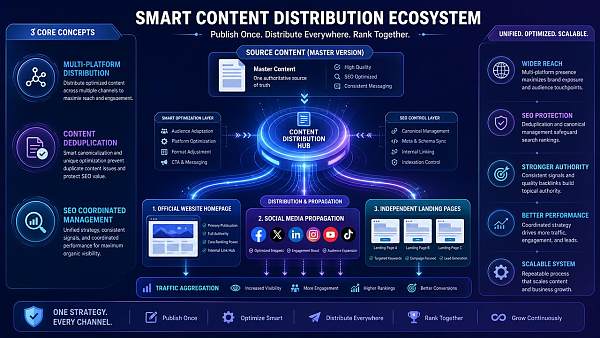
A multi-platform distribution solution refers to a mechanism in which content is produced, rewritten, published, tracked, and reviewed across the official website, industry sites, social media, news sources, and landing pages under a unified strategy.
It is not simply “one-click mass posting.” A truly effective multi-platform distribution solution must handle content versions, link attribution, indexing paths, channel cadence, and data feedback at the same time.
In an integrated website + marketing services scenario, content distribution is no longer just an exposure tactic, but more directly affects organic traffic growth, brand asset accumulation, and the integrity of the conversion journey.
Why Content Duplication Issues Occur Frequently
Content duplication does not mean complete identity. Search engines pay more attention to topic, structure, semantics, and original publication relationship. If multiple platforms publish similar content within a short period of time, duplicate detection may be triggered.
Common issues are mainly concentrated in the following categories:
- Official website articles and third-party advertorial content are highly consistent
- The same title and summary are copied in bulk to multiple sites
- Different regional sites share the same page template and copy
- Social media content is directly fed back to the official website, creating internal duplication
- Backlink landing points are disorganized, preventing authority from being concentrated
Many projects do not lack a distribution system, but rather “channel differentiation” and “primary-secondary page planning.” This is also the dividing line for whether a multi-platform distribution solution is effective.
What a Multi-Platform Distribution Solution Can Solve, and What It Cannot Solve
The conclusion is: a multi-platform distribution solution can significantly reduce the risk of content duplication, but it cannot rely solely on tools to automatically eliminate all duplication issues.
What it can solve are publishing order, version management, link strategy, and data tracking issues. It cannot replace an original content strategy, nor can it enable low-quality rewrites to naturally gain high authority.
Practical Business Value in an Integrated Website and Marketing Scenario
For a growth system centered on the official website, the most important value of a multi-platform distribution solution is not only expanding exposure, but turning exposure into accumulable on-site assets.
Yiyingbao Information Technology (Beijing) Co., Ltd. has been deeply engaged in global digital marketing for more than ten years. Centered on intelligent website building, SEO optimization, social media marketing, and advertising placement, it has formed a more coordinated data-driven distribution approach.
The key to this approach lies in first defining the primary pages of the official website, and then letting different platforms undertake different tasks, such as customer acquisition, endorsement, interaction, and traffic generation, rather than copying the same piece of content everywhere.
When content is published intensively, the underlying access capacity is also very important. For example, the website traffic package seamlessly integrated with Yiyingbao Cloud intelligent website building system is more suitable for traffic cost management and stable support during peak content distribution periods.
Differences in Distribution Strategies Under Typical Scenarios
Whether a multi-platform distribution solution is effective depends to a large extent on scenario matching. Under different goals, the way content is organized should be completely different.
If the publishing volume is large, regions are many, and nodes are dense, traffic budgeting also needs to be planned in advance. Prepaid cost locking, remaining quota monitoring alerts, and automated procurement support can reduce operation and maintenance fluctuations during distribution scaling.
Practical Methods to Improve SEO Performance
To make a multi-platform distribution solution truly serve SEO, it is recommended to start simultaneously from the three aspects of content, technology, and cadence.
Content Level
- Keep the most complete version on the official website as the core indexing page
- Use viewpoint restructuring for external distribution rather than mechanical word substitution
- Vary the title, summary, case examples, and closing call to action separately
Technical Level
- Keep on-site URLs stable and avoid loading the same content on multiple addresses
- Standardize category structures to reduce duplicate indexing of tag pages
- Monitor changes in crawling, indexing, bounce rate, and conversions
Cadence Level
- Publish first on the official website, then carry out delayed distribution
- Give priority to differentiated summary versions on high-authority platforms
- Review channel indexing quality weekly instead of only looking at the number of published posts
Precautions When Implementing a Multi-Platform Distribution Solution
First, do not mistake “covering more platforms” for “better results.” The more platforms there are, the more necessary it is to define priorities clearly; otherwise, it will intensify content dilution and increase management costs.
Second, do not focus only on rankings. Content duplication issues often first manifest as indexing disorder, scattered authority, and longer inquiry paths, while ranking fluctuations are only one of the results.
Third, integrate distribution data into the analytics system. If traffic consumption, channel visits, and conversion behavior cannot be observed in a unified way, even the best multi-platform distribution solution will be difficult to optimize continuously.
Fourth, global business should also attach importance to compliance requirements. Cross-border content, data calls, and traffic access arrangements need to balance target market rules and long-term stability.
Next-Step Implementation Approach
If you are evaluating a multi-platform distribution solution, it is recommended to first sort out existing content assets, distinguish core official website pages, channel distribution pages, and short-cycle campaign pages, and then establish unified version and link rules.
After that, incorporate publishing sequence, rewriting templates, indexing monitoring, and traffic budgeting into the same process. In this way, a multi-platform distribution solution is not just an execution tool, but an operational mechanism that truly serves growth.
If content is published frequently and access fluctuations are obvious, you can also configure capabilities related to the website traffic package simultaneously, balancing cost control, monitoring alerts, and continuous distribution stability.
Overall, a multi-platform distribution solution cannot eliminate duplicate content out of thin air, but through strategic distribution, technical standards, and data coordination, it can significantly reduce duplication risks and improve the overall efficiency of SEO and brand communication.
Related Articles



Related Products
 EasyCamp SaaS Smart Website Marketing SystemE-Yingbao SaaS Smart Website Marketing System: AI-powered, zero-code website building. Rapidly launch multilingual independent e-commerce sites in just 10 minutes. Global server acceleration and AI-driven SEO optimization empower businesses to efficiently connect with global markets. The seamless integration of technology and user-friendly operation makes building e-commerce sites incredibly simple.
 AI+SEM Intelligent Advertising Marketing SystemAI+SEM drives intelligent ad creation, empowering full-funnel precision advertising marketing. The system automatically generates weekly/monthly reports, AI recommends keywords and target countries, monitors core metrics in real-time with intelligent alerts, and enables one-click high-conversion ad solutions to help quickly acquire customers and improve ROI.
 AI+SEO Dual Engine Optimization ServiceEasyWin AI+SEO Dual Engine Optimization System leverages AI-powered keyword mining, content generation, and comprehensive technical optimization to help foreign trade enterprises acquire high-quality organic traffic, significantly improving search rankings and conversion rates.
 AI+SNS Social Media Marketing SystemYingbao AI+SNS Social Media Marketing System - Precision social capture for the social media era. Supports one-click content synchronization across major platforms like Facebook and LinkedIn. AI intelligently rewrites posts for enhanced relevance. 24/7 AI customer service and user profiling analysis empower businesses to efficiently expand into global markets.
 AI+SEO营销解决方案易营宝AI+SEO营销解决方案,通过AI批量写作、智能生成TDK、精准关键词扩词等功能,全面优化网站SEO效果,提升流量与转化率。助力企业构建高效智能网站新生态。
 AI+SEM Advertising Marketing SolutionsAI+SEM Advertising Marketing Solution leverages AI technology to deeply empower SEM ad campaigns. It automatically generates weekly/monthly reports using AI, presenting account data across multiple dimensions for comprehensive insights into campaign performance and trends. The system precisely recommends keywords and target countries, intelligently generates high-conversion ad copy, and enables one-click activation of efficient campaign plans to help businesses rapidly acquire customers. Simultaneously, it monitors core metrics in real time, intelligently identifies abnormal fluctuations, and issues timely alerts to ensure stable, high-return advertising results.
 Domain Name ServicesEasyWin provides professional domain name services, including intelligent queries, one-stop registration, brand protection, and full lifecycle management, helping businesses build a digital brand image.
 EasyOperate B2C Cross-Border E-Commerce Platform & Independent WebsiteEasyStore B2C Cross-border E-commerce Independent Store is an intelligent website building and cross-border e-commerce integrated solution independently developed by EasyStore Information Technology (Beijing) Co., Ltd. The system is specially designed for small and medium-sized as well as large export enterprises, integrating 'website building, operation, marketing, advertising, and conversion' into one, helping enterprises quickly establish cross-border e-commerce independent stores to achieve brand globalization and global sales growth.
The platform supports multiple languages, multiple currencies, and multi-channel marketing, with built-in AI intelligent translation and SEO optimization systems, suitable for mainstream markets such as Southeast Asia, Europe and America, Latin America, and the Middle East, assisting Chinese manufacturing enterprises in efficiently deploying international e-commerce strategies. SSL证书易营宝提供专业SSL安全证书服务,包括单域名和泛域名证书,确保网站数据传输加密、身份验证和完整性保护,助力企业建立安全可信的在线业务环境。









