I. Authoritative Definition, Strategic Core, and Functional Division of Overseas Promotion Channels
1. Authoritative Definition and Professional Elements of Overseas Promotion Channels
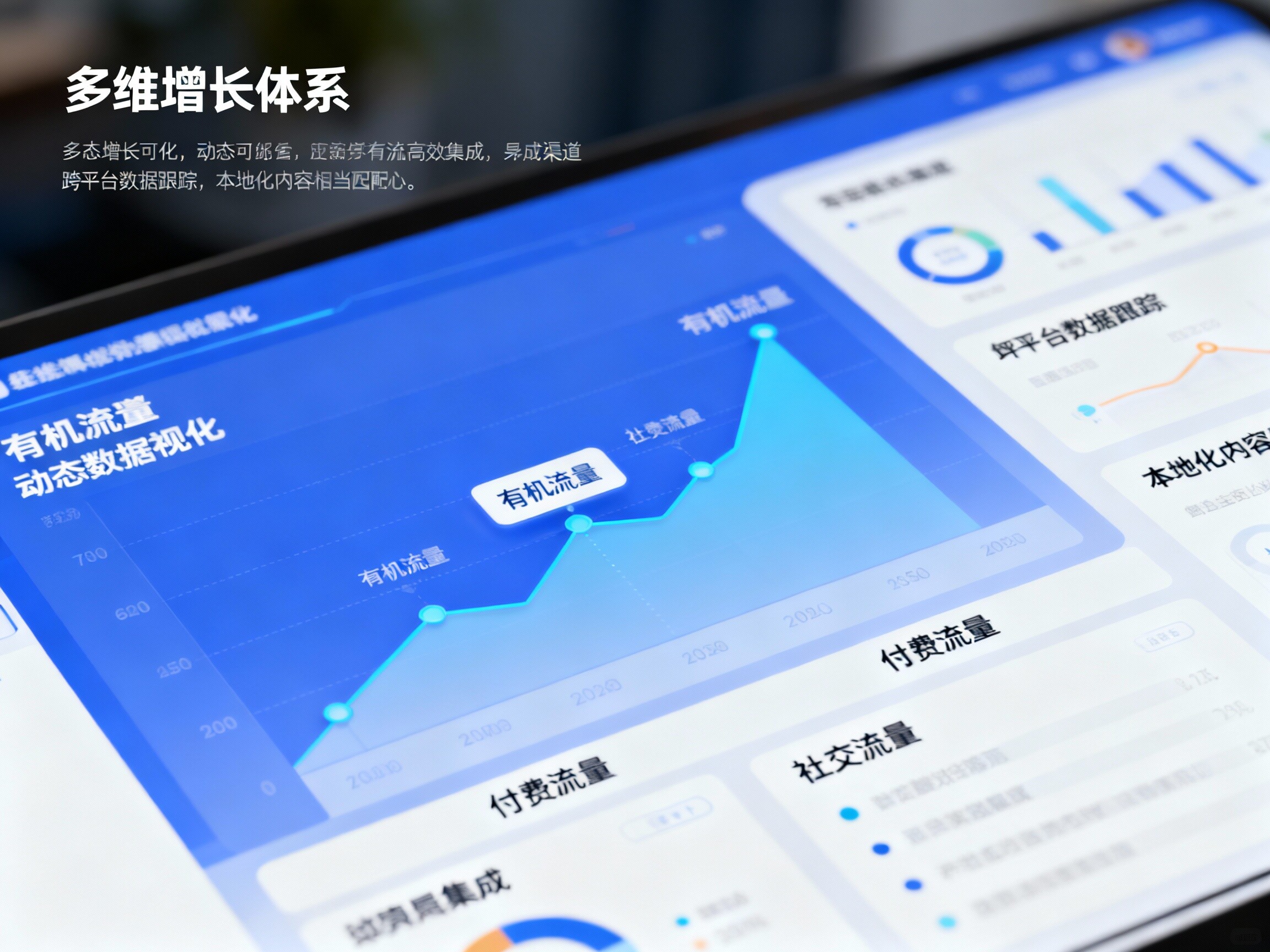
**Overseas Promotion Channels** refer to all digital platforms and media used by foreign trade enterprises to **reach, attract, and convert global target customers**. They are a **diversified resource collection**, covering **organic traffic, paid traffic, social traffic, referral traffic, and private domain traffic**. Professional elements include: **channel feature analysis, user journey matching, channel budget allocation, cross-platform data tracking, and localized content adaptation**.
2. The Three Irreplaceable Strategic Values of Building Diversified Overseas Promotion Channels
A scientific channel combination strategy is the survival foundation for foreign trade enterprises:
- **Diversify risks and ensure traffic stability:** Avoid over-reliance on a single channel (e.g., Google SEO or a paid ad platform) to effectively address **algorithm updates or platform policy changes** that cause traffic fluctuations.
- **Full-funnel coverage of the user journey:** Match different channels to **various stages of the user journey** (from awareness to decision-making) to ensure customized information is provided at every customer touchpoint.
- **Maximize ROAS/CLV:** Leverage **multi-channel synergy**, using free channels (SEO) to reduce long-term acquisition costs and paid channels (SEM) to accelerate conversions, maximizing **Customer Lifetime Value (CLV)**.
3. Development History and Trends of Overseas Promotion Channels
Early stage (2000s): Focused on **B2B platforms (e.g., Alibaba) and basic email marketing**. Mid-stage (2010s): Shifted to **Google SEO/SEM and Facebook/Twitter**. Modern era (2020s–present): Trends include **“traffic diversification, content videoization, and channel privatization”**. Emerging channels like **TikTok, Instagram Reels, WhatsApp/Telegram** are growth drivers, while **deep integration of cross-channel data and AI-powered automation management** is emphasized.
II. The Five Core Technical Principles and Synergy Mechanisms of Overseas Promotion Channels

The underlying technical logic supporting efficient multi-channel operations and high conversion rates:
1. Channel User Intent Matching Principle
Principle: User intent varies by channel. Practice:
- **Google Search (SEO/SEM):** User intent is **information query and purchase decision** (high intent), requiring **deep content (E-E-A-T) and precise ads**.
- **Meta/TikTok:** User intent is **entertainment and socializing** (low intent), requiring **engaging, visually impactful brand exposure and lead-generation content**.
- **LinkedIn:** User intent is **professional networking and business collaboration** (professional intent), requiring **industry insights and solution-oriented content**.
2. Cross-Channel Attribution Technology Principle
Principle: Track all user touchpoints **across channels and devices**. Practice: Use **UTM tracking parameters and data-driven attribution models (DDA)** to accurately assess the **contribution value** of **content marketing, SEO, and paid ads** to final conversions, guiding scientific budget allocation.
3. SEO and Paid Media Synergy Principle
Principle: Integrate **free and paid traffic data** for 1+1 > 2 effects. Practice: Apply **high-converting keywords from Google Ads** to **SEO content topics and optimization**; use **SEO traffic to create high-quality remarketing audiences** for Meta Ads, improving paid ad ROI.
4. Localized E-E-A-T and Channel Adaptation Principle
Principle: **Content quality** determines performance across all channels. Practice: Content must **adapt to channel features** (e.g., professional articles for LinkedIn, short videos for TikTok) and incorporate **local culture and language** to establish **authority and trust (E-E-A-T)** in every channel.
5. Private Domain Channel Value and Closed-Loop Principle
Principle: Redirect public traffic to private domains (e.g., email lists, WhatsApp groups) to establish **direct brand-customer connections**. Practice: Offer **personalized services, exclusive perks, and technical support** in private domains to cultivate high-loyalty customers, enabling **low-cost repeat purchases and referrals**.
III. The Four Core Technical Features and Applications of Overseas Promotion Channels
1. Technical Feature: Headless CMS-Driven Multi-Channel Content Distribution
Feature: Use **Headless CMS** to separate content from presentation. Application: High-quality **“Pillar Content”** can be **quickly adapted and published** to websites, emails, social media, and apps, significantly enhancing **content asset reuse and channel consistency**.
2. Application: Cross-Platform Remarketing Audience Customization
Application: Use tools like **Google Analytics 4 (GA4)** to create **custom audiences (e.g., “users who visited pricing pages in the last 30 days”)** and sync them to **Google Ads, Meta Ads, and LinkedIn Ads**, ensuring tailored ads reach customers on their preferred channels post-website visit.
3. Application: B2B Blue Ocean Exploration on TikTok
Application: While TikTok is seen as B2C-focused, B2B firms can leverage it for **professional content marketing**. Examples: Short videos showcasing **factories, manufacturing processes, or tech demos** attract professional buyers **visually and engagingly**, building **technical credibility (E-E-A-T)**.
4. Application: Vertical Community and Forum Penetration
Application: Promote in niche overseas forums (e.g., Reddit subforums, tech communities). Strategy: **Avoid hard ads**; instead, have **industry experts (E-E-A-T roles)** provide **Q&A and solution-sharing** to drive traffic to standalone sites, establishing **brand authority**.
IV. Channel Feature Comparison: Organic vs. Paid vs. Social Channels
1. Core Overseas Promotion Channel Comparative Analysis
2. Typical Industry Scenarios for Overseas Promotion Channel Strategies
Channel strategies vary by industry:
- **Industrial Products/Machinery (B2B):** Focus on **Google SEO** (technical E-E-A-T docs), **LinkedIn Ads**, and **industry forums** (expert Q&A).
- **FMCG/Fashion DTC Brands (B2C):** Prioritize **Meta Ads, TikTok** (viral visuals), and **Google Shopping Ads**.
- **SaaS/Tech Services:** Emphasize **Google SEO/SEM** (solution searches), **YouTube** (tutorials), and **email marketing** (user retention).
3. Channel Management Certifications and Professional Standards
Criteria for evaluating promotion channel service providers:
- **Certifications:** Hold **Google Ads/Analytics, Meta Blueprint** advanced certifications.
- **Data Integration:** Proficient in **GA4** to build **cross-channel attribution models** and provide clear **ROAS/CLV reports**.
- **Compliance & Localization:** Strictly adhere to **GDPR/CCPA** and have **multilingual, cross-cultural content adaptation** expertise.
V. Immediate Action: Build Your Dedicated Multi-Channel Overseas Growth System!
Are you **confused about channel selection**? Want to achieve **perfect synergy between paid and free traffic**? Book a **free “Overseas Promotion Channel Diagnosis & Strategy Analysis”** for a **customized channel mix and budget optimization** tailored to your industry!
Click for Free Channel Synergy StrategyFAQ
1. How many overseas promotion channels should a foreign trade website invest in?
Answer: Quality over quantity. Lock in **2-3 core channels**: **1 organic channel (SEO)** for long-term traffic stability and **1-2 paid channels (Google/Meta)** for short-term precision traffic. Focus resources on channels delivering **high conversions and ROI**.
2. How to assess traffic quality across different overseas promotion channels?
Answer: Core metrics: **conversion rate and CLV**. Typically, **search intent channels (Google SEO/SEM)** yield the highest-quality traffic; **social media traffic** is lower-quality but aids brand exposure. Use **GA4 conversion reports** for precise comparisons.
3. How to adapt content for different overseas promotion channels?
Answer: **Highly customize content**. Examples: **blog articles** for SEO; **short videos/carousels** for Meta/TikTok; **industry reports/whitepapers** for LinkedIn/email; **concise high-intent copy** for Google Ads.
4. What is channel risk diversification, and how to implement it?
Answer: Avoid >60% traffic dependency on one channel. Practice: Continuously invest in **SEO** (stable long-term traffic) while allocating **paid budgets** across **Google Ads and Meta Ads/LinkedIn** to mitigate single-platform algorithm risks.
Customer Reviews
Mr. Chen, Precision Instrument Exporter
“We previously relied only on Google SEO, with slow traffic growth. After adopting their **multi-channel synergy strategy**, we leveraged **LinkedIn and industry forums** as B2B breakthroughs, **significantly improving inquiry quality and volume**. Now, SEO provides a stable foundation, paid channels accelerate conversions, **making growth more sustainable!**”
Ms. Zhao, Cross-border DTC Apparel Brand
"The best part is their **cross-channel attribution analysis**. We clearly know how much **TikTok exposure** contributes to **final conversions on Google Shopping**. This helps us **allocate budgets scientifically**, spending money where it matters most, **improving overall marketing ROAS by 35%**."
 How to Avoid HTTPS Mixed Content Warnings in Overseas Promotion Channels? International Digital Agency Provides a 4-Step Standardized Configuration SolutionWhat is the Role of HTTPS for Websites? International Digital Agency Explains the Risks of Mixed Content in Overseas Promotion Channels! AI+SNS Marketing Security Base+4-Step Standardized Configuration, the Preferred Solution for Website System Encryption.
 Why Is Website Loading Speed So Important? Start with These 4 ImpactsWhy is website loading speed so important? Start with 4 key comparisons: it not only affects user retention, SEO rankings, and ad conversions, but also relates to brand trust and customer acquisition costs. If you want to improve your website marketing performance, this article is worth reading first.
 Can AI+SEM advertising systems replace outsourcing teams? Real case study shows SME average customer acquisition costs drop by 37%AI+SEM advertising system + SaaS agency + AI website building + WeChat mini-program configuration + AI Multilingual Website System helps SMEs reduce average customer acquisition costs by 37%! Get free health diagnosis now
 After the launch of AI+SEM Advertising System, foreign trade clients' CTR increased by 27%? AB test report from real client feedback in 2024What is the role of HTTPS for websites? International digital agency EasyWin verifies: After AI+SEM Advertising System went live, foreign trade CTR increased by 27%! Integrated with AI Multilingual Website system and overseas promotion channels, reducing costs and increasing effectiveness with immediate results.
 How much does an AI website generally cost? 2024 SaaS agency version vs custom development cost comparison analysisHow much does an AI website generally cost? The 2024 SaaS agency version starts at 8800 yuan! In-depth comparison of AI+SEM advertising systems, AI+SNS marketing, multilingual website costs, revealing new efficient overseas expansion paths for SMEs.
 What is the role of HTTPS for websites? 2024 international digital agency actual test: 3 key factors affecting overseas conversion rates and Google trust scoresWhat is the role of HTTPS for websites? International digital agency actual test: significantly improves overseas conversion rates, Google trust scores, and ad quality scores! AI+SNS marketing, AI+SEM Advertising System and essential underlying safeguards for overseas promotion channels.
 Is AI Website Building Suitable for SMEs? Measured from Three Dimensions: Delivery Cycle, Operational Costs, and ROIIs AI Website Building Suitable for SMEs? Actual Measurements Show Delivery Cycle <72 Hours, Annual Operational Costs of 128,000, ROI Reaches 3.2:1! Covers Core Capabilities Including AI+SEM Advertising Systems, AI+SNS Marketing, AI Multilingual Website System.
 How Does AI + SNS Marketing Synergize with HTTPS Security Badges to Boost Facebook Ad CTR? 2024 Cross-Border DTC Brand Case Study BreakdownWhat Role Does HTTPS Play for Websites? It's the Trust Foundation! International Digital Agency EYcase Explains: AI + SNS Marketing × HTTPS Strategy to Improve Facebook Ad CTR, Covering AI+SEM, Multilingual Websites & Overseas Promotion Channels