I. The authoritative definition, core strategy, and market characteristics of B2B independent website optimization
1. Authoritative definition and professional elements of B2B independent website optimization
**B2B Independent Website Optimization** refers to a comprehensive upgrade of a foreign trade independent website, focusing on content depth, technical structure, trust mechanisms, and conversion paths, based on the buyer's lengthy decision-making cycle and professional search habits. It goes far beyond basic SEO, emphasizing information architecture, content marketing, and conversion rate optimization (CRO). Key professional elements include: in-depth deployment of EEAT (Experience, Expertise, Authority, Trust) content, Topic Cluster website architecture, multi-layered CTA design, and efficient integration with a CRM system.
2. Three irreplaceable strategic values of professional B2B independent website optimization
B2B optimization is the ultimate weapon for businesses to acquire high-value customers:
- Attracting highly targeted, high-intent professional traffic: B2B buyers search for longer, more specialized keywords. Optimization strategies ensure that the website **precisely matches these long-tail, high-conversion-intent keywords**, filtering out invalid traffic.
- **Shorten the procurement decision-making cycle and increase CLV:** Through **clear solutions, authoritative case studies, and easy-to-use technical documentation**, we accelerate the process of building buyer awareness and trust, effectively shortening the cycle from inquiry to transaction and increasing customer lifetime value (CLV).
- **Building Industry EEAT Authority:** In the B2B field, **trust and professionalism are prerequisites for closing deals.** Through continuous and in-depth optimization of content and certification displays, we aim to establish our independent website as **a knowledge center and authoritative resource within the industry.**
3. The Development History and Evolution of B2B Independent Website Optimization
Early Stage (2000s): The website primarily functioned as an **electronic product brochure**, lacking interactive and marketing features. Mid-Stage (2010s): Emphasis began on **basic SEO**, but content remained primarily product-oriented, and inquiry forms were simple. Modern Stage (2020s to Present): Evolved into a comprehensive **content-driven + technology-enabled** system, emphasizing **user experience, solutions center, personalized recommendations, and AI/automation integration**, transforming the website into a **24/7 global sales representative**.
II. Five Core Techniques and Principles for Optimizing B2B Independent Websites: Content, Architecture, and Conversion

The underlying technical logic for ensuring B2B websites acquire targeted traffic and high-value inquiries:
1. Topic Cluster Content Architecture Principles
Principle: Organize website content around a **core business theme (Pillar Page)**, using a **series of interconnected supporting content (Cluster Content)** to enhance the website's **thematic depth and authority**. Practice: This allows Google to better understand the website's expertise, significantly improving the website's **overall keyword ranking and EEAT score** in the vertical field.
2. Inquiry Funnel Optimization (CRO) and Multi-level CTA Principles
Principle: B2B customers require different levels of conversion paths. Practice: Design a multi-tiered call to action (CTA): For high-intent customers, offer an "Instant Quote"; for low-intent customers, offer "Download White Paper/Industry Report," "Schedule an Expert Consultation," etc., covering different stages of the procurement process to prevent potential customer churn.
3. EEAT Trust Building Principles and Schema Tags
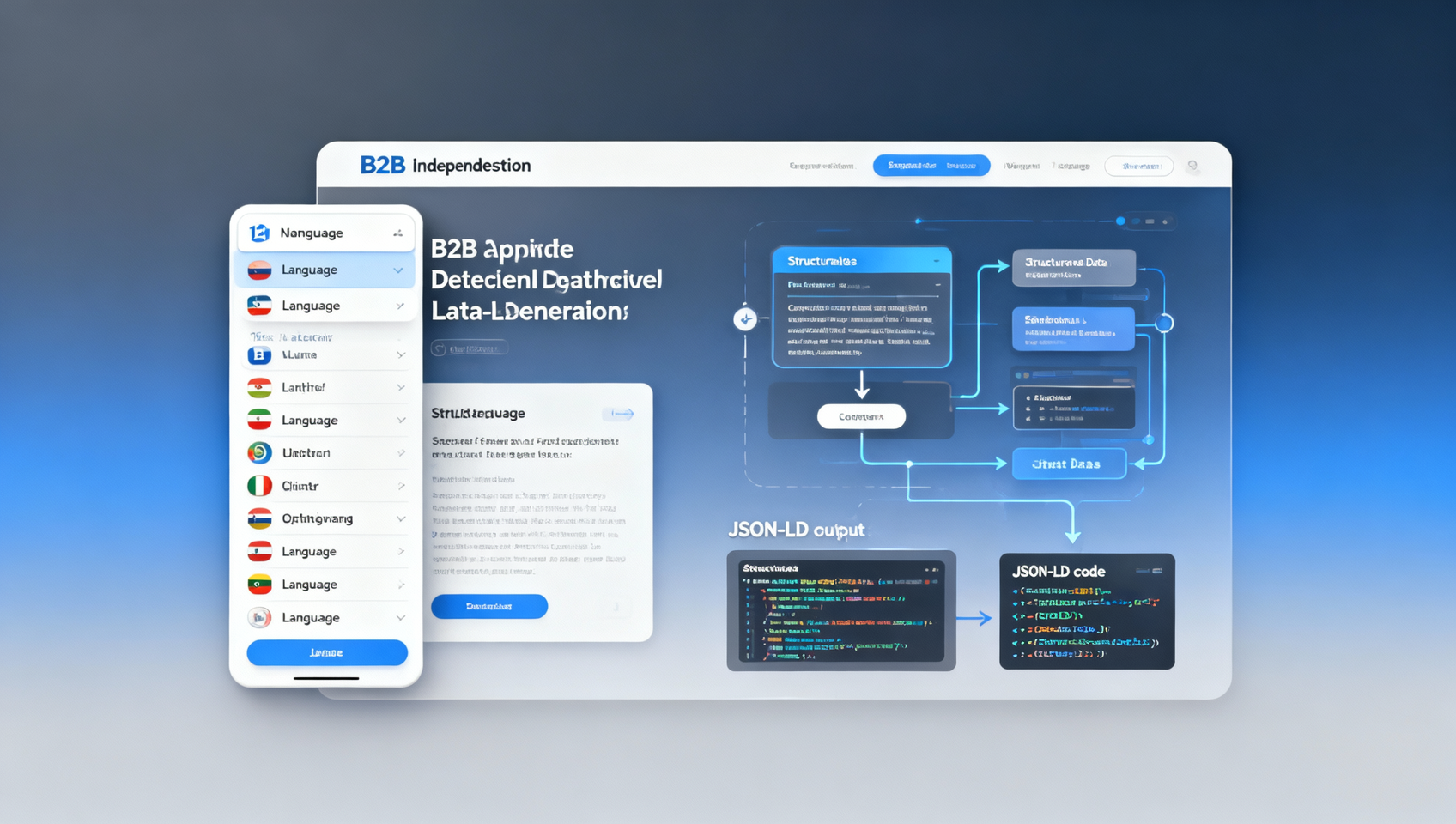
Principle: To showcase a company's **experience, professionalism, authority, and trustworthiness** to search engines and users. Practice: Highlight **company qualifications, ISO/CE certifications, patent certificates, client case studies, and founder/technical expert biographies** on the website. Simultaneously, tag this information with **Organization and Review structured data (Schema Markup)** to enhance Google's recognition.
4. Multilingual/Multi-region SEO and Hreflang Deployment Principles
Principle: B2B businesses operate globally, requiring differentiated SEO for different countries and languages. Practice: Create **localized content** for target markets (e.g., German, Spanish) and use **Hreflang tags** to precisely inform Google about the relationships between different versions, preventing **duplicate content** and ensuring accurate rankings in each region.
5. Website Performance and Core Web Vitals (CWV) Optimization Principles
Principle: B2B buyers demand a high-performance browsing experience. Practice: Optimize website loading speed, ensuring **LCP (Maximum Content Rendering)** and **FID (First Input Delay)** meet Google CWV standards. Employ a high-performance CDN and lightweight code, especially optimizing the loading speed of **product catalogs and large technical documents**.
III. Four Core Technical Features and Applications of B2B Independent Website Optimization
1. Technical Features: Intelligent Inquiry Forms and CRM Integration
Features: The inquiry form is designed with a focus on simplicity and includes intelligent field filling and anti-spam mechanisms. Application: The form needs to be deeply integrated into the enterprise's CRM system to achieve real-time synchronization of inquiry information (such as IP address and access path) and rapid customer allocation, ensuring quick follow-up on inquiries.
2. Application Practice: SEO Optimization of High-Value Technical Documents (PDF/PPT)
Application: B2B buyers frequently search for technical information. Optimize the filenames, metadata, and text content of **all PDF, CAD drawings, or PPT documents** on your website for SEO, making them indexable by search engines and driving high-intent traffic through technical search entry points.
3. Application Practice: Personalized Content Recommendation and Buyer Profile Matching
Application: Leveraging **AI or advanced algorithms**, relevant products, solutions, or case studies can be **personally recommended** on the website based on the buyer's **visit history, industry, and geographic location**, thereby improving user experience and conversion efficiency.
4. Practical Application: Integrating Video Marketing with YouTube SEO
Application: Embed high-quality factory tours, product demonstrations, and equipment operation videos on your website. Simultaneously, optimize the videos for SEO (e.g., titles, descriptions, and captions) and mark them with VideoObject Schema to ensure Google indexes the content, securing a prominent position in SERPs as a video result.
IV. Comparative Analysis and Industry Scenarios of B2B Independent Website Optimization vs. Traditional B2C Optimization

1. Comparative Analysis of B2B Independent Website Optimization vs. Traditional B2C Optimization
2. Typical industry scenarios for B2B independent website optimization
B2B independent website optimization is crucial for the following industries:
- **Heavy Machinery and Automation Equipment:** Procurement decision-making cycles are long, requiring extensive technical details and customized solutions.
- **Chemicals/Raw Materials and Components Supply:** Keywords are highly specialized, relying on a Topic Cluster architecture to seize industry knowledge center dominance.
- **IT Software and SaaS Services:** Professional consultation and trust need to be established through solution content and case studies.
3. Standard Certification and Professional Specifications for B2B Independent Website Optimization
Criteria for evaluating high-quality B2B independent website optimization services:
- **Content Depth:** Able to provide **professional in-depth content of over 3000 words** and **Topic Cluster architecture** design.
- **Technical Compliance:** Ensure **CWV performance meets standards** and correctly deploy **Hreflang and EEAT Schema**.
- **Conversion Efficiency:** The core performance indicators are **inquiry quality and CLV improvement**, rather than just traffic.
V. Immediately launch B2B independent website optimization and upgrade your website to a 24/7 global sales expert!
Is your B2B independent website just an "electronic product manual"? In-depth optimization is needed now! Our **B2B Independent Website Optimization Strategy** helps you build a **Topic Cluster content architecture, an EEAT trust system, and a high-conversion CRO funnel**. Sign up now for a **free "B2B Website Inquiry Quality Diagnosis"** to get your personalized high-value customer acquisition solution!
Click to get a free professional optimization solutionFAQ
1. How to ensure the quality of inquiries from optimized B2B independent websites?
Answer: We attract high-intent users through **precise keyword targeting and Topic Clustering**, and through **multi-layered CTAs and meticulously designed inquiry forms (e.g., asking professional questions such as company size and specific needs)**, we screen and guide high-value customers at the source, ensuring inquiry quality.
2. What is EEAT, and why is it crucial for B2B websites?
Answer: EEAT stands for **Experience, Expertise, Authority, and Trust**. Trust is fundamental in B2B transactions. Google uses EEAT to assess a website's professionalism. B2B websites must demonstrate their EEAT through **case studies, certifications, expert profiles, and in-depth content**, otherwise they will struggle to achieve high rankings and gain customer trust.
3. How does the Topic Cluster architecture help B2B websites improve their rankings?
Answer: Topic Cluster integrates fragmented content into a **professional thematic system**. This allows Google to clearly define a website's **knowledge depth and breadth** in a particular field, thus positioning the website as an **authoritative source in that field**, resulting in an **overall improvement in ranking and traffic** for all related pages.
4. What are the key differences in CRO optimization focus between B2B and B2C websites?
Answer: B2C focuses on **reducing checkout steps** and pursuing instant purchases. B2B focuses on **guiding customers into the inquiry funnel**, providing multiple conversion paths (such as white paper downloads, expert consultations, and customized quotes), and its core is building long-term relationships and trust, rather than one-off transactions.

Customer Reviews
Mr. Li, CEO of Industrial Automation Equipment Export
"After optimization, our independent website has completely overcome the dilemma of **high traffic but few inquiries**. They reshaped our **Topic Cluster content architecture**, making our website a **'automation solutions expert' in Google search. Now, almost all inquiries are from **high-value, high-intent professional buyers**, and **customer lifetime value has increased by more than 50%**."
Manager Zhang, General Manager of B2B Chemical Raw Materials Business
"What we are most satisfied with is the establishment of the **E-E-A-T credibility system**. The website clearly displays our **ISO certifications, expert team, and detailed case studies**, and the inquiry form is perfectly integrated with our CRM. **Customer trust has significantly increased**, and now many clients directly express clear purchasing intentions in their inquiries."
 Chengdu Multilingual Website Design Case Study: How Localized Content Supports Overseas PromotionBased on Chengdu multilingual website design cases, this article explains how the AI+SEO dual-engine optimization system transforms multilingual foreign trade marketing websites into stable customer acquisition engines. It covers niche language website TDK configuration, B2B standalone site optimization, AI-powered foreign trade standalone site solutions, and provides implementation insights and overseas promotion strategies for Shenzhen multilingual website development, Hangzhou multilingual website companies, and Wuhan multilingual website suppliers. Readers can obtain practical operation checklists, closed-loop deployment guidance, and free diagnostics. Click to view demos and customized solutions, and consult our expert team immediately.
 Yingbao Website Builder System Q2 2026 Update: New Features Include Automatic Multilingual Detection and One-Click Structured Data GenerationYingbao has upgraded its multilingual auto-detection and one-click structured data generation, enhancing overseas marketing, independent website SEO optimization, and Facebook ad placement techniques to empower B2B independent websites for efficient global expansion!
 How Distributors Can Improve B2B Website Inquiry Conversion Rates Through Facebook Marketing and Google PromotionCombining Facebook Marketing with Google Promotion for B2B Standalone Site Optimization to Enhance Inquiry Quality and Conversion; Achieve Precise Traffic Through Google SEO, Yandex Promotion, and Google Ads Optimization, Build an Integrated SEO+SEM Marketing and Foreign Trade Marketing Tool for Multilingual Websites, Immediately Obtain Customized Growth Solutions, and Help B2B Websites Achieve High-Quality Inquiry Conversion.
 Entering the Russian Market: Yandex Advertising Landing Strategies and Inquiry Quality Improvement on B2B WebsitesYandex Advertising, B2B Independent Site Optimization, Inquiry Quality, Google SEO, Facebook Marketing: Multilingual Website Localization Solutions for Russian-Focused Foreign Trade Marketing, Combining AI Keyword Expansion, Google Ads Optimization, and SEO+SEM Integrated Marketing to Enhance B2B Website Natural Rankings and High-Quality Inquiries, Including Case Studies and ROI Analysis.
 B2B Standalone Site Optimization Cost Comparison: Building a Multilingual Website In-House vs. Third-Party Services? Five Key Metrics Affecting Inquiry QualityB2B Standalone Site Optimization: Comparing Costs and Effectiveness of In-House Multilingual Websites vs. Third-Party Services, Revealing Five Key Metrics That Impact Inquiry Quality. Integrating Google SEO, Facebook Marketing, and Google Ads Optimization, Providing Practical SEO+SEM Integrated Marketing Recommendations to Help Foreign Trade Enterprises Improve Conversion Rates. Click to View Solution Details.
 How B2B Websites Can Integrate Facebook Marketing into SEO+SEM Strategies to Improve Lead QualitySynergizing Facebook marketing, Google SEO, and Yandex promotion through integrated SEO+SEM strategies, combined with Google Ads optimization, AI automation, and multilingual website tools for foreign trade marketing, enables B2B standalone site optimization. This approach achieves traffic segmentation, landing page and form conversion optimization, and real-time data feedback—helping B2B websites precisely target high-value buyers, reduce per-inquiry costs, and significantly enhance lead quality and conversion rates. Get the localized solution now.
 How to Ensure Inquiry Quality and Data Security Through SEO+SEM Integrated Marketing on B2B WebsitesB2B Standalone Site Optimization and SEO+SEM Integrated Marketing, Prioritizing Inquiry Quality and Data Security: AI-Driven Keyword and Landing Page Optimization, Combined with Google SEO, Google Ads Optimization, Google Promotion, Yandex Promotion, and Facebook Marketing, Creating a Multilingual Website as a Foreign Trade Marketing Tool, Acquiring High-Quality Inquiries and Controllable Traffic, Click to Learn Practical Solutions.
 How to Improve Inquiry Quality Through B2B Standalone Site Optimization + Multilingual Website in 2025: Google SEO Practical MethodsB2B standalone site optimization + foreign trade marketing leverages multilingual websites, combining Google SEO and Google Ads optimization, Facebook marketing, and Yandex promotion to precisely enhance inquiry quality and conversion rates. Through semantic keyword modeling, structured content, performance and localization optimization, an integrated SEO+SEM marketing closed-loop is formed, reducing customer acquisition costs while supporting data-driven A/B testing, immediately obtaining actionable practical solutions.