- Die USA und China erreichen bei den Zollregelungen einen Konsens, und der Handelsrat wird gegründet15-06-2026Details anzeigen
- Was bestimmt die Entwicklungskosten eines B2C-Cross-Border-Onlineshops? Eine Analyse von Funktionen, Schnittstellen und Bereitstellungsmodellen17-06-2026Details anzeigen
- Grenzenloser Zollfreilagerstandort, Kostenoptimierung für marokkanische Warenexporte11-06-2026Details anzeigen
- Welches Signal zur vorübergehenden Aussetzung der japanischen Exportfreigabe?10-06-2026Details anzeigen
- China's LNG imports rebounded in May, with Russia and Canada increasing volumes to fill the Middle East supply gap10-06-2026Details anzeigen
- Wird GEO seine SEO-Strategie ändern?04-06-2026Details anzeigen
Wie kann die Google-Indexierungsoptimierung effektiver gestaltet werden? Von der Crawling- und Indexierungsphase bis zur schrittweisen Überprüfung der Seitenqualität
Google Indexing Optimization is often misunderstood as “submitting a link and waiting for results”, but in actual evaluation, the problem often occurs earlier in the crawl path, or later in the page quality assessment. For businesses that rely on overseas independent sites for customer acquisition, indexing is not a single action, but the result of website architecture, content strategy, and marketing system collaboration. Especially in an integrated website building and marketing service scenario, indexing efficiency directly affects natural traffic accumulation, ad landing page acceptance, and the stability of subsequent conversion paths.
First, identify which layer the indexing problem occurs in

The core of Google Indexing Optimization is not simply pursuing page quantity, but confirming whether the page can be discovered, whether it can enter the index, and whether it is worth keeping after entering it. Simply put, crawl, index, and quality assessment are three continuous links, and any blockage in one layer will manifest as “page not indexed” or “indexed and then disappeared”.
From a technical troubleshooting perspective, first distinguish between “Google did not come to crawl” and “crawled but not included in the index”, then determine “why there is no stable display after inclusion”. The advantage of doing this is to avoid repeatedly changing titles and stacking content, while ignoring the real bottleneck.
Corresponding layers of common problems
Crawl efficiency determines the starting point of indexing optimization
The first step of Google Indexing Optimization is usually not to revise the copy, but to confirm whether the search engine can access the site at a low cost and stably. A website with a messy structure, too deep a click hierarchy, and too many parameter pages will consume a large amount of crawl budget even if the content is good.
For multilingual official websites, cross-border stores, and landing pages existing in parallel, a unified crawl logic is even more necessary. The more pages there are, the less it is appropriate to rely on manual page-by-page submission, and the more it depends on a clear directory structure, a standardized sitemap, and an effective internal linking network.
Technical points to check first
- Whether robots settings are incorrectly blocking directories, scripts, or image resources.
- Whether the response code is stable, and whether there are many 302, 404, or soft 404 pages.
- Whether canonical links are consistent, to avoid multiple URLs for the same page existing simultaneously.
- Whether the sitemap submits only valid URLs and is updated regularly.
- Whether important pages can be reached within three clicks, avoiding deep orphan pages.
In actual construction, the reason why Yiyingbao and similar AI-driven website building and marketing platforms place greater emphasis on the underlying structure is that indexing performance and subsequent SEO and ad placement are not separate. Only when pages can be crawled can they be indexed; only when they can be indexed can subsequent content strategies have a landing point.
Index status is not just “indexed or not”, but “why it was not included”
Many websites see “Crawled, currently not indexed” in Search Console and rush to continue submitting links. In fact, this is more like a quality screening signal. Google has already visited the page, but has not yet determined that it is worth occupying index resources.
At this point, the focus of Google Indexing Optimization should shift from “letting it be seen” to “letting it understand value”. If a page only changes a few keywords, has highly duplicated core information with same-site content, or if a large number of template pages differ only in model number, the indexing improvement is usually not obvious.
Signals most likely to be ignored at the indexing layer
- The title, body, and search intent do not match, and the page topic is vague.
- Large batches of similar pages are produced, but differentiated information is lacking.
- Pagination, filtering, and parameter pages are not processed in a standardized way.
- Multilingual versions interfere with each other, and regional targeting relationships are unclear.
This is also why, in technical assessment, you cannot only check server logs, but also need to combine content models. Especially in high-SKU scenarios, pages are not better the more there are, but the clearer they are, the easier it is to gain indexing opportunities.
Page quality is the key to whether Google Indexing Optimization can remain stable
After Google Indexing Optimization enters the third layer, the focus shifts from “whether there are pages” to “whether the page is worth keeping long term”. Here, quality is not only originality, but also information completeness, professionalism, readability, and user experience.
For foreign trade websites, cross-border stores, and B2B inquiry sites, a page that can be indexed usually has several common traits: clear topic, clear structure, sufficient evidence, stable loading, and the ability to answer the questions visitors really want confirmed.
Quality assessment can be viewed like this
Using an electronics component website as an example, if mass-type product displays rely only on a list of names, they are usually not conducive to indexing or conversion. A more effective approach is to connect categories, parameters, application descriptions, and related content. Capabilities like electronics component industry solutions are valuable precisely because they use intelligent categorization and parameterized presentation to create structural differentiation and retrieval efficiency for mass product pages, improving user experience while reducing low-quality duplicate pages.
An integrated website and marketing system is more suitable for continuous indexing
The reason indexing issues recur is often not that a certain page is wrong, but that website construction, content generation, landing page placement, and SEO strategy are disconnected from each other. If a page goes live today, is revised tomorrow, and changes URL the day after tomorrow, crawl records and authority signals will be constantly interrupted.
From an industry practice perspective, platforms like Yiyingbao, which serve long-term foreign trade enterprises and brand global expansion businesses, emphasize building “promotable, indexable, and convertible” capabilities at the same time. In other words, search structure is considered during website building, regional adaptation is considered during multilingual setup, and AI and manual review are combined during content production to avoid costly later rework to fix indexing issues.
This approach is particularly important for Google Indexing Optimization. Because indexing is not an isolated metric, it affects the rhythm of natural traffic growth, the trustworthiness of ad pages, the discoverability of brand sites, and content visibility in AI search scenarios.
Troubleshooting order is more important than technique
If you want to improve Google Indexing Optimization efficiency, it is recommended to first establish a fixed judgment order, rather than changing whatever is not indexed. A clear sequence can reduce ineffective actions.
- First check crawl: review logs, response codes, robots, sitemap, and internal link structure.
- Then check index: compare crawled but unindexed pages to find duplication and standardization issues.
- Then assess quality: check content depth, template duplication, and page experience.
- Finally check coordination: confirm whether the website building, content, and landing pages use consistent logic.
If the site is still in the expansion stage, it is better to first complete the indexing loop for high-value pages than to pursue a one-time full-site rollout, which is more stable. Start with category pages, core product pages, and key solution pages, then replicate the successful model, and overall quality will be easier to control.
In the end, Google Indexing Optimization is not a single SEO action, but a judgment method from technical details to underlying content. First sort out the bottlenecks, then decide whether to fix the structure, adjust indexing, or补 page value; usually this is more effective than repeatedly submitting links. If you want to assess the current status of a site next, you can first extract a batch of unindexed pages and build a checklist based on three dimensions: crawl, index, and quality. Many problems will surface faster than expected.
Verwandte Artikel
 Google Search Console startet das KI-Panel für Inhaltsgesundheit
 Wie erstellt man eine normgerechtere Page-SEO-Einrichtung? Analyse von Titel, internen Links, Bildern und strukturierten Daten
 Wie kann die Google-Indexierungsoptimierung effektiver gestaltet werden? Von der Crawling- und Indexierungsphase bis zur schrittweisen Überprüfung der Seitenqualität


Verwandte Produkte
 EasyCamp SaaS Intelligenter Website-Builder und Marketing-SystemE-Yingbao SaaS Intelligent Website Marketing System: KI-gesteuerte Website-Erstellung ohne Programmieraufwand. Erstellen Sie in nur 10 Minuten mehrsprachige, unabhängige Export-Websites. Globale Serverbeschleunigung und KI-gestützte SEO-Optimierung ermöglichen Unternehmen eine effiziente Anbindung an globale Märkte. Die nahtlose Verschmelzung von Technologie und benutzerfreundlicher Bedienung macht die Erstellung von Export-Websites bemerkenswert einfach.
 AI+SEO-Doppelantrieb-OptimierungsserviceEasypack AI+SEO-Doppelantrieb-Optimierungssystem nutzt KI zur intelligenten Keyword-Extraktion, Content-Generierung und umfassenden technischen Optimierung, um Exportunternehmen hochwertigen organischen Traffic zu verschaffen und die Suchmaschinenrankings sowie Conversion-Raten deutlich zu steigern.
 AI+SEM intelligente Werbemarketing-SystemAI+SEM-gesteuerte intelligente Kampagnenerstellung, ganzheitliche Unterstützung für präzises Werbemarketing. Das System generiert automatisch Wochen-/Monatsberichte, KI empfiehlt Keywords und Zielmärkte, überwacht Echtzeit-Kennzahlen und warnt intelligent, startet mit einem Klick hochkonvertierende Kampagnen, beschleunigt Lead-Generierung und steigert ROI.
 AI+SNS Social-Media-Marketing-SystemYingyingbao AI+SNS Social Media Intelligent Marketing System – Präzise Erfassung sozialer Daten für das Zeitalter der sozialen Medien. Unterstützt die Synchronisierung von Inhalten mit einem Klick auf allen wichtigen Plattformen, einschließlich Facebook und LinkedIn. KI-gestütztes Umschreiben von Beiträgen verbessert die Lokalisierung. Intelligenter Kundenservice rund um die Uhr und Analyse von Nutzerprofilen ermöglichen Unternehmen eine effiziente Expansion in globale Märkte.
 AI+SEM-Lösungen für WerbemarketingKI-gestützte SEM-Werbelösungen nutzen künstliche Intelligenz, um das SEM-Kampagnenmanagement erheblich zu verbessern. Mithilfe von KI werden wöchentliche und monatliche Berichte erstellt, die Kontodaten in mehreren Dimensionen darstellen und so einen umfassenden Überblick über die Werbeleistung und Trends ermöglichen. KI liefert präzise Empfehlungen zu Keywords und Zielländern, erstellt auf intelligente Weise Werbetexte mit hoher Konversionsrate und initiiert mit einem einzigen Klick eine effiziente Kampagnenumsetzung, wodurch die Kundenakquise für Unternehmen beschleunigt wird. Gleichzeitig überwacht das System die wichtigsten Kennzahlen in Echtzeit, identifiziert auf intelligente Weise ungewöhnliche Schwankungen und gibt rechtzeitig Warnmeldungen aus, um eine stabile Werbeleistung und hohe Renditen zu gewährleisten.
 AI+SEO营销解决方案易营宝AI+SEO营销解决方案,通过AI批量写作、智能生成TDK、精准关键词扩词等功能,全面优化网站SEO效果,提升流量与转化率。助力企业构建高效智能网站新生态。
 Domain-DienstleistungenEasyWin bietet professionelle Domain-Dienstleistungen an, einschließlich intelligenter Abfrage, One-Stop-Registrierung, Markenschutz und Rund-um-die-Uhr-Management, um Unternehmen bei der Gestaltung eines digitalen Markenimages zu unterstützen.
 EasySell B2C Cross-Border E-Commerce-Plattform und eigenständige WebsiteDer EasyStore B2C Cross-Border E-Commerce Independent Store ist eine intelligente Website-Erstellungs- und Cross-Border-E-Commerce-All-in-One-Lösung, die von der EasyStore Information Technology (Beijing) Co., Ltd. eigenständig entwickelt wurde. Das System wurde speziell für kleine, mittlere und große Exportunternehmen entwickelt und vereint „Website-Erstellung, Betrieb, Marketing, Werbung und Konversion“ in einem, um Unternehmen dabei zu unterstützen, schnell einen Cross-Border-E-Commerce-Independent-Store aufzubauen und so Markenexport und globalen Verkaufszuwachs zu realisieren.
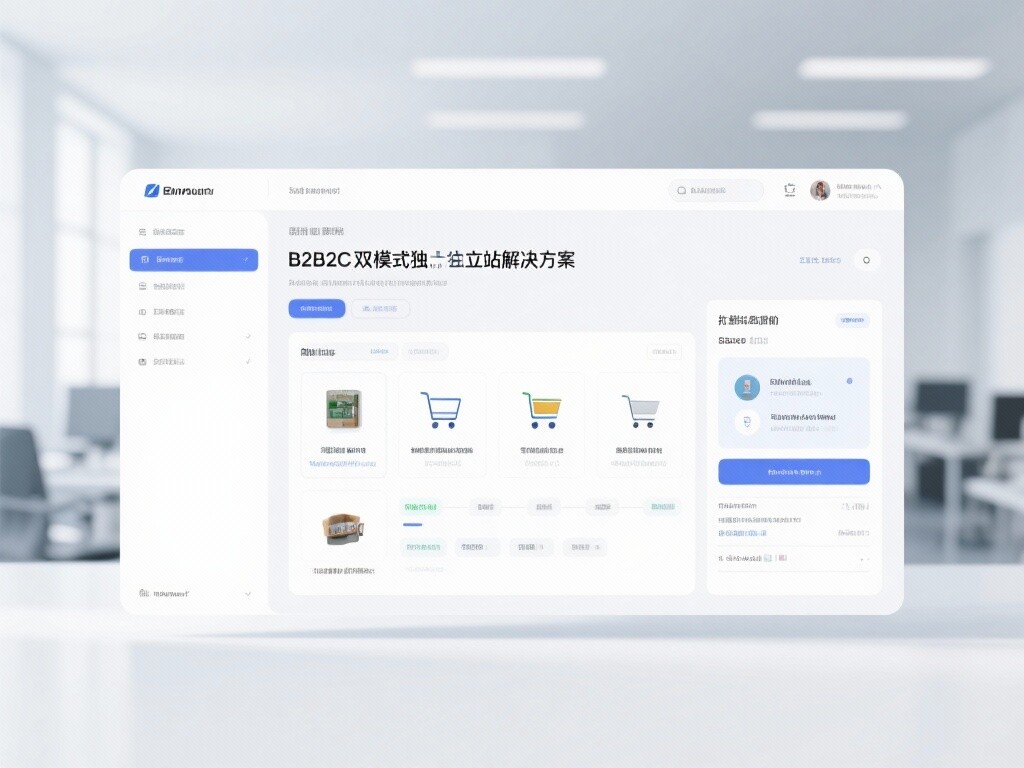
Die Plattform unterstützt Mehrsprachigkeit, Multi-Währungen und Multi-Kanal-Marketing, verfügt über integrierte KI-Übersetzungs- und SEO-Optimierungssysteme und ist für Hauptmärkte wie Südostasien, Europa/Amerika, Lateinamerika und den Nahen Osten geeignet, um chinesischen Herstellern bei der effizienten Erschließung internationaler E-Commerce-Märkte zu helfen. B2B2C双模式独立站解决方案易营宝推出的B2B2C双模式独立站解决方案,专为同时开展批发与零售业务的企业打造。平台支持商品价格展示、商品多规格管理、购物车与购物车弹窗、购物车总价计算,以及统一批量询价等功能,帮助企业以更高效、更直观的方式触达B端与C端客户。通过云建站、大数据分析与广告智能投放体系,助力企业打破渠道壁垒,实现国内外市场拓展与品牌价值提升。