- Welche neuen Signale gibt es im SaaS-Marketingbericht für Unternehmensdienstleistungen?27-07-2026Details anzeigen
- Was macht ein Global-Traffic-Ökosystem-Dienstleister? Und worin unterscheidet er sich von einer einzelnen Werbeagentur?16-07-2026Details anzeigen
- Was ist der neueste Fokus im Enterprise-Services-SaaS-Bericht? Von Verlängerungsrate, Lieferkosten bis zu Ausland-Wachstumschancen12-07-2026Details anzeigen
- Was ist in einem Bericht zu Trends im grenzüberschreitenden Marketing am wichtigsten zu beachten? Welche 6 Signale sollten B2B-Unternehmen beachten?11-07-2026Details anzeigen
- Wie man einen Bericht über Trends im grenzüberschreitenden Marketing liest? Die 5 Schlüsseldimensionen, um zu beurteilen, ob ein Kanal Chancen bietet11-07-2026Details anzeigen
- Welcher Kanal liefert im globalen Traffic-Ökosystem den höchsten ROI? Vergleich von Suche, Social Media und Werbeschaltung10-07-2026Details anzeigen
- Welche Dienstleistungen bietet eine mehrsprachige Website in Sanya? Welches Modell ist für lokale Unternehmen, die ins Ausland gehen und eine Website erstellen, besser geeignet?08-07-2026Details anzeigen
- Wie findet man die vollständige Liste der 100 größten SaaS-Unternehmen Chinas? Praktische Methoden zur Auswahl von Anbietern für Website-Erstellung und Marketingdienstleistungen.08-07-2026Details anzeigen
Viele Klicks auf Google-Anzeigen, aber keine Anfragen, prüfen Sie zuerst diese 6 Probleme in der Conversion-Kette
Google Ads Traffic Gets High Clicks But No Inquiries, Don't Rush to Blame the Traffic
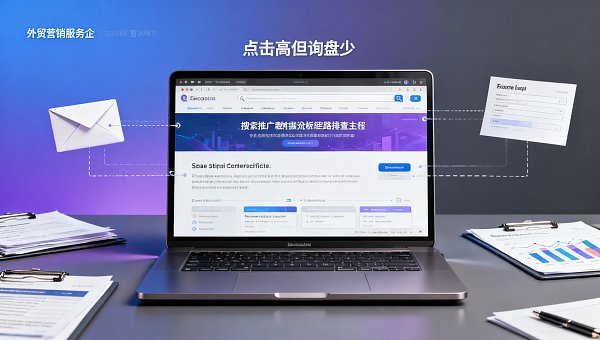
When many websites run Google Ads, the most common confusion is not the lack of clicks, but the fact that clicks are not low and costs keep rising, yet the backend has almost no valid inquiries. On the surface, it looks like an ad problem, but in reality, the more common issue is that the conversion path breaks in the middle.
Especially in foreign trade customer acquisition scenarios, ads, websites, forms, customer service, and data tracking are originally a connected system. Any weak link will cause Google Ads to show the result of “hot traffic, cold conversions.” What really needs to be checked is not only the bidding account, but also whether the user intent matches, whether the page can build trust, and whether the inquiry action is smooth enough.
This is also why more and more companies are unifying website building, SEO, advertising, and data analysis into one system when doing overseas promotion. The longer the chain, the more you cannot only focus on click-through rate.
The Focus of Google Ads Differs Across Different Business Scenarios
For the same Google Ads campaign, some pages sell standard products, some pages handle custom inquiries, some target the English market, and some cover Spanish, French, and Arabic regions at the same time. When the scenario changes, the conversion evaluation criteria also change accordingly.
For example, standard products pay more attention to whether the inquiry action is direct, while custom businesses rely more on cases, qualifications, and communication entry design; single-language websites can more easily test advertising efficiency first, while multilingual websites must consider translation accuracy, page loading speed, and local trust at the same time. When Yiyingbao serves overseas marketing scenarios for the long term, it usually does not treat Google Ads as a standalone traffic-buying action, but evaluates it within the complete customer acquisition path.
Start by Looking at 6 High-Frequency Breakpoints
- Whether clicks brought by keywords truly reflect purchase or inquiry intent
- Whether the ad copy matches the landing page promise
- Whether the page loading speed, structure, and trust information are sufficient
- Whether the form is too long, too complicated, or asks for information too early
- Whether customer service responds in time and supports cross-time-zone coverage
- Whether conversion tracking is inaccurate and invalid leads are being counted as effective results
Lots of Clicks But Few Inquiries, Usually the Problem Starts with Keyword and Intent Mismatch
The most easily overlooked point in Google Ads is that “search volume” does not equal “inquiry intent.” Many accounts also include broad match terms, informational terms, and tutorial terms in advertising. Clicks may come in, but visitors are not ready to submit a request.
A more common situation is that the ad group covers too many countries and languages, and the keyword meaning is not completely consistent across different markets. The words may look fine on the surface, but the people entering the page are not the target customers, so conversions naturally do not follow.
When judging, do not only look at click-through rate; at minimum, also check the search term report, bounce rate, time on page, and first-screen interaction. If a large number of clicks leave within a few seconds, the problem is usually not the page design, but that the traffic entry point is already off.
The Landing Page Is Not a Display Page, and Google Ads Cares More About Whether It Can Take the Lead
Many websites use the official homepage directly as the ad landing page. This may not be a problem in brand-term scenarios, but in product-term or solution-term scenarios, it often prevents users from finding the key point. After clicking in, if users cannot see the corresponding product, delivery capability, and communication entry at first glance, their willingness to inquire will quickly drop.
If the business covers multiple countries, the issue becomes even more obvious. Unnatural page language, mixed price units, and non-local contact methods will all weaken trust. At this time, whether the website system supports localization becomes very critical. Capabilities like Foreign Trade Multilingual Website Solution are more suitable for handling Google Ads across multiple regions, because they not only support 300+ language conversions, but also combine market habits to optimize product descriptions, and have built-in GA4, GTM, and other tracking tools, making it easier to calibrate the conversion path later.
Whether a landing page works well is not judged by “looks good or not,” but by three questions: whether it quickly answers what the user is looking for, whether it proves you can deliver, and whether it makes the submission action easy enough.
Form Design and Customer Service Response Decide Whether a Lead Really Lands
Some Google Ads accounts are not without opportunities; the opportunity is just stuck at the last step. A typical case is that page visit depth is good and people click buttons, but form submissions are very low.
The reasons are often very practical: too many fields, complicated verification codes, poor mobile usability, required file uploads, and no clear feedback after submission. For overseas visitors contacting for the first time, they are more willing to leave an email, describe their needs, and provide country information in the early stage, rather than completing all purchase details in one step.
Another situation that is easier to underestimate is response speed. If the form is replied to only after 24 hours, it is basically equivalent to losing the lead in cross-time-zone scenarios. The traffic bought through Google Ads is not a long-term interest, but a very short communication window.
When Data Tracking Fails, Google Ads Optimization Will Drift More and More Off Course
There is another more hidden type of problem: it looks like the account is converting, but in fact what is recorded are button clicks, page stays, or even repeated submissions. In this case, the Google Ads system will keep pushing budget toward the “fake conversion” audience, resulting in more and more clicks, while real inquiries do not grow accordingly.
In actual diagnosis, it is recommended to handle conversion actions in layers: page visit, form start, form successfully submitted, email successfully delivered, and effective customer follow-up. The clearer the chain is, the easier it is to know exactly which step the problem breaks at, rather than blaming everything on “ads not working.”
If the website itself supports multilingual conversion rate monitoring, automatic tagging, and integration with marketing tools, diagnostic efficiency will be much higher. Especially in multi-region operations, page speed also directly affects tracking completeness. Stable global nodes and loading capability under 2 seconds often improve the overall performance of Google Ads more than simply tweaking the copy.
Several Situations That Are Easily Misjudged Often Waste Budget for Nothing
The first misjudgment is treating “having clicks” as “having demand.” If the search term is biased toward informational queries, even high clicks are hard to turn into inquiries.
The second misjudgment is only adjusting bids without improving the page. Google Ads can amplify advantages, but it can also amplify shortcomings on the landing page.
The third misjudgment is ignoring multilingual and compliance details. Some regional visitors are very sensitive to privacy statements, Cookie notices, and form authorization; missing this information will directly affect submission rates.
The fourth misjudgment is placing all countries on one page to handle. Different markets have different expression habits, price perceptions, and trust points, and one unified page often cannot take care of everyone.
A More Stable Approach Is to Establish Diagnostic Standards Step by Step Along the Chain
If Google Ads already has a click base, the next most effective action is not to immediately increase the budget, but to first do a small-scale diagnosis. You can proceed in the following order:
- Check search terms and eliminate low-intent traffic
- Check whether the ad language matches the first screen of the landing page
- Compress form fields and add an immediate communication entry
- Test mobile opening speed and submission process
- Confirm whether GA4, GTM, and form return tracking are truly effective
- Compare conversion differences by country, language, and device
If the website also undertakes brand display, SEO indexing, and ad conversion tasks, it is recommended to optimize from the site structure for the long term, rather than only relying on temporary landing page fixes. For example, during the second round of website iteration, incorporating multilingual SEO, localized meta tags, synchronized content updates, ad tracking, and compliance templates together is usually more suitable for a long-term overseas advertising environment.
In the end, the real solution to Google Ads having many clicks but few inquiries is not “buy more traffic,” but finding out where each step is leaking. First clarify keyword quality, then check page reception, submission thresholds, response efficiency, and data authenticity. Many seemingly complex problems can often be pinpointed to a specific link. Fixing this diagnostic standard first will make later scaling more stable.
Verwandte Artikel
 Welche neuen Signale gibt es im SaaS-Marketingbericht für Unternehmensdienstleistungen?
 Google ändert seine Gebotsstrategien am 8.17 grundlegend! Ihre Kosten für die Kundengewinnung werden steigen – Teil 1
 Blindes Aneinanderreihen von Keywords bringt nichts! Yiyingbao zeigt Ihnen, wie Sie echte Google-Suchbegriffe mit einem Klick abrufen


Verwandte Produkte
 EasyCamp SaaS Intelligenter Website-Builder und Marketing-SystemE-Yingbao SaaS Intelligent Website Marketing System: KI-gesteuerte Website-Erstellung ohne Programmieraufwand. Erstellen Sie in nur 10 Minuten mehrsprachige, unabhängige Export-Websites. Globale Serverbeschleunigung und KI-gestützte SEO-Optimierung ermöglichen Unternehmen eine effiziente Anbindung an globale Märkte. Die nahtlose Verschmelzung von Technologie und benutzerfreundlicher Bedienung macht die Erstellung von Export-Websites bemerkenswert einfach.
 AI+SEO-Doppelantrieb-OptimierungsserviceEasypack AI+SEO-Doppelantrieb-Optimierungssystem nutzt KI zur intelligenten Keyword-Extraktion, Content-Generierung und umfassenden technischen Optimierung, um Exportunternehmen hochwertigen organischen Traffic zu verschaffen und die Suchmaschinenrankings sowie Conversion-Raten deutlich zu steigern.
 AI+SEM intelligente Werbemarketing-SystemAI+SEM-gesteuerte intelligente Kampagnenerstellung, ganzheitliche Unterstützung für präzises Werbemarketing. Das System generiert automatisch Wochen-/Monatsberichte, KI empfiehlt Keywords und Zielmärkte, überwacht Echtzeit-Kennzahlen und warnt intelligent, startet mit einem Klick hochkonvertierende Kampagnen, beschleunigt Lead-Generierung und steigert ROI.
 AI+SNS Social-Media-Marketing-SystemYingyingbao AI+SNS Social Media Intelligent Marketing System – Präzise Erfassung sozialer Daten für das Zeitalter der sozialen Medien. Unterstützt die Synchronisierung von Inhalten mit einem Klick auf allen wichtigen Plattformen, einschließlich Facebook und LinkedIn. KI-gestütztes Umschreiben von Beiträgen verbessert die Lokalisierung. Intelligenter Kundenservice rund um die Uhr und Analyse von Nutzerprofilen ermöglichen Unternehmen eine effiziente Expansion in globale Märkte.
 AI+SEM-Lösungen für WerbemarketingKI-gestützte SEM-Werbelösungen nutzen künstliche Intelligenz, um das SEM-Kampagnenmanagement erheblich zu verbessern. Mithilfe von KI werden wöchentliche und monatliche Berichte erstellt, die Kontodaten in mehreren Dimensionen darstellen und so einen umfassenden Überblick über die Werbeleistung und Trends ermöglichen. KI liefert präzise Empfehlungen zu Keywords und Zielländern, erstellt auf intelligente Weise Werbetexte mit hoher Konversionsrate und initiiert mit einem einzigen Klick eine effiziente Kampagnenumsetzung, wodurch die Kundenakquise für Unternehmen beschleunigt wird. Gleichzeitig überwacht das System die wichtigsten Kennzahlen in Echtzeit, identifiziert auf intelligente Weise ungewöhnliche Schwankungen und gibt rechtzeitig Warnmeldungen aus, um eine stabile Werbeleistung und hohe Renditen zu gewährleisten.
 AI+SEO营销解决方案易营宝AI+SEO营销解决方案,通过AI批量写作、智能生成TDK、精准关键词扩词等功能,全面优化网站SEO效果,提升流量与转化率。助力企业构建高效智能网站新生态。
 Domain-DienstleistungenEasyWin bietet professionelle Domain-Dienstleistungen an, einschließlich intelligenter Abfrage, One-Stop-Registrierung, Markenschutz und Rund-um-die-Uhr-Management, um Unternehmen bei der Gestaltung eines digitalen Markenimages zu unterstützen.
 EasySell B2C Cross-Border E-Commerce-Plattform und eigenständige WebsiteDer EasyStore B2C Cross-Border E-Commerce Independent Store ist eine intelligente Website-Erstellungs- und Cross-Border-E-Commerce-All-in-One-Lösung, die von der EasyStore Information Technology (Beijing) Co., Ltd. eigenständig entwickelt wurde. Das System wurde speziell für kleine, mittlere und große Exportunternehmen entwickelt und vereint „Website-Erstellung, Betrieb, Marketing, Werbung und Konversion“ in einem, um Unternehmen dabei zu unterstützen, schnell einen Cross-Border-E-Commerce-Independent-Store aufzubauen und so Markenexport und globalen Verkaufszuwachs zu realisieren.
Die Plattform unterstützt Mehrsprachigkeit, Multi-Währungen und Multi-Kanal-Marketing, verfügt über integrierte KI-Übersetzungs- und SEO-Optimierungssysteme und ist für Hauptmärkte wie Südostasien, Europa/Amerika, Lateinamerika und den Nahen Osten geeignet, um chinesischen Herstellern bei der effizienten Erschließung internationaler E-Commerce-Märkte zu helfen. B2B2C双模式独立站解决方案易营宝推出的B2B2C双模式独立站解决方案,专为同时开展批发与零售业务的企业打造。平台支持商品价格展示、商品多规格管理、购物车与购物车弹窗、购物车总价计算,以及统一批量询价等功能,帮助企业以更高效、更直观的方式触达B端与C端客户。通过云建站、大数据分析与广告智能投放体系,助力企业打破渠道壁垒,实现国内外市场拓展与品牌价值提升。