









- CBP Finalizes Electronic Rail Export Manifest Rule, Effective October 26, 2026Oct 26, 2026View details
- Amazon’s 2026 peak season surcharge takes effect on October 25Oct 26, 2026View details
- AI Is Eating SaaS: Three Real-World Cases in One AfternoonOct 25, 2026View details
- Exiger CEO: The SaaS Apocalypse Is Real, but It Means Something DifferentOct 25, 2026View details
- Hengqin Cooperation Zone Shares Cross-Border E-Commerce Developments, Focusing on Macao-Hengqin Collaboration and International MarketsOct 24, 2026View details
- A Shenyang study highlights the development of the “cross-border e-commerce + industrial cluster” modelOct 24, 2026View details
What Is the Typical Conversion Rate for Manufacturing Websites Acquiring Overseas Customers?
There is no single fixed conversion rate for overseas lead-generation websites in manufacturing that applies to all product categories. When measured by clear actions such as “submitting an inquiry, sending drawings, requesting a quotation, or scheduling a discussion,” the conversion rate varies significantly depending on traffic intent, product procurement cycles, page information completeness, and contact barriers. Including all visits in the same denominator often produces a low figure with little practical guidance value.
When evaluating website performance, it is more valuable to first distinguish where visitors come from, what they are looking for, and what action the page asks them to take. Visits searching for specific models, materials, or machining capabilities are closer to actual purchasing needs and generally have higher conversion expectations than visits that only browse industry information, company news, or broad category pages. In businesses involving complex equipment, custom components, engineering materials, and similar products, a valid lead is highly valuable, so a website does not need to pursue an immediate order rate like that of a retail e-commerce store.
First, establish a consistent definition of “conversion”
A common misjudgment on manufacturing websites is treating the number of form submissions directly as the final number of acquired customers. Forms may include job applications, promotional messages, and irrelevant quotation requests, while genuine needs submitted through email, telephone, or instant communication tools may be missed. Therefore, at least three levels should be recorded separately:
- Page actions: Clicking an email address, calling by phone, downloading a catalog, viewing contact details, or opening an inquiry form. These data are suitable for assessing whether a page encourages visitors to learn more.
- Qualified inquiries: Visitors provide contact information and specify some details such as product name, specifications, quantity, application, project stage, or drawing requirements. This is closer to a sales opportunity than a simple form submission.
- Actionable opportunities: After initial communication, the requirements match the supply scope, minimum order conditions, and delivery capability, and proceed to quotation, sampling, or technical confirmation.
If a website aims to collect leads for complex projects, looking only at the rate of the first or second level is insufficient. A more reasonable approach is to observe how many qualified inquiries each traffic type generates, how many enter the quotation process, and how many receive continued follow-up after quotation. This avoids creating overly loose lead-capture entry points merely to increase form numbers, which instead raises the cost of handling invalid leads.
Different traffic sources cannot be measured by the same standard
Organic search visits often involve relatively specific needs, such as searching for a particular alloy, machined parts with specific tolerances, accessories compatible with certain equipment, or verification of a manufacturing capability. When this traffic reaches product or capability pages and the information matches the search terms, inquiry quality is generally good, although page dwell time may not necessarily be long. Visitors may quickly confirm the material range, process capabilities, and contact details before leaving, and then initiate communication by email.
The conversion performance of advertising landing pages is more influenced by keyword selection, geographic targeting, and page promises. Directing broad terms such as “custom machining” to a company homepage can easily attract many visitors still in the information-gathering stage; directing specific processes, application scenarios, or part categories to corresponding pages is more likely to generate assessable requirements. Visits from social media are often at an earlier stage and are more suitable for first completing case study browsing, catalog downloads, or subscriptions, followed by observation of later return visits and lead submissions. Channel performance should not be judged solely by the form rate of first visits.
Traffic from direct visits, trade show material links, or referrals from existing customers has a different trust foundation, and its conversion rate will also differ from search channels. If these sources are calculated together, the website may appear to perform steadily while actually concealing landing page issues in a key channel.
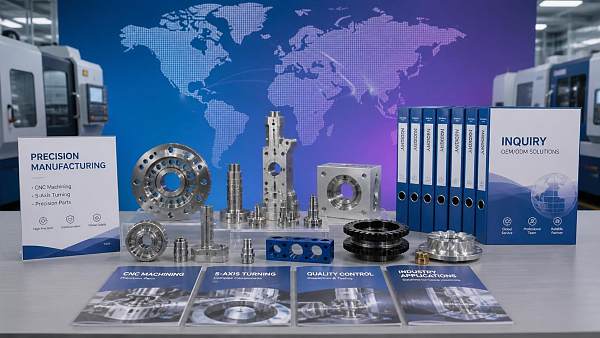
Insufficient page information is a common reason for lost manufacturing inquiries
Overseas procurement processes often require an initial assessment of supply scope and technical feasibility. When product pages contain only images and general descriptions, visitors find it difficult to determine whether they match their projects and may turn to supplier websites with more complete information. Pages do not need to disclose every process detail or pricing rule, but they should answer the basic questions needed for visitors to continue the conversation.
For projects customized according to drawings, the inquiry area can clearly indicate the types of information that may be submitted, such as 2D drawings, 3D models, target quantities, material requirements, surface treatments, operating conditions, and expected delivery dates. The purpose is not to increase the burden of form completion, but to let visitors with clear needs know what information they should provide. Overly long form fields reduce willingness to submit, while too few fields require sales staff to spend substantial time screening. A more prudent design is to retain a small number of required fields while setting drawing uploads, project descriptions, and required quantities as clear but not excessively mandatory supplementary items.
Low conversion does not necessarily mean there is a website problem
When traffic grows but inquiries do not increase accordingly, first check whether the search terms and landing pages are aligned. For example, if visits come from repair tutorials, material definitions, or product usage instructions, while the page’s main goal is to obtain bulk custom orders, low conversion may reflect a mismatch in traffic intent. Conversely, if visits are concentrated on specific product and process pages, dwell time is normal, and contact details receive many clicks but no trackable inquiries are submitted, priority should be given to checking email availability, mobile forms, telephone country codes, response speed, and whether privacy notices create obstacles.
There is also a situation where the number of inquiries is not low but the qualification rate is poor. The cause may not be traffic acquisition; the page may also fail to clearly state the minimum order quantity, primary service regions, core process scope, or product positioning, resulting in a large number of mismatched requests. In this case, simply lowering the form threshold is meaningless. Screening information should be completed, and source reports should be used to identify the keywords, countries or regions, and pages where invalid inquiries are concentrated.
Evaluate performance by page groups rather than the site-wide average
The site-wide conversion rate is suitable for an overview but not for directly guiding optimization. Manufacturing websites can at least be divided by page purpose: product detail pages, custom capability pages, industry application pages, content articles, and advertising landing pages. Article pages are responsible for explaining process choices, material differences, or procurement issues, and visitors may not request quotations immediately; product detail pages, on the other hand, should be closer to actual purchasing decisions and need to provide specifications, applications, and inquiry entry points. Their reasonable performance should not be the same.
Data should also be reviewed separately by device. Desktop visitors are more likely to open drawings, compare parameters, and complete longer forms; mobile users are better suited to quickly confirming capabilities, clicking contact details, or sending brief requirements. If contact clicks on mobile are high but form submissions are low, this does not necessarily mean the user experience has failed, but it is necessary to confirm whether phone, email, and messaging entry points can be correctly attributed; otherwise, actual conversions will be underestimated.
Address the shortest breakpoints first during optimization
Do not redesign the homepage, rewrite all content, and change advertising strategies at the same time, as it will be difficult to identify what caused the change. Start with pages that have relatively high traffic and strong commercial intent but have long lacked qualified leads, and verify whether the title promise, above-the-fold product definition, parameter descriptions, trust information, and inquiry path are coherent. For a precision-machined part page, after entering from search results, visitors should quickly understand the part type, machinable materials, key capabilities, application scope, and how to provide drawings next, rather than first reading a lengthy company introduction.
Data observation should also allow for the procurement cycle. From the first visit to a formal inquiry and then order confirmation, high-value industrial products may involve multiple communications. After page adjustments, in addition to immediate form submissions, subsequent return visits, email inquiries, quotation requests, and source attribution should also be tracked. Only by connecting traffic quality, page actions, and qualified opportunities can the question “what is the typical conversion rate for overseas lead-generation websites in manufacturing” become not an isolated number, but a basis for improving customer acquisition efficiency.
Related Articles
 How Can a Website Analytics Platform Track the Ad Sources of Inquiries?
 How Can Digital Marketing Consulting Use Data Analytics to Identify Ineffective Ad Spend?
 How Should You Allocate a Global Digital Marketing Budget Across Target Markets?


Related Products
 Yiyingbao SaaS Intelligent Website Building and Marketing SystemYiyingbao SaaS Intelligent Website Building and Marketing System, AI-powered no-code website building, rapid creation of multilingual B2B international websites in 10 minutes, global server acceleration, AI-powered SEO optimization, helping businesses connect efficiently with global markets. The perfect integration of technology and operation makes building an international trade website remarkably simple
 AI+SEM Intelligent Advertising Marketing SystemAI+SEM drives intelligent ad creation, empowering full-funnel precision advertising marketing. The system automatically generates weekly/monthly reports, AI recommends keywords and target countries, monitors core metrics in real-time with intelligent alerts, and enables one-click high-conversion ad solutions to help quickly acquire customers and improve ROI.
 AI+SEO Dual-Engine System Optimization ServicesYiyingbao’s AI+SEO dual-engine optimization system helps foreign trade enterprises acquire high-quality organic traffic through AI-powered keyword research, content generation, and comprehensive technical optimization, significantly improving search rankings and conversion rates.
 AI+SNS Social Media Marketing SystemYingbao AI+SNS Social Media Marketing System - Precision social capture for the social media era. Supports one-click content synchronization across major platforms like Facebook and LinkedIn. AI intelligently rewrites posts for enhanced relevance. 24/7 AI customer service and user profiling analysis empower businesses to efficiently expand into global markets.
 AI+SEO营销解决方案易营宝AI+SEO营销解决方案,通过AI批量写作、智能生成TDK、精准关键词扩词等功能,全面优化网站SEO效果,提升流量与转化率。助力企业构建高效智能网站新生态。
 AI+SEM Advertising Marketing SolutionsAI+SEM Advertising Marketing Solution leverages AI technology to deeply empower SEM ad campaigns. It automatically generates weekly/monthly reports using AI, presenting account data across multiple dimensions for comprehensive insights into campaign performance and trends. The system precisely recommends keywords and target countries, intelligently generates high-conversion ad copy, and enables one-click activation of efficient campaign plans to help businesses rapidly acquire customers. Simultaneously, it monitors core metrics in real time, intelligently identifies abnormal fluctuations, and issues timely alerts to ensure stable, high-return advertising results.
 Domain Name ServicesEasyWin provides professional domain name services, including intelligent queries, one-stop registration, brand protection, and full lifecycle management, helping businesses build a digital brand image.
 EasyOperate B2C Cross-Border E-Commerce Platform & Independent WebsiteEasyStore B2C Cross-border E-commerce Independent Store is an intelligent website building and cross-border e-commerce integrated solution independently developed by EasyStore Information Technology (Beijing) Co., Ltd. The system is specially designed for small and medium-sized as well as large export enterprises, integrating 'website building, operation, marketing, advertising, and conversion' into one, helping enterprises quickly establish cross-border e-commerce independent stores to achieve brand globalization and global sales growth.
The platform supports multiple languages, multiple currencies, and multi-channel marketing, with built-in AI intelligent translation and SEO optimization systems, suitable for mainstream markets such as Southeast Asia, Europe and America, Latin America, and the Middle East, assisting Chinese manufacturing enterprises in efficiently deploying international e-commerce strategies. SSL证书易营宝提供专业SSL安全证书服务,包括单域名和泛域名证书,确保网站数据传输加密、身份验证和完整性保护,助力企业建立安全可信的在线业务环境。









