









- How to Choose Topics for an Industry News Section to Attract More Organic Search TrafficJul 29, 2026View details
- Can Zhejiang foreign trade independent websites still be developed today? Look at changes in traffic and lead generationJul 28, 2026View details
- What New Signals Are Emerging in Enterprise Services SaaS Marketing ReportsJul 27, 2026View details
- What Does a Global Traffic Ecosystem Service Provider Do? What Are the Differences from a Single Advertising AgencyJul 16, 2026View details
- What should you focus on in the latest enterprise SaaS report? From renewal rates and delivery costs to overseas growth opportunitiesJul 12, 2026View details
- What signals are worth paying attention to in a cross-border marketing trend report? B2B companies should look at these 6 signalsJul 11, 2026View details
- How to Read a Cross-Border Marketing Trends Report? Five Key Dimensions for Evaluating Channel OpportunitiesJul 11, 2026View details
- Which channel has the highest ROI in the global traffic ecosystem? Comparative analysis of search, social media, and advertisingJul 10, 2026View details
How should the structure and conversion path of a foreign trade marketing website be planned to make it easier to generate inquiries?
Foreign trade marketing website construction, first clarify the column logic and conversion logic
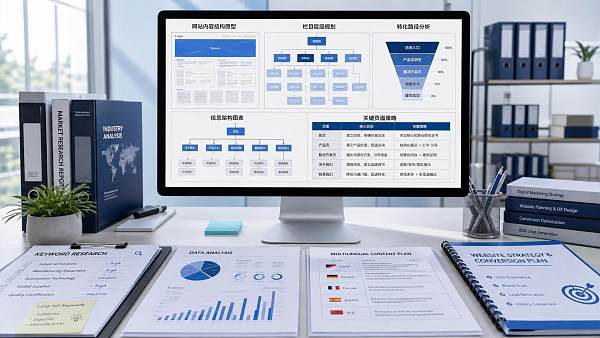
Foreign trade marketing website construction is truly difficult. It is usually not about whether the page looks good, but whether visitors can quickly find the answer after entering the site and be willing to leave an inquiry.
Many websites have a lot of homepage information and many columns, but the paths are scattered. Visitors finish looking at the products but cannot see the company’s strength; after seeing the strength, they cannot find the contact action, and inquiries naturally get interrupted.
In practical applications, different business stages, different overseas markets, and different customer acquisition methods place different requirements on website structure. If a foreign trade marketing website only uses a general official website framework, it will be difficult for SEO, advertising, and social media traffic to connect smoothly later on.
This is also why more and more companies, when building a website, place it within the overall marketing funnel. Platforms like 易营宝, which focus on long-term intelligent website building, SEO optimization, advertising, and multilingual overseas expansion services, usually emphasize planning “indexable, promotable, and convertible” together, rather than treating the website as a standalone display page.
Under different business scenarios, the focus of the columns is naturally different
The reason foreign trade marketing website construction cannot simply copy a template is that the tasks the website needs to carry may be completely different. Some websites mainly capture search traffic, some rely more on advertising landing pages, and some carry brand storytelling and multilingual distribution.
If the main goal is B2B inquiries, the columns should solve “trust building” and “demand matching.” If the main goal is independent site transactions or sample conversion, the path will focus more on product screening, payment instructions, and fulfillment information.
A more common way of judging is to first look at where the traffic comes from, and then see what visitors care about most when they enter the website. Different traffic sources require different column order, content depth, and conversion actions.
When relying on search to acquire customers, the columns should serve indexing and comparison
If inquiries mainly come from Google SEO, foreign trade marketing website construction cannot just keep basic columns such as “Home, About Us, Products, Contact Us.” Such a structure is too thin, and keyword coverage is insufficient.
In this scenario, product category pages, application scenario pages, solution pages, case pages, and knowledge content pages are all very important. Because after search traffic enters the site, visitors are often not in a hurry to inquire; they first want to screen and compare.
When relying on advertising placement, the path should be short and the action should be focused
If inquiries mainly come from Google ads, Facebook ads, or short-video traffic, the website structure should not be too deep. After clicking an ad, the landing page must first solve relevance, rather than making the content longer and longer.
At this time, column design is more suitable for layered connection. Ad pages are responsible for conversion, while official website columns are responsible for supplementing credibility, factory capabilities, certification qualifications, and more product lines, so as to avoid visitors losing direction beyond the first screen.
When multiple language markets operate in parallel, the columns should consider localization differences
When facing North America, Europe, the Middle East, or Latin America, the content priorities behind the same column name can also be different. Some markets pay more attention to technical parameters, while others value delivery cycles, certification compliance, and after-sales response.
Therefore, multilingual foreign trade marketing website construction cannot rely on mechanical translation alone. Column hierarchy, case presentation, contact method display, and form fields all need to be fine-tuned according to regional habits.
How to arrange high-frequency columns depends on how the inquiries are formed
A more effective idea is not to first think about which pages the website should include, but to work backward: what does the visitor see from the product, to the confirmation of capability, and then to the willingness to submit a request, and what information is missing in between.
The order of the columns is also very important. In most cases, the product entrance, solutions, case qualifications, about page, and contact action should form a progression rather than being isolated from one another.
What truly affects inquiries is often not the number of pages, but the conversion path
In foreign trade marketing website construction, many problems arise from “having content but no path.” Visitors can see the information, but do not know what to do next, or the guidance actions on each page are inconsistent.
A clear conversion path usually includes at least four steps: entry, understanding, trust, and submission. Each step must have corresponding content support and cannot end with only a contact form at the bottom of the page.
- Entry stage: the title, above-the-fold information, and entrance columns must correspond to search terms or ad intent.
- Understanding stage: use categories, parameters, and application descriptions to answer “Is this what I want?”
- Trust stage: use cases, certifications, delivery processes, and company capabilities to answer “Can we cooperate?”
- Submission stage: forms, buttons, and instant communication entrances should lower the operational threshold.
If the website also needs to work with SEO, advertising, and social media in a coordinated way, the path design must be more unified. The value of platforms like 易营宝 that combine website building and marketing lies precisely in placing the website system, content structure, and placement support within the same logic, reducing later rework.
Several common misjudgments that easily make foreign trade marketing website construction lose effectiveness
A common misjudgment is equating foreign trade marketing website construction with a design upgrade. Visual refresh is certainly important, but if the columns do not carry keywords and the paths do not carry conversions, the inquiries after the revision may not necessarily increase.
Another situation is treating different markets as the same need. The content focus, trust expression, and form style of English sites, Russian sites, and Spanish sites often cannot be completely copied.
Another easily ignored point is only looking at the website construction cost and not the subsequent operating cost. If there are too many columns, the structure is messy, and the backend is hard to maintain, then the efficiency will obviously drop when doing SEO content updates, multilingual expansion, and advertising landing page replication later on.
What needs to be confirmed before landing is not actually “how many pages to make,” but which pages will continue to bring traffic, which pages are responsible for assisting conversion, and which pages are only for display purposes.
A more stable planning approach is to first define the connection, then expand the pages
If you are preparing to start a foreign trade marketing website construction project, a more practical approach is to first sort out the existing customer acquisition sources, key markets, main product lines, and inquiry form quality, and then decide on the column hierarchy.
You can first list three types of pages: pages that bring traffic, pages that build trust, and pages that promote conversion. This way, after the website goes live, it is easier to form a closed loop, and it is also convenient for subsequent SEO optimization, ad placement, and content iteration.
- First clarify the core keywords and long-tail keywords to avoid disconnect between column names and search demand.
- Then sort out the differences in key markets to determine whether multilingual content needs an independent structure.
- Check whether each key page has a clear next action.
- Evaluate backend maintenance efficiency to ensure continued updates later on.
In the end, if foreign trade marketing website construction wants to more easily obtain inquiries, the core is not to fill the columns, but to let each column undertake a clear task. Once scenario differences, information hierarchy, and conversion paths are planned clearly together, the website can truly transform from a “showcase window” into a basic infrastructure that continuously acquires customers.
Related Articles



Related Products
 Yiyingbao SaaS Intelligent Website Building and Marketing SystemYiyingbao SaaS Intelligent Website Building and Marketing System, AI-powered no-code website building, rapid creation of multilingual B2B international websites in 10 minutes, global server acceleration, AI-powered SEO optimization, helping businesses connect efficiently with global markets. The perfect integration of technology and operation makes building an international trade website remarkably simple
 AI+SEM Intelligent Advertising Marketing SystemAI+SEM drives intelligent ad creation, empowering full-funnel precision advertising marketing. The system automatically generates weekly/monthly reports, AI recommends keywords and target countries, monitors core metrics in real-time with intelligent alerts, and enables one-click high-conversion ad solutions to help quickly acquire customers and improve ROI.
 AI+SEO Dual-Engine System Optimization ServicesYiyingbao’s AI+SEO dual-engine optimization system helps foreign trade enterprises acquire high-quality organic traffic through AI-powered keyword research, content generation, and comprehensive technical optimization, significantly improving search rankings and conversion rates.
 AI+SNS Social Media Marketing SystemYingbao AI+SNS Social Media Marketing System - Precision social capture for the social media era. Supports one-click content synchronization across major platforms like Facebook and LinkedIn. AI intelligently rewrites posts for enhanced relevance. 24/7 AI customer service and user profiling analysis empower businesses to efficiently expand into global markets.
 AI+SEO营销解决方案易营宝AI+SEO营销解决方案,通过AI批量写作、智能生成TDK、精准关键词扩词等功能,全面优化网站SEO效果,提升流量与转化率。助力企业构建高效智能网站新生态。
 AI+SEM Advertising Marketing SolutionsAI+SEM Advertising Marketing Solution leverages AI technology to deeply empower SEM ad campaigns. It automatically generates weekly/monthly reports using AI, presenting account data across multiple dimensions for comprehensive insights into campaign performance and trends. The system precisely recommends keywords and target countries, intelligently generates high-conversion ad copy, and enables one-click activation of efficient campaign plans to help businesses rapidly acquire customers. Simultaneously, it monitors core metrics in real time, intelligently identifies abnormal fluctuations, and issues timely alerts to ensure stable, high-return advertising results.
 Domain Name ServicesEasyWin provides professional domain name services, including intelligent queries, one-stop registration, brand protection, and full lifecycle management, helping businesses build a digital brand image.
 EasyOperate B2C Cross-Border E-Commerce Platform & Independent WebsiteEasyStore B2C Cross-border E-commerce Independent Store is an intelligent website building and cross-border e-commerce integrated solution independently developed by EasyStore Information Technology (Beijing) Co., Ltd. The system is specially designed for small and medium-sized as well as large export enterprises, integrating 'website building, operation, marketing, advertising, and conversion' into one, helping enterprises quickly establish cross-border e-commerce independent stores to achieve brand globalization and global sales growth.
The platform supports multiple languages, multiple currencies, and multi-channel marketing, with built-in AI intelligent translation and SEO optimization systems, suitable for mainstream markets such as Southeast Asia, Europe and America, Latin America, and the Middle East, assisting Chinese manufacturing enterprises in efficiently deploying international e-commerce strategies. SSL证书易营宝提供专业SSL安全证书服务,包括单域名和泛域名证书,确保网站数据传输加密、身份验证和完整性保护,助力企业建立安全可信的在线业务环境。









