









- Fujian Announces the First Batch of Provincial-Level Cross-Border E-Commerce Industrial Parks and Key Brands for CultivationNov 14, 2026View details
- Amazon Global Store Announces the Launch of the 2026 Black Friday Global Shopping SeasonNov 14, 2026View details
- CCTV.com Examines APEC’s Role in China’s Foreign TradeNov 12, 2026View details
- China’s Tariff Commission of the State Council Adjusts Additional Tariffs on U.S. Goods: 24% Tariff Suspended for Two MonthsNov 10, 2026View details
- APEC Shenzhen Spotlight: Cross-Border E-Commerce Orders Promote Asia-Pacific Trade and Economic CooperationNov 08, 2026View details
- China-Europe Railway Express and CIIE Hold Business Matchmaking Event, Focusing on Cross-Border E-commerce B2B ExportsNov 07, 2026View details
Which Customer Acquisition Stages Are Standalone Websites for Foreign Trade Marketing Solutions Suitable For
Which Customer Acquisition Stages Are Suitable for an Independent Website for Foreign Trade Marketing Solutions?
When many companies first learn about independent websites, they often understand them simply as “having an English website.” Only after entering the overseas customer acquisition process do they realize that whether a website can support search, advertising, social media, and sales follow-up determines whether it is a business asset or merely an electronic business card that remains unvisited for a long time. An independent website for foreign trade marketing solutions is not only suitable for mature companies with stable overseas orders; from market testing and inquiry growth to brand globalization, each stage has corresponding website-building priorities and promotional combinations.
The key to determining whether an independent website is needed is not the size of the company, but whether customer acquisition has begun to rely on scalable online channels. If customers mainly come from trade shows, referrals from existing customers, or trading platforms, the website may temporarily serve only as a supporting tool. However, once a company wants overseas buyers to find its products through search, wants advertising clicks to lead to pages that explain its solutions, or needs to present different languages and product information to different countries, the website becomes a central node in the marketing chain.
Market Validation Stage: First Prove “Who Is Interested in What Content”
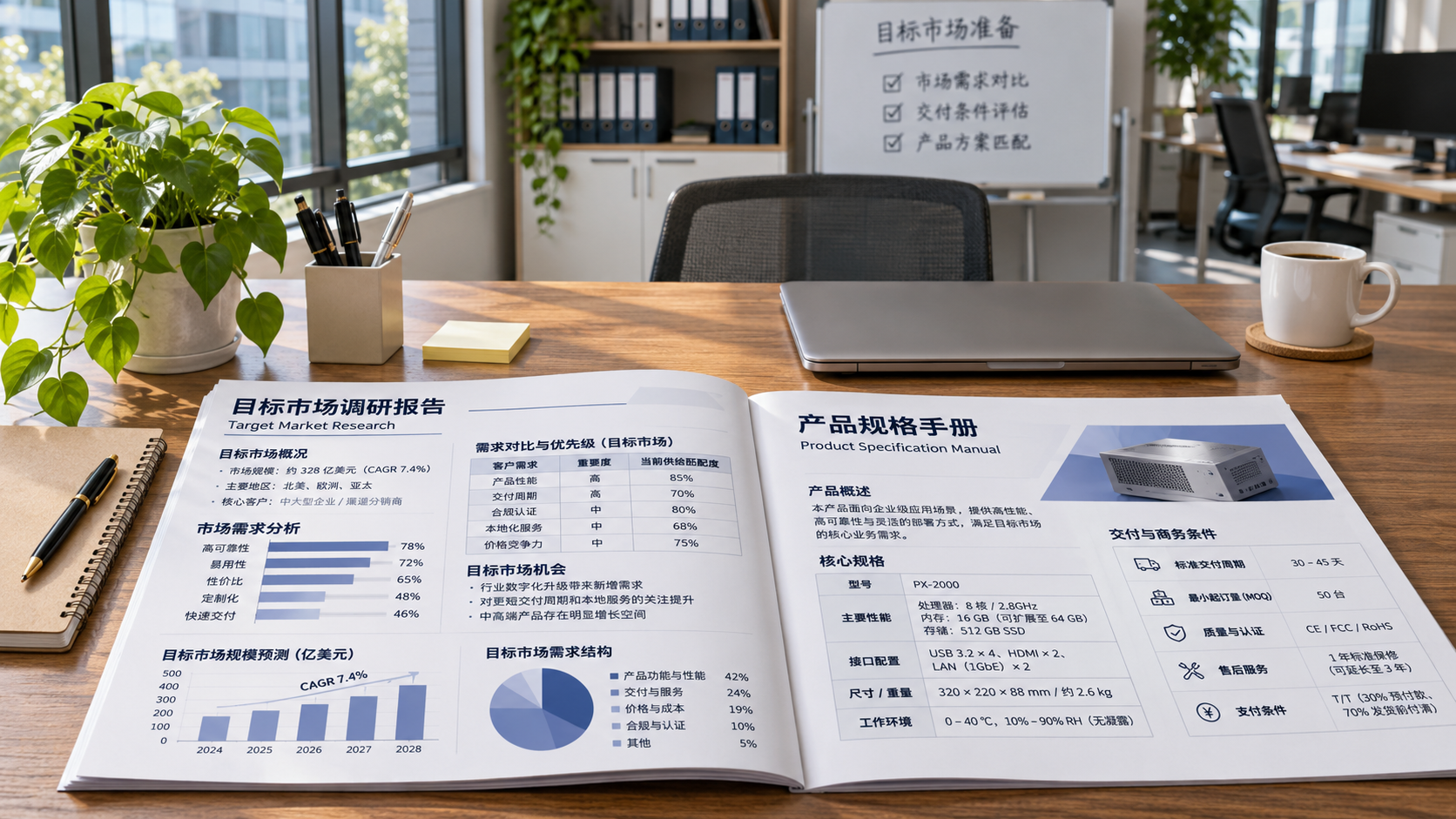
Manufacturing plants, trading companies, or newly established overseas expansion teams that are just beginning to explore overseas markets usually face not insufficient traffic, but unclear market positioning: Which countries are their key products suitable for? Do buyers care more about price, delivery time, certifications, or customization capabilities? Can the advantages described by sales teams be quickly understood by unfamiliar visitors? At this stage, it is not advisable to build a content-heavy website from the outset. It is more suitable to establish a basic website around core product categories, target applications, and inquiry paths.
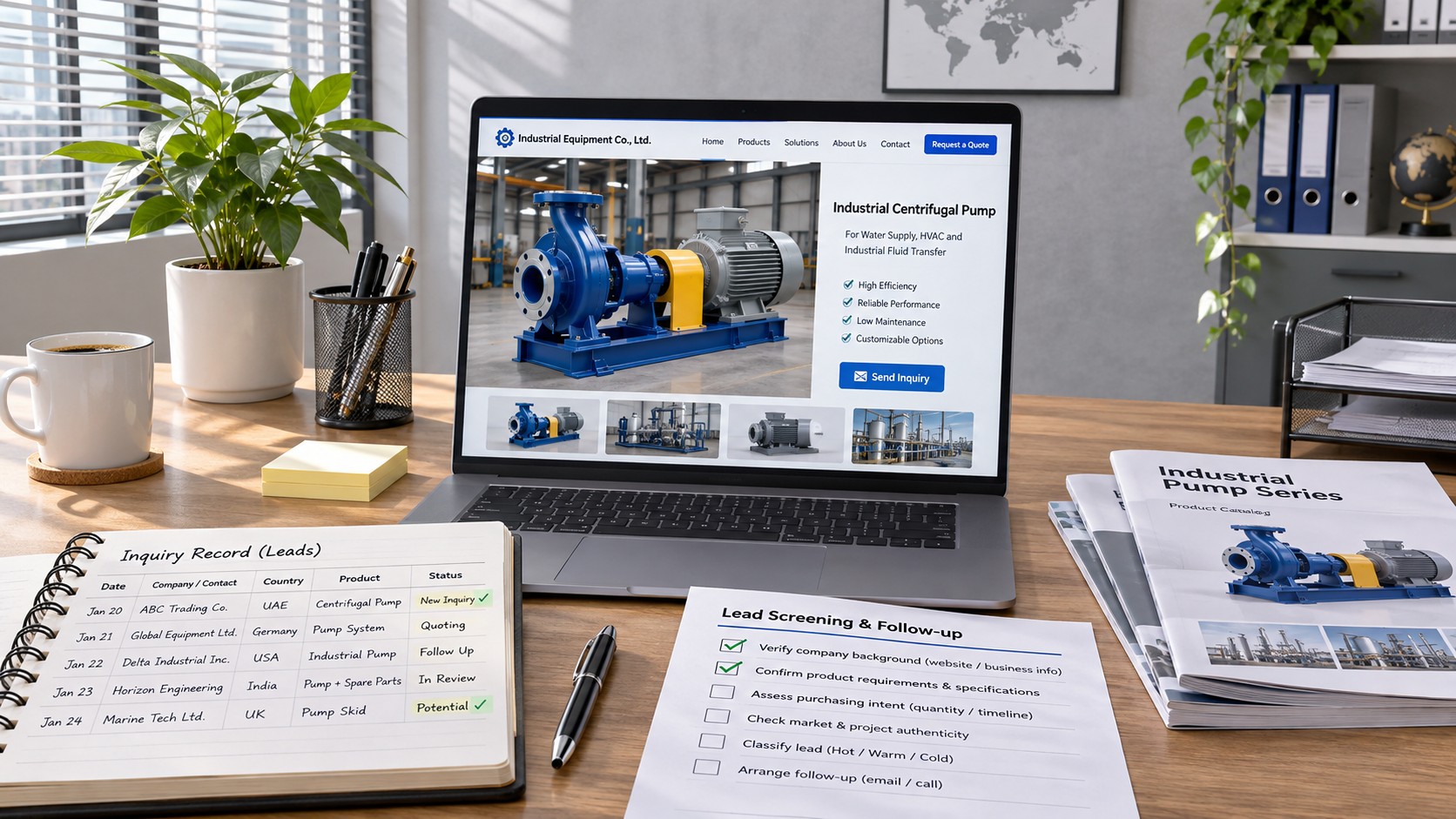
At this stage, the website should have three capabilities: clearly presenting product specifications, materials, application scenarios, and production capabilities; preparing basic content by country or language; and recording visitor behavior through forms, instant communication tools, or downloadable materials. For advertising tests, landing pages must also be consistent with the keywords used in campaigns. For example, if visitors search for customized equipment but the page only displays a company overview and a broad product catalog, it will be difficult to generate qualified leads even if the cost per click is low.
The goal at this point is not to pursue attractive metrics, but to obtain actionable insights: which product pages are visited, which markets submit inquiries, and which parameters customers focus their questions on. Questions repeatedly raised in search advertising, social media content, and sales communications can in turn serve as the basis for the next round of website content optimization.
Inquiry Growth Stage: The Website Must Evolve from a Display Tool into a Conversion Tool
When a company already has a group of key products ready for promotion and wants to steadily increase overseas inquiries, the requirements for its independent website rise significantly. Customers no longer only look at whether the homepage “looks like a legitimate company”; they assess supplier reliability through product pages, solution pages, qualification documents, factory information, and contact details. Particularly in non-standard products, industrial products, and project-based procurement, purchasing decisions often involve multiple roles, and product images alone are far from sufficient.
At this stage, an independent website for foreign trade marketing solutions is more like a sales front end that can be continuously improved. Product categories should align with customers’ purchasing logic rather than simply copying the classification of internal production departments; pages should explain common questions regarding available parameters, minimum order quantities, sampling, lead times, and quality control; for customers in different industries, application pages can also be used to explain how products solve practical problems. Where certifications, testing, or compliance requirements are involved, information should be based on materials the company already possesses and regulations in the target market. Vague claims such as “compliant with international standards” should not be used in place of specific explanations.
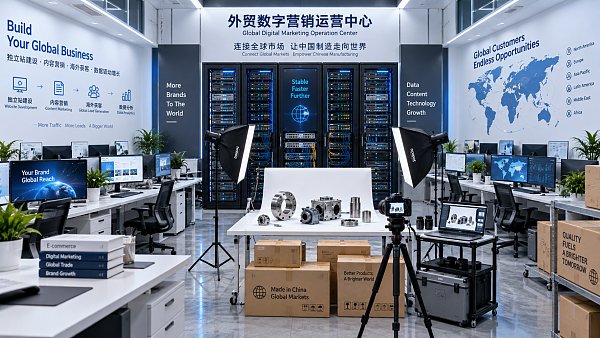
The growth stage is also where a common misconception is most likely to arise: website development, search optimization, advertising, and social media operations are assigned to different teams without unified content standards or data definitions. The advertising team does not know which inquiries ultimately prove effective, the website team does not know what customers actually search for, and the sales team does not feed frequent questions back to content personnel, causing each channel to consume budget independently. The value of integrated website and marketing services does not lie in simply bundling all work together, but in creating a continuous closed loop among keywords, pages, campaign materials, conversion tracking, and lead qualification.
Scaled Customer Acquisition Stage: Distinguish Short-Term Leads from Long-Term Search Assets
Once a company has validated its products and markets and wants to expand its country coverage and increase the share of organic traffic, its independent website needs to take on more complex tasks. On the one hand, Google Ads, Facebook Ads, and social media promotion can test markets and reach specific audiences relatively quickly; on the other hand, SEO content development usually requires a longer accumulation period, but can continuously cover product keywords, application keywords, question-based keywords, and comparison-related search demand. The two are not substitutes: advertising can help validate pages and conversion paths, while search optimization builds content that can be discovered repeatedly.
Multilingual development should not consist of text translation alone. Purchasing habits, units of measurement, delivery priorities, and communication methods may differ across markets such as North America, Europe, the Middle East, and Southeast Asia. For operations in multiple countries, it is necessary at minimum to clarify whom each language version targets, which product categories it primarily promotes, whether localized inquiry fields are needed, and how to avoid duplicate content and information conflicts between different pages. On the technical side, attention should also be given to loading speed, mobile experience, site structure, form usability, and ongoing content maintenance; otherwise, traffic generated by promotion will be difficult to retain.
As generative search gradually influences how information is obtained, companies will also focus on GEO generative engine optimization. This does not mean traditional search fundamentals can be abandoned. Clear information architecture, complete product facts, logical connections between pages, and consistent company information remain prerequisites for enabling search engines and artificial intelligence systems to understand website content. For B2B companies, authentic technical documentation, application descriptions, and verifiable service information are generally more valuable than generic promotional copy.
Brand Globalization Stage: An Independent Website Must Unify Trust and Channel Order
When a company progresses from “obtaining a single inquiry” to “building overseas brand awareness,” the role of its website continues to expand. In particular, companies with multiple product lines, multi-regional distributor networks, or simultaneous B2B and B2C operations need to consider whether their brand story, content standards, distributor and direct-sales boundaries, and pre-sales and after-sales information are consistent. At this point, the website is not only an entry point for customer acquisition, but also affects how customers, partners, and potential channel partners evaluate the company’s capabilities.
The brand stage does not mean that the more pages created, the better. What truly needs to be clarified is: which content supports purchasing decisions, and which content supports brand awareness; which countries are suitable for a unified website, and which markets require independent operations; and how advertising landing pages can remain consistent with the main website without slowing conversion. For cross-border online stores, payment, logistics, tax notices, return and exchange policies, and local consumer requirements must also be additionally confirmed. These matters usually need to be assessed individually based on the operating model and target region.
When Choosing a Solution, Assess Collaboration Capabilities Before Feature Lists
When evaluating service providers, companies can easily be drawn to the number of templates, pages, or individual features. However, more worthwhile questions include: Who is responsible for content iteration after the website goes live? How do advertising and organic traffic data flow back? How is multilingual content managed? After sales teams receive leads, what information can help them assess customer quality? Without clear mechanisms for these issues, even a comprehensive set of features may remain at the presentation level.
Yiyingbao Information Technology (Beijing) Co., Ltd. was established in 2013 and is headquartered in Beijing. It has long served foreign trade companies, manufacturing plants, cross-border e-commerce sellers, and brand globalization projects. Based on artificial intelligence and big data technologies, it provides coordinated support for intelligent website development, SEO optimization, advertising, social media marketing, and GEO generative engine optimization. The company was selected as one of the “Top 100 Chinese SaaS Companies” in 2023, and its business covers multiple major overseas trade regions. For teams that need to extend from website development to promotion and ongoing operations, the value of this type of integrated service lies in reducing handover gaps rather than replacing business judgment with a single tool.
An independent website for foreign trade marketing solutions is not suited to only one fixed stage of development, but to all companies that have begun to prioritize the quality of overseas online customer acquisition. When the market has not yet been validated, first establish a testable entry point; when inquiries need to grow, improve content and conversion paths; and once channels begin to expand, integrate search, advertising, social media, and multilingual operations into the same framework. Clearly defining the target market, key products, sales follow-up capabilities, and content resources before determining the order of investment in website and marketing services is often more prudent than hastily pursuing a full-featured launch.
Related Articles
 How should you choose which markets to enter first for global growth?
 China Securities Journal: Double 11 Reflects the Upgrading of Cross-Border E-Commerce
 How to Diagnose Slow Growth in B2B Export Inquiries
Related Products
 Yiyingbao SaaS Intelligent Website Building and Marketing SystemYiyingbao SaaS Intelligent Website Building and Marketing System, AI-powered no-code website building, rapid creation of multilingual B2B international websites in 10 minutes, global server acceleration, AI-powered SEO optimization, helping businesses connect efficiently with global markets. The perfect integration of technology and operation makes building an international trade website remarkably simple
 AI+SEM Intelligent Advertising Marketing SystemAI+SEM drives intelligent ad creation, empowering full-funnel precision advertising marketing. The system automatically generates weekly/monthly reports, AI recommends keywords and target countries, monitors core metrics in real-time with intelligent alerts, and enables one-click high-conversion ad solutions to help quickly acquire customers and improve ROI.
 AI+SEO Dual-Engine System Optimization ServicesYiyingbao’s AI+SEO dual-engine optimization system helps foreign trade enterprises acquire high-quality organic traffic through AI-powered keyword research, content generation, and comprehensive technical optimization, significantly improving search rankings and conversion rates.
 AI+SNS Social Media Marketing SystemYingbao AI+SNS Social Media Marketing System - Precision social capture for the social media era. Supports one-click content synchronization across major platforms like Facebook and LinkedIn. AI intelligently rewrites posts for enhanced relevance. 24/7 AI customer service and user profiling analysis empower businesses to efficiently expand into global markets.
 AI+SEO营销解决方案易营宝AI+SEO营销解决方案,通过AI批量写作、智能生成TDK、精准关键词扩词等功能,全面优化网站SEO效果,提升流量与转化率。助力企业构建高效智能网站新生态。
 AI+SEM Advertising Marketing SolutionsAI+SEM Advertising Marketing Solution leverages AI technology to deeply empower SEM ad campaigns. It automatically generates weekly/monthly reports using AI, presenting account data across multiple dimensions for comprehensive insights into campaign performance and trends. The system precisely recommends keywords and target countries, intelligently generates high-conversion ad copy, and enables one-click activation of efficient campaign plans to help businesses rapidly acquire customers. Simultaneously, it monitors core metrics in real time, intelligently identifies abnormal fluctuations, and issues timely alerts to ensure stable, high-return advertising results.
 Domain Name ServicesEasyWin provides professional domain name services, including intelligent queries, one-stop registration, brand protection, and full lifecycle management, helping businesses build a digital brand image.
 EasyOperate B2C Cross-Border E-Commerce Platform & Independent WebsiteEasyStore B2C Cross-border E-commerce Independent Store is an intelligent website building and cross-border e-commerce integrated solution independently developed by EasyStore Information Technology (Beijing) Co., Ltd. The system is specially designed for small and medium-sized as well as large export enterprises, integrating 'website building, operation, marketing, advertising, and conversion' into one, helping enterprises quickly establish cross-border e-commerce independent stores to achieve brand globalization and global sales growth.
The platform supports multiple languages, multiple currencies, and multi-channel marketing, with built-in AI intelligent translation and SEO optimization systems, suitable for mainstream markets such as Southeast Asia, Europe and America, Latin America, and the Middle East, assisting Chinese manufacturing enterprises in efficiently deploying international e-commerce strategies. SSL证书易营宝提供专业SSL安全证书服务,包括单域名和泛域名证书,确保网站数据传输加密、身份验证和完整性保护,助力企业建立安全可信的在线业务环境。









