









- Which customer acquisition channels will be affected by cross-border marketing trends in 2026?Sep 06, 2026View details
- Which homogenization risks should be considered in an analysis of the AI-powered website building industry?Aug 30, 2026View details
- How Will AI Marketing Trends 2026 Change Advertising Budget AllocationAug 28, 2026View details
- Is the EV SSL certificate market shrinking or upgrading? How should companies assess certificate procurement?Aug 11, 2026View details
- Why the old AMP SEO 2020 practices no longer work and what has changed in current optimization prioritiesAug 02, 2026View details
- How to Choose Topics for an Industry News Section to Attract More Organic Search TrafficJul 29, 2026View details
At which stages are low inquiry volumes most common on B2B export marketing websites?
When a B2B foreign trade marketing website receives few inquiries, do not focus solely on traffic volume first. After procurement-oriented visitors enter the website, they will quickly assess three things: whether the products fit their projects, whether the supply capability is trustworthy, and whether submitting an inquiry is convenient. Any break in the information chain can result in a situation of “traffic but few inquiries.” When identifying the issue, first distinguish whether there is insufficient target traffic or loss in the post-visit conversion path.
First, check whether the traffic truly aligns with target demand
Visits from organic search, advertising, and social media links all count as traffic on the surface, but their commercial value varies greatly. Visitors searching for “product definition,” “repair methods,” or “free drawings” may not be at the purchasing stage; those searching for specific models, materials, processing capabilities, customization requirements, delivery times, or application fields show clearer inquiry intent. If website pages mainly target broad keywords, it is not surprising to see traffic growth without a corresponding increase in inquiries.
Keywords should also be matched with their landing pages. If an ad for “stainless steel custom parts” directs users to the company homepage, visitors must find the processes, equipment capabilities, size range, and quotation entry by themselves. Similarly, when keywords for a type of flange, valve, packaging equipment, or component are promoted but the landing page lacks corresponding product content, visitors may leave quickly after clicking. The click-through rate in an advertising account alone cannot prove that promotion is effective; search terms, landing pages, browsing paths, and form submission sources should be reviewed together.
Regions and languages also affect evaluation. If pages targeting multiple countries are merely translated directly while retaining units, trade term expressions, or phone number formats that do not match local purchasing practices, visitors may be concerned about communication costs. For multilingual pages, it is especially important to verify whether product specifications, image descriptions, downloadable materials, and inquiry fields are synchronized, rather than simply translating the navigation and body text.
Product pages lack purchasable information
Many websites have product pages with a name, several images, and a brief introduction, yet they do not answer the questions that arise early in procurement communications. For non-standard products, material grades, surface treatments, processing methods, dimensional tolerances, minimum order requirements, sampling arrangements, packaging methods, and common applications often do more to advance the next step than slogans. For finished equipment, details such as voltage, power, applicable capacity range, installation space, wearing parts, and the scope of after-sales support should also be clearly stated.
Insufficient information can reduce inquiries, but overpromising can also lead to low-quality leads. For example, describing every product as “fully customizable” without explaining whether dimensions, colors, structures, or functions can be adjusted; or giving a highly vague delivery time that prevents visitors from determining whether it fits their projects. A more reliable approach is to present confirmed capability ranges and specify what drawings, samples, quantities, or operating-condition information are needed to verify uncertain details.
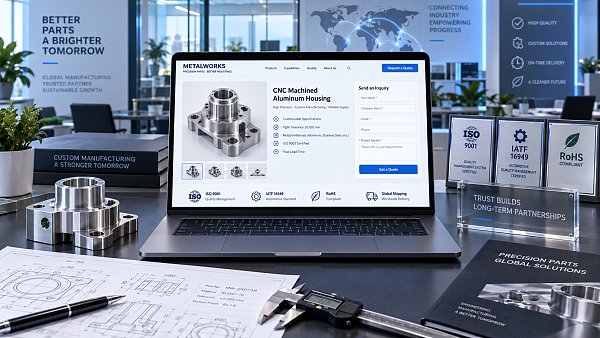
Images also serve an evaluative function. Trade show photos, office photos, or heavily retouched renderings alone cannot replace product details. For metal parts, photos of edges, hole positions, welds, coatings, and packaging can reduce misunderstandings; for equipment, operating conditions, control panels, interface locations, and installation sites offer greater reference value. Inconsistencies between images and specifications are a common detail that causes visitors to leave without leaving an inquiry.
Trust information remains at the level of “self-description”
B2B procurement cycles are relatively long. A website does not need to turn every page into a company introduction, but key assessments need to be supported by evidence. Simply stating “extensive experience,” “excellent quality,” or “professional service” does not explain whether production is in-house or outsourced, at which stage quality inspection takes place, how export packaging is handled, or how exceptional orders are communicated. Vague descriptions can be replaced with production processes, inspection items, packaging standards, types of documents available, and typical delivery steps.
A common misconception arises here: filling a page with numerous certificates, award images, or partner logos does not necessarily improve credibility. If certificates cannot be identified, their scope does not relate to the current products, or partner logos do not explain the business relationship, the page may instead appear cluttered. Evidence directly relevant to current procurement decisions should be placed close to the corresponding product or solution pages, rather than being concentrated entirely on the “About Us” page.
For projects requiring approval or internal supplier comparisons, downloadable materials also affect inquiry quality. Downloadable specification sheets, material descriptions, installation manuals, or FAQs should indicate their version, applicable products, and language. When incorporating inventory, delivery cycles, and quotation capabilities into website content management, the approach to information coordination in Application Strategies of Lean Cost Concepts in Corporate Inventory Management is also applicable to preventing a disconnect between website commitments and actual supply status.
The inquiry path requires too much effort from visitors
When visitors have already reviewed specifications, cases, and capability descriptions but still do not submit a form, the problem often lies in the final step. Too many form fields, difficult CAPTCHA verification, buttons blocked on mobile devices, or no feedback after submission can directly interrupt conversion. An initial inquiry usually requires only contact information, a description of requirements, and a few project conditions; fields such as drawing uploads, target quantities, and ports of destination can remain optional or be supplemented during follow-up communication.
Different pages should provide different inquiry entry points. Product detail pages are suitable for inquiries based on models, specifications, or customization requirements; process capability pages are suitable for submitting drawings and material requirements; if a content page discusses product selection or maintenance issues, its entry point can guide visitors to provide application scenarios. Using only one generic form across all pages may simplify management, but it increases the burden on visitors to organize information.
The post-submission status should not be overlooked either. Clearly confirming receipt of the request, indicating the types of materials that need to be prepared, and providing related pages for continued browsing can reduce repeated submissions and unnecessary drop-off. If leads enter an email inbox but are not assigned to anyone, or the response language differs from the language of the visitor’s page, even thorough website optimization will be offset by subsequent responses.
Use funnel data for diagnosis rather than redesigning based on intuition
During diagnosis, observe the sequence of “enter page—view core content—click inquiry entry—start filling out—submit successfully.” If homepage visits are high but few visitors reach product pages, the issue is often in navigation, above-the-fold messaging, or traffic matching. If product page dwell time is short and scrolling is shallow, first check whether the content matches search intent. If inquiry buttons receive many clicks but few forms are completed, check the fields, loading speed, attachment restrictions, and mobile interaction.
It is not advisable to rewrite all pages at the same time during a redesign; otherwise, it will be impossible to determine where changes in inquiries come from. First select a product line with relatively stable traffic and clear commercial intent, complete the page information and conversion path, and then compare the quality of valid inquiries before and after the changes. Valid inquiries are not just about the number of submissions; they should also be assessed by whether they include information that can support further communication, such as products, quantities, applications, or drawings. Only then can you identify the actual bottleneck affecting inquiries on a B2B foreign trade marketing website.
Related Articles
 Why do SaaS cross-border e-commerce customer acquisition efforts often get stuck at demo booking?
 For an independent foreign trade website in Shanghai, is it better to focus first on inquiries or transactions?
 What parameters should a product selection guide include to reduce repeated communication with sales?


Related Products
 Yiyingbao SaaS Intelligent Website Building and Marketing SystemYiyingbao SaaS Intelligent Website Building and Marketing System, AI-powered no-code website building, rapid creation of multilingual B2B international websites in 10 minutes, global server acceleration, AI-powered SEO optimization, helping businesses connect efficiently with global markets. The perfect integration of technology and operation makes building an international trade website remarkably simple
 AI+SEM Intelligent Advertising Marketing SystemAI+SEM drives intelligent ad creation, empowering full-funnel precision advertising marketing. The system automatically generates weekly/monthly reports, AI recommends keywords and target countries, monitors core metrics in real-time with intelligent alerts, and enables one-click high-conversion ad solutions to help quickly acquire customers and improve ROI.
 AI+SEO Dual-Engine System Optimization ServicesYiyingbao’s AI+SEO dual-engine optimization system helps foreign trade enterprises acquire high-quality organic traffic through AI-powered keyword research, content generation, and comprehensive technical optimization, significantly improving search rankings and conversion rates.
 AI+SNS Social Media Marketing SystemYingbao AI+SNS Social Media Marketing System - Precision social capture for the social media era. Supports one-click content synchronization across major platforms like Facebook and LinkedIn. AI intelligently rewrites posts for enhanced relevance. 24/7 AI customer service and user profiling analysis empower businesses to efficiently expand into global markets.
 AI+SEO营销解决方案易营宝AI+SEO营销解决方案,通过AI批量写作、智能生成TDK、精准关键词扩词等功能,全面优化网站SEO效果,提升流量与转化率。助力企业构建高效智能网站新生态。
 AI+SEM Advertising Marketing SolutionsAI+SEM Advertising Marketing Solution leverages AI technology to deeply empower SEM ad campaigns. It automatically generates weekly/monthly reports using AI, presenting account data across multiple dimensions for comprehensive insights into campaign performance and trends. The system precisely recommends keywords and target countries, intelligently generates high-conversion ad copy, and enables one-click activation of efficient campaign plans to help businesses rapidly acquire customers. Simultaneously, it monitors core metrics in real time, intelligently identifies abnormal fluctuations, and issues timely alerts to ensure stable, high-return advertising results.
 Domain Name ServicesEasyWin provides professional domain name services, including intelligent queries, one-stop registration, brand protection, and full lifecycle management, helping businesses build a digital brand image.
 EasyOperate B2C Cross-Border E-Commerce Platform & Independent WebsiteEasyStore B2C Cross-border E-commerce Independent Store is an intelligent website building and cross-border e-commerce integrated solution independently developed by EasyStore Information Technology (Beijing) Co., Ltd. The system is specially designed for small and medium-sized as well as large export enterprises, integrating 'website building, operation, marketing, advertising, and conversion' into one, helping enterprises quickly establish cross-border e-commerce independent stores to achieve brand globalization and global sales growth.
The platform supports multiple languages, multiple currencies, and multi-channel marketing, with built-in AI intelligent translation and SEO optimization systems, suitable for mainstream markets such as Southeast Asia, Europe and America, Latin America, and the Middle East, assisting Chinese manufacturing enterprises in efficiently deploying international e-commerce strategies. SSL证书易营宝提供专业SSL安全证书服务,包括单域名和泛域名证书,确保网站数据传输加密、身份验证和完整性保护,助力企业建立安全可信的在线业务环境。









