









- Levanta’s Inaugural China Summit Held in Shenzhen, Focusing on AI and Cross-Border Brand GrowthOct 20, 2026View details
- The October Edition of the 2026 GGE Shenzhen Cross-Border E-Commerce Expo OpensOct 20, 2026View details
- Dongguan’s foreign trade imports and exports reached RMB 1.29 trillion in the first three quarters, a record high for the same periodOct 20, 2026View details
- Liaoning Holds Province-Wide Meeting to Advance Cross-Border E-Commerce, Emphasizing the Need to Explore Differentiated Development PathsOct 20, 2026View details
- Advanced Manufacturing Seizes Global Opportunities as Guangdong’s Q3 Foreign Trade Surpasses RMB 3 Trillion for the First TimeOct 20, 2026View details
- Can the average annual growth rate reflect real opportunities in overseas markets?Oct 07, 2026View details
What type of website architecture should an auto parts export website choose?
When overseas buyers search for a specific brake pad model, wiper blade specification, or suspension part OE number, they usually do not have the patience to study how “beautifully designed” a supplier’s website is. What they care about more is whether they can quickly find matching products, confirm vehicle compatibility, obtain specification documents, and submit an inquiry smoothly.
Therefore, “What type of website architecture is best for an automotive parts export website?” is not simply a technical selection question. The architecture determines how product information is organized, whether multilingual pages can be understood by Google, whether adding thousands of SKUs later will create confusion, and it directly affects the initial impression distributors, repair chains, and importers form of a company’s capabilities.
For most automotive parts exporters, the answer is not that one architecture “fits all.” A more reasonable approach is to first assess the business model, then determine whether to focus on a B2B marketing-oriented independent website, product catalog website, B2C cross-border online store, or a hybrid architecture.
Do Not Rush to Choose a System: The Automotive Parts Business Determines the Website Framework
Automotive parts have one notable characteristic: products may appear similar, but their actual compatibility logic is highly complex. A filter, spark plug, or wheel hub may need to correspond simultaneously to an OE number, brand, vehicle model, model year, engine model, dimensions, and material standards. If a website is organized only by “product name + image,” buyers can easily get lost, and search engines will also struggle to determine the value of the pages.
Before building the website, companies can first answer three questions:
- Are the main customers wholesalers, brand owners, repair channels, or end consumers directly?
- Are there only a few key product lines, or a large volume of models, OE numbers, and vehicle compatibility data?
- Is the goal to generate long-term organic Google inquiries, or to simultaneously support advertising, social media, and online retail orders?
If a company mainly focuses on export wholesale and OEM/ODM cooperation, its website does not need to rush to imitate a retail store. If it has standardized packaging, clear retail pricing, and stable cross-border fulfillment capabilities, it should not remain merely a display website with a “Contact Us” page. The clearer the business path, the less likely the architecture will need to be repeatedly rebuilt after launch.
B2B Inquiry-Oriented Architecture: Suitable for Factories, Trading Companies, and Custom Parts Suppliers
This is the most common choice for automotive parts export websites and is also the most suitable option for manufacturing enterprises. The core of the website is not online payment, but building trust, demonstrating supply capabilities, and enabling buyers to quickly submit an RFQ (request for quotation).
This type of architecture typically follows a main flow of “product category—product details—applicable vehicle or OE information—document downloads—inquiry entry.” For example, a company producing braking system components can organize primary categories such as Brake Pads, Brake Discs, and Brake Calipers; product detail pages can further display model numbers, materials, dimensions, compatible vehicle models, packaging methods, MOQ, certification or testing information, and provide a “Request a Quote” form.
The key is not to fill every page with all possible information, but to let buyers confirm within two or three minutes: Is this the product I am looking for? Does this company have stable supply and customization capabilities? How should I contact them next?
For companies with a large number of product models, it is recommended to add OE Number Search, Part Number Search, or vehicle filtering functions. However, filtering options must be built on accurate and maintainable data. If coding and vehicle data have not yet been properly organized, rushing to launch a complex search function may instead create numerous empty results and incorrect matches, damaging the professional image.
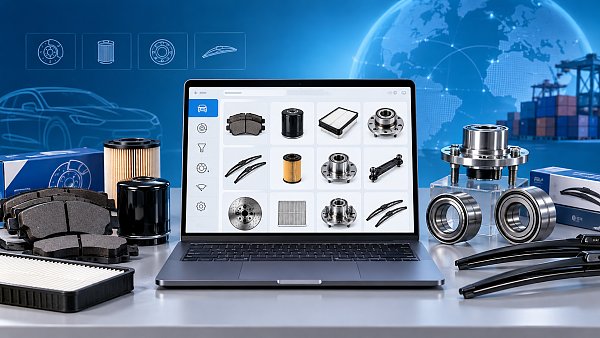
Product Catalog Architecture: More Worth Investing In When There Are Many SKUs and Complex Specifications
When a company handles hundreds or even thousands of automotive parts SKUs, a catalog-based architecture is often more suitable than a standard corporate website. Its essence is to turn product data into searchable, indexable, and scalable content assets.
Unlike a simple “product listing page,” a catalog website needs to predesign its classification dimensions. For example, products can be organized across product systems, vehicle brands, OE numbers, application scenarios, materials, or processes. This not only makes it easier for overseas buyers to find products, but also provides Google SEO with clearer page topics. For example, pages such as “Toyota Suspension Parts,” “Heavy Duty Truck Filters,” and “Aftermarket Wheel Hub Bearing” can address more specific overseas search demands.
However, catalog-based architecture has a common pitfall: mechanically generating nearly identical pages for every model. A large number of pages with duplicate content and incomplete specifications may not achieve effective indexing and may instead dilute the overall quality of the website. A safer approach is to prioritize key category pages, core application pages, and model detail pages with complete information, then gradually expand long-tail product content.
B2C Cross-Border Online Stores: Not Every Automotive Parts Company Needs One
If a company sells highly standardized products with low installation barriers that are suitable for individual consumers, such as in-car accessories, small modification parts, maintenance consumables, or universal electronic accessories, a B2C store architecture can shorten the path from traffic to transaction.
An online store requires more than just a shopping cart and payment buttons. It also requires inventory synchronization, shipping rules, tax information, return and exchange policies, order notifications, review systems, and customer service processes. For automotive parts with complex compatibility relationships, it is especially important to provide a clear vehicle compatibility confirmation mechanism before ordering; otherwise, the after-sales costs caused by purchasing the wrong part will quickly escalate.
Therefore, if a company does not yet have overseas warehousing, retail pricing, cross-border payment, and after-sales coordination capabilities, it is more suitable to first validate the market through a B2B inquiry website or a “catalog + inquiry” approach. Turning a website into an online store does not mean the company has acquired cross-border retail capabilities.
A Hybrid Architecture of “Inquiries + Content + Promotion” Is Better Suited to Most Companies
Many automotive parts exporters are in a practical middle position: they want to obtain bulk purchase inquiries while also continuously generating overseas traffic through Google, Facebook, LinkedIn, or short-video channels. In this case, a single display website is usually insufficient, while a pure online store can be overly complex. A hybrid architecture offers greater flexibility.
It uses product catalogs and inquiry conversion as the main focus, while also incorporating content sections such as brand introduction, factory capabilities, quality control, industry solutions, vehicle knowledge, installation guides, and FAQs. The former serves buyer decision-making, while the latter supports SEO and content marketing. Advertising landing pages can also be designed separately for different promotion themes, such as braking components, filters, and commercial vehicle parts, avoiding directing all traffic to the homepage.
For companies entering multiple national markets, multilingual support does not simply mean translation. English, German, Spanish, Russian, or Arabic pages should consider local buyers’ search habits, specification expressions, and purchasing priorities. Each language should have independent URLs and page content that can be understood by search engines, rather than relying on automatic browser translation.
To Determine Whether a Website Architecture Is “Usable,” Review These Five Details
- Whether product data can be continuously maintained: Can model numbers, specifications, images, PDFs, and compatibility information be conveniently updated by business personnel?
- Whether mobile inquiries are smooth: Overseas buyers often initially screen suppliers on mobile phones. Forms that are too long or pages that load too slowly will both cause visitor loss.
- Whether the SEO foundation is complete: Category hierarchy, independent URLs, title descriptions, image information, sitemaps, and multilingual links should all be manageable.
- Whether marketing channels can be supported: Can advertising landing pages be created, form sources tracked, and data tools such as Google Analytics and advertising pixels integrated?
- Whether future expansion is limited: When adding new languages, product categories, dealer areas, download centers, or online store functions later, the website should not need to be rebuilt every time.
Choosing an Architecture Is Essentially Choosing a Growth Model for the Next Three Years
What type of website architecture is best for an automotive parts export website ultimately depends on the company’s actual customer acquisition path. Factories with few products, high order values, and an emphasis on customization capabilities should prioritize building B2B marketing-oriented websites; companies with extensive SKUs and strong model search requirements should focus on product catalogs and data structures; brands serving overseas consumers and possessing retail fulfillment capabilities can plan cross-border online stores; and companies seeking to balance organic search, advertising, and long-term brand building will generally find a hybrid independent website to be the safer option.
Yiyingbao provides integrated services for foreign trade enterprises, including AI-powered website building, multilingual websites, B2B marketing websites, cross-border online stores, and SEO/GEO optimization. In actual planning, website building should not stop at launching pages; it should be designed around product data, search visibility, promotional landing pages, and inquiry management together. Only then can a website have a better opportunity to grow from an online product brochure into a business platform that continuously acquires global customers.
Related Articles

Related Products
 Yiyingbao SaaS Intelligent Website Building and Marketing SystemYiyingbao SaaS Intelligent Website Building and Marketing System, AI-powered no-code website building, rapid creation of multilingual B2B international websites in 10 minutes, global server acceleration, AI-powered SEO optimization, helping businesses connect efficiently with global markets. The perfect integration of technology and operation makes building an international trade website remarkably simple
 AI+SEM Intelligent Advertising Marketing SystemAI+SEM drives intelligent ad creation, empowering full-funnel precision advertising marketing. The system automatically generates weekly/monthly reports, AI recommends keywords and target countries, monitors core metrics in real-time with intelligent alerts, and enables one-click high-conversion ad solutions to help quickly acquire customers and improve ROI.
 AI+SEO Dual-Engine System Optimization ServicesYiyingbao’s AI+SEO dual-engine optimization system helps foreign trade enterprises acquire high-quality organic traffic through AI-powered keyword research, content generation, and comprehensive technical optimization, significantly improving search rankings and conversion rates.
 AI+SNS Social Media Marketing SystemYingbao AI+SNS Social Media Marketing System - Precision social capture for the social media era. Supports one-click content synchronization across major platforms like Facebook and LinkedIn. AI intelligently rewrites posts for enhanced relevance. 24/7 AI customer service and user profiling analysis empower businesses to efficiently expand into global markets.
 AI+SEO营销解决方案易营宝AI+SEO营销解决方案,通过AI批量写作、智能生成TDK、精准关键词扩词等功能,全面优化网站SEO效果,提升流量与转化率。助力企业构建高效智能网站新生态。
 AI+SEM Advertising Marketing SolutionsAI+SEM Advertising Marketing Solution leverages AI technology to deeply empower SEM ad campaigns. It automatically generates weekly/monthly reports using AI, presenting account data across multiple dimensions for comprehensive insights into campaign performance and trends. The system precisely recommends keywords and target countries, intelligently generates high-conversion ad copy, and enables one-click activation of efficient campaign plans to help businesses rapidly acquire customers. Simultaneously, it monitors core metrics in real time, intelligently identifies abnormal fluctuations, and issues timely alerts to ensure stable, high-return advertising results.
 Domain Name ServicesEasyWin provides professional domain name services, including intelligent queries, one-stop registration, brand protection, and full lifecycle management, helping businesses build a digital brand image.
 EasyOperate B2C Cross-Border E-Commerce Platform & Independent WebsiteEasyStore B2C Cross-border E-commerce Independent Store is an intelligent website building and cross-border e-commerce integrated solution independently developed by EasyStore Information Technology (Beijing) Co., Ltd. The system is specially designed for small and medium-sized as well as large export enterprises, integrating 'website building, operation, marketing, advertising, and conversion' into one, helping enterprises quickly establish cross-border e-commerce independent stores to achieve brand globalization and global sales growth.
The platform supports multiple languages, multiple currencies, and multi-channel marketing, with built-in AI intelligent translation and SEO optimization systems, suitable for mainstream markets such as Southeast Asia, Europe and America, Latin America, and the Middle East, assisting Chinese manufacturing enterprises in efficiently deploying international e-commerce strategies. SSL证书易营宝提供专业SSL安全证书服务,包括单域名和泛域名证书,确保网站数据传输加密、身份验证和完整性保护,助力企业建立安全可信的在线业务环境。









