









- Levanta’s Inaugural China Summit Held in Shenzhen, Focusing on AI and Cross-Border Brand GrowthOct 20, 2026View details
- The October Edition of the 2026 GGE Shenzhen Cross-Border E-Commerce Expo OpensOct 20, 2026View details
- Dongguan’s foreign trade imports and exports reached RMB 1.29 trillion in the first three quarters, a record high for the same periodOct 20, 2026View details
- Liaoning Holds Province-Wide Meeting to Advance Cross-Border E-Commerce, Emphasizing the Need to Explore Differentiated Development PathsOct 20, 2026View details
- Advanced Manufacturing Seizes Global Opportunities as Guangdong’s Q3 Foreign Trade Surpasses RMB 3 Trillion for the First TimeOct 20, 2026View details
- Can the average annual growth rate reflect real opportunities in overseas markets?Oct 07, 2026View details
How Can Construction and Renovation Company Websites Adapt to Overseas Mobile Users?
How can construction and renovation company websites adapt to overseas mobile users? The key is not simply to “shrink” desktop pages onto mobile phones, but to reorganize project showcases, service descriptions, and inquiry paths based on how overseas customers browse on mobile devices. Customers may open the website while commuting through Google, social media ads, or industry platforms, and within seconds decide whether the company is professional, capable of undertaking projects, and easy to contact.
For renovation contractors, building materials suppliers, and engineering design firms, the mobile experience directly affects whether customers continue viewing project cases, submit quote requests, or schedule consultations. Slow-loading pages, unclear project images, and hard-to-find contact buttons can all cause potentially interested visitors to leave.
First, identify what overseas customers most want to see on mobile
A mobile homepage is not suitable for simply replicating company introductions, awards displays, and lengthy service philosophies. Overseas customers usually assess three things first: what services you provide, what types of projects you have completed, and how to get in touch quickly.
Therefore, the first screen should prioritize a clear business positioning. For example, residential renovation, commercial space fit-out, kitchen and bathroom remodeling, exterior construction, or custom building materials supply. English wording should be direct, avoiding the word-for-word translation of Chinese promotional phrases into lengthy slogans. Pair this with an authentic project image that demonstrates the finished result or construction capabilities, and include clear calls to action such as “Request a Quote,” “Book a Consultation,” or “View Projects.”
If the company serves multiple countries or provides various engineering services, the homepage should not attempt to include all information at once. Visitors can first be directed by region, project type, or customer segment, enabling them to reach pages more relevant to their needs more quickly.
Mobile pages should be designed around the inquiry journey
The sales cycle for construction and renovation is usually long. Customers will not place an order after viewing just one page, but the mobile experience should help them take the next step rather than require them to complete a complex form all at once. A more reasonable journey is: enter a service page from a search result or ad landing page, view similar project cases and basic information, then initiate communication through a short form, phone call, WhatsApp, or online booking.
Contact methods should remain visible, but pop-ups should not repeatedly block content. Since mobile screens are limited, a fixed action bar can be placed at the bottom of the page, retaining key options such as “Call,” “WhatsApp,” and “Get a Quote.” For markets such as North America and Europe, phone and email remain important; for some markets in the Middle East, Southeast Asia, and Latin America, instant messaging tools may be used more frequently. The actual setup should be selected according to customer communication preferences in the target region, rather than filling the page with every social media icon.
Inquiry forms should also be kept as short as possible. At the initial contact stage, collecting a name, email or phone number, project location, service requirements, and a brief description is usually sufficient. Information such as area, budget, construction date, and material preferences can be supplemented during follow-up communication. Too many fields will cause mobile users to abandon the form midway, while too few fields make it difficult to assess lead quality. The key is to retain only the information sales staff must know for the first follow-up.
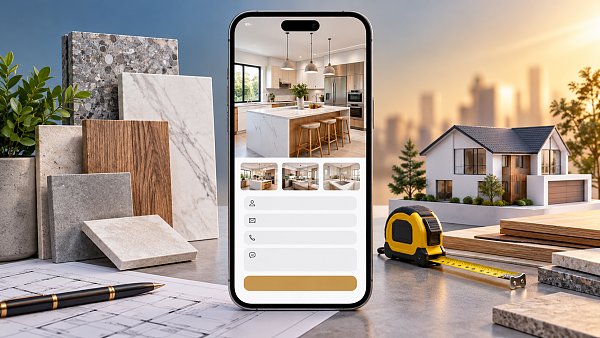
Project case pages need to be mobile-friendly, not just “beautiful image galleries”
A common issue with renovation industry websites is that they contain many project images but are difficult to browse on mobile: image proportions are inconsistent, loading is slow, details cannot be viewed after clicking, or there are only renderings without an explanation of what problems the project actually solved. For overseas customers, project cases not only serve a display function but are also important content for building trust.
Each project page is recommended to retain several basic details: project location, project type, scope of service, main materials or construction work, and the final result. The content does not need to be written as a construction log, but it should allow customers to understand whether you have completed similar requirements. For example, commercial office renovation and residential kitchen remodeling have different priorities: the former may focus more on schedule coordination and functional layout, while the latter is more concerned with design, materials, and finished details.
Images should preferably use compressed, web-optimized formats and provide appropriate sizes for different screens. Do not upload unprocessed original construction photos and then rely on browser scaling. This will slow down the page and consume the data of overseas mobile network users. Project images on the first screen should remain clear, while images below the fold can use lazy loading. Material textures and before-and-after construction comparison images that require detail viewing should support click-to-enlarge.
Multilingual support does not end once translation is complete
When construction and renovation companies expand overseas, multilingual mobile pages are prone to two issues: first, machine translation can make service meanings inaccurate; second, changes in text length across languages can cause buttons, navigation, and forms to become crowded.
Languages such as English, German, French, and Spanish differ significantly in text length. During the design stage, flexible space should be reserved for menus, buttons, and form labels, rather than forcing text into one line by reducing the font size. Fonts that are too small on mobile devices reduce readability and increase the chance of accidental taps. The language switcher should be concise and stable, and after switching, users should be directed to the corresponding page whenever possible instead of returning to the homepage each time.
More importantly, wording must be localized. For example, “装修” may correspond to different terms in different markets, such as renovation, remodeling, fit-out, or interior construction, and their applicable contexts are not exactly the same. Titles on service pages, project case categories, and ad landing pages should use expressions that target customers actually search for and understand, rather than pursuing literal consistency alone.
Speed, maps, and forms are technical details most easily underestimated
Mobile adaptation is not only about visual design. Overseas access speed is affected by server location, image size, third-party scripts, font files, and map components. Many construction companies are accustomed to embedding numerous videos, dynamic carousels, maps, and social media plugins on their homepages. While this may look content-rich on desktop, it can take a long time to finish loading on mobile.
The optimization sequence can be more practical: first compress images and video covers, and reduce unnecessary carousel components; then check whether forms, phone links, and instant messaging buttons work properly; finally, evaluate whether third-party components such as maps, review plugins, and online customer service genuinely provide conversion value. Maps are helpful for local renovation service providers, but it is not necessary to repeatedly load a full map on every page. If the company mainly undertakes cross-regional projects, it should also clearly state its service areas rather than only displaying a headquarters address.
Do not use only a “responsive template” as the acceptance criterion
Responsive design is the foundation, but it does not mean mobile adaptation is complete. Some templates automatically scale pages to mobile dimensions but do not solve practical issues such as overly deep navigation levels, excessively heavy image loading, insufficient button spacing, or difficult-to-complete forms. During acceptance testing, access the site directly using real mobile phones of different sizes instead of only resizing the window in a desktop browser.
It is recommended to test based on the customer journey: enter a service page through a search result, browse project cases, switch languages, click the phone number or WhatsApp, complete an inquiry form, and then confirm whether complete information is received by email or in the backend. If the company runs Google ads or social media ads, the ad landing pages should also be checked separately, because ad users are usually less patient than users conducting active searches, so page information needs to be more focused.
When using a system with multilingual website-building, SEO, and marketing tools, first confirm whether it supports independent service pages, project case categories, mobile editing, form lead management, and promotional requirements for different markets. Website-building and digital marketing platforms such as Yiyingbao, which are designed for overseas marketing scenarios, are suitable for companies that need to manage website development, Google SEO, ad landing pages, and subsequent customer acquisition activities within the same workflow; however, regardless of which tool is chosen, the company itself must still clearly define project content, service boundaries, and customer communication mechanisms.
Ultimately, adapting a construction and renovation website for overseas mobile users must solve one question: “Can customers quickly confirm that you are worth contacting?” First streamline service positioning, project case credibility, and inquiry actions, then address visual decoration and complex functions. Only then will the website have a better chance of converting mobile traffic into qualified business opportunities.
Related Articles


Related Products
 Yiyingbao SaaS Intelligent Website Building and Marketing SystemYiyingbao SaaS Intelligent Website Building and Marketing System, AI-powered no-code website building, rapid creation of multilingual B2B international websites in 10 minutes, global server acceleration, AI-powered SEO optimization, helping businesses connect efficiently with global markets. The perfect integration of technology and operation makes building an international trade website remarkably simple
 AI+SEM Intelligent Advertising Marketing SystemAI+SEM drives intelligent ad creation, empowering full-funnel precision advertising marketing. The system automatically generates weekly/monthly reports, AI recommends keywords and target countries, monitors core metrics in real-time with intelligent alerts, and enables one-click high-conversion ad solutions to help quickly acquire customers and improve ROI.
 AI+SEO Dual-Engine System Optimization ServicesYiyingbao’s AI+SEO dual-engine optimization system helps foreign trade enterprises acquire high-quality organic traffic through AI-powered keyword research, content generation, and comprehensive technical optimization, significantly improving search rankings and conversion rates.
 AI+SNS Social Media Marketing SystemYingbao AI+SNS Social Media Marketing System - Precision social capture for the social media era. Supports one-click content synchronization across major platforms like Facebook and LinkedIn. AI intelligently rewrites posts for enhanced relevance. 24/7 AI customer service and user profiling analysis empower businesses to efficiently expand into global markets.
 AI+SEO营销解决方案易营宝AI+SEO营销解决方案,通过AI批量写作、智能生成TDK、精准关键词扩词等功能,全面优化网站SEO效果,提升流量与转化率。助力企业构建高效智能网站新生态。
 AI+SEM Advertising Marketing SolutionsAI+SEM Advertising Marketing Solution leverages AI technology to deeply empower SEM ad campaigns. It automatically generates weekly/monthly reports using AI, presenting account data across multiple dimensions for comprehensive insights into campaign performance and trends. The system precisely recommends keywords and target countries, intelligently generates high-conversion ad copy, and enables one-click activation of efficient campaign plans to help businesses rapidly acquire customers. Simultaneously, it monitors core metrics in real time, intelligently identifies abnormal fluctuations, and issues timely alerts to ensure stable, high-return advertising results.
 Domain Name ServicesEasyWin provides professional domain name services, including intelligent queries, one-stop registration, brand protection, and full lifecycle management, helping businesses build a digital brand image.
 EasyOperate B2C Cross-Border E-Commerce Platform & Independent WebsiteEasyStore B2C Cross-border E-commerce Independent Store is an intelligent website building and cross-border e-commerce integrated solution independently developed by EasyStore Information Technology (Beijing) Co., Ltd. The system is specially designed for small and medium-sized as well as large export enterprises, integrating 'website building, operation, marketing, advertising, and conversion' into one, helping enterprises quickly establish cross-border e-commerce independent stores to achieve brand globalization and global sales growth.
The platform supports multiple languages, multiple currencies, and multi-channel marketing, with built-in AI intelligent translation and SEO optimization systems, suitable for mainstream markets such as Southeast Asia, Europe and America, Latin America, and the Middle East, assisting Chinese manufacturing enterprises in efficiently deploying international e-commerce strategies. SSL证书易营宝提供专业SSL安全证书服务,包括单域名和泛域名证书,确保网站数据传输加密、身份验证和完整性保护,助力企业建立安全可信的在线业务环境。









