









- China-Europe Railway Express and CIIE Hold Business Matchmaking Event, Focusing on Cross-Border E-commerce B2B ExportsNov 07, 2026View details
- China’s Ministry of Commerce Responds to Additional Charges on Low-Value Imports Imposed by the EUNov 06, 2026View details
- Two Internet Development Reports Released at the 2026 World Internet ConferenceNov 05, 2026View details
- Internet Business Revenue of Enterprises Above the Designated Size Reached RMB 1.716 Trillion in the First Three Quarters, with Profits Up 17.6%Nov 05, 2026View details
- Shopify's Third-Quarter Revenue and GMV Fall Short of Expectations, Sending Shares Tumbling Before the Market OpensNov 04, 2026View details
- Temu Sellers See a Decline in Traffic as the Platform’s Traffic Allocation ShiftsNov 04, 2026View details
How Much Can a Free Website Development Plan Save You, and What Are the Common Hidden Costs Later On?
Many businesses focus on “free website development solutions” not because they want a highly complex official website, but because they want to minimize their initial budget. This starting point is understandable. The problem is that if financial approval focuses only on “0 yuan in the first year” or a “free template,” costs are often gradually recovered later through maintenance, redesign, promotion, and data migration. In the end, the total cost is not necessarily low.
For financial approvers, a website is not a one-time purchase, but more like an ongoing customer acquisition infrastructure investment. The real question should not be “Can it go online for free?” but “After this solution goes live, will we need to keep adding to the budget over the next 12 months?” The following checklist is suitable for reviewing item by item before project initiation, price comparison, and contract confirmation.
Break down “free” first: What exactly is free?
For many so-called free website development solutions, the free portion usually covers only page templates or basic setup. It may not include the domain name, server, SSL certificate, form functionality, backups, technical support, or the SEO settings required for subsequent promotion.
During the approval process, do not look only at the promotional page. Ask the provider to break the costs down into three levels:
- One-time pre-launch costs: design, deployment, information organization, and language-version production.
- Fixed annual costs: domain name, hosting, system licensing, and renewal services.
- On-demand additional costs: feature development, page expansion, advertising landing pages, additional languages, and data migration.
If the quotation only says “free setup” or “official website included” without clearly specifying these three levels, additional charges will almost certainly appear later.
Do not overlook these common hidden costs when calculating the budget
In actual procurement, the easiest costs to underestimate are the small, less visible items. The amount of each item may not be large, but the total can increase quickly when they accumulate.
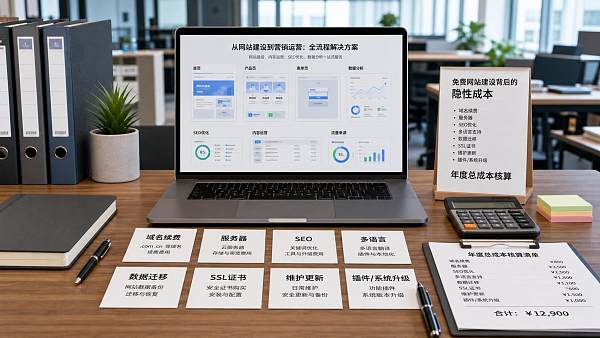
What appears to save money but is most likely to require rework
What finance departments fear most is not high prices, but repeated rework. If a free website development solution only assembles pages without considering subsequent promotion and conversion, the rework rate will be high.
There are several aspects that must be clarified in advance.
Can the site structure support future promotion?
Many free solutions are suitable for presentation but not for customer acquisition. When the number of pages is limited, the section hierarchy is inflexible, and product pages cannot be expanded in batches, companies will find that the original structure is insufficient once they begin Google SEO, advertising, or multilingual expansion.
The assessment method is simple: check whether the backend allows you to add sections, product categories, and landing pages independently, and whether different pages can be used to receive traffic from different markets. If the structure cannot be expanded, a redesign will be the only option later.
Does the backend depend on the service provider for operations?
Some solutions do not charge for website setup, but every subsequent image change, article addition, or form-field modification requires a service request. The cost per request may not be high, but once content is updated frequently, labor costs will continue to rise, and slow response times may affect marketing activities.
During financial approval, examine two things directly: whether internal operations staff can update content independently, and whether permission levels are available. A website that can be maintained independently makes the subsequent budget more controllable.
Is the mobile version merely “viewable” rather than “conversion-ready”?
This issue is very common. A page may open on a mobile phone, but if the buttons are difficult to tap, the form is too long, or the images are too large, traffic will arrive without generating inquiries. Optimizing the mobile version later will require another round of spending.
Do not test only the homepage. At a minimum, check the actual mobile experience of the product pages, contact page, and form submission page.
For foreign trade, cross-border, and multilingual businesses, low-cost solutions often fail here
If a website is merely a domestic company profile page, many basic solutions will work. However, once overseas customer acquisition is involved, the problems become much more apparent. In particular, free solutions are often incomplete when it comes to multilingual capabilities, regional market differences, search engine indexing, and coordination with advertising.
- Are the multilingual versions independent pages rather than the entire site being directly published after machine translation? The former is more conducive to indexing and conversion, while the latter may save money in the short term but sacrifice subsequent results.
- Can different content be configured for different regions? Market needs and form preferences differ across North America, Europe, and Southeast Asia, so a unified page may not be suitable.
- Does it support subsequent integration with SEO, advertising, and social media landing pages? When conducting actual promotion, the website must work with these channels rather than exist as an isolated corporate façade.
In this regard, procurement should not view website development and marketing as completely separate. A website may be inexpensive, but if it adapts poorly to promotion, the final customer acquisition cost will be higher.
Clarify data security and asset ownership before signing the contract
Many approval forms list only the price and rarely separately specify “who owns the website assets.” This oversight may result in costs later that are even higher than the website development fee.
At a minimum, confirm the following:
- Is the domain name registered under the company’s own name?
- Can website content, images, and product information be exported in batches?
- Where are inquiry data and customer form records stored, and what is the export format?
- When changing service providers, is migration supported, and what data does the migration cover?
If the answers to these questions are vague or can only be promised verbally, it is not advisable to regard “free” as a genuine cost advantage. Once the assets are locked into a platform, the cost of exiting is usually very high.
A more practical way to evaluate options during approval: compare the total cost for one year, not the initial price
When finance departments evaluate free website development solutions, the most effective approach is not to compare which quotation is the lowest, but to list all actual expenditures for the coming year. Internal calculations can be made using the following formula:
Total cost for one year = Launch costs + Fixed renewal fees + Labor costs for content maintenance + Additional feature costs + Costs of modifications for promotional adaptation + Potential migration costs.
Once calculated this way, many “free” solutions are simply deferring the costs. Conversely, some solutions that do not appear to have the lowest price may provide coverage for intelligent website development, multilingual expansion, basic SEO, advertising landing pages, and routine operations support. Their overall budgets may actually be more stable, especially for companies that regard their websites as long-term customer acquisition channels.
Review the options in this order for a clearer conclusion
First ask about the scope of what is free, then examine the renewal terms; first review backend permissions, then assess compatibility with subsequent promotion; first confirm data ownership, then discuss the low price. This order can eliminate most solutions that appear inexpensive but add charges later.
If a company’s website will later support overseas promotion, multilingual customer acquisition, or long-term SEO growth, procurement should not treat it merely as a showcase-page project. Instead, it should be regarded as an investment involving the integration of website development, operations, and marketing. What the approval process truly needs to control is not the initial payment, but the total cost of ownership and the cost of exit. Once these two costs are clearly calculated, it is usually easy to see whether a free website development solution really saves money.
Related Articles
 How Does an AI Website Translation SaaS Platform Calculate Translation Costs?
 Can an advertising landing page builder track form conversions?
 How Does a Cross-Border Brand Website System Differ from a Standard Website for Foreign Trade? From Brand Management to Scalability


Related Products
 Yiyingbao SaaS Intelligent Website Building and Marketing SystemYiyingbao SaaS Intelligent Website Building and Marketing System, AI-powered no-code website building, rapid creation of multilingual B2B international websites in 10 minutes, global server acceleration, AI-powered SEO optimization, helping businesses connect efficiently with global markets. The perfect integration of technology and operation makes building an international trade website remarkably simple
 AI+SEM Intelligent Advertising Marketing SystemAI+SEM drives intelligent ad creation, empowering full-funnel precision advertising marketing. The system automatically generates weekly/monthly reports, AI recommends keywords and target countries, monitors core metrics in real-time with intelligent alerts, and enables one-click high-conversion ad solutions to help quickly acquire customers and improve ROI.
 AI+SEO Dual-Engine System Optimization ServicesYiyingbao’s AI+SEO dual-engine optimization system helps foreign trade enterprises acquire high-quality organic traffic through AI-powered keyword research, content generation, and comprehensive technical optimization, significantly improving search rankings and conversion rates.
 AI+SNS Social Media Marketing SystemYingbao AI+SNS Social Media Marketing System - Precision social capture for the social media era. Supports one-click content synchronization across major platforms like Facebook and LinkedIn. AI intelligently rewrites posts for enhanced relevance. 24/7 AI customer service and user profiling analysis empower businesses to efficiently expand into global markets.
 AI+SEO营销解决方案易营宝AI+SEO营销解决方案,通过AI批量写作、智能生成TDK、精准关键词扩词等功能,全面优化网站SEO效果,提升流量与转化率。助力企业构建高效智能网站新生态。
 AI+SEM Advertising Marketing SolutionsAI+SEM Advertising Marketing Solution leverages AI technology to deeply empower SEM ad campaigns. It automatically generates weekly/monthly reports using AI, presenting account data across multiple dimensions for comprehensive insights into campaign performance and trends. The system precisely recommends keywords and target countries, intelligently generates high-conversion ad copy, and enables one-click activation of efficient campaign plans to help businesses rapidly acquire customers. Simultaneously, it monitors core metrics in real time, intelligently identifies abnormal fluctuations, and issues timely alerts to ensure stable, high-return advertising results.
 Domain Name ServicesEasyWin provides professional domain name services, including intelligent queries, one-stop registration, brand protection, and full lifecycle management, helping businesses build a digital brand image.
 EasyOperate B2C Cross-Border E-Commerce Platform & Independent WebsiteEasyStore B2C Cross-border E-commerce Independent Store is an intelligent website building and cross-border e-commerce integrated solution independently developed by EasyStore Information Technology (Beijing) Co., Ltd. The system is specially designed for small and medium-sized as well as large export enterprises, integrating 'website building, operation, marketing, advertising, and conversion' into one, helping enterprises quickly establish cross-border e-commerce independent stores to achieve brand globalization and global sales growth.
The platform supports multiple languages, multiple currencies, and multi-channel marketing, with built-in AI intelligent translation and SEO optimization systems, suitable for mainstream markets such as Southeast Asia, Europe and America, Latin America, and the Middle East, assisting Chinese manufacturing enterprises in efficiently deploying international e-commerce strategies. SSL证书易营宝提供专业SSL安全证书服务,包括单域名和泛域名证书,确保网站数据传输加密、身份验证和完整性保护,助力企业建立安全可信的在线业务环境。









