









- Fujian Announces the First Batch of Provincial-Level Cross-Border E-Commerce Industrial Parks and Key Brands for CultivationNov 14, 2026View details
- Amazon Global Store Announces the Launch of the 2026 Black Friday Global Shopping SeasonNov 14, 2026View details
- CCTV.com Examines APEC’s Role in China’s Foreign TradeNov 12, 2026View details
- China’s Tariff Commission of the State Council Adjusts Additional Tariffs on U.S. Goods: 24% Tariff Suspended for Two MonthsNov 10, 2026View details
- APEC Shenzhen Spotlight: Cross-Border E-Commerce Orders Promote Asia-Pacific Trade and Economic CooperationNov 08, 2026View details
- China-Europe Railway Express and CIIE Hold Business Matchmaking Event, Focusing on Cross-Border E-commerce B2B ExportsNov 07, 2026View details
How Can Social Media Operations for Global Brand Expansion Adapt to Content Preferences in Different Countries?
The most common misconception in social media operations for global brand expansion is to interpret “localization” as translating Chinese content into foreign languages and publishing it according to local time zones. Language is only the entry point. What truly determines whether content is accepted is which platforms local users are accustomed to using for information, what evidence they trust, how much time they are willing to spend understanding a brand, and what steps are required between engagement and inquiry.
For project managers, the goal should not be to make accounts in every country update frequently, but to establish a reusable, collaborative, and measurable content mechanism: core brand information remains consistent, while the mode of expression, content granularity, engagement cadence, and conversion path vary by market. This is the only way to avoid teams constantly “recreating content” without being able to determine which investments actually generate qualified leads.
Segment markets by decision-making preferences, not by language
Markets that use the same language, such as English, may still require completely different content strategies; regions that use the same language, such as Spanish, may also respond differently to pricing, delivery, case studies, and direct-message communication. Before planning, three questions should be answered: Where do local buyers or consumers usually discover brands? What do they most want to verify in public content? What additional information do they need before making an inquiry, submitting contact details, or placing an order?
This is not about labeling countries, but about helping teams establish initial hypotheses. Before formal campaigns or large-scale content production, these hypotheses should still be refined based on account history data, competitor comment sections, sales communication records, and feedback from local partners. Countries are merely units for market segmentation; the actual content audience should be further defined by procurement role, industry, use case, and decision stage.
Content does not need to start from scratch, but one version cannot be published everywhere
A practical approach is to divide content into two layers: “fixed” and “variable.” Fixed elements include brand positioning, core selling points, product facts, visual identity, and risk boundaries; variable elements include opening angles, case scenarios, people featured, tone of voice, content asset proportions, calls to action, and landing page information. Headquarters provides a content asset library, while local markets are responsible for selecting and adapting content, rather than allowing each account to redefine the brand independently.
For example, a piece of equipment capability may be presented in headquarters content as stability and production efficiency. For North American engineering procurement audiences, the focus can be placed on operating environments, maintenance intervals, and technical document downloads; for distributor networks in Southeast Asia, installation training, spare-parts support, and short on-site demonstration videos can be added; for the Japanese market, trust is better built through detailed demonstrations, process explanations, and restrained performance claims. The product has not changed; the basis on which users judge whether it is suitable for them has changed.
The challenge here is usually not translation speed, but whether meaning remains accurate. Rough handling of industry terminology, specification names, units of measurement, date formats, honorifics, and regional expressions can directly affect professionalism and may also lead to user misunderstandings. Teams that frequently maintain multilingual corporate websites, social media landing pages, and product materials can use the E-Marketing AI Translation Center as part of their content collaboration workflow: it supports multilingual content generation, dynamic synchronization, and human-machine collaborative editing, and can adapt to local measurement units, date formats, and regional expressions. Tools are suitable for solving large-scale update challenges, but human review by people familiar with the business should still be retained for technical commitments, contract terms, regulatory statements, and high-risk industry terminology.

Decide what role each platform should play before deciding what to publish
A common inefficient practice in social media operations for global brand expansion is to set the same “number of posts” target for every platform. Platforms differ in how users consume content: some are suitable for building professional awareness, some for amplifying product demonstrations, and others for real-time engagement and community management. Project leaders should assign each account only one or two primary tasks, such as brand endorsement, technical education, driving traffic to landing pages, collecting inquiries, distributor support, or after-sales communication.
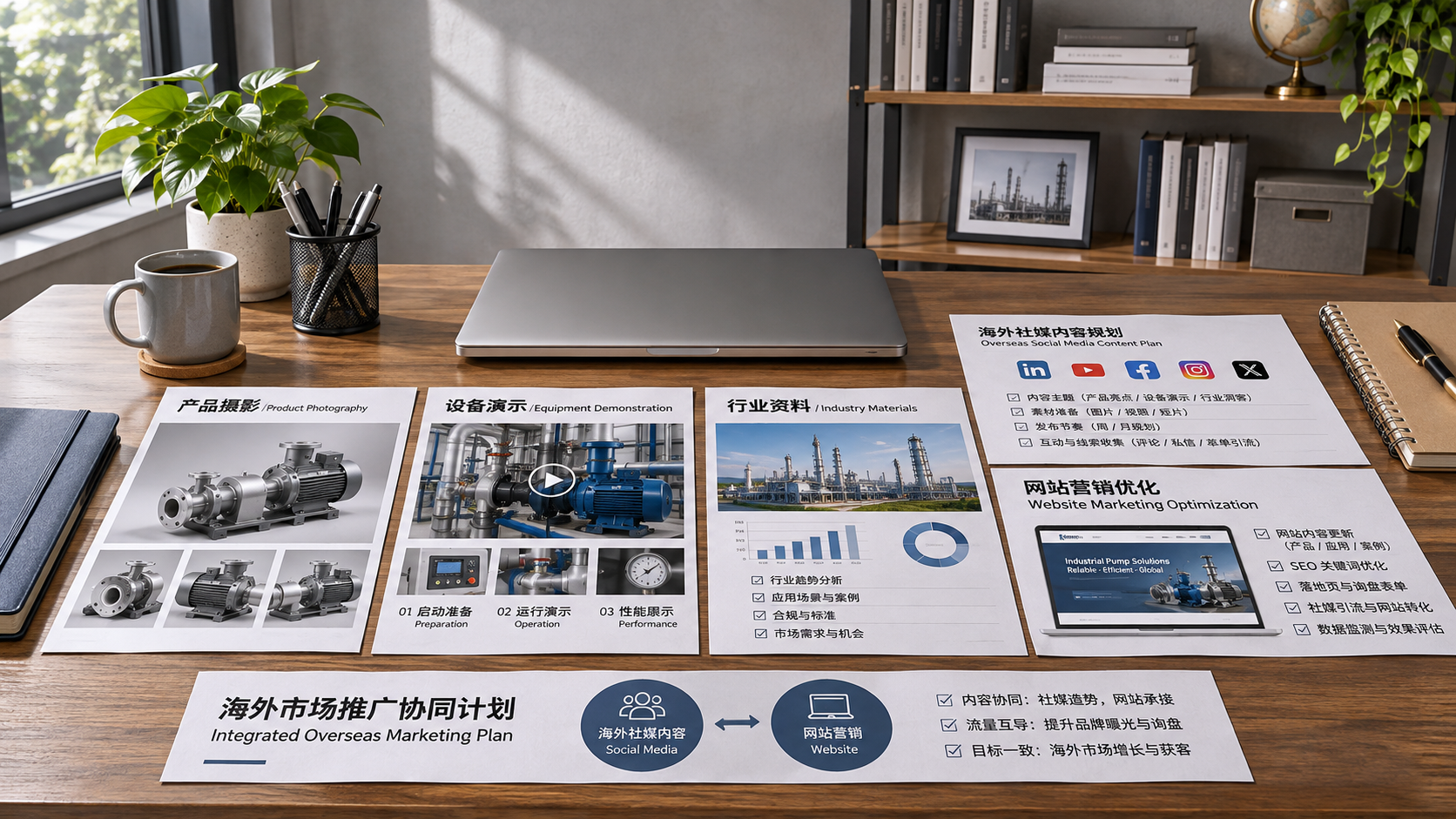
For B2B projects, LinkedIn is more suitable for building up industry perspectives, application cases, and team expertise; YouTube can host more complete demonstrations, installation, or training content; short-video platforms are suitable for easily understood process clips, before-and-after comparisons, or frequently asked questions; Facebook, Instagram, or regional platforms may be more suitable for distributor activities, customer engagement, and remarketing assets. There is no need to open an account simply because a platform is popular, and one account should certainly not be expected to handle conflicting tasks such as brand communication, lead generation, customer service, and recruitment at the same time.
Content and the website should also form a closed loop. Social media posts reduce the barrier to understanding, while landing pages provide parameters, case studies, forms, and next-step actions. If users click through from posts in their local language and find pages that feel heavily machine-translated, use inconsistent currencies and units, or contain form fields that do not match local habits, even high front-end engagement will struggle to convert into qualified opportunities.
Use small-scale validation instead of “gut-feel localization”
A new market does not require a large content calendar from the outset. A more suitable approach is to test two or three content hypotheses around a clearly defined audience within a limited period. For example, test whether technical decision-makers prefer troubleshooting videos or downloading selection guides; test whether price transparency improves inquiry quality; test whether local employees appearing on camera generate engagement more easily than headquarters materials. Change only a few variables in each test; otherwise, it is impossible to determine whether the result comes from the headline, audience, assets, or campaign settings.
- Define the market, product line, and priority conversion action to avoid having one account address every industry and audience.
- Organize existing product materials, sales Q&A, customer concerns, and website search terms to create a pool of content topics.
- Create a unified factual version for each topic, then produce market-specific expression versions.
- Evaluate using engagement quality, qualified visits, document downloads, qualified inquiries, and sales follow-up results, rather than views alone.
- Turn consistently performing content into modules, creating scripts, pages, and review rules that can be reused in other countries.
Engineering project managers in particular should pay attention to “lead quality feedback.” If the social media team only sees likes and follower growth while the sales team only sees insufficient inquiries, the two sides will reach opposite conclusions. Lead sources, countries, industries, project stages, and reasons for failed deals should be marked in forms, CRM systems, or sales records. Only then can teams identify whether the issue is that content attracted the wrong audience, the landing page did not provide adequate follow-through, or the delivery terms themselves were unsuitable.
Three types of content risks require boundaries to be defined in advance
The first is cultural misinterpretation. Humor, holiday-related content, personal imagery, and expressions of values can all be understood differently across regions. For unfamiliar markets, prioritize content focused on product facts, use cases, and professional knowledge, then gradually expand into more emotionally driven creative content.
The second is uncontrolled commitments. Social media copy is often compressed into brief selling points, but descriptions of performance, delivery times, after-sales service, compatibility, and other aspects of B2B equipment, software services, and engineering solutions must remain consistent with the official website and sales materials. Marketing teams need a checklist that can be directly used: “what may be stated, what must be added, and what must not be stated.”
The third is unclear localization responsibility. When headquarters, outsourced teams, local agents, and sales personnel can all provide content, version confusion is most likely to occur. It should be clearly defined who confirms brand information, who reviews language, who responds to comments and direct messages, and who escalates crisis-related content for handling. When processes are unclear, adding more accounts and assets will only amplify management costs.
Ultimately, adapting to content preferences in different countries is not about pursuing the appearance of being a “local brand,” but about enabling local target users to understand products more quickly, validate their value, and move smoothly to the next stage of communication. Start by selecting one market and one business path, connect content, website pages, and sales feedback for validation, and then expand to more countries. This approach usually delivers more sustainable results than launching multilingual accounts across the board all at once.
Related Articles
 How to Find Potential Customers in Japan Through LinkedIn?
 How to Choose a Platform for Overseas Social Media Brand Promotion?
 Vietnam’s E-commerce Market Share Gap Narrows in Q3: Shopee and TikTok Shop Differ by 1.7 Percentage Points


Related Products
 Yiyingbao SaaS Intelligent Website Building and Marketing SystemYiyingbao SaaS Intelligent Website Building and Marketing System, AI-powered no-code website building, rapid creation of multilingual B2B international websites in 10 minutes, global server acceleration, AI-powered SEO optimization, helping businesses connect efficiently with global markets. The perfect integration of technology and operation makes building an international trade website remarkably simple
 AI+SEM Intelligent Advertising Marketing SystemAI+SEM drives intelligent ad creation, empowering full-funnel precision advertising marketing. The system automatically generates weekly/monthly reports, AI recommends keywords and target countries, monitors core metrics in real-time with intelligent alerts, and enables one-click high-conversion ad solutions to help quickly acquire customers and improve ROI.
 AI+SEO Dual-Engine System Optimization ServicesYiyingbao’s AI+SEO dual-engine optimization system helps foreign trade enterprises acquire high-quality organic traffic through AI-powered keyword research, content generation, and comprehensive technical optimization, significantly improving search rankings and conversion rates.
 AI+SNS Social Media Marketing SystemYingbao AI+SNS Social Media Marketing System - Precision social capture for the social media era. Supports one-click content synchronization across major platforms like Facebook and LinkedIn. AI intelligently rewrites posts for enhanced relevance. 24/7 AI customer service and user profiling analysis empower businesses to efficiently expand into global markets.
 AI+SEO营销解决方案易营宝AI+SEO营销解决方案,通过AI批量写作、智能生成TDK、精准关键词扩词等功能,全面优化网站SEO效果,提升流量与转化率。助力企业构建高效智能网站新生态。
 AI+SEM Advertising Marketing SolutionsAI+SEM Advertising Marketing Solution leverages AI technology to deeply empower SEM ad campaigns. It automatically generates weekly/monthly reports using AI, presenting account data across multiple dimensions for comprehensive insights into campaign performance and trends. The system precisely recommends keywords and target countries, intelligently generates high-conversion ad copy, and enables one-click activation of efficient campaign plans to help businesses rapidly acquire customers. Simultaneously, it monitors core metrics in real time, intelligently identifies abnormal fluctuations, and issues timely alerts to ensure stable, high-return advertising results.
 Domain Name ServicesEasyWin provides professional domain name services, including intelligent queries, one-stop registration, brand protection, and full lifecycle management, helping businesses build a digital brand image.
 EasyOperate B2C Cross-Border E-Commerce Platform & Independent WebsiteEasyStore B2C Cross-border E-commerce Independent Store is an intelligent website building and cross-border e-commerce integrated solution independently developed by EasyStore Information Technology (Beijing) Co., Ltd. The system is specially designed for small and medium-sized as well as large export enterprises, integrating 'website building, operation, marketing, advertising, and conversion' into one, helping enterprises quickly establish cross-border e-commerce independent stores to achieve brand globalization and global sales growth.
The platform supports multiple languages, multiple currencies, and multi-channel marketing, with built-in AI intelligent translation and SEO optimization systems, suitable for mainstream markets such as Southeast Asia, Europe and America, Latin America, and the Middle East, assisting Chinese manufacturing enterprises in efficiently deploying international e-commerce strategies. SSL证书易营宝提供专业SSL安全证书服务,包括单域名和泛域名证书,确保网站数据传输加密、身份验证和完整性保护,助力企业建立安全可信的在线业务环境。









