Facebook Content Marketing Not Delivering Results? Start by Fixing Your Topics, Frequency, and Conversion Path
Many teams have been managing Facebook content for several months. Their accounts appear to be updated consistently, but the data is far from ideal: engagement fails to pick up, follower growth is slow, and there is no noticeable change in direct messages or inquiries. The common problem is not that they are “not working hard enough” to publish content, but that the content direction is off, the publishing rhythm is unbalanced, or users simply do not know what to do next after reading the content.
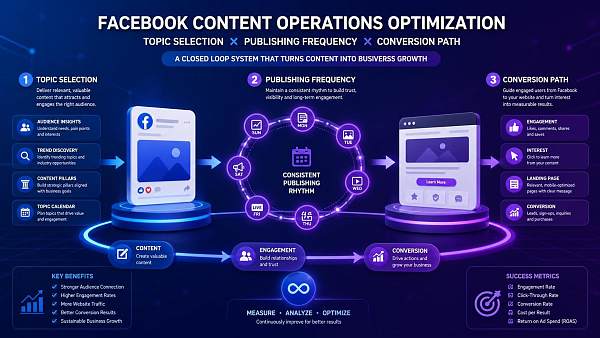
If you are responsible for taking a brand global, driving traffic to an independent website, or continuously managing overseas social media for a B2B website, this situation is especially common. A considerable amount of content has been published, but it has not formed a stable cycle of exposure and conversion. To address the problem, you should usually start by examining three things: whether the topics are meaningful to users, whether the publishing frequency matches the team’s capabilities, and whether the conversion path is short enough.
Why Facebook Content Marketing Easily Ends Up with “Posts Published, but No Results”
Content competition on Facebook is not determined solely by the number of updates. Many pages appear diligent, but the content they publish is not aligned with audience needs. For example, a company may keep posting company updates, product specifications, and holiday graphics. There is nothing inherently wrong with this content, but users will not naturally stop, engage, or click simply because they see this information.
Another common problem is that teams focus all their energy on “what to post today” without planning content objectives in advance. As a result, they publish a brand introduction today, industry news tomorrow, and promotional information the day after, with no continuity between the posts. Users find it difficult to form a consistent understanding, and the platform also has difficulty determining which types of people the page should be recommended to.
Looking further down the funnel, many accounts fail to capture traffic even when some posts achieve reach. The posts lack clear guidance, the landing page contains incomplete information, links load slowly, or the page users reach does not match the promise made in the post. In this case, the content is not necessarily ineffective; its impact has simply stopped at the exposure stage instead of continuing toward inquiries and transactions.
Start with the Topics: Is Your Content Something Users Would Actually Stop to Read?
When managing Facebook content, topic selection errors are often more serious than copywriting problems. Many teams assume that “anything related to the company can be posted,” but users care about their own problems, not the company’s internal perspective. For foreign trade companies, manufacturing factories, and cross-border sellers, content that is more likely to be read and engaged with often includes usage scenarios, selection advice, common misconceptions, purchasing considerations, and industry trend analysis—content related to decision-making.
One simple way to assess a topic is to ask: if the brand name were removed, would this content still provide information value to the target customer? If the answer is no, it is probably just a company statement rather than user-oriented content. Facebook users make quick decisions while scrolling through content. Without a clear value point, they will almost inevitably scroll past it.
When selecting topics, you can first build a content pool around three directions. The first is “problem-based” content, such as common failures, purchasing difficulties, material differences, and process explanations. The second is “decision-based” content, such as how to choose, how to compare, and which solution is more suitable in a given situation. The third is “trust-building” content, such as delivery processes, service methods, detailed demonstrations, and FAQs. With this structure, your content will be closer to real consultation scenarios instead of simply piling up materials.
Then Look at Frequency: Posting Too Little Is Not Enough, but Posting Too Randomly Is Even More Problematic
Many people believe that Facebook content marketing fails because updates are not frequent enough, so they begin forcing themselves to “post every day.” The result is often declining content quality, a team exhausted from producing posts, and an increasingly fragmented account style. For most companies, what is truly needed is not extremely high frequency, but a publishing rhythm that is stable, sustainable, and reviewable.
The right frequency depends on team resources and content types. If only one or two people are responsible for overseas social media, it is not suitable to set a goal of high-volume output. A more practical approach is to first ensure fixed weekly updates and assign different tasks to different types of content—for example, some content for exposure, some for engagement, and some for driving clicks.
Another sign of an unbalanced frequency is concentrated publishing. Many pages publish several posts consecutively within one or two days and then stop updating for a long period. This not only makes it difficult for users to develop expectations, but also makes data analysis confusing. It becomes difficult to determine whether a particular topic was effective or whether the timing simply coincided with a fluctuation in traffic.
Finally, Examine the Conversion Path: People Seeing the Content Does Not Mean They Will Take Action
This is the step most likely to be overlooked. Many posts receive some likes and comments, but when no subsequent inquiries arrive, teams assume that the content is ineffective. In reality, the problem may be that the conversion path is too long or the desired action is unclear.
For example, a post may explain a product’s advantages without telling users where to click to learn more. After being directed to the website, users may see only a long company introduction with no clear form, inquiry button, or contact information. Alternatively, the post may target new prospects while the landing page reads like internal material for existing customers. This disconnect can cause users who have already developed an interest to leave midway.
If a company is also working on an independent website and search traffic, the value of social media content should not stop within the platform. Many teams organize frequently asked questions, popular topics, and user wording from Facebook, then add them to website content for optimization of product pages, FAQ pages, topic pages, or blog pages. This allows content to be reused across multiple channels and makes it easier to accumulate long-term traffic. Tools such as SEO optimization, when used to organize keywords, expand long-tail topics, and match search intent, can help teams turn scattered social media topics into more systematic website content. However, such tools cannot replace topic selection judgment or conversion design.
A More Reliable Set of Corrective Steps
- Audit your content first. Group posts from a recent period by topic, format, and desired action. Do not rush to look at the number of likes. First check whether the content has been biased toward one type for a long time—for example, almost entirely company introductions or almost no posts that guide users to click.
- Assign a clear task to each type of content. Not every piece of content needs to generate inquiries directly. Some content attracts new exposure, some explains professional issues, and some captures existing intent. As long as each role is clear, subsequent evaluation will not become confused.
- Rebuild your topic sources. Do not start only from “what we want to say.” Instead, extract topics from customer inquiries, sales communications, independent website search terms, and the wording used on competitor pages. Questions that are repeatedly asked are usually worth explaining repeatedly.
- Keep your publishing frequency within an executable range. Rather than forcing yourself to post every day, first maintain a stable weekly or every-other-day schedule. Only when the rhythm is stable will you have the conditions to test, compare, and optimize.
- Shorten the conversion action. Each important piece of content should ideally correspond to one core action, such as “visit the product page,” “submit the form,” “send a direct message,” or “view the solution.” Too many actions can cause users to take none of them.
- Check whether the landing page matches the content. If the post discusses selection advice, the landing page should not contain only a company profile. If the post addresses a specific pain point, the page should continue solving that pain point instead of making users search for the next entry point again.
- Establish monthly review criteria. It does not need to be complicated at the beginning, but you should at least know which topics are more likely to be saved, commented on, or clicked, and which content, although receiving average engagement, can generate higher-quality visits.
Three Common Misconceptions That Keep Reappearing
The first misconception is treating “publishing content” as the completion of a task rather than treating “moving users to the next step” as the goal. Content is not a display board. Especially in overseas marketing, it is more like an entry point that guides users to continue learning about your business.
The second misconception is looking only at surface-level engagement. Content with many likes is not necessarily closer to a transaction, while seemingly ordinary content may be better suited to driving website visits or direct-message inquiries. When evaluating content value, you cannot focus only on platform data.
The third misconception is treating Facebook as an isolated channel. In reality, social media content, independent website content, and search content should ideally support one another. If your website is also being developed with content, using capabilities related to SEO optimization to turn frequently raised social media questions into pages that can be continuously indexed on a B2B corporate website or cross-border e-commerce independent site will create more cumulative value than posting on a single channel alone.
Frequently Asked Questions
How often should Facebook content marketing be reviewed?
If your update frequency is low, a monthly review is recommended. If content is published more intensively, you can also review trends every two weeks. The key is not how frequently you conduct reviews, but whether each review can answer three questions: Which topics are being viewed? Which content is being clicked? Which paths lead users to take further action?
Does low engagement mean the content is of poor quality?
Not necessarily. Low engagement may mean that the topic is not suitable for public discussion, or there may be problems with the publishing time, audience targeting, or guidance method. These factors should be evaluated together with clicks, time spent, and subsequent visit behavior. Conclusions should not be based solely on likes and comments.
Do corporate pages need to publish content every day?
In most cases, no. Compared with mechanically pursuing high frequency, it is more important to maintain a stable rhythm and consistency in content. A frequency that the team can execute over the long term is usually more practical than a short-term surge in volume.
If the website has weak conversion, is it still worthwhile to continue publishing Facebook content?
Yes, but the landing page must be corrected at the same time. Otherwise, after the content brings users to the website, its value will be lost at the final step. Social media and the website should ideally be evaluated together rather than handled separately.
Conclusion
When Facebook content marketing fails to deliver results, the problem is often not that the team is not working hard, but that an earlier judgment was incorrect. First change the topics to address issues users genuinely care about, then adjust the frequency to a range that can be executed consistently, and finally shorten and clarify the path from the content to the landing page. The account’s performance will usually be more likely to enter a positive cycle.
If you are currently in a stage where you are “updating continuously but seeing no progress,” the most worthwhile thing to do is not to keep increasing the volume, but to reorganize the content structure and conversion path. This will provide a stronger foundation for social media traffic generation, independent website conversion, and the accumulation of content through search channels.