









- How to Choose Topics for an Industry News Section to Attract More Organic Search TrafficJul 29, 2026View details
- Can Zhejiang foreign trade independent websites still be developed today? Look at changes in traffic and lead generationJul 28, 2026View details
- What New Signals Are Emerging in Enterprise Services SaaS Marketing ReportsJul 27, 2026View details
- What Does a Global Traffic Ecosystem Service Provider Do? What Are the Differences from a Single Advertising AgencyJul 16, 2026View details
- What should you focus on in the latest enterprise SaaS report? From renewal rates and delivery costs to overseas growth opportunitiesJul 12, 2026View details
- What signals are worth paying attention to in a cross-border marketing trend report? B2B companies should look at these 6 signalsJul 11, 2026View details
B2B Enterprise LinkedIn Operations: Content and Outreach Strategies for Developing Middle Eastern Markets
B2B Enterprises' LinkedIn Operation Methods: Content and Outreach Strategies for Customer Development in the Middle East Market
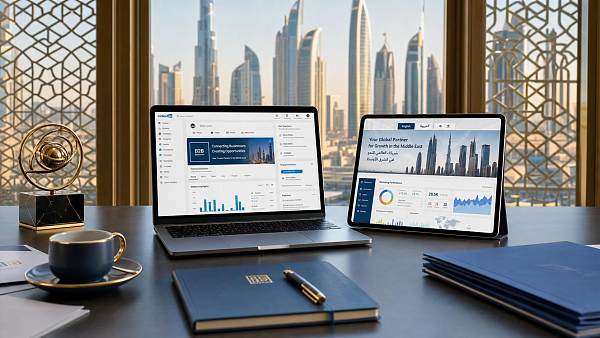
In the Middle East, B2B companies cannot rely solely on posting updates on LinkedIn to acquire customers. Many companies have a lot of content and add many connections, but the actual rate of getting in touch and generating inquiries is not high. The problem is often not with diligence, but with the right approach.
Procurement decisions in the Middle East market prioritize trust, stable partnerships, and delivery capabilities. LinkedIn here is not merely a traffic channel, but rather a platform for businesses to build a professional image, screen clients, and initiate initial business communications. This also means that content, the homepage, and the pace of outreach must be coordinated.
For companies that integrate website and marketing services, the core of B2B LinkedIn operations in the Middle East market is not to pursue exposure numbers, but to get target customers to see you, understand you, be willing to reply to you, and ultimately be willing to enter the official website, forms, or meeting process.
First, understand the Middle Eastern market; don't treat all customers the same way.
The Middle East market is not a single market. Business practices and industry needs differ among the Gulf states, North Africa, and neighboring Turkey. When conducting B2B LinkedIn marketing in the Middle East, the first step is not what to post, but rather clearly defining who you are looking for.
Typically, the target audience can be divided into three groups: brand managers, channel managers, and procurement and business development managers. The first two groups focus more on growth and customer acquisition, while the latter group values supply capabilities, case studies, and cooperation efficiency.
If you offer integrated services including intelligent website building, SEO optimization, social media marketing, and advertising, then you are better suited to target these scenarios: businesses preparing to enter the Middle East, businesses with existing websites but few inquiries, high advertising costs, insufficient content localization, and businesses with social media exposure but weak conversion rates.
- Manufacturing companies: Focus on the credibility of the official website, product display, and inquiry generation.
- Cross-border brands: Focus on multilingual websites, advertising, and brand exposure.
- Channel-based companies: Focus on lead cost, follow-up efficiency, and market entry speed.
The clearer the profile, the easier it is to implement B2B companies' LinkedIn operations in the Middle East market, and the easier it is for the content to hit the target audience's needs, rather than just talking to themselves about "we are very professional".
Optimize the homepage first, then discuss content and reach.
Many companies immediately start by posting content, adding contacts, and sending private messages, but the homepage itself lacks persuasiveness. If customers don't see what problems you can solve within seconds of clicking on the page, the effectiveness of subsequent outreach will significantly decrease.
In the Middle East market, B2B companies' LinkedIn operations should focus on three things: explaining the business, building trust, and outlining the next steps. In particular, the company page and the pages of key business personnel should maintain consistency in information to avoid disjointed communication.
- The title should clearly state the services offered, such as overseas website building, SEO, advertising, and social media growth.
- The introduction highlights the target audience, coverage area, delivery capabilities, and successful experiences.
- Featured content should be placed in case studies, solution pages, or core entry points on the official website.
- The cover image should convey the company's service capabilities in the Middle East market, not just its slogans.
AI-driven intelligent website building and overseas marketing platforms like YiYingBao are well-suited to directly showcase their full-chain capabilities—including website building, SEO, advertising, and social media—in their homepage information. This prevents clients from mistaking you for a simple website building company or merely an advertising agency.
When it comes to content distribution in the Middle East market, the focus isn't on quantity, but on providing clues to decision-making.
Effective LinkedIn marketing for B2B companies in the Middle East requires content designed around the client's decision-making process. They're not there to browse information; they're assessing whether you're worth further communication.
A practical content structure can be divided into four categories: cognitive, skill-based, case study, and conversion-related. Alternating between these four types of content will make the account more stable and easier to build a trust chain.
- Cognitive category: Discusses Middle Eastern market trends, platform changes, and changes in buyer behavior.
- Skills-based: Explain website building logic, SEO strategies, advertising structure, and content localization methods.
- Case studies: Explaining how an industry can obtain more inquiries through its official website and social media.
- Conversion-related topics: discussing common issues, collaboration processes, budget assessment, and implementation suggestions.
Here's a key point: Don't just talk about "big trends" in your content; translate those trends into customer actions. For example, instead of simply saying that social media is active in the Middle East market, explain why your official website must be multilingual and why your landing page needs to respond faster to mobile devices.
Recent developments suggest that shorter content is easier to scale, but content that truly drives business opportunities remains the one that answers specific questions. This is especially true for B2B companies operating on LinkedIn in the Middle East, where clients are more willing to respond to accounts that appear to "understand the business context."
Recommended content pacing
Maintaining an update schedule of three to four times a week is sufficient; there's no need to post daily. More importantly, maintain a consistent pace and structured content so that clients can repeatedly witness your professionalism throughout the week.
How do you achieve precise outreach? Don't just start selling.
Many people understand reaching out as simply adding friends and sending private messages. However, the truly effective LinkedIn strategy for B2B companies in the Middle East market is to first establish weak ties and then move on to one-on-one communication. Selling too early usually results in a very low response rate.
A reasonable approach involves four steps: screening target customers, engaging in pre-launch interaction, sending links, and initiating private messaging. Each step should be purposeful; avoid cramming all actions into a single day.
- First, filter the list by country, industry, job position, and company size.
- I liked and commented on their content for several days in a row to build initial familiarity.
- When sending a link, explain why you are interested and avoid using standardized sales pitches.
- Once the connection is established, private messages can be sent based on content or business issues.
For example, if you see that the other party is expanding into the Gulf market, your entry point could be a multilingual website, SEO indexing, and landing page conversions, rather than directly saying, "We are a service provider, would you like to cooperate?" The former is a business discussion, while the latter is just a sales intrusion.
Private messages should be short but specific.
Middle Eastern clients are not averse to business communication, but only if what you say is relevant to their business. Avoid writing lengthy introductions in private messages, and definitely don't copy and paste mass-message scripts everywhere.
- First, state the business activities or market trends you are interested in.
- Let's raise another specific question or observation.
- Finally, here's a simple suggestion: communicate, look at case studies, or review page suggestions.
This approach is better suited to B2B companies' LinkedIn operations in the Middle East because it focuses on problem-solving rather than rushing to close deals. Getting a response first, then considering conversion, allows for a more stable pace.
Connect LinkedIn with your website, SEO, and advertising to keep leads coming in.
LinkedIn itself is important, but it's more like a front-end touchpoint, not the entire conversion scenario. Mature B2B companies operating LinkedIn in the Middle East will definitely integrate it with independent websites, SEO, advertising landing pages, and form systems.
The reason is simple. After establishing initial trust on LinkedIn, clients typically continue to look at the official website, case studies, page professionalism, and submission path. If the website is weak, the content is disorganized, and the page is slow, even the best outreach can easily lead to client loss.
This is precisely the value of integrated platforms like EasyCreation. Through AI-powered intelligent website building, multilingual website development, Google SEO optimization, advertising, and overseas social media operations, businesses can transform LinkedIn followers into assets such as website visits, form submissions, and follow-up engagement.
In practice, the most recommended approach is to create a separate landing page for LinkedIn, focusing on your capabilities in the Middle East market, industry case studies, frequently asked questions, and contact information. This way, traffic from private messages and your feed won't be directed to a complex homepage with an excessively long conversion path.
These three indicators should be monitored during implementation.
For B2B companies operating on LinkedIn in the Middle East, it's not enough to just look at page views. What should truly be continuously tracked are connection quality, engagement depth, and conversion actions. Without these three metrics, optimization efforts can easily go astray.
- Connection quality: percentage of target positions, percentage of target countries, and pass rate.
- Interaction depth: comments, private message replies, profile page visits, content collection.
- Conversion actions: website visit, form submission, appointment scheduling, and request for a quote.
High pageviews but few replies indicate the content is too general. High number of successful connections but no follow-ups suggests the homepage and private messages are not targeted enough. If there is communication but no inquiries, the problem often lies in the official website's handling and the presentation of the solution.
Ultimately, the LinkedIn operation methodology for B2B companies in the Middle East market is not a single, isolated action, but a coherent process from awareness and trust to conversion. First, clearly define your target customers, then refine your profile and content, and finally reach them in a lighter, more precise way. This approach is usually much more effective than blindly sending mass emails.
If a company is still working on improving its website, SEO, advertising, and social media integration capabilities, then it's more suitable to establish a unified overseas marketing platform as soon as possible. This way, every exposure and every response from LinkedIn has a greater chance of becoming a truly trackable and convertible customer resource in the Middle East market.
Related Articles
Related Products
 Yiyingbao SaaS Intelligent Website Building and Marketing SystemYiyingbao SaaS Intelligent Website Building and Marketing System, AI-powered no-code website building, rapid creation of multilingual B2B international websites in 10 minutes, global server acceleration, AI-powered SEO optimization, helping businesses connect efficiently with global markets. The perfect integration of technology and operation makes building an international trade website remarkably simple
 AI+SEM Intelligent Advertising Marketing SystemAI+SEM drives intelligent ad creation, empowering full-funnel precision advertising marketing. The system automatically generates weekly/monthly reports, AI recommends keywords and target countries, monitors core metrics in real-time with intelligent alerts, and enables one-click high-conversion ad solutions to help quickly acquire customers and improve ROI.
 AI+SEO Dual-Engine System Optimization ServicesYiyingbao’s AI+SEO dual-engine optimization system helps foreign trade enterprises acquire high-quality organic traffic through AI-powered keyword research, content generation, and comprehensive technical optimization, significantly improving search rankings and conversion rates.
 AI+SNS Social Media Marketing SystemYingbao AI+SNS Social Media Marketing System - Precision social capture for the social media era. Supports one-click content synchronization across major platforms like Facebook and LinkedIn. AI intelligently rewrites posts for enhanced relevance. 24/7 AI customer service and user profiling analysis empower businesses to efficiently expand into global markets.
 AI+SEO营销解决方案易营宝AI+SEO营销解决方案,通过AI批量写作、智能生成TDK、精准关键词扩词等功能,全面优化网站SEO效果,提升流量与转化率。助力企业构建高效智能网站新生态。
 AI+SEM Advertising Marketing SolutionsAI+SEM Advertising Marketing Solution leverages AI technology to deeply empower SEM ad campaigns. It automatically generates weekly/monthly reports using AI, presenting account data across multiple dimensions for comprehensive insights into campaign performance and trends. The system precisely recommends keywords and target countries, intelligently generates high-conversion ad copy, and enables one-click activation of efficient campaign plans to help businesses rapidly acquire customers. Simultaneously, it monitors core metrics in real time, intelligently identifies abnormal fluctuations, and issues timely alerts to ensure stable, high-return advertising results.
 Domain Name ServicesEasyWin provides professional domain name services, including intelligent queries, one-stop registration, brand protection, and full lifecycle management, helping businesses build a digital brand image.
 EasyOperate B2C Cross-Border E-Commerce Platform & Independent WebsiteEasyStore B2C Cross-border E-commerce Independent Store is an intelligent website building and cross-border e-commerce integrated solution independently developed by EasyStore Information Technology (Beijing) Co., Ltd. The system is specially designed for small and medium-sized as well as large export enterprises, integrating 'website building, operation, marketing, advertising, and conversion' into one, helping enterprises quickly establish cross-border e-commerce independent stores to achieve brand globalization and global sales growth.
The platform supports multiple languages, multiple currencies, and multi-channel marketing, with built-in AI intelligent translation and SEO optimization systems, suitable for mainstream markets such as Southeast Asia, Europe and America, Latin America, and the Middle East, assisting Chinese manufacturing enterprises in efficiently deploying international e-commerce strategies. SSL证书易营宝提供专业SSL安全证书服务,包括单域名和泛域名证书,确保网站数据传输加密、身份验证和完整性保护,助力企业建立安全可信的在线业务环境。









