









- Can the average annual growth rate reflect real opportunities in overseas markets?Oct 07, 2026View details
- Which customer acquisition channels will be affected by cross-border marketing trends in 2026?Sep 06, 2026View details
- Which homogenization risks should be considered in an analysis of the AI-powered website building industry?Aug 30, 2026View details
- How Will AI Marketing Trends 2026 Change Advertising Budget AllocationAug 28, 2026View details
- Is the EV SSL certificate market shrinking or upgrading? How should companies assess certificate procurement?Aug 11, 2026View details
- Why the old AMP SEO 2020 practices no longer work and what has changed in current optimization prioritiesAug 02, 2026View details
Should a unified domain be used first when building a multilingual independent website for the Middle East market?
Do You Need to Unify Your Domain First When Building a Multilingual Standalone Website for the Middle East Market?
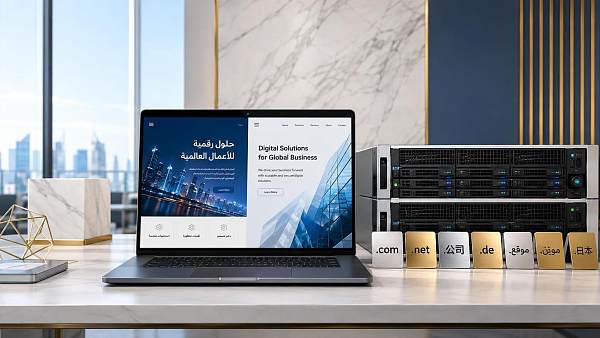
When planning a multilingual standalone website project for the Middle East market, the domain name is often the first issue debated by technical teams: Should separate domains be registered for Arabic, English, and Turkish? Must countries such as Saudi Arabia, the UAE, and Qatar use local country-code domains? Can multiple websites share one primary domain?
The conclusion first: There is no need to unify all countries and languages under the same domain from the outset, nor is there a general rule that the Middle East market must use local domains. A more prudent approach is to first determine the domain architecture based on business coverage, brand strategy, search objectives, and backend management capabilities, and then decide on language directories, country directories, and whether to use separate country domains. Domain unification is only an option, not a prerequisite for launching a multilingual standalone website.
When Is a Unified Primary Domain Usually Suitable?
If a company currently focuses mainly on brand presentation, B2B inquiries, or cross-border services, and its target countries have not yet been fully defined, using one primary domain with language or regional directories is often easier to maintain. For example, it can use “primary domain/Arabic directory” and “primary domain/English directory,” or further subdivide them into “primary domain/Saudi Arabia” and “primary domain/UAE.” The advantages of this approach extend beyond lower domain costs: website code, content management, forms, data analytics, and permissions can also be centralized.
From an SEO perspective, a unified primary domain also helps accumulate brand signals and backlink resources. However, there is a common misconception here: unifying the primary domain does not mean that every page only needs simple machine translation. Arabic pages need to handle right-to-left layouts, font display, number and date formats, while product names, inquiry forms, customer service phone numbers, and payment instructions may also need to be reorganized. A single domain can be shared technically, but content and user experience cannot fully share the same logic.
When Should You Consider Country Domains or Separate Websites?
If a company has established stable sales, warehousing, after-sales service, or a local team in a particular country, using the corresponding country domain, or at least creating an independent country version, may better align with local user expectations. This is especially true for B2C stores, where consumers pay more attention to delivery coverage, returns and exchanges, currency, customer service hours, and local payment methods, rather than just page language.
However, a country domain does not automatically bring rankings or trust. Registration requirements, entity eligibility, local contact information, and other requirements need to be confirmed according to the rules of the relevant suffix registration authority. They cannot be assessed uniformly based solely on the concept of the “Middle East market.” User needs, search terms, and logistics commitments in the UAE and Saudi Arabia are not exactly the same, and placing multiple countries on one Arabic page does not mean regional localization has been completed.
For technical evaluators, the more important question is whether these countries have independent pricing, inventory, delivery, customer service, and marketing data. If the answer is yes, separate regional versions are more valuable; if the same product set is merely used to obtain inquiries from different countries, a unified primary domain is usually more cost-effective to maintain over time.
Beyond Domain Architecture, These Configurations Are What Truly Affect Indexing
For multilingual standalone website development targeting the Middle East market, the domain is only the entry point. Before launch, at minimum, the following technical relationships should be clearly checked:
- Whether each language or regional version has a stable, crawlable, independent URL rather than relying entirely on front-end switching or pop-up displays.
- Whether language and regional annotations are correctly set between pages to prevent search engines from mistakenly identifying Arabic and English pages as duplicate content.
- Whether canonical links, sitemaps, breadcrumbs, and internal links point to the corresponding versions rather than all returning to the default-language homepage.
- Whether the server, content delivery network, image loading, and script loading are suitable for the target region, preventing pages from being accessible but actually loading too slowly.
- Whether users remain on their current page after switching languages. If users switch languages from a product detail page but are sent back to the homepage, inquiries and conversions will be directly affected.
Special attention should also be paid to the technical details of Arabic pages. The page direction usually needs to support right-to-left display, and button positions, tables, filters, pop-ups, and mobile navigation all need to be retested; text in images cannot be prepared only in English; phone numbers, currencies, and contact addresses should not be handled through simple replacement either. Technical acceptance should ideally cover both desktop and mobile versions, rather than checking only the homepage visual effect.
How to Choose Among Three Common Architectures
If the team does not yet have dedicated overseas technical and operational personnel, it is not advisable to register many domains at once merely to “look localized.” The more domains there are, the more likely issues such as unsynchronized language versions, missing certificates or DNS records, dispersed form data, and inconsistencies between advertising landing pages and official website versions will occur. For companies that need to conduct Google SEO, advertising, and social media traffic acquisition over the long term, building a solid architecture for one primary website first is often more practical than spreading resources across multiple empty websites.
Website, Marketing, and Data Should Ideally Be Planned Within the Same Architecture
A standalone website for the Middle East market is not simply a translation project. Advertising accounts may be split by country, social media content needs to be adapted to local audiences, SEO pages need to be built around search expressions in different countries, and forms must also distinguish among purchasers, distributors, and end consumers. If the website-building system can only manage pages, and advertising, social media, search optimization, and data analytics are pieced together afterward, technical teams usually spend more time handling lost tracking data and version confusion.
The enterprise-level intelligent website-building and overseas marketing digital solution provided by Yiyingbao covers multilingual websites, B2B marketing websites, cross-border stores, Google SEO, advertising, overseas social media, and AI search visibility optimization. For companies that need to validate multiple Middle Eastern countries simultaneously, the focus of this integrated website and marketing service model is not to force companies to choose a particular domain approach, but to keep language versions, regional pages, advertising landing pages, and inquiry data trackable and adjustable.
Therefore, domain decisions can be implemented based on three questions: Is the business currently one brand or multiple local business entities? Do different countries use different prices, inventories, and service commitments? Can the team continuously maintain the content and technical configurations of multiple websites? If the latter two questions cannot yet be answered, unifying the primary domain and using clear language or regional directories is usually a lower-risk starting point; if country operations have already become independent, it is not too late to gradually separate the domains.
Related Articles
Related Products
 Yiyingbao SaaS Intelligent Website Building and Marketing SystemYiyingbao SaaS Intelligent Website Building and Marketing System, AI-powered no-code website building, rapid creation of multilingual B2B international websites in 10 minutes, global server acceleration, AI-powered SEO optimization, helping businesses connect efficiently with global markets. The perfect integration of technology and operation makes building an international trade website remarkably simple
 AI+SEM Intelligent Advertising Marketing SystemAI+SEM drives intelligent ad creation, empowering full-funnel precision advertising marketing. The system automatically generates weekly/monthly reports, AI recommends keywords and target countries, monitors core metrics in real-time with intelligent alerts, and enables one-click high-conversion ad solutions to help quickly acquire customers and improve ROI.
 AI+SEO Dual-Engine System Optimization ServicesYiyingbao’s AI+SEO dual-engine optimization system helps foreign trade enterprises acquire high-quality organic traffic through AI-powered keyword research, content generation, and comprehensive technical optimization, significantly improving search rankings and conversion rates.
 AI+SNS Social Media Marketing SystemYingbao AI+SNS Social Media Marketing System - Precision social capture for the social media era. Supports one-click content synchronization across major platforms like Facebook and LinkedIn. AI intelligently rewrites posts for enhanced relevance. 24/7 AI customer service and user profiling analysis empower businesses to efficiently expand into global markets.
 AI+SEO营销解决方案易营宝AI+SEO营销解决方案,通过AI批量写作、智能生成TDK、精准关键词扩词等功能,全面优化网站SEO效果,提升流量与转化率。助力企业构建高效智能网站新生态。
 AI+SEM Advertising Marketing SolutionsAI+SEM Advertising Marketing Solution leverages AI technology to deeply empower SEM ad campaigns. It automatically generates weekly/monthly reports using AI, presenting account data across multiple dimensions for comprehensive insights into campaign performance and trends. The system precisely recommends keywords and target countries, intelligently generates high-conversion ad copy, and enables one-click activation of efficient campaign plans to help businesses rapidly acquire customers. Simultaneously, it monitors core metrics in real time, intelligently identifies abnormal fluctuations, and issues timely alerts to ensure stable, high-return advertising results.
 Domain Name ServicesEasyWin provides professional domain name services, including intelligent queries, one-stop registration, brand protection, and full lifecycle management, helping businesses build a digital brand image.
 EasyOperate B2C Cross-Border E-Commerce Platform & Independent WebsiteEasyStore B2C Cross-border E-commerce Independent Store is an intelligent website building and cross-border e-commerce integrated solution independently developed by EasyStore Information Technology (Beijing) Co., Ltd. The system is specially designed for small and medium-sized as well as large export enterprises, integrating 'website building, operation, marketing, advertising, and conversion' into one, helping enterprises quickly establish cross-border e-commerce independent stores to achieve brand globalization and global sales growth.
The platform supports multiple languages, multiple currencies, and multi-channel marketing, with built-in AI intelligent translation and SEO optimization systems, suitable for mainstream markets such as Southeast Asia, Europe and America, Latin America, and the Middle East, assisting Chinese manufacturing enterprises in efficiently deploying international e-commerce strategies. SSL证书易营宝提供专业SSL安全证书服务,包括单域名和泛域名证书,确保网站数据传输加密、身份验证和完整性保护,助力企业建立安全可信的在线业务环境。









