









- EU Plans to Raise Tax on Incoming Small Parcels to €5Oct 31, 2026View details
- Maersk Adjusts Middle East Emergency Operating Cost Recovery Surcharge to USD 2,000 per ContainerOct 30, 2026View details
- Ministry of Commerce: Online retail sales grew 4.4% in the first three quarters, while cross-border e-commerce maintained relatively rapid growthOct 29, 2026View details
- CCTV reports: AI-powered smart hardware is expanding overseas at a faster pace, with orders for some best-selling products booked through next yearOct 29, 2026View details
- Alphabet Q3 Earnings: Google Search Advertising Revenue Rises 10.5% to $82 BillionOct 29, 2026View details
- AliExpress Announces New Service Rules for Russia, Linked to Wildberries Product IntegrationOct 28, 2026View details
How Can You Avoid Regional Word Choice Pitfalls When Translating Spanish Web Ad Copy?
How can Spanish ad copy avoid regional wording pitfalls? This article explains how to choose words and check localization, focusing on how to translate Spanish content for web ad creatives.
The most effective approach is not to look for a single “standard translation” that works in every country. Instead, identify the target market first, use consistent key terms across the ad, landing page, and conversion buttons, and have people from the target market review them.
Choose the target country first, then decide which variety of Spanish to use
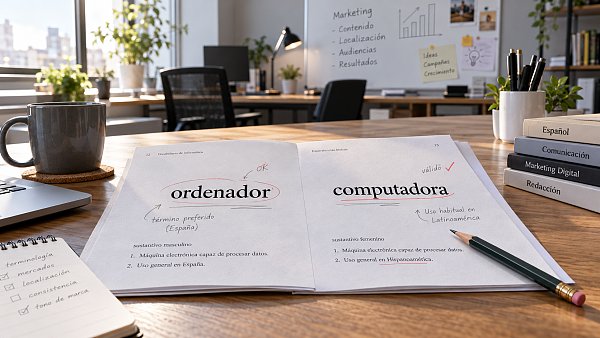
Spanish is spoken across many countries and regions, and the same product or action may be described in different ways. Even if readers understand a particular word, that does not mean it sounds natural locally. Awkward wording can reduce an ad’s credibility and discourage clicks.
Before translating, list the target countries, audience, sales model, and main conversion action. For example, an e-commerce ad aimed at consumers in Mexico should not use exactly the same wording and tone as an industrial equipment ad aimed at purchasing managers in Spain.
If your budget is limited and you need to cover several Latin American markets, you can start with a relatively neutral Spanish version, then create localized versions for high-traffic countries. Neutral wording is only a starting point for reducing misunderstandings; it is no substitute for local review.
Also confirm the source language of the material and the direction of translation. The French keyword above can be understood as asking how to translate Spanish content for web ads. In practice, be clear about whether the content is being translated from Chinese into Spanish or adapted from existing Spanish copy.
Which common words are most likely to cause regional misunderstandings?
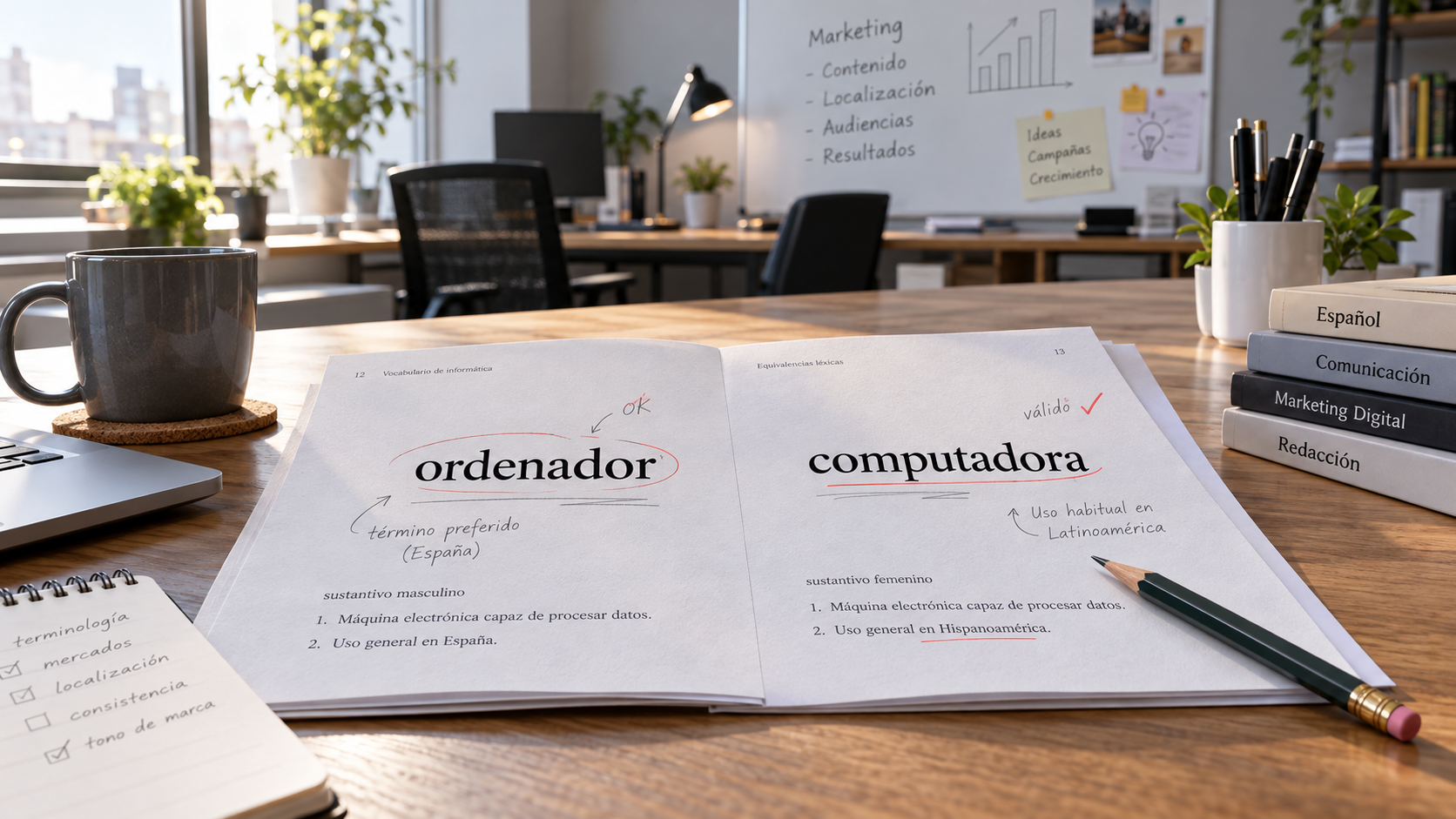
Computers and phones: In Spain, “ordenador” is commonly used for a computer, while “computadora” is common in Mexico and other Latin American markets. A mobile phone is often called a “móvil” in Spain and a “celular” in Mexico and other regions. Always confirm the preferred usage for the specific country.
Cars and driving: “Coche” commonly means car in Spain, “carro” is used in Mexico, and “auto” is common in Argentina. “Conducir” is commonly used for driving in Spain, while “manejar” is also used in Mexico and other regions.
Buttons and actions: Spanish websites commonly use “haz clic” for “click,” while “da clic” is also used in some Latin American markets. When button space is limited, a more direct option may be appropriate depending on the context, such as “Comprar” (Buy) or “Solicitar presupuesto” (Request a quote).
These examples indicate what to check; they are not an exhaustive list of words used exclusively in one country or another. Usage can also vary within a country by age group, industry, and channel. Local review is especially important for slang, wordplay, and product names.
How can you adapt an ad into a version ready to run locally?
First, clarify the intent of the original copy, then work on the language. For example, if the Chinese original says “Buy a computer now and enjoy a limited-time offer,” the facts to preserve are the product, the offer’s time limit, and the purchase action—not the original Chinese word order.
For Spain, you could write “Compra tu ordenador con una oferta por tiempo limitado”; for Mexico, you could consider “Compra tu computadora con una oferta por tiempo limitado.” Both versions should be reviewed locally.
If the advertiser has not specified when the offer ends, do not use wording that implies urgency. If the offer applies only to certain models, make that clear in the ad or on the landing page. Translation must not add claims about discounts, stock, or delivery.
Review the headline, description, and button together. If an ad promises “Get a free quote,” the landing page should provide the corresponding quote request option and explain whether contact details are required. This helps prevent users from clicking through only to find that the process does not match the ad.
For industrial equipment, the conversion action may not be an immediate purchase; it could be submitting a drawing or booking a consultation. In that case, use a button that matches the actual process, such as “Solicitar presupuesto,” and make sure the form fields are suitable for local customers.
How can you check the copy before launch to reduce rework?
Step 1: Build a market-specific glossary. Record product names, industry terms, words to avoid, forms of address, and button wording, and specify the countries where each applies. Ads, website navigation, and forms relating to the same product should use the same approved terminology.
Step 2: Check pronouns and tone. Usage of “tú,” “usted,” and “vos” varies by region and context. Once you choose a form, keep it consistent across headlines, body copy, and buttons. The level of formality should suit the industry, audience, and brand positioning.
Step 3: Verify transaction details. Check that the currency, number formats, shipping costs, taxes, delivery areas, and return conditions are appropriate for the target market. Price examples should use the currency that actually applies; do not simply replace the currency symbol with a local one.
Step 4: Check the ad against the landing page. Review the offer terms, product specifications, delivery scope, and form entry points one by one. Spanish text may be longer than Chinese, so check for truncated headlines, wrapped buttons, and form display issues on mobile devices.
Step 5: Ask local users to review the copy. Reviewers should be familiar with the target country and relevant industry, and should see the complete creative, images, and landing page—not just isolated sentences. Ask them to flag wording that sounds unnatural, is ambiguous, or could cause misunderstandings.
For sensitive products such as medical and financial products, also check applicable laws in the target market, ad platform policies, and any required disclaimers. Local language review does not replace legal or compliance review. Product credentials and evidence supporting promotional claims must also be confirmed separately.
After launching in multiple markets, how can you tell whether the copy is effective?
We recommend tracking ad performance separately by country or language variant and reviewing click-through rate, landing page conversion rate, qualified inquiry rate, and customer acquisition cost together. If clicks are high but qualified inquiries are low, the audience, the offer, or the page flow may be mismatched; translation may not be the only issue.
When testing, keep conditions such as audience, budget, creative, and landing page as consistent as possible, and focus on comparing one variable at a time, such as a local product name or button wording. Do not rush to conclusions when the sample size is too small, and do not attribute changes in seasonality or ad placement to the copy.
Feed questions from customer service, form submissions, and sales feedback back into the glossary. If users frequently ask whether prices include tax, whether delivery is available, or whether a product is compatible, prioritize adding the key information before deciding whether to adjust the ad wording or landing page structure.
Summary: Make regional checks part of the ad production process
The key to Spanish-language web ads is helping users in the target market understand the message, trust it, and complete the next step. Define the target country first, identify high-risk terms, align the ad with the landing page, and then refine both through local review and campaign data.
For teams managing multilingual websites, ads, and social media at the same time, Yiyingbao’s website development and overseas marketing services can help coordinate page content and channel assets. Confirm the specific features and scope of services before use, and make sure local review is still carried out for each target market.
Related Articles
 How Can Localization Services Adapt Website Content to Target Markets?
 How Can You Avoid Regional Word Choice Pitfalls When Translating Spanish Web Ad Copy?
 Do the Costs of Building a Multilingual Website for International Trade Increase with the Number of Languages?
Related Products
 Yiyingbao SaaS Intelligent Website Building and Marketing SystemYiyingbao SaaS Intelligent Website Building and Marketing System, AI-powered no-code website building, rapid creation of multilingual B2B international websites in 10 minutes, global server acceleration, AI-powered SEO optimization, helping businesses connect efficiently with global markets. The perfect integration of technology and operation makes building an international trade website remarkably simple
 AI+SEM Intelligent Advertising Marketing SystemAI+SEM drives intelligent ad creation, empowering full-funnel precision advertising marketing. The system automatically generates weekly/monthly reports, AI recommends keywords and target countries, monitors core metrics in real-time with intelligent alerts, and enables one-click high-conversion ad solutions to help quickly acquire customers and improve ROI.
 AI+SEO Dual-Engine System Optimization ServicesYiyingbao’s AI+SEO dual-engine optimization system helps foreign trade enterprises acquire high-quality organic traffic through AI-powered keyword research, content generation, and comprehensive technical optimization, significantly improving search rankings and conversion rates.
 AI+SNS Social Media Marketing SystemYingbao AI+SNS Social Media Marketing System - Precision social capture for the social media era. Supports one-click content synchronization across major platforms like Facebook and LinkedIn. AI intelligently rewrites posts for enhanced relevance. 24/7 AI customer service and user profiling analysis empower businesses to efficiently expand into global markets.
 AI+SEO营销解决方案易营宝AI+SEO营销解决方案,通过AI批量写作、智能生成TDK、精准关键词扩词等功能,全面优化网站SEO效果,提升流量与转化率。助力企业构建高效智能网站新生态。
 AI+SEM Advertising Marketing SolutionsAI+SEM Advertising Marketing Solution leverages AI technology to deeply empower SEM ad campaigns. It automatically generates weekly/monthly reports using AI, presenting account data across multiple dimensions for comprehensive insights into campaign performance and trends. The system precisely recommends keywords and target countries, intelligently generates high-conversion ad copy, and enables one-click activation of efficient campaign plans to help businesses rapidly acquire customers. Simultaneously, it monitors core metrics in real time, intelligently identifies abnormal fluctuations, and issues timely alerts to ensure stable, high-return advertising results.
 Domain Name ServicesEasyWin provides professional domain name services, including intelligent queries, one-stop registration, brand protection, and full lifecycle management, helping businesses build a digital brand image.
 EasyOperate B2C Cross-Border E-Commerce Platform & Independent WebsiteEasyStore B2C Cross-border E-commerce Independent Store is an intelligent website building and cross-border e-commerce integrated solution independently developed by EasyStore Information Technology (Beijing) Co., Ltd. The system is specially designed for small and medium-sized as well as large export enterprises, integrating 'website building, operation, marketing, advertising, and conversion' into one, helping enterprises quickly establish cross-border e-commerce independent stores to achieve brand globalization and global sales growth.
The platform supports multiple languages, multiple currencies, and multi-channel marketing, with built-in AI intelligent translation and SEO optimization systems, suitable for mainstream markets such as Southeast Asia, Europe and America, Latin America, and the Middle East, assisting Chinese manufacturing enterprises in efficiently deploying international e-commerce strategies. SSL证书易营宝提供专业SSL安全证书服务,包括单域名和泛域名证书,确保网站数据传输加密、身份验证和完整性保护,助力企业建立安全可信的在线业务环境。









