









- Which customer acquisition channels will be affected by cross-border marketing trends in 2026?Sep 06, 2026View details
- Which homogenization risks should be considered in an analysis of the AI-powered website building industry?Aug 30, 2026View details
- How Will AI Marketing Trends 2026 Change Advertising Budget AllocationAug 28, 2026View details
- Is the EV SSL certificate market shrinking or upgrading? How should companies assess certificate procurement?Aug 11, 2026View details
- Why the old AMP SEO 2020 practices no longer work and what has changed in current optimization prioritiesAug 02, 2026View details
- How to Choose Topics for an Industry News Section to Attract More Organic Search TrafficJul 29, 2026View details
How can RTL website design be implemented to balance the Arabic language experience and SEO performance?
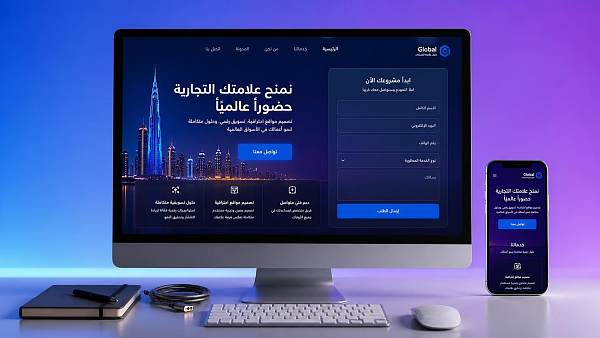
How Should RTL Website Design Be Done to Balance Arabic User Experience and SEO Performance?
When targeting the Middle East market, rtl website design is far more than simply aligning page text to the right. In practice, businesses quickly discover that navigation direction, button placement, form-filling habits, the mixed display of numbers and symbols, mobile reading flow, and even how search engines identify multilingual pages can all affect user experience and subsequent lead generation. If these details are not handled properly, a website may appear to have an “Arabic version,” but in reality it can easily experience a high bounce rate, short visit duration, and weak inquiries.
For business decision-makers, the key issue is not whether to adopt RTL, but whether to treat it as a complete digital development project for the Middle East. Website structure, content organization, technical implementation, and promotion strategy must follow one unified logic rather than having design, translation, and SEO handled independently.
Many Website Problems Are Not Caused by Translation, but by Misunderstanding the “Reading Direction”
Arabic users read from right to left, which is the most basic level. More importantly, users naturally expect the information flow on the page to unfold from right to left as well. For example, the main navigation is generally better organized from the right side, while the visual focus of important buttons, filter conditions, and information cards should also be reversed accordingly. If only the text is translated into Arabic while the page framework still follows the left-to-right logic of an English or Chinese website, users may feel that the page is “readable but awkward.” This awkwardness is difficult to explain through a single metric, but it directly affects inquiry conversion.
This is especially important for B2B websites. Users are not simply browsing content; they often need to quickly determine what you sell, whether you can deliver, whether your offering suits their needs, and how to contact you. The greater the reading friction, the less likely users are to enter the inquiry process. Therefore, the primary task of RTL design is to make Middle Eastern users feel on the first screen that the website was “prepared for me,” rather than being merely “translated into my language.”
At the Structural Level, First Determine What Must Be Mirrored and What Should Not Be Reversed Forcefully
A well-developed Arabic website is usually not a completely mirrored version of the entire page. The real challenge is determining the boundaries.
Elements that are generally suitable for adjustment according to RTL logic include navigation, breadcrumbs, sidebars, the order of text and image cards, form label positions, button group arrangements, pagination, and carousel direction. These elements clearly affect reading paths and operating habits.
However, some content should not simply be flipped. For example, brand Logos, product models that are originally presented in English, numerical sequences in technical specifications, international telephone numbers and email addresses, coordinate relationships in some charts, and certain directional product images should not be mirrored automatically. Doing so may instead cause misunderstandings. Industrial product, equipment, and cross-border service websites need to pay particular attention to this point, because users often cross-check page information against PDFs, catalogs, packaging, or offline materials.
This is also why, when many businesses develop Middle Eastern websites, later rework is often caused not by inaccurate translation, but by unclear component rules. Before page design begins, it is best to establish an RTL component checklist specifying which elements should be mirrored, which should remain unchanged, and which require bilingual mixed-language handling. Although this may seem like a minor step, it can significantly reduce repeated modifications during development and operations.
Content Experience Determines Whether Users Will Continue Reading
A second common issue with Arabic pages is that although the content has been localized, the information organization has not. Many Chinese corporate websites are accustomed to introducing corporate strength, factory scale, qualifications, and awards first, followed by products and services. However, when Middle Eastern users visit a website, they are often more concerned with what exactly you offer, whether you support local delivery, how quickly you respond, and whether communication will be smooth.
Therefore, on the homepage and core landing pages of an Arabic website, it is generally more appropriate to move “solutions, application scenarios, service coverage, and contact information” to the front rather than placing lengthy company introductions first. This does not mean corporate strength is unimportant; the order of presentation simply needs to better match the user decision-making path.
In addition, when Arabic is mixed with numbers and English abbreviations, line breaks may become disorganized, symbol directions may appear abnormal, and table readability may decline. These problems are particularly common on product specification pages, downloadable materials pages, and inquiry form pages. For content-rich B2B websites, font selection, line height, paragraph spacing, and heading hierarchy cannot simply be copied from the settings of the original-language site. They need to be tested and adjusted specifically for Arabic; otherwise, even complete information may come with a high reading cost.
SEO Is Not a Language-Switching Button, but the Multilingual Architecture Itself
Many businesses believe that launching an Arabic version and adding a language-switching entry is enough to gain visibility in Middle Eastern search results. In reality, this is not the case. Whether search engines can correctly understand your Arabic pages depends more on whether the website architecture is clear.
A common approach is to create dedicated paths, subdirectories, or subdomains for Arabic content while keeping the URL structure stable. Page titles, descriptions, body text, image alt text, and internal linking relationships should all match the content of the Arabic pages rather than continuing to use template fields from websites in other languages. For multilingual websites, the correspondence between different language versions must also be handled properly to prevent search engines from interpreting pages as duplicate content or showing pages intended for Arabic users to users in other regions.
This work may appear technical, but it directly affects traffic efficiency in the long term. Yingyingbao has extensive experience in multilingual independent websites and overseas marketing, and considers website development, content management, SEO, and advertising logic within one unified system. For businesses covering multiple regional markets such as the Middle East, Russian-speaking regions, and Europe, this integrated approach is more reliable than “building the website first and adding optimization later,” because the latter often creates hidden costs in indexing, redirects, page canonicalization, and content maintenance.
Among the Technical Details, Mobile Experience and Forms Are the Most Easily Overlooked
A large proportion of Middle Eastern users access websites through mobile devices, which is particularly evident on advertising landing pages, brand websites, and inquiry pages. An RTL page that appears fine on desktop may reveal many issues on mobile: misaligned text and image order, buttons extending beyond boundaries, abnormal expansion directions for filter menus, unnatural cursor positions in input fields, and difficulties entering verification codes or phone numbers.
Forms are the module that deserves the most separate testing. After all, what businesses ultimately need are inquiries, not page views. Arabic forms often combine fields such as name, company, telephone number, email, country, and inquiry details, while telephone numbers and email addresses generally remain left-to-right inputs. If the front end does not properly handle direction, alignment, and placeholder logic, users may find the form noticeably awkward to complete and may even question the professionalism of the website.
Going one step further, the confirmation page displayed after successful submission, automated reply emails, and CRM lead field mapping should ideally also support multilingual scenarios. Otherwise, even if the front end looks well designed, back-end lead management may remain disorganized and the marketing chain will still be disconnected.
Do Not Assign an RTL Project Only to Designers or Only to Translators
From an execution perspective, the biggest risk in rtl website design is a “piecemeal” process: designers create the drafts, developers launch the site, translators handle the text, and operations teams later consider how to promote it. Each step may be completed, but the final website often lacks unified rules.
A more practical approach is to clarify three things at the beginning of the project: whether the target market is the broader Arabic-speaking region or a specific priority country; whether the website is focused on brand presentation, B2B inquiries, or includes e-commerce and advertising landing page functions; and whether future traffic will mainly come from organic search, advertising, or social media referrals. Different objectives require different page structures and SEO strategies.
This is also where the value of integrated services lies. Since its establishment in 2013, Yingyingbao has continued to provide integrated delivery centered on intelligent website development, SEO optimization, social media marketing, and advertising. Its core goal is not merely to “build the website,” but to enable the website to perform genuine lead-generation tasks in different regional markets. Its self-developed cloud-based intelligent website development system, multilingual capabilities, and AI+SEO/GEO optimization system are better suited to businesses that need to operate across multiple overseas regions over the long term, rather than simply creating a static showcase page.
Interestingly, this “structure-first, fully connected process” approach is not limited to foreign trade websites. Information-based pages and professional content topics also need to clarify information relationships first so that both users and search systems can understand them. For example, when certain knowledge-based content pages organize complex topics, they may follow a similar approach. On a topic page such as Research on the Integration Strategy of Business and Finance in Full-Lifecycle Management of University Fixed Assets, for instance, even valuable content may struggle to establish a consistent reading path if the structural hierarchy is disorganized.
Before Implementation, Businesses Should Check at Least These Key Points
If you are evaluating an Arabic website project, do not look only at page mockups. At a minimum, you should also ask several practical questions: Is there an independent RTL component specification? Has real input testing been conducted on mobile devices? Do the Arabic pages have independent URLs and metadata? How will content correspondence between multilingual versions be maintained? Will operations staff be able to conveniently maintain news, products, and landing pages after publication? After the website goes live, can it still connect with SEO, advertising, and social media campaigns?
These questions may sound trivial, but they determine whether a project merely “launches another language” or actually “opens up a market.” A well-developed Middle Eastern website is usually not defined by visual extravagance, but by smooth reading, accurate search visibility, stable forms, and convenient ongoing operation.
If a business is preparing to enter the Middle Eastern market, a more reliable approach is not to rush to decide on the page style, but to first clarify the target countries, content structure, promotion channels, and delivery boundaries. RTL design is never merely the final step of page development; it is essentially part of the collaboration between website localization and the marketing system. Only when this is fully understood can the Arabic experience and SEO performance work together rather than conflict.
Related Articles
Related Products
 Yiyingbao SaaS Intelligent Website Building and Marketing SystemYiyingbao SaaS Intelligent Website Building and Marketing System, AI-powered no-code website building, rapid creation of multilingual B2B international websites in 10 minutes, global server acceleration, AI-powered SEO optimization, helping businesses connect efficiently with global markets. The perfect integration of technology and operation makes building an international trade website remarkably simple
 AI+SEM Intelligent Advertising Marketing SystemAI+SEM drives intelligent ad creation, empowering full-funnel precision advertising marketing. The system automatically generates weekly/monthly reports, AI recommends keywords and target countries, monitors core metrics in real-time with intelligent alerts, and enables one-click high-conversion ad solutions to help quickly acquire customers and improve ROI.
 AI+SEO Dual-Engine System Optimization ServicesYiyingbao’s AI+SEO dual-engine optimization system helps foreign trade enterprises acquire high-quality organic traffic through AI-powered keyword research, content generation, and comprehensive technical optimization, significantly improving search rankings and conversion rates.
 AI+SNS Social Media Marketing SystemYingbao AI+SNS Social Media Marketing System - Precision social capture for the social media era. Supports one-click content synchronization across major platforms like Facebook and LinkedIn. AI intelligently rewrites posts for enhanced relevance. 24/7 AI customer service and user profiling analysis empower businesses to efficiently expand into global markets.
 AI+SEO营销解决方案易营宝AI+SEO营销解决方案,通过AI批量写作、智能生成TDK、精准关键词扩词等功能,全面优化网站SEO效果,提升流量与转化率。助力企业构建高效智能网站新生态。
 AI+SEM Advertising Marketing SolutionsAI+SEM Advertising Marketing Solution leverages AI technology to deeply empower SEM ad campaigns. It automatically generates weekly/monthly reports using AI, presenting account data across multiple dimensions for comprehensive insights into campaign performance and trends. The system precisely recommends keywords and target countries, intelligently generates high-conversion ad copy, and enables one-click activation of efficient campaign plans to help businesses rapidly acquire customers. Simultaneously, it monitors core metrics in real time, intelligently identifies abnormal fluctuations, and issues timely alerts to ensure stable, high-return advertising results.
 Domain Name ServicesEasyWin provides professional domain name services, including intelligent queries, one-stop registration, brand protection, and full lifecycle management, helping businesses build a digital brand image.
 EasyOperate B2C Cross-Border E-Commerce Platform & Independent WebsiteEasyStore B2C Cross-border E-commerce Independent Store is an intelligent website building and cross-border e-commerce integrated solution independently developed by EasyStore Information Technology (Beijing) Co., Ltd. The system is specially designed for small and medium-sized as well as large export enterprises, integrating 'website building, operation, marketing, advertising, and conversion' into one, helping enterprises quickly establish cross-border e-commerce independent stores to achieve brand globalization and global sales growth.
The platform supports multiple languages, multiple currencies, and multi-channel marketing, with built-in AI intelligent translation and SEO optimization systems, suitable for mainstream markets such as Southeast Asia, Europe and America, Latin America, and the Middle East, assisting Chinese manufacturing enterprises in efficiently deploying international e-commerce strategies. SSL证书易营宝提供专业SSL安全证书服务,包括单域名和泛域名证书,确保网站数据传输加密、身份验证和完整性保护,助力企业建立安全可信的在线业务环境。









