









- 21st Century Business Herald: AI and CTV Become Core Growth Engines for Digital Marketing in Overseas MarketsNov 18, 2026View details
- China Presents 25 Cooperation Outcomes in Areas Including Cross-Border E-Commerce During APECNov 18, 2026View details
- AI Products Drive Hong Kong Exports Up 64.9% in September, Fastest Growth in Over 40 YearsNov 17, 2026View details
- National Bureau of Statistics: Foreign trade grew rapidly in October, providing stable support for global tradeNov 17, 2026View details
- The U.S. has ended the $800 de minimis exemption for non-postal shipments; express courier packages must be formally declared.Nov 16, 2026View details
- ASEAN Signs Digital Economy Framework Agreement, Moving Toward Harmonized Cross-Border E-Commerce RulesNov 15, 2026View details
How to Avoid Distorting Brand Messaging When Building an International Corporate Website
Before an overseas corporate website goes live, the most easily underestimated issue is often not translation quality, but the fact that the same brand can take on different “personalities” across language versions: the English page may sound overly sales-driven, the Japanese page may retain exaggerated expressions commonly used domestically, while the right-to-left layout and contact details on the Arabic page may not be properly adapted. Even if customers can understand the content, they may still be unable to determine whether the company is professional, reliable, and worth working with.
To prevent brand expression from becoming distorted in the development of an international corporate website, the key is not to make every market use the same copy. Instead, companies should first define the brand facts, value propositions, and communication boundaries that must remain unchanged, then allow different regions to adjust the expression according to purchasing habits, cultural context, and decision-making processes. During project implementation, brand consistency should be treated as work that can be checked and accepted, rather than left to subjective judgment after translation is completed.
First, distinguish between “localization adjustments” and “brand distortion”
Localization does not mean word-for-word translation. Overseas visitors are more concerned with whether a product solves specific problems, whether delivery is reliable, and whether communication is clear. Terms commonly used on domestic pages, such as “leading,” “high-end,” and “one-stop,” may sound vague in some overseas markets and may even increase distrust. Conversely, removing key capabilities or weakening technical boundaries in order to align with local language can also cause the website to lose its original positioning.
Page content can first be divided into three categories. The first category includes content that should not be changed casually, including the company name, product name, core capabilities, certification or qualification statements, delivery scope, after-sales commitments, and contact entity. The second category includes content that needs to be adjusted by market, such as headline tone, selling point order, units of measurement, case presentation methods, and form fields. The third category includes content that should be rewritten rather than translated directly, such as brand stories, hero-section messaging, call-to-action buttons, and social media traffic-driving pages.
Establish an “expression baseline” before the project begins
Many projects discover only after all multilingual pages have been completed that different versions describe product positioning in contradictory ways. The reason for rework is usually not a language issue, but the failure to clarify at project initiation which expressions can vary and which must remain consistent. A more reliable approach is to first develop an expression baseline for joint use by planning, design, translation, and development teams.
This document does not need to be lengthy, but it should at least answer several practical questions: How does the company want overseas customers to understand it? What problems does the product solve, and what must it not be described as? Which advantages are supported by evidence? Which statements apply only to specific regions? Does the website expect customers to submit an inquiry, book an appointment, download materials, or make a direct purchase? When materials involve multiple departments, the focus is not on accumulating documents, but on confirming data sources, persons responsible for updates, and approved versions. For organizing information standards across departments, the relevant concepts of information management in Reflections on Advancing Financial Management Informatization in Public Institutions in the Context of Big Data can be referenced to transform scattered content into unified materials that are traceable and maintainable.
- Define the brand's core value in the target market in one sentence to avoid taking on conflicting positioning at the same time.
- List prohibited terms and high-risk terms, such as unsubstantiated superlative claims, absolute commitments, and industry terminology whose meaning may easily shift.
- Establish unified versions for product parameters, service scope, delivery lead-time descriptions, and contact information, and prohibit design drafts and page copy from being modified separately.
- Clarify that local-language reviewers are responsible for cultural context and naturalness of expression and should not alter commercial facts without authorization.

Check for expression distortion at three key page stages
Hero section: Can customers quickly understand “who you are”?
The hero section should not directly copy the promotional logic of a Chinese corporate website. Overseas visitors usually first assess the industry category, target product users, application scenarios, and the next action they can take. If the page contains only abstract visions, broad capabilities, or difficult-to-understand brand slogans, customers will need to browse repeatedly to identify the business, increasing the risk of leaving the site.
When reviewing the hero section, temporarily remove the brand statements and retain only the headline, product description, and buttons. Check whether an unfamiliar visitor can still identify what the company offers, whom it serves, and what to do next. If the answer is no, the brand expression is obscuring business information rather than strengthening understanding.
Product pages: Are different language versions still selling the same product?
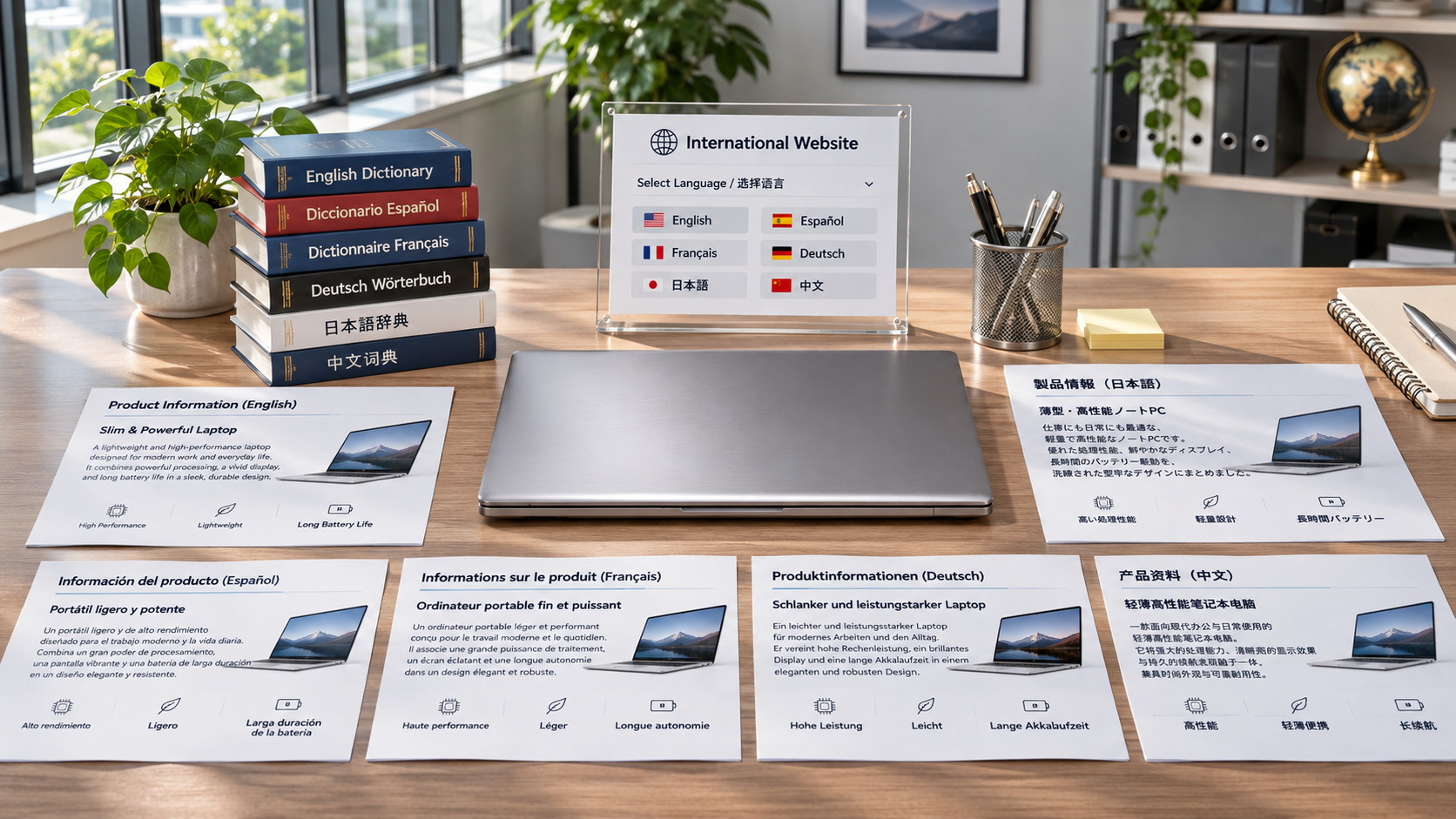
Product pages are where distortion is most subtle. A single instance of “supports” in a Chinese draft may be translated as “includes” in another language; “customizable” may be understood to mean that any requirement can be met. If the units, applicable conditions, and optional configurations of technical parameters are not synchronized, sales personnel will be at a significant disadvantage in subsequent explanations.
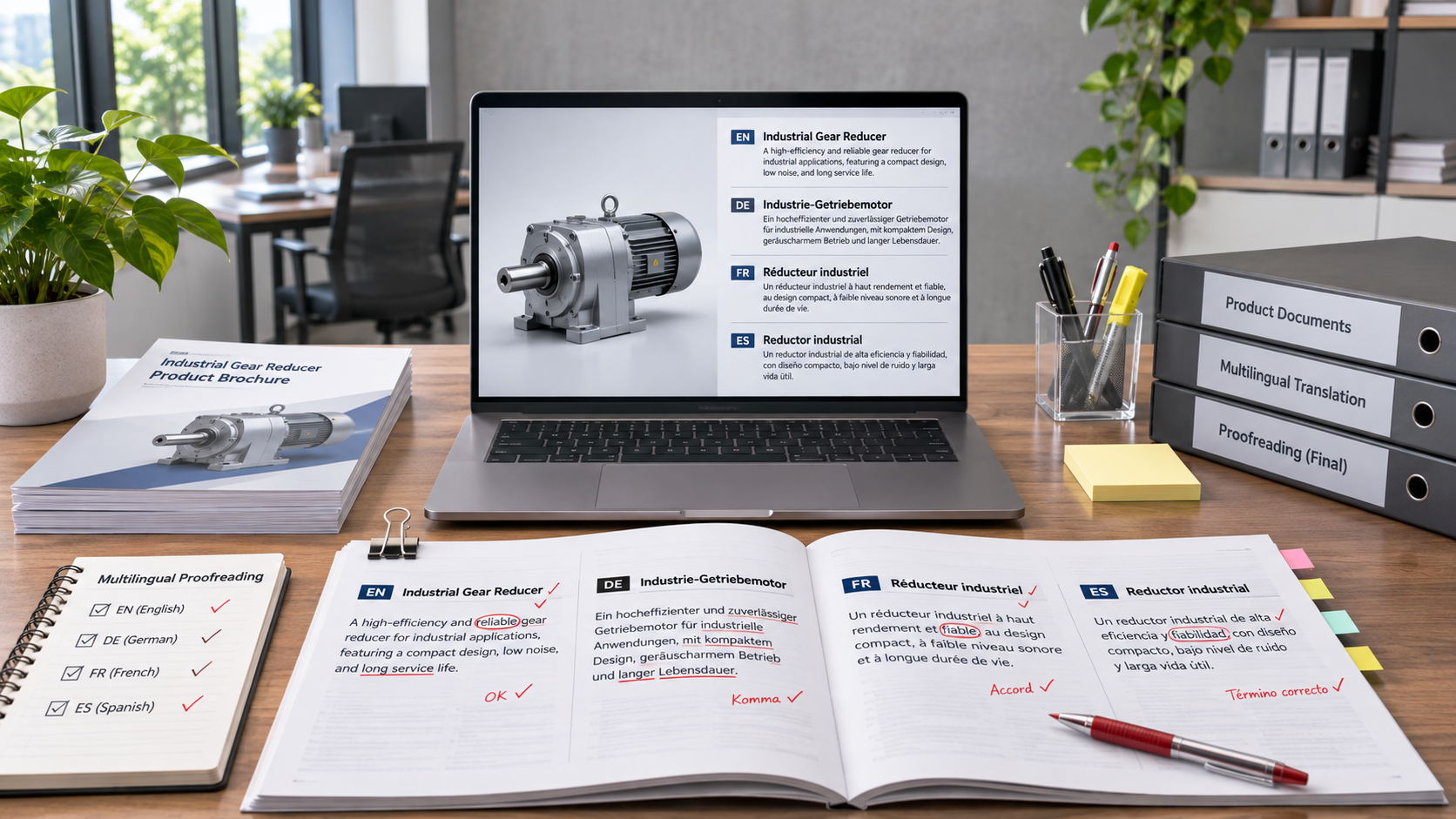
It is recommended to divide product pages into a fixed facts layer and a market expression layer. The fixed facts layer includes models, specifications, operating conditions, service boundaries, and delivery details. The market expression layer includes headlines, application descriptions, customer pain points, and content order. Whenever a new language version is added, verify the facts layer first and then review the expression layer, rather than merely checking whether the page reads smoothly.
Contact and conversion pages: Can commitments actually be fulfilled?
Brand trust is often damaged at the final step. For example, a page promises a “quick response” but has no corresponding lead-assignment rules; a form requires information that local customers are not accustomed to providing; or the phone number, time zone, and email domain do not match the page's target market. These details can quickly weaken the sense of professionalism established earlier.
Before launch, conduct a complete journey test: enter through a search entry point or ad landing page, browse content, switch languages, submit a form, receive a confirmation message, and then confirm internally whether the lead can be correctly identified and processed. During testing, do not only check whether the submission is technically successful; also check whether the salutation, language, time information, and follow-up contact in the automated reply are consistent.
Design adaptation should not address text length alone
Multilingual design is often simplified to “English is longer, so widen the buttons,” but reading direction, information density, cultural cues in images, and symbol usage also have a real impact on brand perception. For example, some markets rely more on clear product information and standardized descriptions, while others place greater emphasis on relationship building and local contact details. If all regions share the same visual rhythm, pages may be technically accessible but psychologically lack a sense of familiarity.
The solution is not to create a separate website for every country, but to retain unified visual identity, core components, and content hierarchy while allowing appropriate variation in hero images, application scenarios, call-to-action buttons, contact details, and supporting materials. Any localized design change should be checked against the expression baseline: Does it make the brand easier for customers to understand, or does it merely pursue superficial differences?
Turn launch acceptance into continuous calibration
International pages will continue to change as products are updated, markets expand, and marketing campaigns evolve. Brand distortion usually occurs in subsequently added pages rather than at the initial launch. The same content validation rules should be established for new languages, ad landing pages, downloadable materials, and social media redirect pages, with particular attention to product names, core claims, commitment boundaries, and contact entities.
When conversion performance in a particular market is unsatisfactory, do not immediately conclude that the brand positioning is wrong. First check whether the page customers enter is consistent with the advertising promise, whether the page language is natural, whether product facts are complete, and whether the form and subsequent response process are coherent. Only after ruling out these execution-level deviations should market expression adjustments be discussed. Advancing the development of an international corporate website in this way can preserve stable brand recognition while allowing customers in different regions to receive a communication experience that aligns with their own habits.
Related Articles
 How Long After Launch Should You Redesign a Multilingual Website? Check Whether the Content Is Outdated First
 How to Choose Target Languages When Building an International Website for Global Brand Expansion
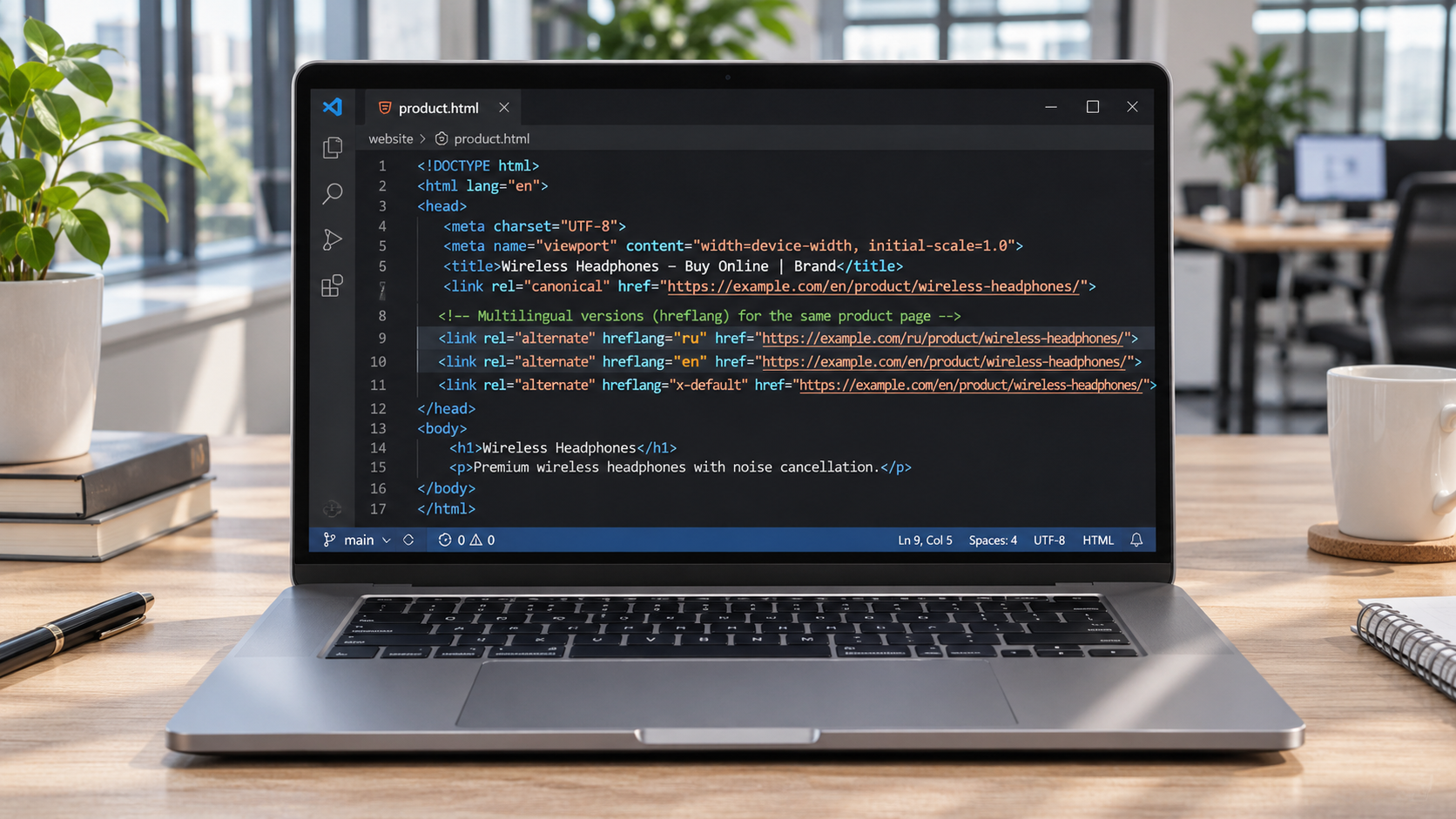
 How Do You Set Up Multilingual SEO Tags for a Russian-Language Website?
Related Products
 Yiyingbao SaaS Intelligent Website Building and Marketing SystemYiyingbao SaaS Intelligent Website Building and Marketing System, AI-powered no-code website building, rapid creation of multilingual B2B international websites in 10 minutes, global server acceleration, AI-powered SEO optimization, helping businesses connect efficiently with global markets. The perfect integration of technology and operation makes building an international trade website remarkably simple
 AI+SEM Intelligent Advertising Marketing SystemAI+SEM drives intelligent ad creation, empowering full-funnel precision advertising marketing. The system automatically generates weekly/monthly reports, AI recommends keywords and target countries, monitors core metrics in real-time with intelligent alerts, and enables one-click high-conversion ad solutions to help quickly acquire customers and improve ROI.
 AI+SEO Dual-Engine System Optimization ServicesYiyingbao’s AI+SEO dual-engine optimization system helps foreign trade enterprises acquire high-quality organic traffic through AI-powered keyword research, content generation, and comprehensive technical optimization, significantly improving search rankings and conversion rates.
 AI+SNS Social Media Marketing SystemYingbao AI+SNS Social Media Marketing System - Precision social capture for the social media era. Supports one-click content synchronization across major platforms like Facebook and LinkedIn. AI intelligently rewrites posts for enhanced relevance. 24/7 AI customer service and user profiling analysis empower businesses to efficiently expand into global markets.
 AI+SEO营销解决方案易营宝AI+SEO营销解决方案,通过AI批量写作、智能生成TDK、精准关键词扩词等功能,全面优化网站SEO效果,提升流量与转化率。助力企业构建高效智能网站新生态。
 AI+SEM Advertising Marketing SolutionsAI+SEM Advertising Marketing Solution leverages AI technology to deeply empower SEM ad campaigns. It automatically generates weekly/monthly reports using AI, presenting account data across multiple dimensions for comprehensive insights into campaign performance and trends. The system precisely recommends keywords and target countries, intelligently generates high-conversion ad copy, and enables one-click activation of efficient campaign plans to help businesses rapidly acquire customers. Simultaneously, it monitors core metrics in real time, intelligently identifies abnormal fluctuations, and issues timely alerts to ensure stable, high-return advertising results.
 Domain Name ServicesEasyWin provides professional domain name services, including intelligent queries, one-stop registration, brand protection, and full lifecycle management, helping businesses build a digital brand image.
 EasyOperate B2C Cross-Border E-Commerce Platform & Independent WebsiteEasyStore B2C Cross-border E-commerce Independent Store is an intelligent website building and cross-border e-commerce integrated solution independently developed by EasyStore Information Technology (Beijing) Co., Ltd. The system is specially designed for small and medium-sized as well as large export enterprises, integrating 'website building, operation, marketing, advertising, and conversion' into one, helping enterprises quickly establish cross-border e-commerce independent stores to achieve brand globalization and global sales growth.
The platform supports multiple languages, multiple currencies, and multi-channel marketing, with built-in AI intelligent translation and SEO optimization systems, suitable for mainstream markets such as Southeast Asia, Europe and America, Latin America, and the Middle East, assisting Chinese manufacturing enterprises in efficiently deploying international e-commerce strategies. SSL证书易营宝提供专业SSL安全证书服务,包括单域名和泛域名证书,确保网站数据传输加密、身份验证和完整性保护,助力企业建立安全可信的在线业务环境。









