









- How Will AI Marketing Trends 2026 Change Advertising Budget AllocationAug 28, 2026View details
- Is the EV SSL certificate market shrinking or upgrading? How should companies assess certificate procurement?Aug 11, 2026View details
- Why the old AMP SEO 2020 practices no longer work and what has changed in current optimization prioritiesAug 02, 2026View details
- How to Choose Topics for an Industry News Section to Attract More Organic Search TrafficJul 29, 2026View details
- Digital Marketing Shenzhen Market Insights: Why Are Companies Expanding Overseas Looking for Growth Teams in Shenzhen?Jul 31, 2026View details
- Can Zhejiang foreign trade independent websites still be developed today? Look at changes in traffic and lead generationJul 28, 2026View details
Common Pitfalls in Multilingual Website Translation
Multilingual website translation may seem like simple language conversion, but it actually affects SEO indexing, user trust, and conversion performance. To truly do multilingual website translation well, you must first understand common pitfalls and avoid undermining overseas marketing results due to literal translation, rigid localization, and technical configuration errors.
For foreign trade companies, manufacturing factories, cross-border e-commerce sellers, and global brand expansion teams, a multilingual official website is not as simple as “adding a few languages.” It is a systematic project that coordinates website development, content, localization, search optimization, and conversion design. If the initial direction is wrong, problems such as slow indexing, high bounce rates, and few inquiries often become concentrated and visible after 3–6 months.
Especially in an integrated website + marketing service scenario, avoiding pitfalls in multilingual website translation affects not only page readability, but also ad landing page quality scores, organic ranking performance, and content comprehensibility in AI search. If companies expect their overseas independent websites to truly generate leads, they must include translation quality, technical configuration, and marketing logic together in the delivery standards.
Why Multilingual Website Translation Is Prone to Pitfalls
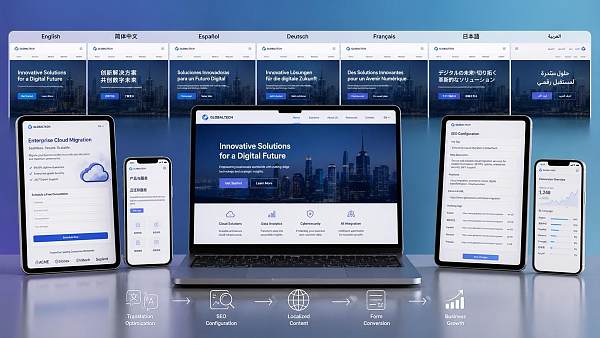
When many companies build their first overseas official website, they usually focus on page design and the number of languages, such as launching 3, 5, or even 8 languages at once, while ignoring differences in search habits, cultural expression, and page structure across different markets. As a result, it may appear that multilingual coverage has been completed, but in reality, no effective traffic entry points have been created.
Based on project experience, the main pitfalls in multilingual website translation are concentrated in 4 types of issues: literal content translation, keyword mismatch, technical configuration errors, and insufficient localization depth. The first two directly affect user understanding, while the latter two gradually affect search crawling, page indexing, and on-site conversion within 2–12 weeks.
Common Misconception 1: Treating Translation as Purely Linguistic Work
Many companies directly hand the original Chinese content to machine translation tools or general translators, then publish it unchanged on English, German, or Japanese pages. This approach may be barely acceptable for a showcase-style website, but it is highly risky for a B2B marketing website, because buyers care about product specifications, application scenarios, delivery time, and service capabilities—not whether the literal meaning has simply been “translated.”
For example, “support customization” may need to be expressed as OEM, ODM, custom fabrication, private label, and other terms in different contexts. If the wrong terminology is selected, even if the grammar is correct, professional buyers may feel that the company does not understand the industry, leading to lower trust. For high-ticket products, this loss usually affects not just one page, but the entire website conversion journey.
Common Misconception 2: Ignoring Local Search Terms Instead of Translating the Original Words
The core of avoiding pitfalls in multilingual website translation is not to convert Chinese keywords word by word into foreign languages, but to identify the expressions that users in the target market actually search for. For example, Chinese terms such as “factory,” “supplier,” and “manufacturer” may correspond to manufacturer, supplier, factory, or producer in English-speaking markets, and the purchasing intent behind different terms is not the same.
If page titles, category names, and body content all use low-frequency or unnatural translations, even if the pages are indexed, it will be difficult to achieve stable rankings. It is generally recommended to first determine at least 20–50 basic keyword groups for each core language, and then extend them into four content structures: product keywords, scenario keywords, problem-based keywords, and transaction keywords.
The table below can help companies quickly identify the most common risk points in multilingual website translation and understand which marketing stages these issues may damage.
As shown in the table, avoiding pitfalls in multilingual website translation is not a single-point optimization task, but a combined issue of “accurate content + correct technology + sound marketing logic.” If a company only solves the translation text but fails to address structure and search logic, it often ends up with an overseas website that is “viewable but not usable.”
6 Translation and Technical Details Companies Most Often Overlook
In multilingual official website projects, what truly determines performance is often not the homepage, but execution details hidden in category structures, URLs, tags, forms, and content templates. The following 6 checklist items should be reviewed at least 2 rounds before project launch, and reviewed again within 30 days after launch.
1. URL Structure Is Not Separated by Language
Multilingual pages should use a clear language directory or independent site structure, such as /en/, /de/, /ja/. If all languages are mixed under the same path, or text is switched through scripts, it is not conducive to search engines identifying independent pages for each language, nor is it helpful for later expansion to more than 10 landing page templates.
2. Titles and Descriptions Are Only Translated, Not Rewritten
Page titles are usually easier to display when kept within 50–65 characters, and descriptions are recommended to stay within 120–160 characters. If Chinese titles are simply translated word for word into English, issues such as length imbalance, unclear focus, or incorrect keyword placement often occur, resulting in a click-through rate lower than expected.
3. Image ALT Text, Button Copy, and Form Prompts Are Not Localized
Many companies translate only the body content while missing image alternative text, download buttons, submit buttons, CAPTCHA prompts, and inquiry form fields. When buyers actually complete conversions, these microcopy elements are often what they interact with most. Whether “Submit” is appropriate, compared with “Get Quote” or “Send Inquiry,” may lead to different conversion results in a B2B scenario.
4. Units, Dates, and Currency Formats Do Not Match
Imperial units are common in the North American market, Europe pays more attention to standardized expressions in a CE context, and bilingual information often coexists in the Middle East and Southeast Asia. If product specification pages still retain many Chinese-style date formats, sizing habits, and payment expressions, professionalism will be significantly reduced. It is recommended to at least standardize 5 types of information: dimensions, weight, temperature, delivery time, and currency.
5. hreflang and Sitemap Are Missing
This is one of the most easily underestimated technical items when avoiding pitfalls in multilingual website translation. Without correct language version annotations, search engines may show English pages to German users, or cause pages in different languages to compete with each other. Usually, within 7–14 days after a multilingual site goes live, the crawling and indexing status can reveal whether the configuration is standardized.
6. The Same Set of Content Is Copied to All Country Pages
English does not mean the same content can be directly used across all overseas markets. Pages targeting the United States, the United Kingdom, Australia, and Singapore may still require differentiated treatment in case studies, logistics lead times, payment explanations, and certification expressions, even if the language is the same. At minimum, differentiated page templates should be established for the top 3 key markets instead of publishing one version everywhere.
- Check whether language directories are independent and avoid multilingual switching under the same URL.
- Check whether the titles, descriptions, and H tags for each language have been rewritten.
- Check whether forms, buttons, ALT text, and breadcrumbs have been fully translated.
- Check whether units, currencies, dates, and phone country codes have been localized.
- Check whether language annotations, sitemaps, and canonical links have been submitted simultaneously.
- Check whether key markets have differentiated content instead of uniform duplication.
The 6 items above may seem basic, but they often determine whether a multilingual website is a “collection of showcase pages” or a “marketing asset that can continuously acquire customers.” For companies that rely on SEO, advertising, and social media traffic working together to acquire leads, these details are usually more important than simply increasing the number of languages.
How to Build a Truly Conversion-Ready Multilingual Website Translation Process
To put multilingual website translation pitfall prevention into execution, the most effective approach is not to “launch once the translation is finished,” but to establish a standardized process. A mature project can usually be divided into 5 steps: market confirmation, keyword planning, content translation and rewriting, technical deployment, and post-launch review. When website development, content, SEO, and marketing teams collaborate across different stages, efficiency is significantly higher than with a single outsourcing model.
Recommended 5-Step Implementation Method
- First define market priorities. It is generally recommended to launch 1–3 primary languages in the first batch.
- Prepare 20–50 core keywords for each language, distinguishing brand terms, product terms, scenario terms, and transaction terms.
- Create separate translation and rewriting templates for the homepage, product pages, case study pages, and FAQ pages.
- Synchronously handle technical items such as URLs, titles, descriptions, language annotations, and sitemaps.
- After launch, review indexing, ranking, and inquiry data at 7-day, 30-day, and 90-day milestones.
For B2B websites, it is recommended to first improve 8 types of high-value pages: homepage, core product pages, industry application pages, About Us, factory capabilities, case study pages, FAQ pages, and contact pages. If the budget is limited, building these 8 types of pages in depth is more effective than filling the site with 100 low-quality translated pages all at once.
The table below can serve as a reference for companies when evaluating service providers, helping determine whether they truly have integrated delivery capabilities for multilingual website development and overseas marketing.
When purchasing related services, companies should not compare only the single-page price, but should also assess whether the provider can support subsequent SEO optimization, advertising, and content expansion. Truly effective multilingual website translation pitfall prevention must ultimately translate into traffic growth, lead generation efficiency, and sustainable overseas market operations.
Which Companies Should Prioritize Upgrading Their Multilingual Websites
If a company currently faces any of the following 3 situations, an upgrade is recommended as a priority: first, the English website has been live for more than 6 months but inquiries remain consistently low; second, advertising has already started but landing page bounce rates are high; third, the company plans to enter new markets such as Europe, Japan and South Korea, or the Middle East, and needs to complete official website localization deployment within 90 days. At this point, avoiding pitfalls in multilingual website translation is no longer an optional optimization item, but a foundational growth requirement.
Platforms like 易营宝, which combine AI-powered website building, multilingual website development, Google SEO optimization, advertising, and overseas social media operation capabilities, are better suited for companies that need one-stop overseas growth execution. Their value lies not only in building the website, but also in establishing a continuous closed loop among website development, indexing, promotion, and conversion, reducing rework cycles caused by multi-vendor collaboration. For common projects, efficiency can often be improved by 1–2 delivery stages.
After Avoiding Translation Errors, Long-Term Operations Still Matter
A multilingual website is not a one-time deliverable, but a marketing asset that requires continuous updates. New product additions, specification changes, case study updates, FAQ expansion, and landing page testing may all affect consistency across pages in different languages. If a site is not maintained for more than 6 months, many websites may experience outdated content, broken links, inconsistent terminology, and other issues.
Companies are advised to check key pages at least once a month and review language performance once every quarter. If a certain language has no new indexing, no organic traffic improvement, or continuously low inquiry quality for 90 consecutive days, the translation strategy, page structure, and localization depth should be reviewed instead of simply increasing the advertising budget.
Long-Term Maintenance Recommendations
- Update 1–4 pieces of content in the corresponding language every month to keep pages active.
- Review the terminology database every quarter to avoid fragmented expressions on newly added pages.
- Create separate translation templates for advertising pages and organic search pages.
- For AI search and generative results, supplement Q&A-style and scenario-based content.
The essence of avoiding pitfalls in multilingual website translation is to enable companies to express product value, build trust, and drive conversions in ways familiar to users across different countries and language environments. For companies currently building overseas independent websites, the earlier they establish standardized translation and operation mechanisms, the easier it will be to control future customer acquisition costs.
If you are planning a multilingual official website, a B2B foreign trade marketing website, or an overseas independent website upgrade, it is recommended to evaluate translation quality, technical architecture, and marketing conversion simultaneously. 易营宝 can combine AI-powered website building, SEO/GEO optimization, advertising, and localized content capabilities to provide companies with solutions better suited to real overseas expansion scenarios. Contact us now to get a customized solution and learn more about multilingual website development and overseas marketing growth services.
Related Articles
Related Products
 Yiyingbao SaaS Intelligent Website Building and Marketing SystemYiyingbao SaaS Intelligent Website Building and Marketing System, AI-powered no-code website building, rapid creation of multilingual B2B international websites in 10 minutes, global server acceleration, AI-powered SEO optimization, helping businesses connect efficiently with global markets. The perfect integration of technology and operation makes building an international trade website remarkably simple
 AI+SEM Intelligent Advertising Marketing SystemAI+SEM drives intelligent ad creation, empowering full-funnel precision advertising marketing. The system automatically generates weekly/monthly reports, AI recommends keywords and target countries, monitors core metrics in real-time with intelligent alerts, and enables one-click high-conversion ad solutions to help quickly acquire customers and improve ROI.
 AI+SEO Dual-Engine System Optimization ServicesYiyingbao’s AI+SEO dual-engine optimization system helps foreign trade enterprises acquire high-quality organic traffic through AI-powered keyword research, content generation, and comprehensive technical optimization, significantly improving search rankings and conversion rates.
 AI+SNS Social Media Marketing SystemYingbao AI+SNS Social Media Marketing System - Precision social capture for the social media era. Supports one-click content synchronization across major platforms like Facebook and LinkedIn. AI intelligently rewrites posts for enhanced relevance. 24/7 AI customer service and user profiling analysis empower businesses to efficiently expand into global markets.
 AI+SEO营销解决方案易营宝AI+SEO营销解决方案,通过AI批量写作、智能生成TDK、精准关键词扩词等功能,全面优化网站SEO效果,提升流量与转化率。助力企业构建高效智能网站新生态。
 AI+SEM Advertising Marketing SolutionsAI+SEM Advertising Marketing Solution leverages AI technology to deeply empower SEM ad campaigns. It automatically generates weekly/monthly reports using AI, presenting account data across multiple dimensions for comprehensive insights into campaign performance and trends. The system precisely recommends keywords and target countries, intelligently generates high-conversion ad copy, and enables one-click activation of efficient campaign plans to help businesses rapidly acquire customers. Simultaneously, it monitors core metrics in real time, intelligently identifies abnormal fluctuations, and issues timely alerts to ensure stable, high-return advertising results.
 Domain Name ServicesEasyWin provides professional domain name services, including intelligent queries, one-stop registration, brand protection, and full lifecycle management, helping businesses build a digital brand image.
 EasyOperate B2C Cross-Border E-Commerce Platform & Independent WebsiteEasyStore B2C Cross-border E-commerce Independent Store is an intelligent website building and cross-border e-commerce integrated solution independently developed by EasyStore Information Technology (Beijing) Co., Ltd. The system is specially designed for small and medium-sized as well as large export enterprises, integrating 'website building, operation, marketing, advertising, and conversion' into one, helping enterprises quickly establish cross-border e-commerce independent stores to achieve brand globalization and global sales growth.
The platform supports multiple languages, multiple currencies, and multi-channel marketing, with built-in AI intelligent translation and SEO optimization systems, suitable for mainstream markets such as Southeast Asia, Europe and America, Latin America, and the Middle East, assisting Chinese manufacturing enterprises in efficiently deploying international e-commerce strategies. SSL证书易营宝提供专业SSL安全证书服务,包括单域名和泛域名证书,确保网站数据传输加密、身份验证和完整性保护,助力企业建立安全可信的在线业务环境。









