









- Which customer acquisition channels will be affected by cross-border marketing trends in 2026?Sep 06, 2026View details
- Which homogenization risks should be considered in an analysis of the AI-powered website building industry?Aug 30, 2026View details
- How Will AI Marketing Trends 2026 Change Advertising Budget AllocationAug 28, 2026View details
- Is the EV SSL certificate market shrinking or upgrading? How should companies assess certificate procurement?Aug 11, 2026View details
- Why the old AMP SEO 2020 practices no longer work and what has changed in current optimization prioritiesAug 02, 2026View details
- How to Choose Topics for an Industry News Section to Attract More Organic Search TrafficJul 29, 2026View details
How to Recover from a Decline in New Customer Inquiries in the Mexican Market
When new customer inquiries in the Mexican market suddenly decline, do not rush to increase your Google Ads budget or expand social media advertising. A drop in inquiries is usually not caused by the failure of a single channel, but by a break somewhere in the chain of “being seen, being trusted, and being willing to submit a request.” First determine whether the decline occurred in traffic, on the page, or during sales follow-up, so that recovery actions do not become ineffective spending.
When assessing how to recover from a decline in new customer inquiries in the Mexican market, the most practical approach is to compare the recent period with a previously stable period: organic search visits, ad clicks, landing page dwell time, form submissions, WhatsApp clicks, and valid response rates. Do not look only at the total number of inquiries. A traffic decline and a conversion decline require entirely different solutions; if the number of forms remains stable but low-quality inquiries increase, this should not simply be attributed to insufficient lead generation.
First identify where the decline occurred: less traffic or a problem in the conversion funnel
If organic search visits and ad clicks decline at the same time, first check the visibility side. Common causes include ranking declines for key pages, ad budgets being consumed by highly competitive keywords, a mismatch between keywords and product demand, or competitors increasing spending on similar terms. Mexican users often search in Spanish for products, specifications, suppliers, and pricing information. Keeping only English pages or directly translating Chinese product terms often makes it difficult to consistently cover actual local search expressions.
If traffic has not changed much but inquiries have decreased, the issue is more likely with website conversion. For example, ads may lead users to a generic homepage with no relevant product information; Spanish content may read unnaturally; purchasing information such as product specifications, lead times, minimum order quantities, and packaging methods may be incomplete; contact options may be hidden too deeply; or mobile forms may load slowly or have too many fields. These issues may not noticeably reduce clicks, but they can cause visitors with genuine needs to leave before submitting an inquiry.
There is also a situation that is easy to misjudge: website and advertising data may both appear normal, but the sales team does not respond promptly. Mexican customers often make initial contact through WhatsApp, email, or forms. If automated replies are only in English, response times are too long, or quotations do not address the specifications, trade terms, and delivery issues they care about, leads acquired at the front end will also be lost in subsequent stages.
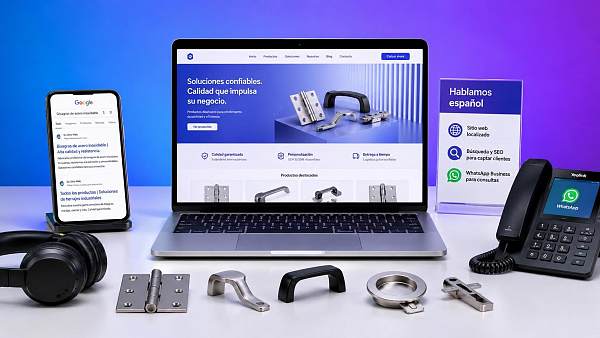
Do not start inquiry recovery by “spending more”
It is recommended to address the issue in the following order. The purpose is to first fix existing traffic waste before expanding new customer acquisition.
- Verify data definitions. Confirm whether all entry points, including forms, phone calls, WhatsApp, and live chat, are being tracked; check whether website redesigns, tracking adjustments, or changes in advertising account settings have caused data loss. Without consistent definitions, subsequent assessments can easily become inaccurate.
- Break down sources and pages. Review inquiry volumes separately from organic search, paid search, social media ads, and direct visits, then identify pages with high traffic but low inquiry rates. Prioritizing pages that already have a traffic foundation is usually faster than creating a large number of new pages.
- Check the quality of Spanish localization. Localization is not simply replacing text with Spanish. Product names, units of measurement, application scenarios, FAQs, and call-to-action buttons must all align with the reading habits of local buyers. Machine translation can be used for an initial draft, but product terminology and commercial wording require human proofreading.
- Make each landing page serve one clear purpose. People searching for a specific product should enter the relevant product or solution page rather than the homepage. The first part of the page should explain applicable product scenarios, key specifications, supply capabilities, and how to obtain a quotation, reducing irrelevant navigation.
- Then adjust the advertising structure. Manage high-intent terms such as “find suppliers,” “request a quote,” and “product model” separately from broad demand terms, and direct different keyword groups to matching pages. Terms with high clicks but no valid leads over a long period should not continue receiving higher bids merely because they bring visits.
Several commonly overlooked details in Mexican website conversion
Many companies regard a Spanish website as a copy of their English site. Although the pages may be complete, they do not reduce purchasing communication costs. B2B pages should clearly display information buyers need to confirm, such as product specification ranges, materials or processes, application industries, customization capabilities, and packaging and shipping arrangements. When information is incomplete, visitors will leave to compare options rather than proactively leave their contact details.
Contact methods should also be arranged according to user habits. In addition to forms and email, a clear WhatsApp entry point is often more suitable for initial communication. However, do not direct every button to the same generic chat window. Inquiry entry points on product pages should include the product name or page source, making it easier for sales staff to quickly understand the prospect's needs. Form fields should be limited to what is necessary; name, company, email or phone number, and a description of requirements are usually sufficient. Requesting complete purchasing information too early can increase submission friction.
For B2C or standardized products, pricing, shipping information, payment methods, return and exchange policies, and delivery expectations directly affect orders or inquiries. For customized industrial products, publicly listing clear prices may not be appropriate, but users should understand what quotation information they can obtain, such as quotations based on quantity, specifications, destination, or customization requirements, so that the inquiry button does not appear vague.
How search optimization and advertising should work together
Advertising is suitable for validating demand and supplementing short-term traffic; SEO is better suited to building sustained coverage. If the two operate independently, a common result is that ads repeatedly purchase traffic that could have been acquired through organic search, while website content cannot gain optimization insights from advertising search terms.
Content development should not focus only on broad, high-volume terms. Content that is more likely to generate purchasing leads usually combines specific products with industry applications, specification comparisons, selection questions, customization conditions, and delivery-related issues. Pages should have clear linking relationships, allowing both search engines and visitors to move from industry demand pages to corresponding product pages and then complete an inquiry.
Do not treat low-quality inquiries as “recovery”
An increase in inquiry volume does not mean customer acquisition has recovered. If targeting or keyword matching is broadened, form submissions may increase, but irrelevant inquiries, individual retail demand, or requirements that cannot result in a transaction will also increase. When evaluating results, leads should be categorized by product fit, purchasing role, completeness of requirements, and follow-up potential. Focus on the proportion of valid inquiries rather than only the total number of forms.
A feedback loop should also be established between sales and marketing. Sales staff know which search terms, product pages, and sources are more likely to generate further communication, while the marketing team can adjust budgets, negative keywords, page content, and remarketing rules accordingly. Without this step, advertising platforms can optimize only based on clicks or form events and may not find people with genuine purchasing intent.
When integrated rebuilding is needed, first evaluate collaboration capabilities
When the website, multilingual content, SEO, advertising, and social media are maintained by different teams, the recovery cycle is often prolonged: advertising changes keywords but landing pages are not updated; pages feature new products but search indexing and conversion tracking are not synchronized; after sales receives leads, the front end cannot adjust strategies based on valid leads. In this situation, it is more suitable to choose a service solution that connects website development, content optimization, advertising, and data tracking.
For example, Yiyingbao provides services including intelligent website building for overseas markets, multilingual websites, Google SEO, Google Ads, social media marketing, and AI search visibility optimization. For those who need to simultaneously improve Spanish website conversion support, search visibility, and advertising landing pages, the key is not the number of functions, but whether a consistent execution plan can be developed around products, language, and lead paths in the Mexican market.
The first step in recovering new customer inquiries is not to immediately scale up, but to confirm which part of the funnel is losing demand. First ensure that Spanish pages can explain products, build trust, and make contact easy; then use ads to validate high-intent search terms and SEO to capture sustained demand. Only then is inquiry growth more likely to become a stable source of new customers.
Related Articles
Related Products
 Yiyingbao SaaS Intelligent Website Building and Marketing SystemYiyingbao SaaS Intelligent Website Building and Marketing System, AI-powered no-code website building, rapid creation of multilingual B2B international websites in 10 minutes, global server acceleration, AI-powered SEO optimization, helping businesses connect efficiently with global markets. The perfect integration of technology and operation makes building an international trade website remarkably simple
 AI+SEM Intelligent Advertising Marketing SystemAI+SEM drives intelligent ad creation, empowering full-funnel precision advertising marketing. The system automatically generates weekly/monthly reports, AI recommends keywords and target countries, monitors core metrics in real-time with intelligent alerts, and enables one-click high-conversion ad solutions to help quickly acquire customers and improve ROI.
 AI+SEO Dual-Engine System Optimization ServicesYiyingbao’s AI+SEO dual-engine optimization system helps foreign trade enterprises acquire high-quality organic traffic through AI-powered keyword research, content generation, and comprehensive technical optimization, significantly improving search rankings and conversion rates.
 AI+SNS Social Media Marketing SystemYingbao AI+SNS Social Media Marketing System - Precision social capture for the social media era. Supports one-click content synchronization across major platforms like Facebook and LinkedIn. AI intelligently rewrites posts for enhanced relevance. 24/7 AI customer service and user profiling analysis empower businesses to efficiently expand into global markets.
 AI+SEO营销解决方案易营宝AI+SEO营销解决方案,通过AI批量写作、智能生成TDK、精准关键词扩词等功能,全面优化网站SEO效果,提升流量与转化率。助力企业构建高效智能网站新生态。
 AI+SEM Advertising Marketing SolutionsAI+SEM Advertising Marketing Solution leverages AI technology to deeply empower SEM ad campaigns. It automatically generates weekly/monthly reports using AI, presenting account data across multiple dimensions for comprehensive insights into campaign performance and trends. The system precisely recommends keywords and target countries, intelligently generates high-conversion ad copy, and enables one-click activation of efficient campaign plans to help businesses rapidly acquire customers. Simultaneously, it monitors core metrics in real time, intelligently identifies abnormal fluctuations, and issues timely alerts to ensure stable, high-return advertising results.
 Domain Name ServicesEasyWin provides professional domain name services, including intelligent queries, one-stop registration, brand protection, and full lifecycle management, helping businesses build a digital brand image.
 EasyOperate B2C Cross-Border E-Commerce Platform & Independent WebsiteEasyStore B2C Cross-border E-commerce Independent Store is an intelligent website building and cross-border e-commerce integrated solution independently developed by EasyStore Information Technology (Beijing) Co., Ltd. The system is specially designed for small and medium-sized as well as large export enterprises, integrating 'website building, operation, marketing, advertising, and conversion' into one, helping enterprises quickly establish cross-border e-commerce independent stores to achieve brand globalization and global sales growth.
The platform supports multiple languages, multiple currencies, and multi-channel marketing, with built-in AI intelligent translation and SEO optimization systems, suitable for mainstream markets such as Southeast Asia, Europe and America, Latin America, and the Middle East, assisting Chinese manufacturing enterprises in efficiently deploying international e-commerce strategies. SSL证书易营宝提供专业SSL安全证书服务,包括单域名和泛域名证书,确保网站数据传输加密、身份验证和完整性保护,助力企业建立安全可信的在线业务环境。









