









- AI Products Drive Hong Kong Exports Up 64.9% in September, Fastest Growth in Over 40 YearsNov 17, 2026View details
- National Bureau of Statistics: Foreign trade grew rapidly in October, providing stable support for global tradeNov 17, 2026View details
- The U.S. has ended the $800 de minimis exemption for non-postal shipments; express courier packages must be formally declared.Nov 16, 2026View details
- ASEAN Signs Digital Economy Framework Agreement, Moving Toward Harmonized Cross-Border E-Commerce RulesNov 15, 2026View details
- Shenzhen Becomes the First City in Mainland China to Exceed RMB 5 Trillion in Foreign TradeNov 15, 2026View details
- Fujian Announces the First Batch of Provincial-Level Cross-Border E-Commerce Industrial Parks and Key Brands for CultivationNov 14, 2026View details
How should manufacturers coordinate their websites, SEO, and advertising campaigns for export digital marketing?
One of the most common disconnects in export lead generation is that ads drive visitors to the homepage, but visitors cannot find the products, process capabilities, or delivery qualifications relevant to their sourcing tasks. Another disconnect occurs when a website has accumulated many pages without creating entry points around actual search terms. The official website, organic search, and paid advertising need to share one lead-generation path: ads validate demand, the website explains and qualifies it, and search content continuously covers long-tail needs that emerge later.
Take searches such as “exportación marketing digital fabricante” as an example. Visitors may not be looking only for marketing services; they may also be seeking certain export manufacturing capabilities, customization requirements, sample procedures, or project lead times. If a landing page only states “reliable quality and professional service,” it can hardly support the next step of making an inquiry. The page needs to quickly answer whether the product can match the application scenario and which technical conditions must be confirmed before communication.
First, turn the official website into an information layer that can support projects
An official website is not an online version of a corporate brochure. For non-standard parts, equipment, and engineering support products, visitors usually first assess whether the specifications are close to their needs, then confirm whether the factory can handle material requirements, machining precision, surface treatment, assembly methods, and batch-volume requirements. Therefore, product pages should not combine different series into one broad page, nor should they use a single rendering to replace key information.
A product page suitable for advertising and organic indexing should at least clearly state the product name and model logic, available materials, size or load range, suitable environments, customization boundaries, quality inspection methods, and packaging and transportation limitations. If installation conditions affect product selection, such as voltage, interface orientation, mounting-hole positions, temperature and humidity, or protection requirements, these should be explained before the inquiry form. The resulting leads may not necessarily be more numerous, but ineffective communication caused by missing key conditions will be significantly reduced.
The homepage is suitable for building trust and providing navigation, but not for handling all conversion tasks. When ads target specific product terms, application terms, or problem terms, they should lead to the corresponding pages separately. For example, for traffic around “custom stainless steel enclosure,” the landing page should show available material grades, sheet thickness, bending or welding processes, outdoor protection requirements, and drawing submission methods. If visitors are directed to a generic company profile page, the traffic source, page promise, and inquiry action become disconnected.

Use ads for validation first; they cannot replace content development
Paid traffic is suitable for quickly identifying which regions, applications, and search expressions generate qualified inquiries, but decisions cannot be based on click-through rates alone. High clicks with few form submissions may indicate overly broad keywords, inconsistency between ad-copy promises and page content, or unreadable specification tables on mobile devices. If inquiry volume rises while sales feedback indicates low lead quality, the inquiry form often lacks fields such as purchase quantity, drawings, application, port of destination, or technical parameters.
The same product should use different landing approaches at different stages. Products with a high degree of standardization and clear delivery cycles can lead directly to model pages with specification filtering highlighted. Customized equipment or engineering components often lack sufficient preliminary information, making application solution pages more suitable to explain the required medium, load, installation space, and operating duration. Directing both types of traffic to the same page often results in the two extremes of too many form fields or insufficient information.
Ad search-term reports are not only a basis for bid adjustments; they are also a source of website topics. Repeated size expressions, industry colloquialisms, fault descriptions, material comparisons, and accessory compatibility questions can be developed into product subpages, technical explanations, or FAQ pages if they are relevant to actual business. Conversely, topics already proven valuable by content pages can be turned into more precise ad groups. In this way, ads capture immediate demand, while the official website does not need to explain everything from scratch each time.
Organic search content should support decision-making before a transaction
The value of organic search pages does not lie in repeatedly placing product terms in titles, but in filling information gaps during the sourcing process. When visitors search for “aluminum vs stainless steel housing,” they usually need to compare corrosion resistance, weight, processing feasibility, and operating environments. When they search for “industrial pump seal leakage causes,” they may be troubleshooting media, pressure, shaft runout, or installation errors. If content stops at conceptual explanations, it cannot naturally connect to the relevant product and inquiry pages.
Keyword planning can be divided by intent: model or category terms lead to product pages, material and parameter terms lead to specification explanations, application problem terms lead to technical articles, while brand alternatives or broad industry terms require careful relevance evaluation. Use clear internal links between pages so that readers who have reviewed material options can access the relevant product series, and those researching installation conditions can find drawings and inquiry entry points. Excessively deep navigation levels, multiple similar URLs for the same product, and parameter pages incorrectly blocked from indexing will all weaken this accumulation.
During content production, the keyword expansion, industry terminology adaptation, and ranking-monitoring capabilities in SEO optimization can be used, but content must still be verified by people familiar with the products before publication. In particular, load-bearing capacity, temperature resistance, pressure resistance, chemical compatibility, and certification scope must not present optional configurations as standard capabilities, nor apply data from laboratory conditions directly to all operating conditions. The same applies to multilingual pages, where direct translation of models, units, and technical terms can easily cause misunderstandings.
Connect the three stages with one set of lead standards
When the official website, content, and advertising are measured separately, “traffic growth” and “difficulty advancing projects” can easily coexist. A more effective approach is to establish unified labels for inquiries: source channel, entry page, search term or ad group, product category, region, estimated quantity, whether drawings are attached, and subsequently determined validity. Missing information identified during sales communication should be fed back into page fields and content topics. If a page consistently generates mismatched inquiries, its title, ad targeting, and above-the-fold description should also be checked to determine whether the scope of application is stated too broadly.
Coordination does not require large-scale advertising or content updates across all pages at the same time. First select one product category with clear product boundaries and inquiries that can be effectively qualified, establish ad groups, landing pages, and several supporting content pieces, and then complete the pages based on actual leads. After one feedback cycle, it will gradually become possible to determine which regions value delivery time, which applications focus more on materials, and which search terms create incorrect expectations, making subsequent expansion require less rework.
Related Articles
 How to Add Structured Data to Product Pages with JSON-LD
 How Long Does It Take to See an Increase in Inquiries from SEO for Your Website?
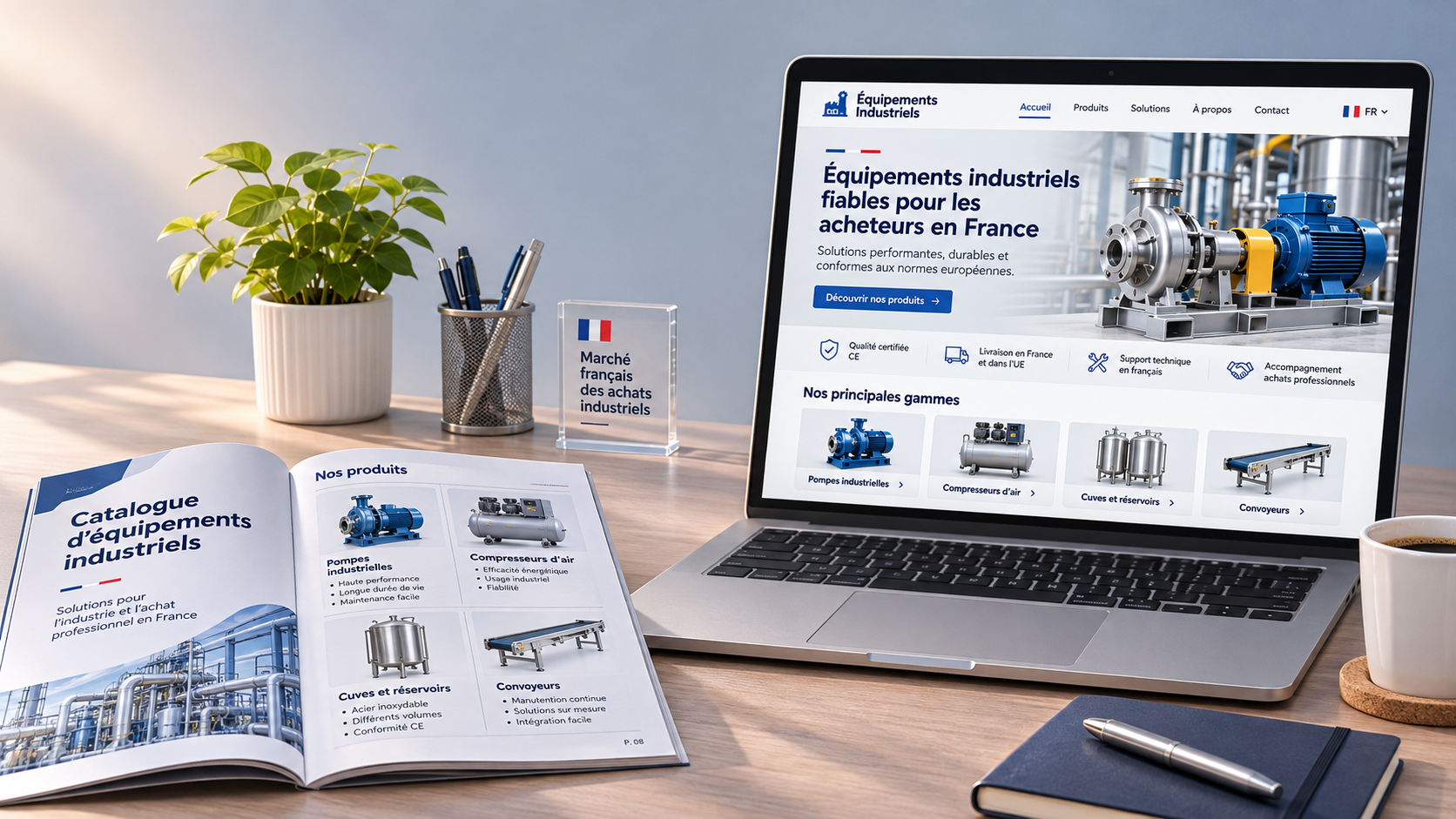
 How to Promote a Website on Google in France: From French Keywords to Local Link Building
Related Products
 Yiyingbao SaaS Intelligent Website Building and Marketing SystemYiyingbao SaaS Intelligent Website Building and Marketing System, AI-powered no-code website building, rapid creation of multilingual B2B international websites in 10 minutes, global server acceleration, AI-powered SEO optimization, helping businesses connect efficiently with global markets. The perfect integration of technology and operation makes building an international trade website remarkably simple
 AI+SEM Intelligent Advertising Marketing SystemAI+SEM drives intelligent ad creation, empowering full-funnel precision advertising marketing. The system automatically generates weekly/monthly reports, AI recommends keywords and target countries, monitors core metrics in real-time with intelligent alerts, and enables one-click high-conversion ad solutions to help quickly acquire customers and improve ROI.
 AI+SEO Dual-Engine System Optimization ServicesYiyingbao’s AI+SEO dual-engine optimization system helps foreign trade enterprises acquire high-quality organic traffic through AI-powered keyword research, content generation, and comprehensive technical optimization, significantly improving search rankings and conversion rates.
 AI+SNS Social Media Marketing SystemYingbao AI+SNS Social Media Marketing System - Precision social capture for the social media era. Supports one-click content synchronization across major platforms like Facebook and LinkedIn. AI intelligently rewrites posts for enhanced relevance. 24/7 AI customer service and user profiling analysis empower businesses to efficiently expand into global markets.
 AI+SEO营销解决方案易营宝AI+SEO营销解决方案,通过AI批量写作、智能生成TDK、精准关键词扩词等功能,全面优化网站SEO效果,提升流量与转化率。助力企业构建高效智能网站新生态。
 AI+SEM Advertising Marketing SolutionsAI+SEM Advertising Marketing Solution leverages AI technology to deeply empower SEM ad campaigns. It automatically generates weekly/monthly reports using AI, presenting account data across multiple dimensions for comprehensive insights into campaign performance and trends. The system precisely recommends keywords and target countries, intelligently generates high-conversion ad copy, and enables one-click activation of efficient campaign plans to help businesses rapidly acquire customers. Simultaneously, it monitors core metrics in real time, intelligently identifies abnormal fluctuations, and issues timely alerts to ensure stable, high-return advertising results.
 Domain Name ServicesEasyWin provides professional domain name services, including intelligent queries, one-stop registration, brand protection, and full lifecycle management, helping businesses build a digital brand image.
 EasyOperate B2C Cross-Border E-Commerce Platform & Independent WebsiteEasyStore B2C Cross-border E-commerce Independent Store is an intelligent website building and cross-border e-commerce integrated solution independently developed by EasyStore Information Technology (Beijing) Co., Ltd. The system is specially designed for small and medium-sized as well as large export enterprises, integrating 'website building, operation, marketing, advertising, and conversion' into one, helping enterprises quickly establish cross-border e-commerce independent stores to achieve brand globalization and global sales growth.
The platform supports multiple languages, multiple currencies, and multi-channel marketing, with built-in AI intelligent translation and SEO optimization systems, suitable for mainstream markets such as Southeast Asia, Europe and America, Latin America, and the Middle East, assisting Chinese manufacturing enterprises in efficiently deploying international e-commerce strategies. SSL证书易营宝提供专业SSL安全证书服务,包括单域名和泛域名证书,确保网站数据传输加密、身份验证和完整性保护,助力企业建立安全可信的在线业务环境。









