









- Which customer acquisition channels will be affected by cross-border marketing trends in 2026?Sep 06, 2026View details
- Which homogenization risks should be considered in an analysis of the AI-powered website building industry?Aug 30, 2026View details
- How Will AI Marketing Trends 2026 Change Advertising Budget AllocationAug 28, 2026View details
- Is the EV SSL certificate market shrinking or upgrading? How should companies assess certificate procurement?Aug 11, 2026View details
- Why the old AMP SEO 2020 practices no longer work and what has changed in current optimization prioritiesAug 02, 2026View details
- How to Choose Topics for an Industry News Section to Attract More Organic Search TrafficJul 29, 2026View details
How to Do Structured Content Optimization?Article Page Title、Summary and FAQ Layout Analysis
How to do structured content optimization,when viewed within an article page,the focus is often not on “writing more”,but on “how information can be understood by both search engines and readers”。The title determines the thematic boundary,the summary affects click expectations,and FAQ plays the role of supplementing semantics,connecting questions,and extending dwell time。For the website + marketing services integration scenario,structured content optimization for article pages is not only an editorial action,but is also related to indexing efficiency,lead quality,and subsequent conversion paths。
Why article pages increasingly rely on structured content optimization
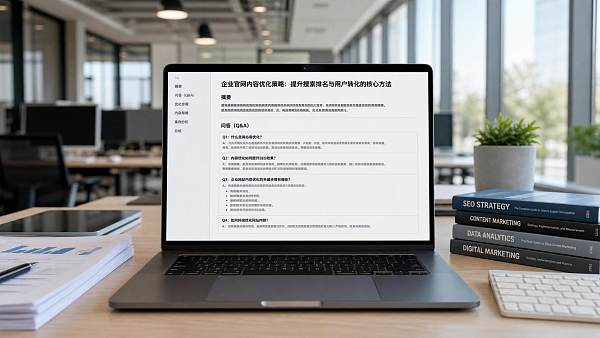
In the past,when creating content,many pages had a chance to gain exposure as long as they had keywords and sufficient length。Now it is different。Search results place greater emphasis on topic clarity,information matching,and page readability,especially in scenarios such as overseas marketing,independent website customer acquisition,and multilingual content layout,where article pages are no longer simple information containers,but intermediate nodes connecting search,clicks,reading,and inquiries。
This is also why structured content optimization for article pages deserves more and more attention。It helps search engines determine what the page is about,which questions it is suitable to answer,and also helps visitors confirm within a few seconds whether the content is worth continuing to read。For websites that need long-term SEO growth,this foundational capability determines whether content assets can continue to accumulate。
In actual business,marketing websites usually undertake brand presentation,product explanation,customer acquisition conversion,and channel connection at the same time。If a page only follows the idea of “writing articles”,it is easy to have problems such as scattered topics,vague summaries,and unfocused question settings,eventually resulting in slow indexing,low clicks,and high bounce rates。
First understand “structured” correctly
The structuring mentioned here is not about mechanically splitting an article into several blocks,nor is it simply stacking a few subheadings。More accurately,it is about building a clear information hierarchy around a core search topic,so that the title,summary,body paragraphs,and FAQ form identifiable logical relationships。
For structured content optimization for article pages,at least three questions need to be answered:whether the page theme is unique,whether the information sequence is smooth,and whether the supplementary questions serve the main topic。As long as these three points are not handled well,even with a large word count,the content can still easily be identified as generic content。
Simply put,structuring is not for “looking professional”,but for reducing comprehension costs in the three stages of search,reading,and conversion。Especially for website content aimed at overseas promotion,it is even more necessary to balance search logic and business expression。
The basic structure of a qualified article page
- The title focuses on one core question and does not mix in too many parallel intents。
- The summary supplements the scenario,audience,and reading value,without repeating the title。
- The body expands around the main question,with clear hierarchy and short yet informative paragraphs。
- FAQ connects real questions and supplements long-tail keywords and decision-making points。
What problems the title,summary,and FAQ solve respectively
Many content results are unsatisfactory not because one part is written incorrectly,but because the three parts each say different things。The title wants traffic,the summary is written as empty talk,and the FAQ is filled with irrelevant questions。Such structured content optimization for article pages can hardly form stable performance。
The title is responsible for locking the topic
The most important task of the title is to let both search engines and visitors know exactly what the page is about。An expression such as “How to do structured content optimization?Analysis of article page title,summary,and FAQ layout” has the core advantage of a clear topic while also defining the reading scope,so the content will not become too scattered。
If too many concepts are inserted into the title at the same time,such as website building,SEO,conversion,traffic,and ranking all listed in parallel,the page will lose focus。The more the title looks like a directory,the harder it is for the page to form a clear intent。
The summary is responsible for establishing click expectations
The summary is not about restating the opening,but about explaining the scenario,pain points,and obtainable information in shorter text。For marketing websites,a well-written summary can reduce invalid clicks such as “only after clicking in do I find that it is not the content I want”。
The summary can also naturally bring out the business background。For example,in an integrated service scenario of intelligent website building,SEO optimization,and advertising,the structural design of the article page itself affects the subsequent traffic reception effect。Putting this information in the summary is more persuasive than vaguely writing “help improve rankings”。
FAQ is responsible for supplementing real search questions
FAQ is not bonus content,but an important supplementary layer of structured content optimization for article pages。It is suitable for taking on more specific questions such as “how to judge”,“which pages are suitable”,and “what are the common mistakes”,and gathering the parts that are not suitable for overly long expansion in the body。
From an SEO perspective,FAQ can also cover more refined long-tail semantics。From a conversion perspective,it can resolve doubts in advance and reduce reading interruption。
A layout approach more suitable for marketing websites
Article pages on marketing websites are different from ordinary information sites。They need to be indexed,and also need to serve subsequent inquiries,product understanding,or solution judgment。Therefore,structured content optimization for article pages cannot only focus on keyword positions,but must also consider the position of the page in the entire customer acquisition chain。
If the website also undertakes tasks such as multilingual website building,overseas promotion,and advertising landing page connection,the article page content had better form synergy with other pages on the site。For example,related semantics such as “independent website indexing”,“multilingual content layout”,and “AI search visibility” appearing in the body can make the page more consistent with the overall website theme。
A service system like 易营宝,which collaboratively advances intelligent website building,SEO,advertising,and social media operations,actually reflects exactly this trend:content pages no longer exist independently,but are part of website structure,search optimization,and conversion design。
Judgment points more easily overlooked in practice
What truly affects results is often not “whether there is FAQ”,but whether the question settings come from real business。For example,foreign trade websites care more about indexing speed,language version consistency,and lead connection after page redirects;cross-border malls care more about whether search intent can be guided to product or topic pages。These differences directly affect the writing method of structured content optimization for article pages。
- Do not let the title mismatch the actual page content,so as to avoid high clicks and low dwell time。
- The summary should state “what this page solves”,rather than broadly writing about industry trends。
- FAQ does not need to be large in number;the key is that the questions have search value and can also respond to concerns。
- Moderately covering synonymous expressions in the body is more natural than repeating the main keyword。
- The information sequence on the page should be close to the actual decision-making sequence。
If the content system itself is connected to intelligent website building or AI+SEO tools,it is recommended to include article page templates in unified standards as well。The value of doing this is not only to improve the efficiency of a single article,but also to keep the entire site consistent in title naming,summary logic,and FAQ granularity,reducing fluctuations in content quality。
FAQ layout is not just an add-on
Many pages place FAQ at the very bottom and simply list a few questions before ending。This approach appears complete in form,but in fact does not play its role。A more effective method is to let FAQ serve the body content,supplementing those questions that affect judgment but are not suitable to be placed into the main thread for expansion。
Types of questions suitable for FAQ
- Which content sections are suitable for structured content optimization for article pages。
- Whether the keywords in the title,summary,and body need to be completely consistent。
- How many FAQ items are more appropriate,and whether every article needs them。
- The layout differences between marketing websites and information websites。
- Points to note when doing structured content optimization for multilingual pages。
FAQ answers should also not be too short。Only one sentence such as “yes” or “not recommended” has almost no supplementary value。A more reasonable writing method is to provide judgment conditions,applicable scenarios,and common deviations,so that the question can truly form a closed loop。
From content optimization to whole-site synergy
When structured content optimization for article pages reaches a certain stage,the focus will shift from single-article performance to whole-site synergy。Especially for projects involving overseas independent websites,Google SEO,and advertising landing page connection,the effect of article pages often depends on whether the site framework is stable,whether the content topic clusters are clear,and whether internal links are developed around business intent。
This is also why more and more platforms put website building,content,SEO,and data analysis into one system for processing。Platforms like 易营宝,which have long served foreign trade enterprises,cross-border e-commerce,and brand globalization projects,emphasize not single-point techniques,but making pages buildable,indexable,and convertible。The structured layout of article pages is precisely one of the links that is most easily underestimated,yet most worth standardizing in advance。
If you are preparing to optimize existing content,you can start with three actions:review whether the title is focused,check whether the summary clearly states the value,and revisit whether the FAQ truly responds to search questions。Making these three links smooth first,and then expanding sections and content scale,is usually more effective than pursuing the number of articles from the beginning。
Related Articles



Related Products
 Yiyingbao SaaS Intelligent Website Building and Marketing SystemYiyingbao SaaS Intelligent Website Building and Marketing System, AI-powered no-code website building, rapid creation of multilingual B2B international websites in 10 minutes, global server acceleration, AI-powered SEO optimization, helping businesses connect efficiently with global markets. The perfect integration of technology and operation makes building an international trade website remarkably simple
 AI+SEM Intelligent Advertising Marketing SystemAI+SEM drives intelligent ad creation, empowering full-funnel precision advertising marketing. The system automatically generates weekly/monthly reports, AI recommends keywords and target countries, monitors core metrics in real-time with intelligent alerts, and enables one-click high-conversion ad solutions to help quickly acquire customers and improve ROI.
 AI+SEO Dual-Engine System Optimization ServicesYiyingbao’s AI+SEO dual-engine optimization system helps foreign trade enterprises acquire high-quality organic traffic through AI-powered keyword research, content generation, and comprehensive technical optimization, significantly improving search rankings and conversion rates.
 AI+SNS Social Media Marketing SystemYingbao AI+SNS Social Media Marketing System - Precision social capture for the social media era. Supports one-click content synchronization across major platforms like Facebook and LinkedIn. AI intelligently rewrites posts for enhanced relevance. 24/7 AI customer service and user profiling analysis empower businesses to efficiently expand into global markets.
 AI+SEO营销解决方案易营宝AI+SEO营销解决方案,通过AI批量写作、智能生成TDK、精准关键词扩词等功能,全面优化网站SEO效果,提升流量与转化率。助力企业构建高效智能网站新生态。
 AI+SEM Advertising Marketing SolutionsAI+SEM Advertising Marketing Solution leverages AI technology to deeply empower SEM ad campaigns. It automatically generates weekly/monthly reports using AI, presenting account data across multiple dimensions for comprehensive insights into campaign performance and trends. The system precisely recommends keywords and target countries, intelligently generates high-conversion ad copy, and enables one-click activation of efficient campaign plans to help businesses rapidly acquire customers. Simultaneously, it monitors core metrics in real time, intelligently identifies abnormal fluctuations, and issues timely alerts to ensure stable, high-return advertising results.
 Domain Name ServicesEasyWin provides professional domain name services, including intelligent queries, one-stop registration, brand protection, and full lifecycle management, helping businesses build a digital brand image.
 EasyOperate B2C Cross-Border E-Commerce Platform & Independent WebsiteEasyStore B2C Cross-border E-commerce Independent Store is an intelligent website building and cross-border e-commerce integrated solution independently developed by EasyStore Information Technology (Beijing) Co., Ltd. The system is specially designed for small and medium-sized as well as large export enterprises, integrating 'website building, operation, marketing, advertising, and conversion' into one, helping enterprises quickly establish cross-border e-commerce independent stores to achieve brand globalization and global sales growth.
The platform supports multiple languages, multiple currencies, and multi-channel marketing, with built-in AI intelligent translation and SEO optimization systems, suitable for mainstream markets such as Southeast Asia, Europe and America, Latin America, and the Middle East, assisting Chinese manufacturing enterprises in efficiently deploying international e-commerce strategies. SSL证书易营宝提供专业SSL安全证书服务,包括单域名和泛域名证书,确保网站数据传输加密、身份验证和完整性保护,助力企业建立安全可信的在线业务环境。









