









- Which customer acquisition channels will be affected by cross-border marketing trends in 2026?Sep 06, 2026View details
- Which homogenization risks should be considered in an analysis of the AI-powered website building industry?Aug 30, 2026View details
- How Will AI Marketing Trends 2026 Change Advertising Budget AllocationAug 28, 2026View details
- Is the EV SSL certificate market shrinking or upgrading? How should companies assess certificate procurement?Aug 11, 2026View details
- Why the old AMP SEO 2020 practices no longer work and what has changed in current optimization prioritiesAug 02, 2026View details
- How to Choose Topics for an Industry News Section to Attract More Organic Search TrafficJul 29, 2026View details
How to Choose SEO Services on Google? Start by Reviewing Case Studies, Deliverables, and Risk Boundaries
When choosing SEO services on Google, don't focus only on ranking promises. First verify real case studies, the delivery scope, and the risk boundaries. For procurement professionals, what truly matters is not the slogan of “getting to the first page quickly,” but whether the service provider can turn the budget into stable traffic, qualified inquiries, and reusable growth assets.
Before Purchasing SEO Services, First Understand the Real Need Behind the Search
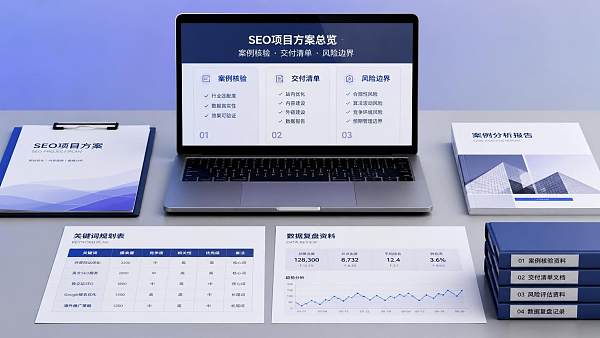
When procurement professionals search for SEO services on Google, their primary goal is usually not to learn SEO concepts, but to select a reliable service provider, reduce the cost of trial and error, and find a sustainable customer acquisition solution for their company. This means the evaluation must focus on the authenticity of results, the service scope, and execution capabilities.
This is especially true for foreign trade companies, manufacturing plants, and brands expanding overseas. SEO is not an isolated task, but a coordinated project involving the website, content, technical structure, and conversion path. If a service provider only discusses keyword rankings without addressing website fundamentals, inquiry handling, and data attribution, procurement risks are often underestimated.
Therefore, the most important question in this type of purchasing decision is not “Can they do SEO?” but “Can they turn SEO into a long-term, effective customer acquisition channel under the company’s existing business conditions?” This is also the first threshold for assessing a service provider’s professionalism.
Why Are Case Studies More Important Than Pricing?
When comparing SEO services on Google, many procurement professionals tend to look at pricing first and promised timelines second. However, SEO project results can vary significantly, so price alone is meaningless. What really demonstrates a provider’s capabilities is what industries they have served, what results they achieved, and what methods they used.
A valuable case study is not simply a screenshot showing that a “keyword reached the first page.” It should explain the client’s background, target market, website foundation, optimization period, key actions, and changes in results. For example, how much did organic traffic increase, how many inquiries did it generate, and did the inquiry quality match the sales expectations?
When reviewing case studies, procurement professionals should prioritize three questions: Can the case be verified as authentic? Is it relevant to their own industry and market? And can the results be explained? If a service provider can only provide vague cases, conceals key data, or cannot clearly explain the logic behind the results, caution is warranted.
For B2B foreign trade companies, case studies from the same industry are particularly valuable. Different countries, product lines, and decision-making processes have different requirements for keyword strategies, content depth, and conversion pages. A team that can handle SEO for consumer products may not necessarily excel at generating inquiries for industrial products or customized products.
An Unclear Delivery Scope Is the Most Common Pitfall When Purchasing SEO Services
Many companies discover only after purchasing SEO services that the so-called “outsourced operations” consist of a small amount of content publishing and reporting, while the work that truly affects indexing, rankings, and conversions has barely begun. This is usually not an execution error, but a result of failing to clearly define the deliverables during the contract stage.
A qualified SEO service plan should at least clearly include website diagnostics, keyword strategy, content planning, page optimization, technical optimization recommendations, backlink or off-site resource strategies, a data monitoring mechanism, and periodic reviews. Without a delivery checklist, it is difficult to assess service quality later.
When making a purchase, do not ask only “How many keywords will you work on?” Also ask “Which specific pages will be optimized, what content will be delivered, how often will it be delivered, who will review it, and how will the results be tracked?” Keywords are only one part of the outcome. The real workload lies in page development and ongoing optimization.
If the company is still building its overseas website, SEO deliverables may need to extend back to the website development stage. Site architecture, URL standards, loading speed, mobile adaptability, multilingual logic, and landing page form design can all directly affect subsequent Google indexing and inquiry conversion efficiency.
Service Providers That Cannot Clearly Define Risk Boundaries Often Cause the Most Disputes Later
One frequently overlooked issue when purchasing SEO services is the definition of risk boundaries. SEO is not paid search advertising, and a service provider cannot unilaterally guarantee that a specific keyword will consistently rank first within a fixed period. Algorithm updates, website foundations, industry competition, and content availability all affect the pace of results.
Therefore, professional service providers explain in advance which results can be promised and which can only be optimized to the best of their ability. For example, they may commit to phased diagnostics, execution frequency, optimization actions, and data reviews, but they should not present uncontrollable algorithm fluctuations as guaranteed deliverables.
Procurement professionals should also pay particular attention to the risks of “black-hat” or gray-hat practices. Some teams use low-quality backlinks, scraped content, or redirect networks to boost rankings in the short term. However, once these practices are detected by Google, traffic may decline or, in more serious cases, the website may be penalized, causing a significant loss of the initial investment.
Risk boundaries also include the responsibilities of both parties. For example, can the company promptly provide product materials, case study content, technical access, and sales feedback? If these prerequisites are not clearly defined, project progress can easily slow down, and both parties may ultimately feel that “the other side did not do its job properly.”
How Should Procurement Professionals Determine Whether an SEO Service Provider Is Reliable?
First, assess whether the team has integrated capabilities across websites, content, and data. SEO is no longer simply about writing articles and building backlinks. Truly effective projects usually require website structure, content strategy, search intent, and the conversion journey to be coordinated as a whole.
Second, assess whether the service provider understands differences between overseas markets. North America, Europe, Southeast Asia, and the Middle East differ significantly in search habits, language use, and content preferences. A team that only knows how to optimize Chinese websites may not be able to effectively support customer acquisition through multilingual corporate websites or overseas standalone sites.
Third, examine whether the data framework is clear. A reliable service provider will not provide only ranking reports, but will analyze traffic, indexing, page performance, inquiry sources, and conversion performance together. What procurement professionals really need to see is whether SEO is driving business growth, rather than short-term fluctuations in a few keywords.
Fourth, determine whether the service approach matches the company’s development stage. Emerging overseas brands, manufacturing companies, and cross-border sellers have different SEO requirements. Some need to address website development and indexing first, some need to overcome competition for core keywords, while others are more concerned with inquiry quality and channel coordination.
Do Not Treat SEO as an Isolated Project; Customer Acquisition Efficiency Often Comes from a Combined Approach
For many companies, purchasing SEO services on Google alone is not necessarily the optimal solution. Especially during the new-site stage, when brand awareness is low, or in highly competitive markets, SEO usually takes time to produce results. A more reasonable strategy is to incorporate SEO into an overall digital marketing framework.
For example, while laying the foundation for SEO, a company can use advertising to obtain initial traffic and conversion data, then use that data to validate high-value keywords and page directions. This reduces the trial and error caused by relying solely on experience and helps identify high-conversion content topics more quickly.
In this combined approach, Facebook advertising is also often used to fill the traffic gap during the early stages of SEO. For cross-border e-commerce and B2B companies, it can leverage precise targeting, remarketing tracking, and daily data dashboards to help companies validate audience and creative performance more quickly.
If a service provider can offer SEO capabilities while also understanding the coordination between website development, advertising, and social media, its procurement value is usually higher. What companies ultimately need is not for one channel to appear effective in isolation, but for overall customer acquisition costs, inquiry quality, and long-term growth efficiency to continue improving.
An Evaluation Checklist for Procurement: Review These 6 Items to Avoid Making the Wrong Choice
The first item is case study authenticity. Require project examples that explain the industry, market, timeline, and logic behind the results, rather than simply providing a few ranking screenshots. The second item is the delivery checklist. Monthly actions, content volume, technical recommendations, and the review mechanism must be clearly defined.
The third item is strategic logic. Determine whether the service provider first studies the business, customers, and competitive environment before developing keyword and page strategies. The fourth item is execution capability. Confirm whether content, technical, data, and project management personnel will work together, rather than relying on a single part-time operator.
The fifth item is risk disclosure. This includes not promising absolute rankings, avoiding non-compliant practices, explaining algorithm fluctuations, and clarifying the cooperation requirements of both parties. The sixth item is the definition of objectives. Agree in advance on which results will be measured: organic traffic, qualified inquiries, growth in target pages, or an improved lead conversion rate.
If all six items can be clearly explained, procurement decisions will become much clearer. Conversely, service providers that emphasize only “low prices, guaranteed rankings, and fast results” while avoiding case details, delivery methods, and risk boundaries are often unsuitable for long-term cooperation.
Conclusion: When Purchasing SEO Services, the Key Is Not the Size of the Promise but Whether the Results Can Be Verified
For procurement professionals, choosing SEO services on Google is essentially choosing a long-term growth capability, not purchasing a short-term ranking result. Case studies help determine whether a service provider has genuinely done the work, deliverables determine whether the cooperation can be implemented, and risk boundaries determine whether the project can proceed steadily.
If a service provider has integrated capabilities in website development, SEO, advertising, and overseas marketing, and can clearly explain the objectives, execution, and risks, it is generally more likely to help a company turn its website into an overseas customer acquisition asset that can be indexed, promoted, and converted.
Therefore, during procurement, shift the focus from “How much does it cost, and how soon can we rank?” to “What have you done, how will it be delivered, what can you promise, and what risks exist?” When these questions are answered clearly, the budget is more likely to translate into long-term traffic and qualified inquiries.
Related Articles


Related Products
 Yiyingbao SaaS Intelligent Website Building and Marketing SystemYiyingbao SaaS Intelligent Website Building and Marketing System, AI-powered no-code website building, rapid creation of multilingual B2B international websites in 10 minutes, global server acceleration, AI-powered SEO optimization, helping businesses connect efficiently with global markets. The perfect integration of technology and operation makes building an international trade website remarkably simple
 AI+SEM Intelligent Advertising Marketing SystemAI+SEM drives intelligent ad creation, empowering full-funnel precision advertising marketing. The system automatically generates weekly/monthly reports, AI recommends keywords and target countries, monitors core metrics in real-time with intelligent alerts, and enables one-click high-conversion ad solutions to help quickly acquire customers and improve ROI.
 AI+SEO Dual-Engine System Optimization ServicesYiyingbao’s AI+SEO dual-engine optimization system helps foreign trade enterprises acquire high-quality organic traffic through AI-powered keyword research, content generation, and comprehensive technical optimization, significantly improving search rankings and conversion rates.
 AI+SNS Social Media Marketing SystemYingbao AI+SNS Social Media Marketing System - Precision social capture for the social media era. Supports one-click content synchronization across major platforms like Facebook and LinkedIn. AI intelligently rewrites posts for enhanced relevance. 24/7 AI customer service and user profiling analysis empower businesses to efficiently expand into global markets.
 AI+SEO营销解决方案易营宝AI+SEO营销解决方案,通过AI批量写作、智能生成TDK、精准关键词扩词等功能,全面优化网站SEO效果,提升流量与转化率。助力企业构建高效智能网站新生态。
 AI+SEM Advertising Marketing SolutionsAI+SEM Advertising Marketing Solution leverages AI technology to deeply empower SEM ad campaigns. It automatically generates weekly/monthly reports using AI, presenting account data across multiple dimensions for comprehensive insights into campaign performance and trends. The system precisely recommends keywords and target countries, intelligently generates high-conversion ad copy, and enables one-click activation of efficient campaign plans to help businesses rapidly acquire customers. Simultaneously, it monitors core metrics in real time, intelligently identifies abnormal fluctuations, and issues timely alerts to ensure stable, high-return advertising results.
 Domain Name ServicesEasyWin provides professional domain name services, including intelligent queries, one-stop registration, brand protection, and full lifecycle management, helping businesses build a digital brand image.
 EasyOperate B2C Cross-Border E-Commerce Platform & Independent WebsiteEasyStore B2C Cross-border E-commerce Independent Store is an intelligent website building and cross-border e-commerce integrated solution independently developed by EasyStore Information Technology (Beijing) Co., Ltd. The system is specially designed for small and medium-sized as well as large export enterprises, integrating 'website building, operation, marketing, advertising, and conversion' into one, helping enterprises quickly establish cross-border e-commerce independent stores to achieve brand globalization and global sales growth.
The platform supports multiple languages, multiple currencies, and multi-channel marketing, with built-in AI intelligent translation and SEO optimization systems, suitable for mainstream markets such as Southeast Asia, Europe and America, Latin America, and the Middle East, assisting Chinese manufacturing enterprises in efficiently deploying international e-commerce strategies. SSL证书易营宝提供专业SSL安全证书服务,包括单域名和泛域名证书,确保网站数据传输加密、身份验证和完整性保护,助力企业建立安全可信的在线业务环境。









