









- Which customer acquisition channels will be affected by cross-border marketing trends in 2026?Sep 06, 2026View details
- Which homogenization risks should be considered in an analysis of the AI-powered website building industry?Aug 30, 2026View details
- How Will AI Marketing Trends 2026 Change Advertising Budget AllocationAug 28, 2026View details
- Is the EV SSL certificate market shrinking or upgrading? How should companies assess certificate procurement?Aug 11, 2026View details
- Why the old AMP SEO 2020 practices no longer work and what has changed in current optimization prioritiesAug 02, 2026View details
- How to Choose Topics for an Industry News Section to Attract More Organic Search TrafficJul 29, 2026View details
How Can Core Web Vitals Improve LCP Through a CDN?
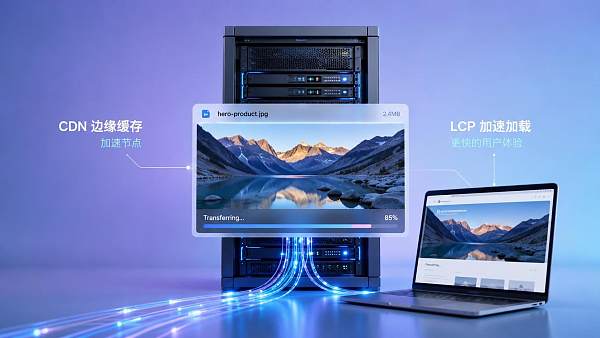
A CDN can improve LCP, but only when the page’s largest content element is actually constrained by “cross-regional transmission, origin server response, or static resource downloads.” This is common for B2B websites targeting overseas customers, multilingual sites, or advertising landing pages: users are far from the origin server, and above-the-fold hero images, product visuals, or key fonts require cross-border requests, which extends LCP. Placing resources on edge nodes closer to users can often reduce the time it takes for resources to start and finish downloading.
However, a CDN is not a tool that turns Core Web Vitals scores “green with one click.” If the LCP element itself is too large, the image format is unsuitable, the page relies on JavaScript to generate above-the-fold content, or the server is slow to return HTML, simply implementing a CDN will provide limited benefits. Operators should first determine at which stage LCP is delayed, then decide what role CDN configuration should play.
Why CDN Affects LCP
LCP measures the time required for the largest content element in the user’s viewport to finish rendering. On marketing websites, this element is usually an above-the-fold banner image, product image, video cover, large background image, or occasionally a large text block. From receiving the page to displaying this element, the browser generally goes through four steps: requesting HTML, discovering the LCP resource, downloading the resource, and completing page rendering.
A CDN is most helpful for the first three steps. Once edge nodes cache HTML, images, CSS, JavaScript, and fonts, users do not need to return to the origin server every time to retrieve files. This is especially relevant when the origin is located in a single region while visitors are distributed across North America, Europe, the Middle East, or Southeast Asia, as differences in network round-trip time will directly affect above-the-fold loading.
In the practical interplay between Core Web Vitals and CDN, the value of a CDN is not simply “greater bandwidth.” More importantly, it shortens connection paths, reuses cached content, reduces response pressure on the origin during peak periods, and enables critical above-the-fold resources to reach the browser earlier. For websites that acquire customers through Google search, ad clicks, or social media referrals, visitors often have little patience to wait. Whether above-the-fold content appears quickly affects whether they continue browsing forms, product pages, and contact information.
First Determine: At Which Stage Is LCP Slow?
Before deploying or adjusting a CDN, use PageSpeed Insights, the Performance panel in Chrome DevTools, or real user monitoring tools to review the components of LCP. Different issues require different actions; not all delays should be attributed to caching.
This distinction is important. For example, an above-the-fold image may already be returned quickly from a CDN node, but if the page still has to wait for a carousel component, tracking scripts, and third-party tags to finish executing before displaying the image, LCP can still be poor. In this case, adding more CDN nodes or increasing bandwidth capacity will generally not produce corresponding results.
The Most Effective CDN Configuration for LCP Is More Than Just “Enabling Caching”
First, ensure that the LCP image is a cacheable static resource and set an appropriate cache-control strategy. Product hero images, above-the-fold visual assets, and site-wide fonts are typically suitable for longer cache durations. When files are updated, use URLs with content version identifiers, such as filenames or query parameters that change with the version. This allows browsers and CDNs to reuse resources for longer while preventing users from continuously seeing old files after images are updated.
Second, distinguish between HTML caching and resource caching. Public pages, article pages, and landing pages on B2B websites can often use edge caching or short-term caching if their content does not depend on login status or real-time personalized information. This enables the CDN to return HTML more quickly when users request a page, allowing browsers to discover above-the-fold images sooner. Pages involving quotations, accounts, shopping carts, regional pricing, or dynamic inventory should use caching rules cautiously to prevent personalized content from being cached and served to other visitors.
Third, ensure the LCP resource uses the correct resource path. A common mistake is that the page’s main image still points to an old domain, third-party image hosting service, or an object storage domain that is not CDN-accelerated. Although other page files may already be accelerated, the most important image may still be fetched cross-border from the origin. In the browser’s Network panel, confirm the final requested domain, cache status, protocol negotiation, and response headers for the main image, rather than only checking whether the CDN console displays “connected.”
Fourth, avoid including the above-the-fold main image in lazy loading. Image lazy loading is suitable for content below the fold; if the largest content image uses loading="lazy", the browser may delay the request and offset the transmission benefits brought by the CDN. Above-the-fold images should appear directly in the HTML, have explicit dimensions, and use a standard <img> structure whenever possible rather than being dynamically created by scripts. For hero visuals that genuinely require preloading, resource hints can be configured carefully, but they should cover only one clearly defined LCP candidate resource rather than preloading a large number of images.
Image Optimization Determines the Upper Limit of CDN Benefits
A CDN can transfer files faster, but it cannot change the fact that a file itself is too large. An original product image suitable for desktop display will still slow down LCP if it is downloaded directly on mobile devices. A more reasonable approach is to provide multiple sizes based on display areas, allowing the browser to select an appropriate version according to screen width. At the same time, use modern formats such as WebP or AVIF while retaining a compatibility strategy. The pixel dimensions of an image should be close to its actual display dimensions, avoiding the practice of scaling down oversized original images on the page.
Many website-building systems configure banners as CSS background images to facilitate text overlays and responsive layouts. This approach is not unusable, but it requires checking when the browser can download the background image: if the CSS file downloads late, or the background image is replaced by a subsequent script, the LCP resource discovery time will be delayed. When above-the-fold performance is the priority, scenarios where semantic image elements can be used are generally easier to manage in terms of loading priority, responsive images, and reserved dimensions.
Several Easily Overlooked Exceptions
Cross-regional access does not mean all resources should be cached aggressively. Third-party customer service tools, maps, video players, analytics scripts, and advertising pixels often come from external domains, and a CDN cannot directly accelerate them. If they block rendering during the above-the-fold stage, assess whether they can be loaded later, loaded asynchronously, or initialized only after user interaction.
Another misconception is treating a cache hit as the final result. For first visits, expired caches, nodes that have not been warmed up, and regions with lower traffic volume, the CDN may still need to fetch from the origin. After launch, check first-visit and repeat-visit performance separately across target markets, and pay attention to the actual request chain of the LCP element. For multilingual websites, also confirm that language paths, image variants, and redirect rules do not direct visitors to distant origin servers or cause repeated redirects.
For operators, acceptance testing after CDN optimization should not focus solely on homepage scores. Select pages that actually perform customer acquisition functions—advertising landing pages, key product pages, category pages, and multilingual homepages—and check above-the-fold resources under different regions, mobile networks, and cold-cache conditions. Only when HTML can be returned consistently and quickly, correctly sized main images are prioritized, and scripts do not delay rendering can a CDN truly translate into LCP improvement, rather than merely adding another configuration to the technology stack.
Related Articles

Related Products
 Yiyingbao SaaS Intelligent Website Building and Marketing SystemYiyingbao SaaS Intelligent Website Building and Marketing System, AI-powered no-code website building, rapid creation of multilingual B2B international websites in 10 minutes, global server acceleration, AI-powered SEO optimization, helping businesses connect efficiently with global markets. The perfect integration of technology and operation makes building an international trade website remarkably simple
 AI+SEM Intelligent Advertising Marketing SystemAI+SEM drives intelligent ad creation, empowering full-funnel precision advertising marketing. The system automatically generates weekly/monthly reports, AI recommends keywords and target countries, monitors core metrics in real-time with intelligent alerts, and enables one-click high-conversion ad solutions to help quickly acquire customers and improve ROI.
 AI+SEO Dual-Engine System Optimization ServicesYiyingbao’s AI+SEO dual-engine optimization system helps foreign trade enterprises acquire high-quality organic traffic through AI-powered keyword research, content generation, and comprehensive technical optimization, significantly improving search rankings and conversion rates.
 AI+SNS Social Media Marketing SystemYingbao AI+SNS Social Media Marketing System - Precision social capture for the social media era. Supports one-click content synchronization across major platforms like Facebook and LinkedIn. AI intelligently rewrites posts for enhanced relevance. 24/7 AI customer service and user profiling analysis empower businesses to efficiently expand into global markets.
 AI+SEO营销解决方案易营宝AI+SEO营销解决方案,通过AI批量写作、智能生成TDK、精准关键词扩词等功能,全面优化网站SEO效果,提升流量与转化率。助力企业构建高效智能网站新生态。
 AI+SEM Advertising Marketing SolutionsAI+SEM Advertising Marketing Solution leverages AI technology to deeply empower SEM ad campaigns. It automatically generates weekly/monthly reports using AI, presenting account data across multiple dimensions for comprehensive insights into campaign performance and trends. The system precisely recommends keywords and target countries, intelligently generates high-conversion ad copy, and enables one-click activation of efficient campaign plans to help businesses rapidly acquire customers. Simultaneously, it monitors core metrics in real time, intelligently identifies abnormal fluctuations, and issues timely alerts to ensure stable, high-return advertising results.
 Domain Name ServicesEasyWin provides professional domain name services, including intelligent queries, one-stop registration, brand protection, and full lifecycle management, helping businesses build a digital brand image.
 EasyOperate B2C Cross-Border E-Commerce Platform & Independent WebsiteEasyStore B2C Cross-border E-commerce Independent Store is an intelligent website building and cross-border e-commerce integrated solution independently developed by EasyStore Information Technology (Beijing) Co., Ltd. The system is specially designed for small and medium-sized as well as large export enterprises, integrating 'website building, operation, marketing, advertising, and conversion' into one, helping enterprises quickly establish cross-border e-commerce independent stores to achieve brand globalization and global sales growth.
The platform supports multiple languages, multiple currencies, and multi-channel marketing, with built-in AI intelligent translation and SEO optimization systems, suitable for mainstream markets such as Southeast Asia, Europe and America, Latin America, and the Middle East, assisting Chinese manufacturing enterprises in efficiently deploying international e-commerce strategies. SSL证书易营宝提供专业SSL安全证书服务,包括单域名和泛域名证书,确保网站数据传输加密、身份验证和完整性保护,助力企业建立安全可信的在线业务环境。









