









- EU Plans to Raise Tax on Incoming Small Parcels to €5Oct 31, 2026View details
- Maersk Adjusts Middle East Emergency Operating Cost Recovery Surcharge to USD 2,000 per ContainerOct 30, 2026View details
- Ministry of Commerce: Online retail sales grew 4.4% in the first three quarters, while cross-border e-commerce maintained relatively rapid growthOct 29, 2026View details
- CCTV reports: AI-powered smart hardware is expanding overseas at a faster pace, with orders for some best-selling products booked through next yearOct 29, 2026View details
- Alphabet Q3 Earnings: Google Search Advertising Revenue Rises 10.5% to $82 BillionOct 29, 2026View details
- AliExpress Announces New Service Rules for Russia, Linked to Wildberries Product IntegrationOct 28, 2026View details
How to choose an agency to improve AI search visibility?
When choosing an agency to improve AI search visibility, first check whether it can explain who it targets, which platforms it works on, and what results it aims to achieve through what content. Then assess whether it can deliver website improvements, content production, and ongoing evaluation. Screenshots showing a few brands mentioned by AI, or promises of fixed rankings, are not enough to support a purchasing decision.
If your company already has a website for its target market, reasonably complete product information, and clear inquiry or sales goals, AI search visibility can be included in your existing marketing evaluation. By contrast, if the website is not accessible, product information has long been missing, or the target market has not yet been determined, it is usually more sensible to address these fundamentals first. Companies searching for “AI search visibility agency recommendations” should also confirm that the provider has expertise in Korean-language content and target-market research, rather than offering only generic Chinese or English solutions.
First, clarify what kind of visibility you want to improve
“Visibility” in AI search can take several forms: a brand may be mentioned directly, a website page may appear as a source, or product information may be used to answer a particular type of question. These outcomes have different commercial value. For export manufacturers, when potential customers ask about product specifications, supply capabilities, and purchasing terms, having relevant pages found and accurately cited is often more meaningful than having the brand appear once in a broad query.
Business evaluators can start by preparing a set of questions closely related to the purchasing process, such as “Which applications are suitable for this type of equipment?” and “How can the technical specifications of different suppliers be compared?” Then agree with the provider on the target language, region, platforms, and scope of questions. If your company serves both Korean- and English-speaking markets, check separately that the language and content are appropriate for each. A mechanically translated product catalog may not answer the questions local purchasing professionals care about.
During initial discussions, also ask the provider to explain the scope of its work: does it only offer content recommendations, or will it also address website structure, page information, technical issues, and ongoing monitoring? If your company wants to turn visibility into inquiries, product pages, contact options, and form usability should also be included in the evaluation. A brand appearing in an AI answer does not automatically mean that customers will visit the website, much less generate qualified business opportunities.
Assess the provider’s capabilities through its deliverables
A sound proposal should connect the current situation, identified issues, and recommended actions. For example, for the target questions, it should identify which pages already contain relevant information and which lack specifications, application conditions, or credible company information; it should also explain which issues can be resolved by revising existing pages and which require additional information from your company. This assessment is easier to verify than a vague “AI optimization plan.”
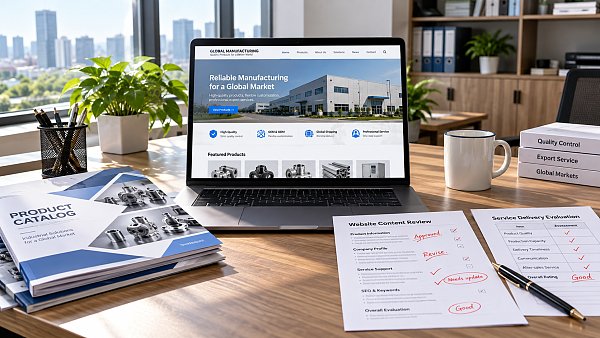
During evaluation, you can ask the provider to show samples or prototypes of its proposed deliverables. Pay particular attention to the following:
- Questions and audiences: Does it distinguish between different stages, such as gathering information, comparing suppliers, and making purchasing decisions, and explain how the questions were selected?
- Website audit: Can it check fundamental issues such as page accessibility, content organization, and search engine crawling, and clarify which tasks require the client’s or website developer’s cooperation?
- Content quality: Is the content organized around product facts, conditions of use, and common purchasing questions? Are qualified professionals assigned to review it, rather than generating large volumes of unsupported articles?
- Execution and review: Are deliverables such as page revisions, content publication, and monitoring reports specified, along with the person responsible for each task and the acceptance criteria?
Website development, SEO, and AI search optimization overlap: pages need to be accessible, information needs to be clear, and content needs to be easy for users to understand. However, improved traditional search rankings do not necessarily lead to citations in AI answers, and AI visibility services cannot replace product positioning or sales work. A team that can provide website development, search optimization, and content services may reduce coordination costs; when procuring these services, you should still verify the actual personnel involved and the scope of each deliverable.
How to identify unreliable promises
First, be wary of claims such as “guaranteed inclusion in AI answers” or “guaranteed first place in the rankings long term.” AI answers are affected by factors such as how a question is phrased, location, language, platform mechanisms, and timing. Even a slight change in wording can produce a different result. A provider can commit to the scope of work, reporting frequency, and response procedures, but it is difficult to reasonably guarantee a fixed display position in all circumstances.
Second, examine how the provider plans to gain visibility. If its approach relies on large volumes of duplicate content, unreviewed product descriptions, or unverifiable information spread across third-party pages, it may damage brand credibility even if it generates mentions in the short term. Your company should retain the right to verify facts in content covering technical specifications, certifications, lead times, and pricing. The provider should not add unverified specifications on its own.
Third-party mentions should also be assessed by quality. Industry directories, media coverage, and other external pages may influence potential customers’ perceptions of your company, but the provider should explain the types of sources, how they are secured, and any associated costs. Paid placements, sponsored content, and independent reviews are different in nature and should not be presented collectively as objective recommendations. When evaluating external channels, relevance and accuracy matter more than simply pursuing a high number of placements.
How to sign the contract and evaluate results
Consider starting with a pilot focused on one target market, one product category, or a defined set of purchasing questions. The pilot does not need to cover the entire business, but it should include the necessary website checks, content adjustments, and before-and-after comparisons; otherwise, it will be difficult to determine whether the provider’s work is suitable for further expansion.
The contract should specify the service period, target languages and platforms, specific deliverables, client responsibilities, and ownership of content and accounts. For website backends, analytics tools, or advertising accounts, prioritize accounts that your company can manage and assign permissions according to work requirements. After the project ends, your company should be able to continue using the delivered and paid-for website content, data, and materials; third-party licensed content should be handled as agreed.
Acceptance should not be based on a single screenshot. At the start of the project, the parties can record answers, brand mentions, and source links for a representative set of questions, then review them under the same conditions at agreed intervals, while noting the time of each query, language, region, and testing method. AI answers fluctuate, so observed results should be treated as indicators of trends, not as evidence for precise attribution.
Business results should also be tracked separately: how much traffic comes from identifiable relevant channels, whether visitors view product pages or submit inquiries, and how the sales team assesses lead quality. Not all AI-driven visits can be fully identified, so exposure counts should not be simply converted into sales revenue. A more prudent choice is a provider that clearly specifies the work it can control, explains which results cannot be guaranteed and the limitations of measurement, and lets you decide whether to renew based on the pilot’s performance.
Related Articles
 How to choose an agency to improve AI search visibility?
 How Does Structured Content Help AI Search Understand Webpages?
 Study Finds Google AI Mode Directs 57% of Product Links to Google Shopping

Related Products
 Yiyingbao SaaS Intelligent Website Building and Marketing SystemYiyingbao SaaS Intelligent Website Building and Marketing System, AI-powered no-code website building, rapid creation of multilingual B2B international websites in 10 minutes, global server acceleration, AI-powered SEO optimization, helping businesses connect efficiently with global markets. The perfect integration of technology and operation makes building an international trade website remarkably simple
 AI+SEM Intelligent Advertising Marketing SystemAI+SEM drives intelligent ad creation, empowering full-funnel precision advertising marketing. The system automatically generates weekly/monthly reports, AI recommends keywords and target countries, monitors core metrics in real-time with intelligent alerts, and enables one-click high-conversion ad solutions to help quickly acquire customers and improve ROI.
 AI+SEO Dual-Engine System Optimization ServicesYiyingbao’s AI+SEO dual-engine optimization system helps foreign trade enterprises acquire high-quality organic traffic through AI-powered keyword research, content generation, and comprehensive technical optimization, significantly improving search rankings and conversion rates.
 AI+SNS Social Media Marketing SystemYingbao AI+SNS Social Media Marketing System - Precision social capture for the social media era. Supports one-click content synchronization across major platforms like Facebook and LinkedIn. AI intelligently rewrites posts for enhanced relevance. 24/7 AI customer service and user profiling analysis empower businesses to efficiently expand into global markets.
 AI+SEO营销解决方案易营宝AI+SEO营销解决方案,通过AI批量写作、智能生成TDK、精准关键词扩词等功能,全面优化网站SEO效果,提升流量与转化率。助力企业构建高效智能网站新生态。
 AI+SEM Advertising Marketing SolutionsAI+SEM Advertising Marketing Solution leverages AI technology to deeply empower SEM ad campaigns. It automatically generates weekly/monthly reports using AI, presenting account data across multiple dimensions for comprehensive insights into campaign performance and trends. The system precisely recommends keywords and target countries, intelligently generates high-conversion ad copy, and enables one-click activation of efficient campaign plans to help businesses rapidly acquire customers. Simultaneously, it monitors core metrics in real time, intelligently identifies abnormal fluctuations, and issues timely alerts to ensure stable, high-return advertising results.
 Domain Name ServicesEasyWin provides professional domain name services, including intelligent queries, one-stop registration, brand protection, and full lifecycle management, helping businesses build a digital brand image.
 EasyOperate B2C Cross-Border E-Commerce Platform & Independent WebsiteEasyStore B2C Cross-border E-commerce Independent Store is an intelligent website building and cross-border e-commerce integrated solution independently developed by EasyStore Information Technology (Beijing) Co., Ltd. The system is specially designed for small and medium-sized as well as large export enterprises, integrating 'website building, operation, marketing, advertising, and conversion' into one, helping enterprises quickly establish cross-border e-commerce independent stores to achieve brand globalization and global sales growth.
The platform supports multiple languages, multiple currencies, and multi-channel marketing, with built-in AI intelligent translation and SEO optimization systems, suitable for mainstream markets such as Southeast Asia, Europe and America, Latin America, and the Middle East, assisting Chinese manufacturing enterprises in efficiently deploying international e-commerce strategies. SSL证书易营宝提供专业SSL安全证书服务,包括单域名和泛域名证书,确保网站数据传输加密、身份验证和完整性保护,助力企业建立安全可信的在线业务环境。









