









- How to Choose Topics for an Industry News Section to Attract More Organic Search TrafficJul 29, 2026View details
- Can Zhejiang foreign trade independent websites still be developed today? Look at changes in traffic and lead generationJul 28, 2026View details
- What New Signals Are Emerging in Enterprise Services SaaS Marketing ReportsJul 27, 2026View details
- What Does a Global Traffic Ecosystem Service Provider Do? What Are the Differences from a Single Advertising AgencyJul 16, 2026View details
- What should you focus on in the latest enterprise SaaS report? From renewal rates and delivery costs to overseas growth opportunitiesJul 12, 2026View details
- What signals are worth paying attention to in a cross-border marketing trend report? B2B companies should look at these 6 signalsJul 11, 2026View details
How to get your website recommended by AI search?First build a content structure suitable for citation
How Can You Get Your Website Recommended by AI Search? First Check Whether the Content Architecture Is Suitable for Citation
If you want to know how to get your website recommended by AI search, many people first think of publishing more articles. This direction cannot be said to be wrong, but it is often not enough. AI search places greater emphasis on whether content can be quickly understood, accurately positioned, and stably cited.
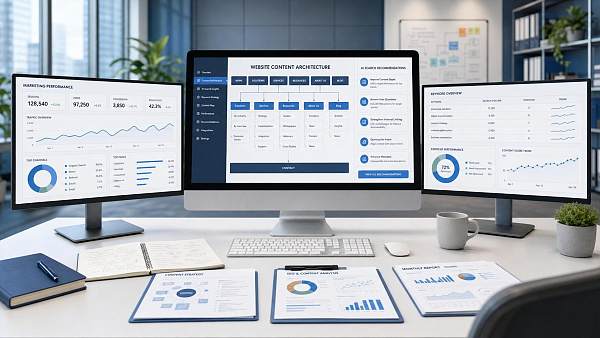
For technical evaluation, content architecture is more critical than content volume. This is because when an AI system crawls information, it does not only read the page text, but also judges topic boundaries, entity relationships, field completeness, and the logical connections between pages.
This also means that the core of how to get a website recommended by AI search is not simply writing more, but first building a content architecture suitable for citation. Only when the structure is clear can AI extract it; only when the relationships are explicit can AI feel confident recommending it.
Why AI Search Pays More Attention to Content Architecture
Traditional search tends to focus on links, titles, and keyword matching. AI search goes a step further by integrating information from multiple pages to generate answers, summaries, and recommendations. Therefore, page content must have characteristics that are decomposable, verifiable, and reusable.
If a website only has scattered pages, without unified naming rules, stable sections, or clear primary and secondary relationships, even if the content itself is good, it will still be difficult to become a preferred source recommended by AI search.
Judging from recent changes, AI search recommendations rely more on “citable units.” For example, definitions, steps, parameters, case conclusions, applicable scenarios, and comparison tables. If this content is clearly structured, it is more likely to be called.
What Types of Pages Are Easier for AI to Cite
- A single topic with a clear page objective
- Consistent hierarchy across the title, summary, and body text
- Short paragraphs with clear answer boundaries
- Standardized fields and structured information included
- Source logic and contextual relevance
Therefore, when discussing how to get a website recommended by AI search, you cannot stop at content update frequency; you need to move into architecture design. When the content architecture is done well, subsequent SEO, GEO, and conversion engagement will all be smoother.
A Content Architecture Suitable for AI Search Recommendations Should Include at Least Four Layers
A website that can be recognized and recommended by AI usually does not rely on the performance of a single page, but on the content relationships across the entire site. During actual construction, it is recommended to plan at least a four-layer structure.
Layer 1: Topic Layer
The topic layer determines “who you are” in the eyes of AI. Each primary topic should remain stable, avoiding discussing website building today, logistics tomorrow, and then suddenly shifting to finance and tax the day after tomorrow, which would cause topic signals to become scattered.
Layer 2: Scenario Layer
The scenario layer answers “who you help solve what problems.” For example, website building for foreign trade enterprises, cross-border mall construction, multilingual official website optimization, Google SEO growth, and AI search visibility improvement are all typical scenarios.
Layer 3: Knowledge Layer
The knowledge layer is used to address technical questions, standards-related questions, and methodology questions. For example, how to design content architecture, how to do technical SEO, and how to standardize page fields are all knowledge-based content that AI search is likely to cite.
Layer 4: Evidence Layer
The evidence layer includes cases, processes, data, delivery capabilities, and product capabilities. Without an evidence layer, pages can easily remain at the statement level. AI search will also be more cautious when generating recommendations.
Taking 易营宝 as an example, it covers AI intelligent website building, multilingual website development, Google SEO optimization, advertising placement, overseas social media operations, and GEO generative engine optimization. This type of full-link capability is suitable for being divided into the topic layer, scenario layer, and evidence layer to form stable citation paths.
How to Get a Website Recommended by AI Search: Page Structure Should Be Designed This Way
If content architecture is the skeleton, then page structure is the interface. Many websites have no problem with their topic direction, but their page writing is disorganized, causing AI to be able to crawl the content but making it difficult to cite it stably.
It Is Recommended to Standardize These Five Items First
- One page answers only one main question
- Give the definition or conclusion directly at the beginning
- Use steps, comparisons, and lists to expand the middle section
- Add applicable conditions and risk reminders at the end
- Use internal links between pages to establish context
This structure is not only helpful for users to scan quickly, but also more suitable for AI to extract answer snippets. In particular, the combination of “definition + method + scenario + risk” is very effective for technical and standards-related search intent.
Recommended Field Modules to Retain
During Technical Evaluation, Focus on Checking These Three Types of Issues
In actual business, many websites do not lack content; rather, their content cannot be systematically consumed. When evaluating how to get a website recommended by AI search, it is recommended to first investigate the following three types of issues.
First: Topic Confusion
The same section contains industry news, product introductions, and operation tutorials. This weakens topic focus, making it difficult for AI to determine the core value of the section.
Second: Inconsistent Fields
Some pages describe applicable scenarios, while some pages do not; some pages have step numbering, while others are only long paragraphs of description. Inconsistent fields reduce the efficiency of content reuse.
Third: Insufficient Evidence
There are only opinions but no cases; only capability descriptions but no product pathway; only service names but no implementation scenarios. Such pages, even if crawled, are not easily recommended by AI search.
For companies integrating website and marketing services, the most effective approach is to place the website building system, SEO capabilities, advertising system, social media operations, and GEO optimization capabilities into a unified content framework, forming closed-loop evidence from entry to conversion.
From Being Indexable to Being Recommendable, It Can Be Implemented This Way
If you are promoting a content upgrade, you can start with small-scale validation and do not need to restructure the entire site at once. Around core business topics, prioritize creating a sample section suitable for AI citation.
- First determine 3 to 5 primary topics
- Break out typical scenario pages under each topic
- Build knowledge Q&A pages around scenarios
- Supplement case, data, and product evidence pages
- Unify page fields, titles, and internal linking rules
A company like 易营宝, an AI-driven enterprise-level SaaS platform, already has capabilities in intelligent website building, cross-border malls, AI advertising marketing, and AI+SEO/GEO optimization. Turning these capabilities into standardized content nodes is essentially improving visibility for AI search recommendations.
Returning to the initial question, how to get a website recommended by AI search is not a mystery. First build the right content architecture, then make the page structure extractable, connectable, and verifiable. Only then will the website have a better chance of moving from “being indexed” to “being recommended.”
The next thing most worth doing is not continuing to pile up pages, but first checking whether existing sections have clear topics, unified fields, and evidence chains. Once these three things are completed, AI search visibility usually shows results faster than simply adding more content.
Related Articles


Related Products
 Yiyingbao SaaS Intelligent Website Building and Marketing SystemYiyingbao SaaS Intelligent Website Building and Marketing System, AI-powered no-code website building, rapid creation of multilingual B2B international websites in 10 minutes, global server acceleration, AI-powered SEO optimization, helping businesses connect efficiently with global markets. The perfect integration of technology and operation makes building an international trade website remarkably simple
 AI+SEM Intelligent Advertising Marketing SystemAI+SEM drives intelligent ad creation, empowering full-funnel precision advertising marketing. The system automatically generates weekly/monthly reports, AI recommends keywords and target countries, monitors core metrics in real-time with intelligent alerts, and enables one-click high-conversion ad solutions to help quickly acquire customers and improve ROI.
 AI+SEO Dual-Engine System Optimization ServicesYiyingbao’s AI+SEO dual-engine optimization system helps foreign trade enterprises acquire high-quality organic traffic through AI-powered keyword research, content generation, and comprehensive technical optimization, significantly improving search rankings and conversion rates.
 AI+SNS Social Media Marketing SystemYingbao AI+SNS Social Media Marketing System - Precision social capture for the social media era. Supports one-click content synchronization across major platforms like Facebook and LinkedIn. AI intelligently rewrites posts for enhanced relevance. 24/7 AI customer service and user profiling analysis empower businesses to efficiently expand into global markets.
 AI+SEO营销解决方案易营宝AI+SEO营销解决方案,通过AI批量写作、智能生成TDK、精准关键词扩词等功能,全面优化网站SEO效果,提升流量与转化率。助力企业构建高效智能网站新生态。
 AI+SEM Advertising Marketing SolutionsAI+SEM Advertising Marketing Solution leverages AI technology to deeply empower SEM ad campaigns. It automatically generates weekly/monthly reports using AI, presenting account data across multiple dimensions for comprehensive insights into campaign performance and trends. The system precisely recommends keywords and target countries, intelligently generates high-conversion ad copy, and enables one-click activation of efficient campaign plans to help businesses rapidly acquire customers. Simultaneously, it monitors core metrics in real time, intelligently identifies abnormal fluctuations, and issues timely alerts to ensure stable, high-return advertising results.
 Domain Name ServicesEasyWin provides professional domain name services, including intelligent queries, one-stop registration, brand protection, and full lifecycle management, helping businesses build a digital brand image.
 EasyOperate B2C Cross-Border E-Commerce Platform & Independent WebsiteEasyStore B2C Cross-border E-commerce Independent Store is an intelligent website building and cross-border e-commerce integrated solution independently developed by EasyStore Information Technology (Beijing) Co., Ltd. The system is specially designed for small and medium-sized as well as large export enterprises, integrating 'website building, operation, marketing, advertising, and conversion' into one, helping enterprises quickly establish cross-border e-commerce independent stores to achieve brand globalization and global sales growth.
The platform supports multiple languages, multiple currencies, and multi-channel marketing, with built-in AI intelligent translation and SEO optimization systems, suitable for mainstream markets such as Southeast Asia, Europe and America, Latin America, and the Middle East, assisting Chinese manufacturing enterprises in efficiently deploying international e-commerce strategies. SSL证书易营宝提供专业SSL安全证书服务,包括单域名和泛域名证书,确保网站数据传输加密、身份验证和完整性保护,助力企业建立安全可信的在线业务环境。









