









- Fujian Announces the First Batch of Provincial-Level Cross-Border E-Commerce Industrial Parks and Key Brands for CultivationNov 14, 2026View details
- Amazon Global Store Announces the Launch of the 2026 Black Friday Global Shopping SeasonNov 14, 2026View details
- CCTV.com Examines APEC’s Role in China’s Foreign TradeNov 12, 2026View details
- China’s Tariff Commission of the State Council Adjusts Additional Tariffs on U.S. Goods: 24% Tariff Suspended for Two MonthsNov 10, 2026View details
- APEC Shenzhen Spotlight: Cross-Border E-Commerce Orders Promote Asia-Pacific Trade and Economic CooperationNov 08, 2026View details
- China-Europe Railway Express and CIIE Hold Business Matchmaking Event, Focusing on Cross-Border E-commerce B2B ExportsNov 07, 2026View details
How can you assess your company website’s visibility in AI search?
Assessing a company website’s visibility in AI search requires more than checking whether its brand name appears in an answer. More useful questions are whether target pages can be retrieved and read, whether the website is cited in response to relevant queries, and whether the cited content accurately supports the answer. If any of these elements is missing, you may mistakenly believe the website has visibility without being able to verify its business value.
Search indexing, mentions in AI answers, and source citations are not the same thing. Different products may use different retrieval sources, crawling mechanisms, and generation methods. Even when the same question is asked repeatedly, the answers may vary. Therefore, assessing “AI search visibility” calls for a set of reproducible questions and evidence, rather than relying on a single screenshot.
Build a Reproducible Test Set Around Business Questions
First, define the platforms, target countries or regions, languages, and testing period. Then organize questions around real business needs. For industrial export websites, test questions can cover product specifications, operating conditions, supply capabilities, and selection comparisons—for example, “What configurations are required for heavy-duty vehicles used in port transport?”—rather than simply searching for the company name.
Include both branded and non-branded queries: branded queries help check whether company information is accurate, while non-branded queries show whether the website can enter potential customers’ research process. Also cover different ways of phrasing questions, such as local languages, industry terminology, and common abbreviations, while avoiding a test set made up only of questions favorable to the company.
At a minimum, test records should include the original query, platform and mode, region and language, test time, answer, whether the brand appeared, whether a source link was provided, the cited URL, and the relevant statement. Run multiple independent tests for the same query and retain the results; do not save only the best-performing result. If possible, test both while logged out and with a commonly used account, noting any differences that may stem from personalization or prior context.

Check Discoverability, Citation, and Accurate Interpretation Separately
Search coverage. Check whether key pages can be found through regular search, and use search engine webmaster tools to review index status, crawl errors, and sitemaps. A page’s absence from search results is a signal worth investigating, but a site search operator alone cannot conclusively prove that the page is not indexed. Conversely, a page being indexed does not mean that a particular AI product will retrieve or cite it.
Appearance in answers. Record whether the brand, product, or specific page appears in an answer, and distinguish between “being mentioned” and “being accompanied by an accessible source link.” A brand may appear in an answer based on the company website or third-party information. If there is no citation to check, do not assume that the company website was used.
Citation quality. Open each cited link and check whether the page supports the specific claims in the answer. For example, if an answer says that a company serves a particular region, confirm that the cited page clearly states the service area, applicable conditions, and when the information was updated. Flag separately cases where the homepage is cited but contains no relevant evidence, or where the cited page does not match the answer’s conclusion.
You can analyze results separately by platform, query type, and language. For example, calculate “the number of test queries for which an official website link appeared at least once ÷ the total number of test queries in that set” as the official website citation coverage for that test set. You can also calculate “the number of cited statements that were supported ÷ the number of verifiable citations” to assess citation accuracy. These are internal comparison metrics only; they do not represent official platform rankings and should not be compared directly across different test sets.
Check Whether Machines Can Read the Page, Not Just How It Looks
The specific mechanisms used by AI search are not fully public, but websites can check basic access conditions: whether pages return a normal status code, and whether they are affected by login walls, regional restrictions, anti-crawling measures, or unusual redirects; and whether robots.txt or page-level robot directives restrict relevant crawling. Different platforms may use different crawlers for different purposes. Before changing rules, consult the relevant platform’s public documentation and distinguish search crawling from other uses. Do not open access indiscriminately just to pursue visibility.
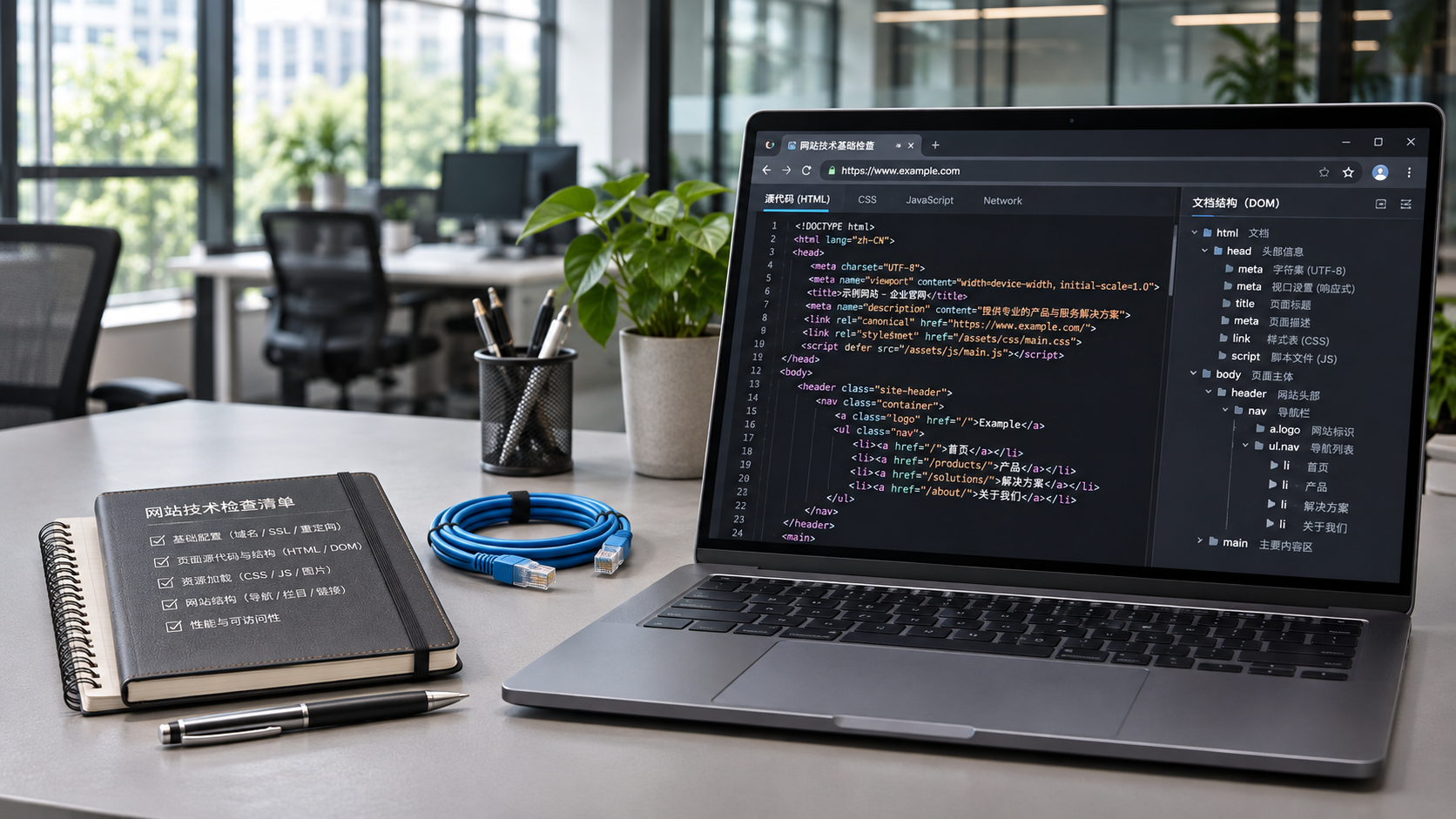
Next, check the HTML actually returned and the rendered page. If product specifications exist only in images, interactive components, or content that loads only after user interaction, visitors may be able to see them, but that does not mean every crawling and parsing process can reliably access them. Key specifications, application scope, certification details, and contact information should be available as readable text. Also check page titles, canonical links, language versions, and language annotations to avoid confusion between pages for different regions.
For example, the industrial portal scenario involving heavy-duty vehicles, logistics may use an interactive map to show overseas business coverage and a product search center to present different categories. When assessing such a site, also confirm whether the regions shown on the map, product categories, and key specifications are available in text or on accessible pages. A complete map or dashboard display does not automatically mean its data will become citable evidence in AI answers.
Structured data can help search systems understand page entities and attributes, but it should match the visible page content and does not guarantee citation. Multilingual sites should also verify units, model numbers, and regional names in translated content: even if technical information can be crawled, translation or unit errors may still lead to inaccurate answers.
Use Logs and Retesting to Locate Issues—Don’t Mistake Correlation for Causation
When a page does not appear in a target answer, investigate in order: Does the target platform provide source links? Can the relevant page be accessed and indexed? Does it directly answer the test query? Are the facts on the page specific and presented with context? Website server logs can help confirm visits from recognized crawlers, but a page being crawled does not mean it was used to generate an answer. Likewise, not observing a crawl does not, by itself, prove that the platform did not obtain the information through another route.
After updating a page, retain the before-and-after versions and testing conditions, then retest in batches using the same query set. An increase in citation coverage only shows that the test results changed; the platform model, retrieval results, and external information may also have changed, so a before-and-after comparison alone cannot establish that a particular change caused the result. For key pages, prioritize fixing accessibility, factual accuracy, and content gaps, then monitor subsequent performance.
Ultimately, the assessment should address specific questions: Can key questions in the target market consistently surface company information? Do citations point to appropriate pages? Are claims about product capabilities and business scope in the answers supported by evidence? These verifiable results are a more suitable basis for website technical optimization than seeking brand exposure in a single answer.
Related Articles
 How Can GEO Optimization Increase the Chances of Content Being Cited in AI Search Results?
 OpenAI tests Business in ChatGPT, allowing merchants to create profiles and business agents
 Google: Technical SEO Remains an Important Foundation for AI Search Visibility

Related Products
 Yiyingbao SaaS Intelligent Website Building and Marketing SystemYiyingbao SaaS Intelligent Website Building and Marketing System, AI-powered no-code website building, rapid creation of multilingual B2B international websites in 10 minutes, global server acceleration, AI-powered SEO optimization, helping businesses connect efficiently with global markets. The perfect integration of technology and operation makes building an international trade website remarkably simple
 AI+SEM Intelligent Advertising Marketing SystemAI+SEM drives intelligent ad creation, empowering full-funnel precision advertising marketing. The system automatically generates weekly/monthly reports, AI recommends keywords and target countries, monitors core metrics in real-time with intelligent alerts, and enables one-click high-conversion ad solutions to help quickly acquire customers and improve ROI.
 AI+SEO Dual-Engine System Optimization ServicesYiyingbao’s AI+SEO dual-engine optimization system helps foreign trade enterprises acquire high-quality organic traffic through AI-powered keyword research, content generation, and comprehensive technical optimization, significantly improving search rankings and conversion rates.
 AI+SNS Social Media Marketing SystemYingbao AI+SNS Social Media Marketing System - Precision social capture for the social media era. Supports one-click content synchronization across major platforms like Facebook and LinkedIn. AI intelligently rewrites posts for enhanced relevance. 24/7 AI customer service and user profiling analysis empower businesses to efficiently expand into global markets.
 AI+SEO营销解决方案易营宝AI+SEO营销解决方案,通过AI批量写作、智能生成TDK、精准关键词扩词等功能,全面优化网站SEO效果,提升流量与转化率。助力企业构建高效智能网站新生态。
 AI+SEM Advertising Marketing SolutionsAI+SEM Advertising Marketing Solution leverages AI technology to deeply empower SEM ad campaigns. It automatically generates weekly/monthly reports using AI, presenting account data across multiple dimensions for comprehensive insights into campaign performance and trends. The system precisely recommends keywords and target countries, intelligently generates high-conversion ad copy, and enables one-click activation of efficient campaign plans to help businesses rapidly acquire customers. Simultaneously, it monitors core metrics in real time, intelligently identifies abnormal fluctuations, and issues timely alerts to ensure stable, high-return advertising results.
 Domain Name ServicesEasyWin provides professional domain name services, including intelligent queries, one-stop registration, brand protection, and full lifecycle management, helping businesses build a digital brand image.
 EasyOperate B2C Cross-Border E-Commerce Platform & Independent WebsiteEasyStore B2C Cross-border E-commerce Independent Store is an intelligent website building and cross-border e-commerce integrated solution independently developed by EasyStore Information Technology (Beijing) Co., Ltd. The system is specially designed for small and medium-sized as well as large export enterprises, integrating 'website building, operation, marketing, advertising, and conversion' into one, helping enterprises quickly establish cross-border e-commerce independent stores to achieve brand globalization and global sales growth.
The platform supports multiple languages, multiple currencies, and multi-channel marketing, with built-in AI intelligent translation and SEO optimization systems, suitable for mainstream markets such as Southeast Asia, Europe and America, Latin America, and the Middle East, assisting Chinese manufacturing enterprises in efficiently deploying international e-commerce strategies. SSL证书易营宝提供专业SSL安全证书服务,包括单域名和泛域名证书,确保网站数据传输加密、身份验证和完整性保护,助力企业建立安全可信的在线业务环境。









