









- Can the average annual growth rate reflect real opportunities in overseas markets?Oct 07, 2026View details
- Which customer acquisition channels will be affected by cross-border marketing trends in 2026?Sep 06, 2026View details
- Which homogenization risks should be considered in an analysis of the AI-powered website building industry?Aug 30, 2026View details
- How Will AI Marketing Trends 2026 Change Advertising Budget AllocationAug 28, 2026View details
- Is the EV SSL certificate market shrinking or upgrading? How should companies assess certificate procurement?Aug 11, 2026View details
- Why the old AMP SEO 2020 practices no longer work and what has changed in current optimization prioritiesAug 02, 2026View details
How to Choose Japanese Q&A Topics for AI Search Optimization in the Japanese Market
The Japanese-language page is live and the Q&A has been updated, but you still may not know which topics to prioritize. Translating Chinese questions directly can lead to content that is grammatically correct but does not reflect how Japanese users actually ask questions. Chasing popular terms alone may attract traffic unrelated to your business. When optimizing for AI search in the Japanese market, prioritize topics that meet three conditions: users genuinely ask about them, your company has evidence to answer them, and the answers help users make their next decision—rather than aiming to maximize the number of questions first.
In practice, start by collecting the questions Japanese users actually ask. Then group them by use case and decision stage, and determine the publishing order based on business relevance and the completeness of your supporting evidence. Review the Japanese wording after screening the topics, so you do not spend time polishing questions that are not worth addressing in the first place.
Start with real questions, not bulk translations of Chinese keywords
First, organize existing Japanese-language inquiries, presales emails, on-site search terms, and after-sales records. Pay particular attention to the applications, constraints, and concerns users mention, such as lead times, compatibility, installation requirements, and maintenance costs. If you have no Japanese-language inquiry records, you can review related questions in search results for your target market, public discussions, and descriptions of similar products. However, these are only clues to potential needs and cannot, on their own, prove the scale of market demand.
When building a topic-planning sheet, record at least the “original question, source, specific scenario, available answer materials, and relevant page” for each topic. Questions that recur or directly affect pricing, trials, or purchases are usually more worthwhile to prioritize than topics with only broad search interest. Do not automatically discard questions that arise infrequently but concern critical compatibility requirements.
For example, “What are the product’s advantages?” is often what a company wants to talk about. “Can it be used with existing equipment?” and “What installation requirements should I consider when replacing it?” are closer to the tasks users need to solve. Start with the latter, then decide which product information needs to be included.
Frame Japanese questions around users’ decision-making tasks
For Japanese-language topics, simply replacing words with Japanese is not enough. Search phrases, full questions, and page titles can differ, but they must address the same need. The examples below use industrial components to illustrate possible questions; they are not verified popular search terms:
Do not write every title in the form “〜とは” (“What is...?”). Definition-style questions are useful for explaining concepts, but may not help users select a product. When users need to compare options, specify the items and conditions being compared; when they need to troubleshoot, state the symptom. After drafting, check commonly used industry terminology, units, and conventional expressions in Japanese. Do not treat correct honorifics as the sole standard of localization.
When there are many candidate topics, what should you publish first?
Assess each topic by asking three questions: Does it relate to a real business need? Can your existing materials provide a clear answer? After reading it, will users know what to compare, what to prepare, or how to proceed? Prioritize topics that meet all three conditions. Put topics with traffic potential but little connection to your business on hold.
- Prioritize: Compatibility requirements, specification selection, preparing for a quote, and common usage questions—provided you have supporting specifications, processes, or documentation.
- Gather more information before writing: Service life, costs, and performance comparisons. Without test conditions or a clear calculation basis, it is easy to present a conditional conclusion as universally applicable.
- Combine: Questions with different wording but essentially the same answer, such as “Do you support small-batch orders?” and “Can I order a small quantity?”
Also check whether existing Japanese-language pages already cover the topic. Questions with the same answer that address the same task can usually be added as supplementary sections to one page. Consider separate topics only when the intended users or steps involved are clearly different, to avoid creating large numbers of near-duplicate Q&As.
Validate topic choices by checking whether you can write a credible answer
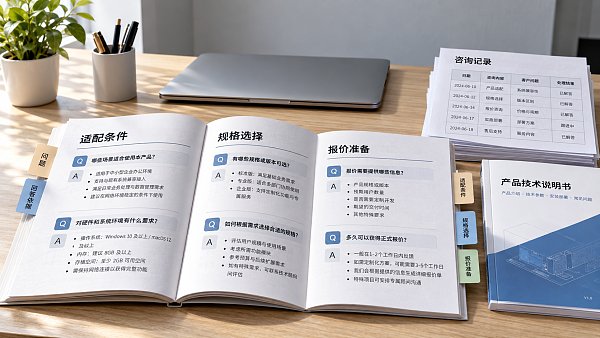
Before finalizing a topic, try drafting two or three sentences that capture the core answer. If all you can say is “It depends” or “Please contact us,” the topic may be too broad or you may lack supporting materials. Narrow it to specific conditions—for example, change “Which material is best?” to “What should you check when selecting a material for a particular medium and temperature range?”
A clear answer should state the conclusion first, then explain the applicable conditions, supporting evidence, and exceptions. Specify the relevant model or version for product parameters. Do not present changeable information such as lead times or stock levels as a long-term commitment. When comparing options, make the scope of the comparison clear and do not turn a specific advantage into a claim of overall superiority.
AI search may draw on multiple sources to generate answers. Clear, verifiable content can help it interpret information, but does not guarantee that your content will be cited or recommended. You also do not need to turn all your site content into Q&As: keep complete specifications on product pages, use Q&As to explain how to make a decision, and link to the relevant pages.
After publishing, distinguish a poor topic choice from an incomplete answer
Each topic should lead to a reasonable next action, such as viewing specifications, downloading documentation, or submitting selection criteria—not always requesting a quote immediately. This makes it possible to assess whether the content is genuinely helping users complete their task.
When reviewing performance, look separately at search impressions, page visits, and subsequent actions. If impressions are very low, first check indexing and whether the Japanese wording matches user needs. If visitors arrive but leave quickly, check whether the opening answers the question directly and whether the conditions are clear. If users keep asking about the same detail, add it to the answer. A decline in inquiries does not necessarily mean the content is ineffective: the page may already be resolving some basic questions, so assess the quality of the inquiries as well.
When manually checking AI-generated answers, record the original question, the time of the check, and the pages cited. Do not use a single result to judge long-term performance. For the next round of topic planning, prioritize questions that address decisions users still cannot make, rather than continually adding Japanese questions with similar meanings.
Related Articles
Related Products
 Yiyingbao SaaS Intelligent Website Building and Marketing SystemYiyingbao SaaS Intelligent Website Building and Marketing System, AI-powered no-code website building, rapid creation of multilingual B2B international websites in 10 minutes, global server acceleration, AI-powered SEO optimization, helping businesses connect efficiently with global markets. The perfect integration of technology and operation makes building an international trade website remarkably simple
 AI+SEM Intelligent Advertising Marketing SystemAI+SEM drives intelligent ad creation, empowering full-funnel precision advertising marketing. The system automatically generates weekly/monthly reports, AI recommends keywords and target countries, monitors core metrics in real-time with intelligent alerts, and enables one-click high-conversion ad solutions to help quickly acquire customers and improve ROI.
 AI+SEO Dual-Engine System Optimization ServicesYiyingbao’s AI+SEO dual-engine optimization system helps foreign trade enterprises acquire high-quality organic traffic through AI-powered keyword research, content generation, and comprehensive technical optimization, significantly improving search rankings and conversion rates.
 AI+SNS Social Media Marketing SystemYingbao AI+SNS Social Media Marketing System - Precision social capture for the social media era. Supports one-click content synchronization across major platforms like Facebook and LinkedIn. AI intelligently rewrites posts for enhanced relevance. 24/7 AI customer service and user profiling analysis empower businesses to efficiently expand into global markets.
 AI+SEO营销解决方案易营宝AI+SEO营销解决方案,通过AI批量写作、智能生成TDK、精准关键词扩词等功能,全面优化网站SEO效果,提升流量与转化率。助力企业构建高效智能网站新生态。
 AI+SEM Advertising Marketing SolutionsAI+SEM Advertising Marketing Solution leverages AI technology to deeply empower SEM ad campaigns. It automatically generates weekly/monthly reports using AI, presenting account data across multiple dimensions for comprehensive insights into campaign performance and trends. The system precisely recommends keywords and target countries, intelligently generates high-conversion ad copy, and enables one-click activation of efficient campaign plans to help businesses rapidly acquire customers. Simultaneously, it monitors core metrics in real time, intelligently identifies abnormal fluctuations, and issues timely alerts to ensure stable, high-return advertising results.
 Domain Name ServicesEasyWin provides professional domain name services, including intelligent queries, one-stop registration, brand protection, and full lifecycle management, helping businesses build a digital brand image.
 EasyOperate B2C Cross-Border E-Commerce Platform & Independent WebsiteEasyStore B2C Cross-border E-commerce Independent Store is an intelligent website building and cross-border e-commerce integrated solution independently developed by EasyStore Information Technology (Beijing) Co., Ltd. The system is specially designed for small and medium-sized as well as large export enterprises, integrating 'website building, operation, marketing, advertising, and conversion' into one, helping enterprises quickly establish cross-border e-commerce independent stores to achieve brand globalization and global sales growth.
The platform supports multiple languages, multiple currencies, and multi-channel marketing, with built-in AI intelligent translation and SEO optimization systems, suitable for mainstream markets such as Southeast Asia, Europe and America, Latin America, and the Middle East, assisting Chinese manufacturing enterprises in efficiently deploying international e-commerce strategies. SSL证书易营宝提供专业SSL安全证书服务,包括单域名和泛域名证书,确保网站数据传输加密、身份验证和完整性保护,助力企业建立安全可信的在线业务环境。









