









- Hengqin Cooperation Zone Shares Cross-Border E-Commerce Developments, Focusing on Macao-Hengqin Collaboration and International MarketsOct 24, 2026View details
- A Shenyang study highlights the development of the “cross-border e-commerce + industrial cluster” modelOct 24, 2026View details
- Three China Advertising Association GEO group standards take effect on October 23Oct 24, 2026View details
- Amazon Raises Fulfillment Fees Twice, Yet the Median Platform Fee Remains Around 40%Oct 22, 2026View details
- AliExpress and YouTube Partner to Expand Marketing Opportunities for Chinese Brands Going GlobalOct 22, 2026View details
- Publicis says AI marketing is developing at two speeds, with agentic AI helping win clientsOct 21, 2026View details
How Can Brands Going Global Get Their Websites Recommended by AI Search?
How Can Global Brands Get Their Websites Recommended by AI Search? Look Beyond Keyword Rankings
In the past, when building overseas websites, companies often set clear goals: rank on the first page of Google, generate clicks through ads, and obtain inquiries through forms. This logic still applies today, but user search behavior has gained another entry point—more and more people directly ask AI search tools complete questions, such as “Which industrial valve suppliers are suitable for the German market?”, “What procurement requirements must a certain type of equipment meet?”, or “Can Chinese manufacturers provide customized delivery?”
What AI provides is no longer a list of blue links, but an integrated answer that may cite a brand's official website, product pages, technical articles, third-party materials, or public social media content. For companies expanding brands globally, the question is no longer simply whether a website has been indexed, but how to get the website recommended by AI search and become a trusted source of information in its answers.
This cannot be solved simply by adding a few “AI-related articles” to an old website. AI more easily understands websites with clear structures, specific information, credible identities, and languages and market positioning that align; conversely, pages filled with marketing slogans, vague product specifications, and mixed-language content may not be suitable for system citation even if they have some organic traffic.
What AI Search Really Needs Is Information That Can Be Assessed and Verified
Many companies mistakenly believe that AI recommendations depend on a new algorithm or some “special optimization technique.” In actual projects, a more common issue is that the website itself does not answer the details that buyers will ask about. For example, a manufacturing company may only state “high quality, professional customization, and global service,” without explaining product applications, material options, minimum order rules, factors affecting lead times, testing capabilities, customization boundaries, or after-sales processes. Such pages are not useful enough for people and also lack extractable facts for AI.
AI search recommendations typically do not simply capture a keyword; they assess whether a page can support a specific conclusion. Therefore, corporate websites need to shift from “display-oriented pages” to “problem-solving pages.” If customers ask, “Can this product be used in high-humidity environments?”, the website should explain the applicable conditions, limiting factors, and confirmation methods on the relevant product or technical page. If customers are concerned about cross-border delivery, they should be able to quickly find packaging, logistics, trade terms, or project communication processes, rather than having to search through the entire website.
There is a trade-off here that is easily overlooked: more content is not necessarily better. A large volume of unreviewed, low-quality pages can result in inconsistent product names, specifications, and delivery commitments. For B2B companies, it is better to first thoroughly explain core categories, key markets, and frequent procurement questions than to rush into filling the site with broad keyword pages.
First Build a Business Structure That AI Can Understand
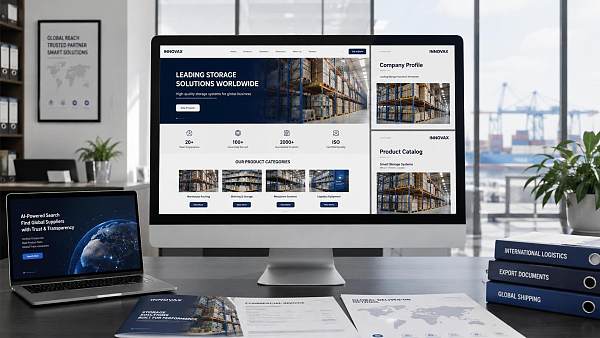
To address the question of “how global brands can get their websites recommended by AI search,” website structure is the first foundational task. Both AI systems and search engines need to identify who you are, what you sell, which regions you serve, which customers you target, and why you are worth citing. The brand homepage establishes overall awareness, category pages explain product or service boundaries, detail pages address specific needs, and knowledge content answers questions in procurement decisions. These types of pages cannot replace one another.
For example, foreign trade manufacturing companies should avoid having product detail pages contain only images and inquiry buttons. More valuable content includes commonly used industry terms for the product name, main applications, available specifications, production or customization conditions, applicable industries, information to be confirmed before inquiry, and differences among related products. Data that cannot be verified should not be forced into the content; where certifications, performance, or compliance requirements are involved, the actual materials the company can provide should prevail, and differences between markets should be noted.
Technical aspects must not hold the website back either. Whether pages can be crawled normally, whether multilingual versions have clear corresponding relationships, whether mobile access is smooth, whether images have accurate descriptions, and whether old links have become invalid may seem basic, but they directly affect the efficiency with which content is discovered and understood. This is especially important for multilingual sites: Chinese pages should not simply be mechanically translated and then all launched. Terminology, measurement conventions, procurement expressions, and prohibited terms often vary by market.
Multilingual Content Is Not a Translation Task, but a Localized Reorganization of Information
North American buyers may prioritize applications, delivery lead times, and after-sales response; customers in certain European industries may pay more attention to documentation completeness, compliance evidence, and long-term maintenance; communication methods, payment preferences, and social media usage habits may also differ in the Middle East, Latin America, and Russian-speaking regions. A global official website cannot rely only on an English homepage to serve every market.
A more practical approach is to select languages and regions according to business priorities rather than launching more than a dozen versions at once. Each priority language should retain content that local customers genuinely search for, compare, and ask about. For example, B2C cross-border online stores need to emphasize sizing, delivery, returns and exchanges, and review mechanisms; B2B inquiry-based websites need product documentation, factory capabilities, sample communication, and project processes. Different page purposes require different ways of organizing content.
Brand Credibility Must Form a Closed Loop Both On and Off the Website
AI search does not look at only one page. Whether the brand name, legal entity, contact information, main business, content publisher, and external public information are consistent will all affect the system's assessment of information reliability. Corporate websites should clearly present authentic company introductions, business scope, contact channels, and regularly updated content, rather than turning the “About Us” page into a few unverifiable promotional statements.
Off-site development also requires restraint. Overseas social media, video content, industry platforms, and advertising landing pages can help customers learn about a brand through different channels, but core information must remain consistent: product names should not be written differently everywhere, service regions should not contradict one another, and contact information and the brand entity should also remain consistent. Advertising can quickly test market demand, but it cannot replace the accumulation of official website content; social media can expand reach, but it cannot replace product and knowledge pages that can be cited in depth.
For teams just beginning their deployment, three areas can be checked first: whether the official website can clearly explain the company's business within one minute; whether core product pages can answer customers' key questions; and whether content in priority languages is truly suitable for the target market. Address these shortcomings first, then discuss more complex generative engine optimization; investment is usually more stable this way.
From Website Building to Customer Acquisition, Channels Cannot Be Viewed Separately
Improving AI search visibility essentially relies on a continuously operating website and marketing system: during the website-building stage, determine content structures and multilingual rules; use SEO to continuously accumulate searchable topical content; use advertising to validate high-intent keywords and landing page conversions; use social media and short videos to expand brand touchpoints; then feed real customer questions back into website content. Discussing “being recommended” apart from conversion goals often leads teams back to the old approach of focusing only on exposure and not on lead quality.
Since its establishment in 2013, Yiyingbao Information Technology (Beijing) Co., Ltd. has provided integrated services centered on intelligent website building, SEO optimization, social media marketing, and advertising. Its cloud-based intelligent website-building system, cross-border online store system, and AI+SEO/GEO optimization capabilities for foreign trade enterprises, manufacturing factories, cross-border sellers, and global brands are well suited to teams that need to manage multilingual official websites, customer acquisition pages, and overseas promotion channels within the same operational rhythm. For companies that already have websites but whose content is fragmented and whose promotional data cannot be fed back, they can also begin by diagnosing core markets and core categories rather than rashly rebuilding everything.
AI search will not create trust for businesses out of thin air; it will only filter and organize existing information more quickly. For brands expanding globally to gain recommendations, the key is not to chase a short-term technique, but to ensure that the website consistently provides accurate, clear content with decision-making value for target customers. What truly deserves priority is often not “how many more pages to add,” but “whether the official website has a verifiable answer when customers ask critical questions.”
Related Articles
 How can you determine whether GEO optimization has increased brand visibility?
 2026 Brand AI Search Guide: Tmall Double 11 Coupon GEO Optimization
 Yuke GEO explains how businesses can choose tools: Focus on brand visibility in AI answers


Related Products
 Yiyingbao SaaS Intelligent Website Building and Marketing SystemYiyingbao SaaS Intelligent Website Building and Marketing System, AI-powered no-code website building, rapid creation of multilingual B2B international websites in 10 minutes, global server acceleration, AI-powered SEO optimization, helping businesses connect efficiently with global markets. The perfect integration of technology and operation makes building an international trade website remarkably simple
 AI+SEM Intelligent Advertising Marketing SystemAI+SEM drives intelligent ad creation, empowering full-funnel precision advertising marketing. The system automatically generates weekly/monthly reports, AI recommends keywords and target countries, monitors core metrics in real-time with intelligent alerts, and enables one-click high-conversion ad solutions to help quickly acquire customers and improve ROI.
 AI+SEO Dual-Engine System Optimization ServicesYiyingbao’s AI+SEO dual-engine optimization system helps foreign trade enterprises acquire high-quality organic traffic through AI-powered keyword research, content generation, and comprehensive technical optimization, significantly improving search rankings and conversion rates.
 AI+SNS Social Media Marketing SystemYingbao AI+SNS Social Media Marketing System - Precision social capture for the social media era. Supports one-click content synchronization across major platforms like Facebook and LinkedIn. AI intelligently rewrites posts for enhanced relevance. 24/7 AI customer service and user profiling analysis empower businesses to efficiently expand into global markets.
 AI+SEO营销解决方案易营宝AI+SEO营销解决方案,通过AI批量写作、智能生成TDK、精准关键词扩词等功能,全面优化网站SEO效果,提升流量与转化率。助力企业构建高效智能网站新生态。
 AI+SEM Advertising Marketing SolutionsAI+SEM Advertising Marketing Solution leverages AI technology to deeply empower SEM ad campaigns. It automatically generates weekly/monthly reports using AI, presenting account data across multiple dimensions for comprehensive insights into campaign performance and trends. The system precisely recommends keywords and target countries, intelligently generates high-conversion ad copy, and enables one-click activation of efficient campaign plans to help businesses rapidly acquire customers. Simultaneously, it monitors core metrics in real time, intelligently identifies abnormal fluctuations, and issues timely alerts to ensure stable, high-return advertising results.
 Domain Name ServicesEasyWin provides professional domain name services, including intelligent queries, one-stop registration, brand protection, and full lifecycle management, helping businesses build a digital brand image.
 EasyOperate B2C Cross-Border E-Commerce Platform & Independent WebsiteEasyStore B2C Cross-border E-commerce Independent Store is an intelligent website building and cross-border e-commerce integrated solution independently developed by EasyStore Information Technology (Beijing) Co., Ltd. The system is specially designed for small and medium-sized as well as large export enterprises, integrating 'website building, operation, marketing, advertising, and conversion' into one, helping enterprises quickly establish cross-border e-commerce independent stores to achieve brand globalization and global sales growth.
The platform supports multiple languages, multiple currencies, and multi-channel marketing, with built-in AI intelligent translation and SEO optimization systems, suitable for mainstream markets such as Southeast Asia, Europe and America, Latin America, and the Middle East, assisting Chinese manufacturing enterprises in efficiently deploying international e-commerce strategies. SSL证书易营宝提供专业SSL安全证书服务,包括单域名和泛域名证书,确保网站数据传输加密、身份验证和完整性保护,助力企业建立安全可信的在线业务环境。









