









- Which customer acquisition channels will be affected by cross-border marketing trends in 2026?Sep 06, 2026View details
- Which homogenization risks should be considered in an analysis of the AI-powered website building industry?Aug 30, 2026View details
- How Will AI Marketing Trends 2026 Change Advertising Budget AllocationAug 28, 2026View details
- Is the EV SSL certificate market shrinking or upgrading? How should companies assess certificate procurement?Aug 11, 2026View details
- Why the old AMP SEO 2020 practices no longer work and what has changed in current optimization prioritiesAug 02, 2026View details
- How to Choose Topics for an Industry News Section to Attract More Organic Search TrafficJul 29, 2026View details
Brand AI Assistant Answer Optimization Methods: How to Avoid Incorrect Citations
When customers ask in AI search, enterprise knowledge assistants, or chatbots, “Does this brand have a certain capability?” or “What scenarios is a particular product suitable for?”, an answer that appears complete but contains incorrect citations can be enough to undermine the credibility of previously accumulated content assets. More troublingly, incorrect citations often do not arise out of nowhere: outdated webpages, information about similar brands, cases taken out of context, and unsynchronized product materials may all be recombined by AI, ultimately forming answers that “seem true.”
Therefore, methods for optimizing answers from brand AI assistants are not merely about adjusting copywriting. They are an operational mechanism centered on information sources, citation paths, semantic boundaries, and continuous monitoring. For personnel responsible for official websites, content, overseas marketing, or customer inquiries, the focus is not on making AI “say more,” but on ensuring that it answers correctly with evidence when needed and knows to reserve judgment when uncertainty exists.
First, understand why AI produces incorrect citations
After discovering that AI has provided an incorrect answer, many teams first react by deleting the relevant pages or repeatedly submitting updates. However, if the source of the error is not identified, such changes are often only short-term remedies. In general, incorrect citations are concentrated in the following situations.
- Conflicting source versions: Old product pages on the official website can still be crawled, while new pages do not clearly indicate update dates, replacement relationships, or discontinuation notices.
- Brand entity confusion: A brand name, product model, or service abbreviation is similar to that of another company, and AI combines multiple sources into a single conclusion.
- Conclusions exceeding the original text: The original material only states that a certain function is supported, but AI extends this to “suitable for all industries” or “can guarantee a certain result.”
- Distorted third-party information: Press releases, directory sites, social media posts, or partner pages have not been updated for a long time, yet receive more citation opportunities than the official website.
- Structures that are difficult to identify: Key information is buried in images, PDFs, long paragraphs, or dynamic modules, making it difficult for machines to determine the subject, applicable conditions, and timeliness.
The essence of incorrect citations is that AI has not obtained sufficiently stable, verifiable, and contextually complete brand facts. Solving this cannot rely solely on a statement such as “please refer to the official website”; the official website and content across all channels must themselves meet the conditions for becoming authoritative answer sources.
Build a “citable fact base” instead of scattering materials everywhere
One point that is easily overlooked in practice is treating brand information as ordinary marketing content. In fact, content intended for AI assistants should first be consolidated into a set of reviewable fact units: who the company is, what it provides, which markets it serves, what boundaries its functions have, what its cases can demonstrate, and which claims cannot be used.
It is recommended that personnel related to the website, marketing, products, and sales jointly maintain a basic list and prioritize it by “frequently asked, easy to answer incorrectly, and likely to affect decisions.” For example, the scope of enterprise services, differences between product versions, multilingual support, delivery processes, applicable users, and contact channels. Each item of information should clearly specify its source page, person in charge, publication date, and review cycle.
For integrated service platforms such as Yiyingbao that provide AI-powered website building, multilingual website development, Google SEO, advertising placement, overseas social media operations, and GEO generative engine optimization, it is especially important to avoid mixing different service lines together. For example, “able to build B2B foreign trade marketing websites” does not mean “all companies are suitable for the same website-building solution”; “providing Google advertising placement services” should also not be presented as an unconditional promise of campaign results. The value of a fact base lies in drawing clear boundaries for such statements.
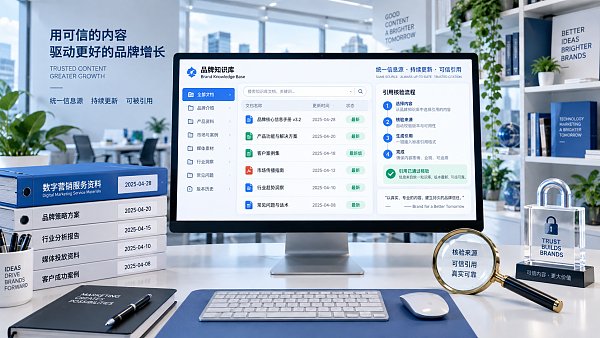
Enable official website pages to form a complete citation path
Content that can be cited correctly with ease can usually answer four questions: who is speaking, what is being said, under what conditions it applies, and when the information is valid. If a page only states, “We provide global marketing solutions,” AI will find it difficult to give an accurate answer based on that; if it further explains the service recipients, covered channels, typical application scenarios, and necessary prerequisites, the answer is less likely to be misunderstood.
When optimizing pages, the following areas can be checked as priorities:
- Whether core pages have a clear subject. Company profiles, product pages, and service pages should not frequently switch between vague terms such as “we,” “platform,” and “system”; they should clearly explain the relationship between the brand and its services.
- Whether key conclusions are adjacent to evidence. After statements involving capabilities, scope, or processes, functional explanations, application conditions, and links to relevant pages can be added instead of leaving only slogans.
- Whether old content is properly handled. After a page is upgraded, retaining historical pages without marking their status can easily create citation conflicts. Depending on the actual situation, they should be updated, consolidated, redirected, or clearly marked as no longer available.
- Whether multilingual content remains consistent. When targeting markets such as North America, Europe, Southeast Asia, and the Middle East, different language versions cannot be created independently. Service names, functional scope, and brand profiles should have a unified source draft, followed by translation and review based on local expression habits.
Structured expression is equally important. Clear subheadings, Q&A modules, service descriptions, publication dates, and author or review information help search engines and AI understand the page hierarchy. It should be noted that structured data is an aid; adding several lines of code to a page cannot correct every error. If the page text is inconsistent with actual business operations, even the most complete markup cannot establish genuine trust.
Add “citation verification” before answering to avoid confidently giving incorrect answers
If an enterprise is using an internal knowledge assistant, official website intelligent customer service, or sales support chatbot, necessary verification rules should be established in the answer-generation process. One practical principle is: for factual questions, retrieve designated knowledge sources first, and do not fill in gaps when supporting evidence is lacking.
For example, when a user asks, “Do you support multilingual independent websites for a certain region?”, the assistant should first retrieve the latest service materials and product descriptions. When the materials only cover certain languages or markets, it should answer within the confirmed scope and advise that a consultant conduct further verification, rather than making assumptions based on common knowledge. For sensitive content such as pricing, client partnerships, performance data, and compliance commitments, citations should be restricted to approved sources.
Operations personnel can establish three levels of judgment for answers: where official and up-to-date evidence exists, answer directly and provide the source; where relevant materials exist but conditions are insufficient, explain the applicable prerequisites; where no reliable information exists, honestly state that confirmation is currently unavailable and transfer the matter for manual handling. Such answers may not appear as clever as being “all-knowing,” but they are better able to protect brand trust.
Do not only search the brand name; monitor according to real ways of asking questions
Whether methods for optimizing answers from brand AI assistants are effective cannot be measured solely by the indexing volume of the official website. What is more worthwhile to test regularly are the questions users would actually ask: What services does the brand provide? Is it suitable for foreign trade factories or cross-border retail? What issues do SEO and GEO optimization each address? Can advertising and social media customer acquisition be connected after the website is built?
It is recommended to create a monthly question-monitoring sheet to record answers from different AI platforms or on-site assistants, cited pages, error types, and corrective actions. If “an old page was cited” is found, address the version relationship; if “the service scope was expanded” is found, supplement boundary explanations; if “incorrect third-party information was cited” is found, concurrently review external directories, social media accounts, and partner pages. Do not rush to evaluate results after making corrections; allow a reasonable period for page crawling, indexing, and answer updates.
Several common misconceptions can instead amplify risks
The first is “feeding” search engines with large numbers of repeated brand terms. Keyword stuffing does not increase the credibility of facts and can also undermine the user reading experience. The second is publishing similar advertorials or Q&A pages in order to make AI mention the brand more often, resulting in multiple versions contradicting one another. The third is entering unverified sales scripts directly into the knowledge base; this may seem convenient in the short term but can become an untraceable source of errors in the long run.
A more prudent approach is to treat every incorrect answer as a signal for content governance: What exactly is the user asking? Which piece of evidence is missing from existing pages? Is the information not updated in time, or is the wording itself ambiguous? By optimizing along this path, website content, AI customer service, and overseas marketing materials will gradually use the same factual foundation.
Ultimately, a brand’s credibility in an AI environment does not depend on how many times it is mentioned, but on whether it can withstand verification every time it is cited. Only by unifying data sources, writing pages clearly, setting boundaries for answers, and making monitoring a routine process can AI assistants become a reliable entry point for customers to learn about the brand rather than a new source of information risk.
Related Articles

Related Products
 Yiyingbao SaaS Intelligent Website Building and Marketing SystemYiyingbao SaaS Intelligent Website Building and Marketing System, AI-powered no-code website building, rapid creation of multilingual B2B international websites in 10 minutes, global server acceleration, AI-powered SEO optimization, helping businesses connect efficiently with global markets. The perfect integration of technology and operation makes building an international trade website remarkably simple
 AI+SEM Intelligent Advertising Marketing SystemAI+SEM drives intelligent ad creation, empowering full-funnel precision advertising marketing. The system automatically generates weekly/monthly reports, AI recommends keywords and target countries, monitors core metrics in real-time with intelligent alerts, and enables one-click high-conversion ad solutions to help quickly acquire customers and improve ROI.
 AI+SEO Dual-Engine System Optimization ServicesYiyingbao’s AI+SEO dual-engine optimization system helps foreign trade enterprises acquire high-quality organic traffic through AI-powered keyword research, content generation, and comprehensive technical optimization, significantly improving search rankings and conversion rates.
 AI+SNS Social Media Marketing SystemYingbao AI+SNS Social Media Marketing System - Precision social capture for the social media era. Supports one-click content synchronization across major platforms like Facebook and LinkedIn. AI intelligently rewrites posts for enhanced relevance. 24/7 AI customer service and user profiling analysis empower businesses to efficiently expand into global markets.
 AI+SEO营销解决方案易营宝AI+SEO营销解决方案,通过AI批量写作、智能生成TDK、精准关键词扩词等功能,全面优化网站SEO效果,提升流量与转化率。助力企业构建高效智能网站新生态。
 AI+SEM Advertising Marketing SolutionsAI+SEM Advertising Marketing Solution leverages AI technology to deeply empower SEM ad campaigns. It automatically generates weekly/monthly reports using AI, presenting account data across multiple dimensions for comprehensive insights into campaign performance and trends. The system precisely recommends keywords and target countries, intelligently generates high-conversion ad copy, and enables one-click activation of efficient campaign plans to help businesses rapidly acquire customers. Simultaneously, it monitors core metrics in real time, intelligently identifies abnormal fluctuations, and issues timely alerts to ensure stable, high-return advertising results.
 Domain Name ServicesEasyWin provides professional domain name services, including intelligent queries, one-stop registration, brand protection, and full lifecycle management, helping businesses build a digital brand image.
 EasyOperate B2C Cross-Border E-Commerce Platform & Independent WebsiteEasyStore B2C Cross-border E-commerce Independent Store is an intelligent website building and cross-border e-commerce integrated solution independently developed by EasyStore Information Technology (Beijing) Co., Ltd. The system is specially designed for small and medium-sized as well as large export enterprises, integrating 'website building, operation, marketing, advertising, and conversion' into one, helping enterprises quickly establish cross-border e-commerce independent stores to achieve brand globalization and global sales growth.
The platform supports multiple languages, multiple currencies, and multi-channel marketing, with built-in AI intelligent translation and SEO optimization systems, suitable for mainstream markets such as Southeast Asia, Europe and America, Latin America, and the Middle East, assisting Chinese manufacturing enterprises in efficiently deploying international e-commerce strategies. SSL证书易营宝提供专业SSL安全证书服务,包括单域名和泛域名证书,确保网站数据传输加密、身份验证和完整性保护,助力企业建立安全可信的在线业务环境。









