









- Which customer acquisition channels will be affected by cross-border marketing trends in 2026?Sep 06, 2026View details
- Which homogenization risks should be considered in an analysis of the AI-powered website building industry?Aug 30, 2026View details
- How Will AI Marketing Trends 2026 Change Advertising Budget AllocationAug 28, 2026View details
- Is the EV SSL certificate market shrinking or upgrading? How should companies assess certificate procurement?Aug 11, 2026View details
- Why the old AMP SEO 2020 practices no longer work and what has changed in current optimization prioritiesAug 02, 2026View details
- How to Choose Topics for an Industry News Section to Attract More Organic Search TrafficJul 29, 2026View details
How to optimize AI search indexing? Make your official website content easier for answer engines to cite
How to Optimize for AI Search Indexing? First Understand What Answer Engines Look For
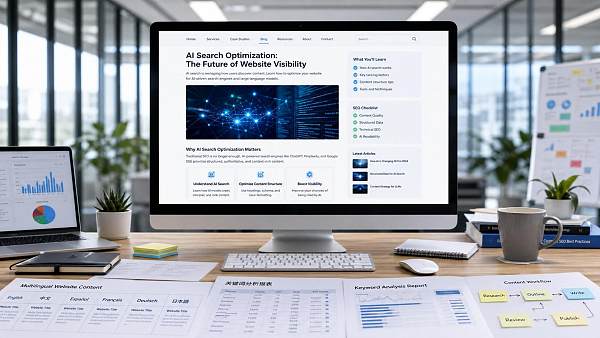
The core of AI search indexing optimization is not “stuffing keywords,” but making content easier to understand, break down, and cite. When many answer engines crawl official website content today, they place more emphasis on whether the information is clear, the structure is stable, and the semantics are complete.
In other words, an official website is not only for people to read; it also needs to be easy for machines to read. If a page contains only large blocks of promotional copy, answer engines often find it difficult to accurately extract key points, and naturally they are less likely to cite your content in their responses.
Judging from recent changes, AI search indexing optimization has evolved from a supplementary part of traditional SEO into a key element of official website content development. This is especially true for companies engaged in foreign trade lead generation, global brand expansion, and independent website operations: the earlier they start building this foundation, the easier it is to accumulate a visibility advantage.
For integrated website + marketing services, this is even more obvious. An official website not only serves a display function, but also supports inquiry conversion, content accumulation, and search exposure. Simply making pages look good is no longer enough.
To Do AI Search Indexing Optimization Well, Start with Content Structure
Many official websites are not cited not because they lack content, but because the way their content is organized is not suitable for answer engines to read. The first step in AI search indexing optimization is to write pages as “extractable information units.”
A practical approach is to build each page around one clear topic. One page should clearly explain one question, such as “How to optimize for AI search indexing,” “How multilingual websites can improve Google indexing,” or “How a B2B official website can improve inquiry conversion.”
Within the page, it is recommended to use a structure of “conclusion first, explanation later.” Give the answer directly first, then supplement it with reasons, steps, and points to note. This better matches the way answer engines extract summaries.
Specifically, it can be broken down as follows:
- The page title corresponds to one clear question
- The opening paragraph answers the question directly
- The middle section uses subheadings to explain the steps
- Lists and tables carry key information
- The ending provides implementation suggestions or next steps
This type of structure has two benefits. First, it is easier for users to read. Second, the results of AI search indexing optimization are more stable, because engines can more easily locate the core paragraphs.
Official Website Content Should Not Only Talk About “Who We Are”
Many corporate official website homepages and service pages still focus mainly on company introductions. This type of content is suitable for brand presentation, but not for AI search indexing optimization. Answer engines prefer content that can directly solve problems.
In actual business scenarios, a more effective content mix usually includes solution pages, scenario pages, Q&A pages, case study pages, and how-to guide pages. They can cover different search intents and are also more likely to enter the citation scope of AI answers.
Clear Semantic Organization Makes AI Search Indexing Optimization More Stable
If structure determines whether content can be understood, then semantics determine whether it will be cited. AI search indexing optimization is not just about including keywords; it also requires the context to form a complete semantic chain.
For example, around “AI search indexing optimization,” the body text can naturally extend to related expressions such as “answer engine citations,” “official website content visibility,” “generative engine optimization,” “AI search exposure,” and “semantic organization of content.” This is closer to real problem scenarios and is also more helpful for understanding the boundaries of the topic.
However, it is important to note that more related terms are not necessarily better. The key is that each term must be placed in a specific context. Simply piling up words without providing judgment or conclusions will instead weaken page quality.
Question-and-Answer Style Expression Is Recommended
Answer engines naturally prefer Q&A structures because this type of content is easier to match with real search questions. When doing AI search indexing optimization, you can embed several highly relevant questions into a page.
- What is the difference between AI search indexing optimization and traditional SEO
- Which pages on an official website are most likely to be cited by answer engines
- How can a multilingual website improve AI search visibility
- After indexing improves, how can it drive inquiry conversion
Under each question, provide a concise answer first, then add details. This writing style is good for reading and also helps AI search indexing optimization continuously accumulate page signals.
Without a Solid Technical Foundation, AI Search Indexing Optimization Is Hard to Scale
No matter how well the content is written, if the technical foundation is messy, answer engines may still fail to crawl it completely or read it accurately. AI search indexing optimization cannot be separated from a stable website foundation.
Here, focus on checking four things:
For foreign trade companies and global brand expansion businesses, multilingual websites are especially critical. If language versions are disorganized and content overlaps with each other, AI search indexing optimization can easily suffer from recognition bias, affecting overall exposure.
This is also why integrated website building and marketing systems have more advantages. AI-driven enterprise-level SaaS platforms such as 易营宝 can connect website building, SEO optimization, GEO generative engine optimization, ad placement, and content management, reducing execution-level breakpoints.
An Actionable Checklist for AI Search Indexing Optimization
If you want to move forward as soon as possible, you do not need to overhaul the entire website from the start. A more realistic approach is to begin with high-value pages and gradually build an AI search indexing optimization framework.
- First select 10 core service pages and high-conversion pages
- Define one main question and two extended questions for each page
- Rewrite the first paragraph to directly provide a conclusion-style answer
- Break large blocks of copy into short paragraphs, subheadings, and lists
- Add cases, data, processes, and applicable scenarios
- Unify heading hierarchy and page description logic
- Check crawling, indexing, speed, and mobile experience
- Review indexed pages and high-click topics every month
The focus of this method is not doing a lot at once, but continuously producing “pages that can be cited.” The more pages there are and the more complete the topic coverage becomes, the more obvious the compounding effect of AI search indexing optimization will be.
Two Risks That Are Easy to Overlook
First, only pursuing traffic while ignoring answer quality. Even if a page is crawled, it may not necessarily become a citation source.
Second, content is disconnected from the business. For example, a service page may be lively and attractive, but without product capabilities, delivery processes, and scenario support, it will ultimately be difficult to convert.
View AI Search Indexing Optimization Together with Conversion Goals
The purpose of AI search indexing optimization is not only to make pages visible, but also to make the right content appear in the right scenarios. Optimization only becomes truly valuable when exposure, understanding, and conversion are connected.
For companies that need long-term customer acquisition, the official website remains the most stable digital asset. Only by improving content structure, semantic expression, and the technical foundation together will answer engines be more willing to cite your pages.
If your business also involves AI-powered intelligent website building, multilingual website development, Google SEO optimization, overseas ad placement, and GEO generative engine optimization, then a systematic approach is more suitable. This can improve the efficiency of AI search indexing optimization while also channeling traffic into inquiries and transactions.
Truly effective practices are usually very straightforward: first make the official website clear, then standardize the pages, and finally continue updating content around user questions. As long as the direction is right, AI search indexing optimization will gradually become part of stable growth.
Related Articles



Related Products
 Yiyingbao SaaS Intelligent Website Building and Marketing SystemYiyingbao SaaS Intelligent Website Building and Marketing System, AI-powered no-code website building, rapid creation of multilingual B2B international websites in 10 minutes, global server acceleration, AI-powered SEO optimization, helping businesses connect efficiently with global markets. The perfect integration of technology and operation makes building an international trade website remarkably simple
 AI+SEM Intelligent Advertising Marketing SystemAI+SEM drives intelligent ad creation, empowering full-funnel precision advertising marketing. The system automatically generates weekly/monthly reports, AI recommends keywords and target countries, monitors core metrics in real-time with intelligent alerts, and enables one-click high-conversion ad solutions to help quickly acquire customers and improve ROI.
 AI+SEO Dual-Engine System Optimization ServicesYiyingbao’s AI+SEO dual-engine optimization system helps foreign trade enterprises acquire high-quality organic traffic through AI-powered keyword research, content generation, and comprehensive technical optimization, significantly improving search rankings and conversion rates.
 AI+SNS Social Media Marketing SystemYingbao AI+SNS Social Media Marketing System - Precision social capture for the social media era. Supports one-click content synchronization across major platforms like Facebook and LinkedIn. AI intelligently rewrites posts for enhanced relevance. 24/7 AI customer service and user profiling analysis empower businesses to efficiently expand into global markets.
 AI+SEO营销解决方案易营宝AI+SEO营销解决方案,通过AI批量写作、智能生成TDK、精准关键词扩词等功能,全面优化网站SEO效果,提升流量与转化率。助力企业构建高效智能网站新生态。
 AI+SEM Advertising Marketing SolutionsAI+SEM Advertising Marketing Solution leverages AI technology to deeply empower SEM ad campaigns. It automatically generates weekly/monthly reports using AI, presenting account data across multiple dimensions for comprehensive insights into campaign performance and trends. The system precisely recommends keywords and target countries, intelligently generates high-conversion ad copy, and enables one-click activation of efficient campaign plans to help businesses rapidly acquire customers. Simultaneously, it monitors core metrics in real time, intelligently identifies abnormal fluctuations, and issues timely alerts to ensure stable, high-return advertising results.
 Domain Name ServicesEasyWin provides professional domain name services, including intelligent queries, one-stop registration, brand protection, and full lifecycle management, helping businesses build a digital brand image.
 EasyOperate B2C Cross-Border E-Commerce Platform & Independent WebsiteEasyStore B2C Cross-border E-commerce Independent Store is an intelligent website building and cross-border e-commerce integrated solution independently developed by EasyStore Information Technology (Beijing) Co., Ltd. The system is specially designed for small and medium-sized as well as large export enterprises, integrating 'website building, operation, marketing, advertising, and conversion' into one, helping enterprises quickly establish cross-border e-commerce independent stores to achieve brand globalization and global sales growth.
The platform supports multiple languages, multiple currencies, and multi-channel marketing, with built-in AI intelligent translation and SEO optimization systems, suitable for mainstream markets such as Southeast Asia, Europe and America, Latin America, and the Middle East, assisting Chinese manufacturing enterprises in efficiently deploying international e-commerce strategies. SSL证书易营宝提供专业SSL安全证书服务,包括单域名和泛域名证书,确保网站数据传输加密、身份验证和完整性保护,助力企业建立安全可信的在线业务环境。









