









- Which customer acquisition channels will be affected by cross-border marketing trends in 2026?Sep 06, 2026View details
- Which homogenization risks should be considered in an analysis of the AI-powered website building industry?Aug 30, 2026View details
- How Will AI Marketing Trends 2026 Change Advertising Budget AllocationAug 28, 2026View details
- Is the EV SSL certificate market shrinking or upgrading? How should companies assess certificate procurement?Aug 11, 2026View details
- Why the old AMP SEO 2020 practices no longer work and what has changed in current optimization prioritiesAug 02, 2026View details
- How to Choose Topics for an Industry News Section to Attract More Organic Search TrafficJul 29, 2026View details
What are the core metrics for improving AI search brand visibility? How do you determine whether optimization is effective?
AI search brand visibility is moving from a new concept to a practical topic in website development and digital marketing evaluation. For many export-oriented businesses, the question is no longer whether they have exposure, but whether the brand can be consistently recognized and accurately cited by AI answer systems, and further bring in high-quality visits and real business opportunities.
This is also why it is not enough to judge optimization effectiveness by looking only at impressions. What is more worth paying attention to is how many times the brand appears in AI search results, in what position it appears, how it is described, and whether these changes are being transferred to website visits, leads, and inquiry conversions. For website + marketing service integrated businesses, this judgment standard is especially important, because content, technical structure, channel coordination, and conversion handoff are inherently connected.
First, let’s make it clear what AI search brand visibility is actually improving
Traditional search visibility mainly focuses on page rankings and clicks. AI search goes a step further: it directly generates answers, compressing the process by which users filter information. If a brand does not enter the answer layer, it may end up in the situation where it “has content and is indexed, but users never truly see the brand.”
Therefore, AI search brand visibility improvement is essentially not about simply chasing more pages being crawled, but about improving the brand’s recognizability, citability, and convertibility in AI answers. Simply put, it means making the system more willing to mention you and understand you more accurately.
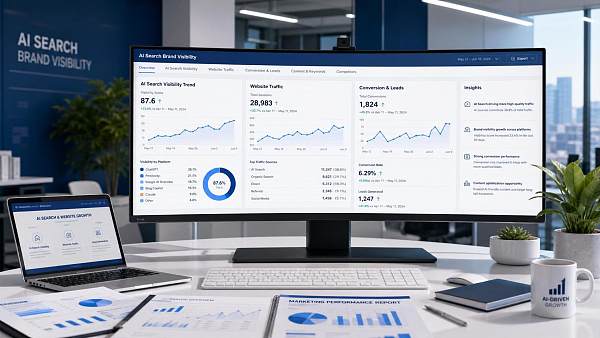
In actual business, this kind of improvement is usually built on three foundations: website content is clear enough, page structure is standardized enough, and brand information remains consistent across multiple channels. If any one of these is missing, AI search can easily produce understanding deviations, or even confuse the brand with competitors.
Why this has to be taken seriously now
One obvious change is that user search behavior is shifting forward. More and more decisions are completed earlier in AI Q&A, summary results, and recommendation answers. Users no longer necessarily click through ten web pages one by one as before; instead, they first look at the conclusion provided by the system and then decide whether to enter the official website.
This means that if a brand cannot establish a sense of presence in AI search scenarios, it will lose opportunities during the user’s initial screening stage. This is especially true for foreign trade customer acquisition, multilingual website building, cross-border e-commerce, and B2B inquiry generation, where the sales cycle is longer and early trust building is often more important than a single click.
From industry practice, AI search brand visibility improvement is no longer just the work of the content team. It will involve website architecture, SEO data, landing pages, social media information consistency, and language expression strategies for different regional markets. In other words, it is naturally suitable to be evaluated within an integrated operation framework.
Core metrics, not just a traffic number
If you only measure by “whether growth happened,” the conclusion is usually unreliable. A more stable approach is to build a set of metrics that can be compared horizontally and tracked vertically. The indicators below can usually better reflect whether AI search brand visibility improvement is truly occurring.
1. Citation frequency
This is the most direct visibility signal. By looking at how many times a brand, official website content, product pages, or core viewpoints are cited in AI answers, you can initially judge whether the content has entered the system’s reference sources.
2. Answer coverage depth
Being mentioned once is not necessarily effective. More important is whether the brand appears in the core answer section rather than as a marginal supplement. The closer the placement is to the front, the higher the probability that users will remember the brand.
3. Brand expression accuracy
Whether AI can correctly describe the company positioning, product capabilities, service regions, and differentiated advantages determines whether brand exposure is valuable. Incorrect citations can instead lead to cognitive loss.
4. Related topic coverage
High-quality visibility does not only occur in brand terms; it should also cover industry terms, solution terms, scenario terms, and comparison terms. For example, in related topics such as website building, SEO, advertising, and GEO, whether the brand continues to appear.
5. Traffic quality
For visits brought by AI search, whether dwell time, visit depth, and bounce behavior are better than ordinary traffic determines whether the visibility improvement has brought stronger intent.
6. Conversion results
Ultimately, everything still has to come back to business. Inquiry volume, form submission rate, number of valid conversations, and the proportion of visits from key countries are the data that can show whether AI search brand visibility improvement has truly generated returns.
How to judge whether optimization is effective, rather than merely seeing better-looking data
During evaluation, the most common mistake is to mistake short-term fluctuations for long-term improvement. A single event, a single round of ad placement, or a piece of content briefly performing well can all bring surface-level growth, but that does not mean AI search brand visibility has already been established.
A more reliable way of judging is to look at the indicators over continuous cycles. At a minimum, observe the changes in brand terms, industry terms, and scenario terms, and then compare them with website visits and conversion results to see whether the optimization is stable.
- Whether it is cited continuously over multiple weeks, rather than appearing only occasionally.
- Whether it covers multiple country and language versions, rather than being effective only in a single region.
- Whether it brings higher-intent traffic, rather than just visits without interaction.
- Whether there is a clear corresponding relationship with official website updates and structural optimization.
- Whether more stable exposure opportunities are obtained in competitive comparison questions.
If these aspects improve at the same time, the optimization can usually be considered to be taking effect. Conversely, if exposure increases, but brand descriptions are chaotic, bounce rates remain high, and inquiries do not improve, then the reference significance of such growth is limited.
In actual business, which scenarios are most worth prioritizing
Not every business needs to invest in the same way. Usually, the following scenarios are more suitable for prioritizing AI search brand visibility improvement, because these scenarios have higher requirements for early awareness building and content credibility.
Multilingual official websites and overseas independent sites
For sites facing different markets, information consistency and structural standardization are especially important. Once AI search captures inconsistent expressions, brand understanding can be diluted.
B2B inquiry lead-generation pages
The purchase decision cycle is long, and users repeatedly search for solutions and supply capabilities. Whether the brand can continue to appear in AI answers directly affects initial trust building.
Cross-border e-commerce and brand sites
These scenarios pay more attention to unified brand expression, understandable product pages, and a clear conversion path. If visibility improvement cannot land on page-level handoff, its value will be discounted.
From this point of view, platforms like Yiyingbao, which connect intelligent website building, SEO optimization, ad placement, social media operations, and GEO capabilities, are more suitable for systematic evaluation. The reason is not that they have many functions, but that website structure, content production, search visibility, and conversion data can be viewed within the same logic, making it easier to determine which link is truly bringing results.
Several issues that are easy to overlook during optimization
Many projects have been running for a period of time, but the data remains unstable, often not because there is no content, but because the underlying judgment has gone off track.
- Only updating articles without handling the site structure, making it difficult for AI to understand key pages.
- Only looking at brand-term performance while ignoring the incremental opportunities brought by industry terms and comparison terms.
- Inconsistent expression across different channels, causing conflicts between the official website, social media, and ad pages.
- Attributing all growth to AI search without excluding the impact of ads and campaigns.
- Only looking at traffic volume, without looking at valid conversations, lead quality, and regional fit.
These issues may seem minor, but in practice they directly affect the authenticity of whether AI search brand visibility improvement has occurred. This is especially true for cross-market businesses: if language versions, product naming, and capability descriptions are not standardized, optimization is hard to accumulate steadily.
The next step is more suitable for evaluation in this way
A more practical approach is to first clarify the brand’s current status in AI search, and then decide where to focus investment. You can first organize brand terms, core product terms, industry solution terms, and priority regional language versions to establish a basic observation list.
Next, place citation frequency, answer coverage, expression accuracy, traffic quality, and inquiry results into the same evaluation table and compare them month by month. This way, you can determine whether AI search brand visibility improvement has really occurred, and also see whether the improvement comes from content optimization, website construction, or multi-channel coordination.
Once the evaluation standards are gradually clarified, it becomes easier to compare different solutions and different service capabilities. For export growth, what is truly worth investing in is not short-term popularity, but the part of visibility that can be understood by AI, seen by users, accepted by the website, and ultimately converted.
Related Articles



Related Products
 Yiyingbao SaaS Intelligent Website Building and Marketing SystemYiyingbao SaaS Intelligent Website Building and Marketing System, AI-powered no-code website building, rapid creation of multilingual B2B international websites in 10 minutes, global server acceleration, AI-powered SEO optimization, helping businesses connect efficiently with global markets. The perfect integration of technology and operation makes building an international trade website remarkably simple
 AI+SEM Intelligent Advertising Marketing SystemAI+SEM drives intelligent ad creation, empowering full-funnel precision advertising marketing. The system automatically generates weekly/monthly reports, AI recommends keywords and target countries, monitors core metrics in real-time with intelligent alerts, and enables one-click high-conversion ad solutions to help quickly acquire customers and improve ROI.
 AI+SEO Dual-Engine System Optimization ServicesYiyingbao’s AI+SEO dual-engine optimization system helps foreign trade enterprises acquire high-quality organic traffic through AI-powered keyword research, content generation, and comprehensive technical optimization, significantly improving search rankings and conversion rates.
 AI+SNS Social Media Marketing SystemYingbao AI+SNS Social Media Marketing System - Precision social capture for the social media era. Supports one-click content synchronization across major platforms like Facebook and LinkedIn. AI intelligently rewrites posts for enhanced relevance. 24/7 AI customer service and user profiling analysis empower businesses to efficiently expand into global markets.
 AI+SEO营销解决方案易营宝AI+SEO营销解决方案,通过AI批量写作、智能生成TDK、精准关键词扩词等功能,全面优化网站SEO效果,提升流量与转化率。助力企业构建高效智能网站新生态。
 AI+SEM Advertising Marketing SolutionsAI+SEM Advertising Marketing Solution leverages AI technology to deeply empower SEM ad campaigns. It automatically generates weekly/monthly reports using AI, presenting account data across multiple dimensions for comprehensive insights into campaign performance and trends. The system precisely recommends keywords and target countries, intelligently generates high-conversion ad copy, and enables one-click activation of efficient campaign plans to help businesses rapidly acquire customers. Simultaneously, it monitors core metrics in real time, intelligently identifies abnormal fluctuations, and issues timely alerts to ensure stable, high-return advertising results.
 Domain Name ServicesEasyWin provides professional domain name services, including intelligent queries, one-stop registration, brand protection, and full lifecycle management, helping businesses build a digital brand image.
 EasyOperate B2C Cross-Border E-Commerce Platform & Independent WebsiteEasyStore B2C Cross-border E-commerce Independent Store is an intelligent website building and cross-border e-commerce integrated solution independently developed by EasyStore Information Technology (Beijing) Co., Ltd. The system is specially designed for small and medium-sized as well as large export enterprises, integrating 'website building, operation, marketing, advertising, and conversion' into one, helping enterprises quickly establish cross-border e-commerce independent stores to achieve brand globalization and global sales growth.
The platform supports multiple languages, multiple currencies, and multi-channel marketing, with built-in AI intelligent translation and SEO optimization systems, suitable for mainstream markets such as Southeast Asia, Europe and America, Latin America, and the Middle East, assisting Chinese manufacturing enterprises in efficiently deploying international e-commerce strategies. SSL证书易营宝提供专业SSL安全证书服务,包括单域名和泛域名证书,确保网站数据传输加密、身份验证和完整性保护,助力企业建立安全可信的在线业务环境。









