









- Is the EV SSL certificate market shrinking or upgrading? How should companies assess certificate procurement?Aug 11, 2026View details
- Why the old AMP SEO 2020 practices no longer work and what has changed in current optimization prioritiesAug 02, 2026View details
- How to Choose Topics for an Industry News Section to Attract More Organic Search TrafficJul 29, 2026View details
- Digital Marketing Shenzhen Market Insights: Why Are Companies Expanding Overseas Looking for Growth Teams in Shenzhen?Jul 31, 2026View details
- Can Zhejiang foreign trade independent websites still be developed today? Look at changes in traffic and lead generationJul 28, 2026View details
- What New Signals Are Emerging in Enterprise Services SaaS Marketing ReportsJul 27, 2026View details
Facebook Ads Have High Clicks but No Conversions? Check These 5 Optimization Areas First
Facebook ad clicks are high but there are no conversions. Usually, the problem is not that “the ads are ineffective,” but that at least one link in the process is broken. Many people’s first reaction is to increase the budget or change the creatives, which only magnifies the problem. Truly effective Facebook advertising optimization techniques do not focus solely on the click-through rate, but troubleshoot the chain step by step: “targeting, creatives, landing page, pixel, and remarketing.”
If you are experiencing this situation now, don’t rush to rebuild the account. Check these five areas first. In many cases, you can quickly identify why conversions are not coming through.
First, confirm: What kind of “clicks” are you actually seeing?
This step is easy to overlook. The “high number of clicks” shown in many dashboards may simply refer to link clicks, landing page views, or even accidental clicks. It does not necessarily mean that users have genuine purchase or inquiry intent.
If the ads are generating inexpensive clicks, but users spend little time on the page, leave quickly, and do not submit forms, the problem is usually not “insufficient traffic,” but that “the traffic is not right” or “the page is unable to convert it.” This is also the first judgment that needs to be corrected when applying Facebook advertising optimization techniques.
1. Check targeting first: Are you showing ads to “people who will click” rather than “people who will buy”?
Facebook advertising can easily create an illusion: the audience reach is broad and the click-through rate is not low, but conversions are poor. The usual reason is overly broad targeting. The system delivers ads to people who are more likely to click, rather than those who are closer to making a purchase.
There are three common problems. The first is overly scattered audience interests. For example, the audience may include both industry customers and broad-interest groups, resulting in many clicks but weak intent. The second is insufficiently restricted locations, ages, or devices, which leads to large fluctuations in traffic quality. The third is pursuing scale too quickly during the cold-start stage without first identifying high-intent audiences.
In practice, start by narrowing the core audience to “the people most likely to make a purchase,” and then see whether the data improves. For B2B, it is more suitable to begin with job titles, industries, company size, and remarketing audiences. For B2C, purchase intent and recent engagement behavior are more important. Targeting is not always better when it is broader; in many cases, greater precision means lower costs.
2. Then check the creatives: Attracting attention does not mean filtering out the right people
A creative with a high click-through rate is not necessarily a good creative. It may simply have a more provocative headline, a more eye-catching image, or copy that attracts everyone without clearly explaining the product’s actual value.
If users find that the content does not match their expectations after clicking through, conversions will naturally decline. For example, the ad may promise a “free solution,” while the landing page contains only a lengthy introduction; or the ad may emphasize a low price, while the page keeps focusing on the brand story. This inconsistency directly lowers the conversion rate.
A more effective approach is to keep the promise made by the creative consistent with the landing page. The ad is responsible for attracting the right people, while the page is responsible for completing the next action. The copy should clearly state who the offer is suitable for, what problem it solves, and what users will receive next. For service-based businesses, real-world scenarios are more useful than empty claims. For e-commerce, selling points, price, usage results, and trust information should be presented more directly.
3. Is the landing page unable to “receive” the traffic? This is the most common reason for high clicks but no conversions
Many account problems ultimately come down to the landing page. Slow loading, disorganized content, unclear buttons, overly long forms, and cramped mobile layouts can all cause users to leave within seconds.
You can use a very practical standard to assess the situation: After clicking through, can users understand within 5 to 10 seconds what you sell, whether it is suitable for them, and what they should do next? If the answer is unclear, conversions will be poor.
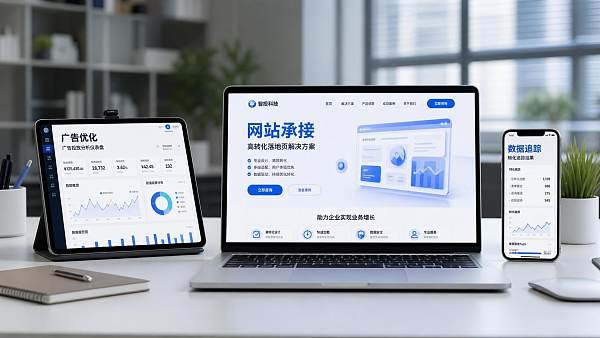
When reviewing a landing page, focus on these points: Does the first screen clearly communicate the core value? Is there a clear call-to-action button? Have unnecessary redirects been reduced? Is the form easy to complete on mobile? Is there sufficient trust information? For website and marketing integration projects, the issue is often not that the ads are ineffective, but that the independent website has not properly designed the inquiry path. For an integrated platform such as 易营宝, which provides AI-powered website building, Google SEO optimization, Facebook advertising marketing, and landing page development, the real value lies here: viewing “traffic acquisition” and “traffic conversion” within the same framework instead of focusing only on the advertising dashboard.
4. Are the pixel and events installed correctly? Don’t let the system fail to learn conversion signals
Some accounts appear to have “clicks but no conversions,” when the real issue is that the pixel is not sending data back correctly. The system simply does not know who the genuinely valuable users are.
Common problems include an incompletely installed pixel, duplicate event triggers, incorrectly configured conversion events, incomplete domain verification, parameters being lost after page redirects, or the “Lead” event not being recorded after a form submission. As a result, the ad optimization system can only guess the audience based on clicks and views, causing performance to drift further off course.
If you already have stable traffic, it is recommended that you first confirm whether the basic events are accurate, and then determine whether you need to add the Conversions API, server-side data transmission, or more detailed event segmentation. For independent websites and cross-border e-commerce stores, this step often determines the room available for subsequent scaling. Without accurate data, even more Facebook advertising optimization techniques will only be superficial actions.
5. Is remarketing connected? Many people let potential customers go after they fail to convert the first time
Facebook ads are not a one-time conversion tool, especially for industries with high average order values and long decision cycles. It is normal for the first click not to generate a conversion. Genuine conversions often occur on the second, third, or even later interaction.
The problem is that many accounts run only cold-start ads and do not bring back people who visited the website, watched videos, added products to their cart without placing an order, or opened a form without submitting it. This wastes the interest that has already been generated during the earlier stages.
Remarketing does not need to be complicated. Start with these three groups: people who visited the landing page but did not convert, people who interacted with the ads but took no further action, and people who submitted partial information but did not complete the process. Remarketing creatives should not be identical to the first-round creatives. They should be more direct and specific, using offers, case studies, comparisons, or consultation entry points to encourage the next action.
In many cases, conversion is not about going “from 0 to 1,” but about giving hesitant users one more push.
If you can change only one thing first, what should you prioritize?
I generally recommend checking the landing page first, then the pixel, and finally returning to targeting and creatives. When clicks are high but conversions are low, the most obvious problem is usually at the conversion end. Once you have improved the page, you can make more accurate judgments about the advertising audience and creative concepts.
If you already have multiple ad sets, the safest approach is not to make major changes all at once, but to change only one variable at a time. For example, change the page first and observe the results for 3 to 7 days. If conversions are still poor, narrow the targeting. If the problem remains, redesign the creatives. This is the only way to determine where the problem lies without turning the account into a complete mess.
For companies that need to manage their website, SEO, social media, and advertising at the same time, the biggest risk is that each department manages only one part of the process, leaving no one responsible for conversions. What truly works is viewing website conversion, advertising, remarketing, and data transmission together. Facebook advertising is only the entry point. What really determines the result is whether the entire process forms a closed loop.
If you are ready to take action now, review these five areas first: Is the targeting too broad? Are the creatives consistent with the page? Can the landing page effectively receive the traffic? Is the pixel transmitting data correctly? Is remarketing connected? Once these points are addressed, Facebook ad conversions are usually more stable than they would be through simply increasing the budget.
Frequently Asked Questions
Q: Why do I still receive no inquiries when the click-through rate is high?
A: In most cases, the people clicking are not sufficiently well targeted, or the landing page does not clearly communicate the value. A high click-through rate does not equal purchase intent.
Q: Do I necessarily need to redesign the ad creatives?
A: Not necessarily. Check the page and pixel first. In many cases, the problem is not the creatives themselves, but the conversion process and data transmission.
Q: Is remarketing suitable for every industry?
A: It is suitable for most industries, but the intensity may vary. The longer the decision cycle, the more important remarketing becomes.
Q: Which part of Facebook ad optimization should be changed first?
A: Prioritize the landing page and pixel, followed by targeting and then creatives. If the order is wrong, your efforts may be wasted.
Q: Will a poorly performing independent website affect Facebook advertising?
A: Yes, and the impact can be significant. Advertising brings people in, while the website keeps them there and converts them.
Recommended Internal Link Anchor Text
- Facebook advertising campaign optimization: advertising account optimization/campaign execution page
- Landing page conversion improvement: marketing website/landing page development page
- Pixel installation and event tracking: data tracking/conversion tracking page
- Remarketing ad setup: retargeting campaign tutorial page
- Customer acquisition through an independent website for foreign trade: overseas website development and SEO integration page
Recommended External Authoritative Sources
- Meta Official Advertising Help Center
- Official documentation for Meta Pixel and conversion tracking
- Industry digital marketing research reports or official best-practice documentation from overseas advertising platforms
SEO Self-Check
- Does it meet the “application/solution” requirement: Yes
- Does it fit the “problem-solving” category: Yes
- Is it written for “users/operators”: Yes
- Does the primary keyword appear naturally: Yes
- Is keyword stuffing avoided: Yes
- Is AI-template-like wording avoided: Yes
- Does the article structure have natural variation: Yes
- Are there any unverified facts: No data-based conclusions requiring additional verification were used
- Is 易营宝 naturally incorporated: Yes, it appears naturally as a reference scenario for website conversion and integrated solutions
Related Articles
Related Products
 Yiyingbao SaaS Intelligent Website Building and Marketing SystemYiyingbao SaaS Intelligent Website Building and Marketing System, AI-powered no-code website building, rapid creation of multilingual B2B international websites in 10 minutes, global server acceleration, AI-powered SEO optimization, helping businesses connect efficiently with global markets. The perfect integration of technology and operation makes building an international trade website remarkably simple
 AI+SEM Intelligent Advertising Marketing SystemAI+SEM drives intelligent ad creation, empowering full-funnel precision advertising marketing. The system automatically generates weekly/monthly reports, AI recommends keywords and target countries, monitors core metrics in real-time with intelligent alerts, and enables one-click high-conversion ad solutions to help quickly acquire customers and improve ROI.
 AI+SEO Dual-Engine System Optimization ServicesYiyingbao’s AI+SEO dual-engine optimization system helps foreign trade enterprises acquire high-quality organic traffic through AI-powered keyword research, content generation, and comprehensive technical optimization, significantly improving search rankings and conversion rates.
 AI+SNS Social Media Marketing SystemYingbao AI+SNS Social Media Marketing System - Precision social capture for the social media era. Supports one-click content synchronization across major platforms like Facebook and LinkedIn. AI intelligently rewrites posts for enhanced relevance. 24/7 AI customer service and user profiling analysis empower businesses to efficiently expand into global markets.
 AI+SEO营销解决方案易营宝AI+SEO营销解决方案,通过AI批量写作、智能生成TDK、精准关键词扩词等功能,全面优化网站SEO效果,提升流量与转化率。助力企业构建高效智能网站新生态。
 AI+SEM Advertising Marketing SolutionsAI+SEM Advertising Marketing Solution leverages AI technology to deeply empower SEM ad campaigns. It automatically generates weekly/monthly reports using AI, presenting account data across multiple dimensions for comprehensive insights into campaign performance and trends. The system precisely recommends keywords and target countries, intelligently generates high-conversion ad copy, and enables one-click activation of efficient campaign plans to help businesses rapidly acquire customers. Simultaneously, it monitors core metrics in real time, intelligently identifies abnormal fluctuations, and issues timely alerts to ensure stable, high-return advertising results.
 Domain Name ServicesEasyWin provides professional domain name services, including intelligent queries, one-stop registration, brand protection, and full lifecycle management, helping businesses build a digital brand image.
 EasyOperate B2C Cross-Border E-Commerce Platform & Independent WebsiteEasyStore B2C Cross-border E-commerce Independent Store is an intelligent website building and cross-border e-commerce integrated solution independently developed by EasyStore Information Technology (Beijing) Co., Ltd. The system is specially designed for small and medium-sized as well as large export enterprises, integrating 'website building, operation, marketing, advertising, and conversion' into one, helping enterprises quickly establish cross-border e-commerce independent stores to achieve brand globalization and global sales growth.
The platform supports multiple languages, multiple currencies, and multi-channel marketing, with built-in AI intelligent translation and SEO optimization systems, suitable for mainstream markets such as Southeast Asia, Europe and America, Latin America, and the Middle East, assisting Chinese manufacturing enterprises in efficiently deploying international e-commerce strategies. SSL证书易营宝提供专业SSL安全证书服务,包括单域名和泛域名证书,确保网站数据传输加密、身份验证和完整性保护,助力企业建立安全可信的在线业务环境。









