









- How to Choose Topics for an Industry News Section to Attract More Organic Search TrafficJul 29, 2026View details
- Can Zhejiang foreign trade independent websites still be developed today? Look at changes in traffic and lead generationJul 28, 2026View details
- What New Signals Are Emerging in Enterprise Services SaaS Marketing ReportsJul 27, 2026View details
- What Does a Global Traffic Ecosystem Service Provider Do? What Are the Differences from a Single Advertising AgencyJul 16, 2026View details
- What should you focus on in the latest enterprise SaaS report? From renewal rates and delivery costs to overseas growth opportunitiesJul 12, 2026View details
- What signals are worth paying attention to in a cross-border marketing trend report? B2B companies should look at these 6 signalsJul 11, 2026View details
- How to Read a Cross-Border Marketing Trends Report? Five Key Dimensions for Evaluating Channel OpportunitiesJul 11, 2026View details
- Which channel has the highest ROI in the global traffic ecosystem? Comparative analysis of search, social media, and advertisingJul 10, 2026View details
What should you do if Google Search Console indexing volume drops? First check these 8 common causes
When Google Search Console Indexed Pages Drop,Do Not Rush to Make Major Website Changes
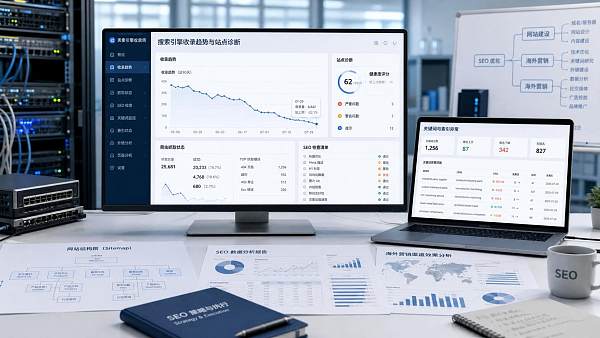
What should you do when Google Search Console indexed pages drop?Many people’s first reaction is to change the homepage,delete sections,or rebuild the structure。But in actual troubleshooting,the real cause of a drop in indexed pages is often not the quality of a single page,but changes in technical settings,content fluctuations,crawl signals,and site strategy together。
This is especially common when foreign trade official websites,multilingual sites,cross-border malls,and advertising landing pages are operated in parallel。While the site is doing SEO and receiving ad traffic,if there is no stable website building system and monitoring mechanism,the data in Search Console can easily show cliff-like changes。
A more prudent approach is to first confirm whether the decline is real,and then check common causes by priority。The following 8 types of issues basically cover most practical scenarios for “what to do when Google Search Console indexed pages drop”。
When Indexed Pages Drop,First Determine Whether It Is Data Fluctuation or an Indexing Anomaly
A downward curve does not necessarily mean the website has a major problem。Google recalculates its index,and may also reduce the total number of indexed pages when cleaning up duplicate pages and low-value pages。If clicks,impressions,and core rankings are all stable,a drop in indexed pages alone does not necessarily require major action。
A practical way to judge is to look at three metrics together:the number of indexed pages,organic traffic trends,and rankings of key pages。If only the total volume declines,but inquiry pages,product pages,and core content pages remain stable,it is more like structural contraction rather than a site-wide failure。
If indexed pages,crawl volume,and impressions decline at the same time,then troubleshooting should be done as soon as possible。The risk is higher especially for new sites,multilingual sites,sites that have just migrated domains,or sites that have adjusted URL rules。
Look at this judgment table first,do not change the template right away
The 8 Most Common Causes Usually Fall Into These Categories
If you are repeatedly searching for “what to do when Google Search Console indexed pages drop”,most situations cannot escape the following 8 items。They do not appear in isolation,and many times they overlap with each other。
- robots.txt blocks by mistake,and important directories are disallowed from crawling。
- Pages have been given noindex,or templates have inherited the wrong tag in bulk。
- After site redesign,migration,or URL rule adjustment,redirects were not handled properly。
- The sitemap was not updated,invalid URLs were submitted,or core pages were omitted。
- Page content has a high level of duplication,and Google proactively compresses indexing。
- Page quality is relatively low,especially machine-stitched content or thin content pages。
- The server is unstable,returning 5xx,timeouts,or frequent downtime。
- Internal links are weak and section hierarchy is deep,causing crawl budget waste。
Among these 8 items,the first 4 are more technical,and the last 4 are more about content and structure。The troubleshooting order should follow the same logic:first rule out configuration errors,then return to content value。
Why Does Google Still Not Index Pages That Have Clearly Been Submitted?
Submitting a URL only tells Google “there is a page here”,but it does not mean it will definitely enter the index。Google cares more about whether this page is worth indexing,whether it can be crawled steadily,and whether it is important enough within the entire site。
A more common situation is that although the page can be opened,the content is too thin,the title and body text are repetitive,there are too many parameter pages,or the same product has multiple similar versions。Even if such pages are submitted,they may remain in “Discovered,currently not indexed” or “Crawled,currently not indexed”。
For website + marketing service integration projects,such issues often appear in multilingual copied sites,bulk product pages,advertising landing pages,and filtered result pages。The number of pages grows quickly,but there are not many pages with truly independent value。
When this happens,first look at three signals
- Whether URL Inspection shows “Google chose different canonical than user”。
- Whether the page has only a small amount of text and differs very little from similar pages。
- Whether the page has almost no internal link entrances。
If these three signals exist at the same time,the answer is usually not to keep submitting,but to rewrite the page,add information,optimize internal site paths,and reduce the production of low-value URLs。
If There Is a Problem With Technical Settings,Where Should You Check First?
What should you do when Google Search Console indexed pages drop?Technical troubleshooting should always come first。Because as long as one of robots,noindex,canonical,or redirects is configured incorrectly,even the best content cannot enter the index。
It is recommended to first check whether any of these actions were taken in the past 30 days:redesign,template replacement,plugin switching,CDN replacement,multilingual path adjustment,category structure rebuilding,bulk product import,or integration with a new website building system。Many indexing declines happen after these operations。
In actual applications,the issue most easily overlooked is template inheritance。For example,noindex was used in the test environment and not removed after launch;or the English site template is normal,but other language sites canonical to the main language page by default,causing a large number of pages to be merged。
If a website carries SEO,advertising,and social media traffic acquisition,the underlying site foundation must be stable。Systems like 易营宝,which cover intelligent website building,SEO optimization,and overseas marketing at the same time,place more emphasis on the unified logic of pages being crawlable,indexable,and convertible,which essentially reduces the chain impact of technical errors on traffic。
Why Does Indexing Still Drop Even Though Content Has Not Been Deleted?
At this point,you need to switch from “whether there are pages” to “whether the pages are valuable”。Google’s evaluation has become stricter in recent years,and the existence of a page does not mean it should be kept in the index for the long term。Content that is generated in bulk,lightly rewritten,or excessively duplicated is especially likely to be reassessed。
Many sites rely on a large number of product pages,regional pages,and article pages in the early stage to rapidly build volume,and short-term indexing may look good,but it gradually falls back later。The reason is not mysterious:the differences between pages are too small,and they cannot meet real search demand。
If you are building a multilingual site,you also need to pay extra attention to translation quality。Literal translations,forced keyword stuffing,and highly similar paragraph structures can all make different language versions lose independent value。Google may not necessarily penalize them,but it will reduce its willingness to index them。
These content issues are usually fixed this way
- Merge duplicate pages,keep the main page,and set the correct canonical tag。
- Add product parameters,scenario descriptions,case content,and FAQs。
- Reduce tag pages,filter pages,and empty category pages with no search value。
- Reorganize multilingual content to avoid machine-like copying across the entire site。
If Backlinks Have Not Dropped and Content Is Still Being Updated,Could the Problem Be Crawl Efficiency?
Yes,and it is very common。Many people focus on content quality but ignore the fact that Google has not smoothly crawled the pages at all。Server fluctuations,slow response,heavy JS loading,confusing pagination paths,and poor internal link distribution can all reduce crawl depth。
For cross-border business websites,especially when covering visits from multiple regions such as North America,Europe,and Southeast Asia,stability is even more important。Slow page loading does not only affect conversion,it also affects Googlebot’s crawl frequency and willingness。
A more stable approach is to look at crawl issues together with marketing page construction。A website suitable for long-term SEO is not just visually attractive,but has a clear structure,distinct language versions,a moderate code burden,and core content that can be discovered quickly。
When crawl efficiency drops,check these items first
- Whether server logs show a large number of 404,5xx,and timeouts。
- Whether core pages are too many click levels away from the homepage。
- Whether JS-rendered content is too heavy and the above-the-fold source code contains too little information。
- Whether the sitemap contains canonical URLs rather than redirect URLs。
What Should You Do When Google Search Console Indexed Pages Drop,and How Should You Prioritize in the End?
Do not treat the problem as a single-point failure。A more effective order is to first confirm the scope of the anomaly,then look at technical settings,then check crawling,and then return to content and internal links。Doing this usually helps identify the main cause in a relatively short time。
If the site is responsible for overseas customer acquisition,especially when operating an independent website,SEO,advertising,and social media traffic acquisition at the same time,it is recommended to establish a fixed inspection checklist。Check index coverage every week,review template changes every month,and verify URLs and indexing before and after every redesign。This is more cost-effective than fixing problems afterward。
To conclude simply:what should you do when Google Search Console indexed pages drop?The core is not “change immediately”,but “judge first,then troubleshoot,then correct”。Compare the 8 common causes one by one,confirm whether the issue belongs to the technical,content,or crawl layer,and then decide whether you need to adjust the structure,update pages,or optimize the website building system。Handled this way,indexing recovery will be more certain,and subsequent organic traffic will be more stable。
Related Articles



Related Products
 Yiyingbao SaaS Intelligent Website Building and Marketing SystemYiyingbao SaaS Intelligent Website Building and Marketing System, AI-powered no-code website building, rapid creation of multilingual B2B international websites in 10 minutes, global server acceleration, AI-powered SEO optimization, helping businesses connect efficiently with global markets. The perfect integration of technology and operation makes building an international trade website remarkably simple
 AI+SEM Intelligent Advertising Marketing SystemAI+SEM drives intelligent ad creation, empowering full-funnel precision advertising marketing. The system automatically generates weekly/monthly reports, AI recommends keywords and target countries, monitors core metrics in real-time with intelligent alerts, and enables one-click high-conversion ad solutions to help quickly acquire customers and improve ROI.
 AI+SEO Dual-Engine System Optimization ServicesYiyingbao’s AI+SEO dual-engine optimization system helps foreign trade enterprises acquire high-quality organic traffic through AI-powered keyword research, content generation, and comprehensive technical optimization, significantly improving search rankings and conversion rates.
 AI+SNS Social Media Marketing SystemYingbao AI+SNS Social Media Marketing System - Precision social capture for the social media era. Supports one-click content synchronization across major platforms like Facebook and LinkedIn. AI intelligently rewrites posts for enhanced relevance. 24/7 AI customer service and user profiling analysis empower businesses to efficiently expand into global markets.
 AI+SEO营销解决方案易营宝AI+SEO营销解决方案,通过AI批量写作、智能生成TDK、精准关键词扩词等功能,全面优化网站SEO效果,提升流量与转化率。助力企业构建高效智能网站新生态。
 AI+SEM Advertising Marketing SolutionsAI+SEM Advertising Marketing Solution leverages AI technology to deeply empower SEM ad campaigns. It automatically generates weekly/monthly reports using AI, presenting account data across multiple dimensions for comprehensive insights into campaign performance and trends. The system precisely recommends keywords and target countries, intelligently generates high-conversion ad copy, and enables one-click activation of efficient campaign plans to help businesses rapidly acquire customers. Simultaneously, it monitors core metrics in real time, intelligently identifies abnormal fluctuations, and issues timely alerts to ensure stable, high-return advertising results.
 Domain Name ServicesEasyWin provides professional domain name services, including intelligent queries, one-stop registration, brand protection, and full lifecycle management, helping businesses build a digital brand image.
 EasyOperate B2C Cross-Border E-Commerce Platform & Independent WebsiteEasyStore B2C Cross-border E-commerce Independent Store is an intelligent website building and cross-border e-commerce integrated solution independently developed by EasyStore Information Technology (Beijing) Co., Ltd. The system is specially designed for small and medium-sized as well as large export enterprises, integrating 'website building, operation, marketing, advertising, and conversion' into one, helping enterprises quickly establish cross-border e-commerce independent stores to achieve brand globalization and global sales growth.
The platform supports multiple languages, multiple currencies, and multi-channel marketing, with built-in AI intelligent translation and SEO optimization systems, suitable for mainstream markets such as Southeast Asia, Europe and America, Latin America, and the Middle East, assisting Chinese manufacturing enterprises in efficiently deploying international e-commerce strategies. SSL证书易营宝提供专业SSL安全证书服务,包括单域名和泛域名证书,确保网站数据传输加密、身份验证和完整性保护,助力企业建立安全可信的在线业务环境。









