









- Is the EV SSL certificate market shrinking or upgrading? How should companies assess certificate procurement?Aug 11, 2026View details
- Why the old AMP SEO 2020 practices no longer work and what has changed in current optimization prioritiesAug 02, 2026View details
- How to Choose Topics for an Industry News Section to Attract More Organic Search TrafficJul 29, 2026View details
- Digital Marketing Shenzhen Market Insights: Why Are Companies Expanding Overseas Looking for Growth Teams in Shenzhen?Jul 31, 2026View details
- Can Zhejiang foreign trade independent websites still be developed today? Look at changes in traffic and lead generationJul 28, 2026View details
- What New Signals Are Emerging in Enterprise Services SaaS Marketing ReportsJul 27, 2026View details
- What Does a Global Traffic Ecosystem Service Provider Do? What Are the Differences from a Single Advertising AgencyJul 16, 2026View details
- What should you focus on in the latest enterprise SaaS report? From renewal rates and delivery costs to overseas growth opportunitiesJul 12, 2026View details
Common Misconceptions About AMP Mobile SEO: Why Hasn’t Ranking Improved Even Though the Page Is Faster?
Why Has the Ranking Not Improved Even Though the Page Is Faster?
When many companies first implement amp mobile seo, they see a clear improvement in their speed-test scores and assume that organic rankings will rise accordingly. In practice, this is where the biggest gap often appears: AMP improves page delivery efficiency, but it does not, by itself, resolve how search engines evaluate content value, page relationships, indexing quality, and the overall mobile experience. Speed is a threshold factor, not a decisive factor. This is especially true for overseas independent websites, brand globalization websites, and multilingual inquiry websites, where stagnant rankings are often not caused by a lack of technical implementation, but by the failure to address the other factors that truly affect visibility after the technical work is completed.
This issue is quite common when Yiyingbao provides overseas marketing services. Companies usually start with slow mobile loading and high bounce rates, then place their hopes on AMP. However, after launch, if keyword coverage, content structure, internal linking logic, and regional and language adaptation remain unchanged, search engines will not automatically assign higher rankings simply because the pages are lighter. A faster site only means that some of the barriers to crawling and access have been reduced; it does not mean that the page is now more worthy of ranking higher.
What Is Easily Overlooked Is Not AMP Itself, but the Indexing Path
One of the most common misconceptions observed in practice is launching AMP as an independent page template without properly managing the relationship between the canonical version and the AMP version. This is particularly evident with content pages, news pages, and blog pages: if the canonical tags, bidirectional references, mobile page mapping, sitemap submission, or cache update schedules are inconsistent, search engines may index the standard page while displaying signals from another version. In the end, neither version receives the full value it should have.
When companies conduct their own checks, they often focus only on whether “the page can be opened” and “the code passes validation.” In project practice, however, three points are more important: which version is actually indexed in Search Console; whether competing duplicate content exists among core pages; and whether the structured content, body text, headings, and internal links on the AMP page have been weakened compared with the original page. If the AMP version shortens the body text, removes related recommendations, or narrows the inquiry entry point in pursuit of a lightweight design, the page may become semantically weaker even though its speed improves. It is therefore unsurprising if rankings do not improve.
This issue is even more typical for B2B manufacturing websites. The core pages of many factory websites are not news pages, but product pages, application pages, and solution pages. These pages need parameters, industry adaptation information, certification details, delivery conditions, and frequently asked questions to collectively support their search value. If AMP conversion retains only a simplified introduction, search engines receive a page that is “fast but information-poor.” For businesses with long procurement cycles and complex decision-making chains, this simplification often directly weakens long-tail keyword performance.
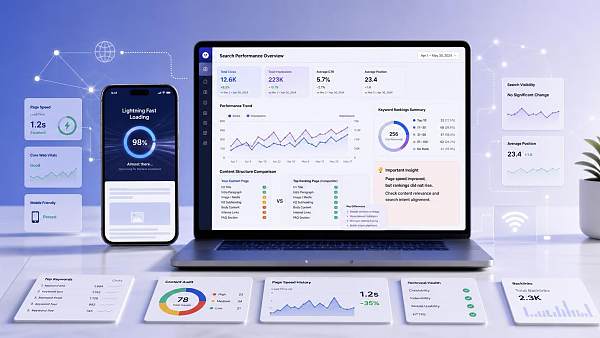
Being Fast on Mobile Does Not Mean the Mobile Experience Is Adequate
Another situation is even easier to misjudge: the technical score improves, but the actual mobile experience does not. When evaluating mobile pages, search engines look at more than above-the-fold loading. Whether buttons are easy to tap, forms are convenient to use, images and specification tables are readable, pop-ups obscure the content, and language switching remains stable can all affect dwell time, returns, and subsequent conversion behavior. Many companies implement AMP on news pages, while the inquiry pages, product detail pages, and quotation pages with the highest commercial value still retain complex scripts and heavy modules. The pages that truly affect conversions and behavioral signals have not improved.
Cross-border e-commerce websites and brand-owned independent sites also face another practical limitation: they often rely heavily on visual design, interactions, review components, and recommendation modules, and AMP is not always suitable as the main framework. If compatibility with AMP comes at the cost of product comparison, variant displays, review content, or important trust information before checkout, rankings may not benefit, while order conversions may decline first. For these sites, mobile performance optimization is often more appropriate than treating AMP as the only answer.
AMP Cannot Make Up for Content Quality Issues
After some projects go live, the technical team may say that the pages are already very lightweight, while the marketing team may say that plenty of keywords have been added, yet rankings remain stuck. When the issue is broken down further, the problem is often found at the content level. Search engines do not lower their requirements for content completeness, topical focus, and information credibility simply because a mobile page uses AMP. This is especially true when companies expanding overseas build multilingual websites. If a page merely translates Chinese materials directly into English, Spanish, or Russian and then applies a faster mobile template, the result is often just “a piece of content with no local search value displayed more quickly.”
On foreign trade websites, the pages that truly create differentiation generally explain application scenarios, delivery scope, certification boundaries, material differences, industry terminology, and common procurement questions in depth. For example, even for the same equipment component page, the search terms, priorities, and reading habits of North American procurement professionals and Southeast Asian distributors are not exactly the same. AMP can optimize the access path, but it cannot replace the content strategy itself. The value of an integrated website and marketing service platform such as Yiyingbao lies precisely in viewing website development, SEO, advertising, and multilingual content together, rather than optimizing an individual page template in isolation.
Which Scenarios Are More Suitable, and Which Require Caution?
If a site receives most of its traffic through news, industry articles, case analyses, and educational content, AMP is generally more likely to deliver benefits. These pages usually have clear objectives, short content-consumption paths, strong compatibility with lightweight templates, and more stable crawling and distribution. If a company is developing an English blog, an industry encyclopedia, or educational content for overseas markets, AMP can be used as part of the mobile content entry point.
However, if the core of a site depends on complex interactions, or if most traffic lands on product filters, specification comparisons, inquiry forms, or payment processes, AMP should not be the only focus. The first step should be to determine whether the pages users visit most frequently are informational; whether mobile conversion actions depend on scripts; whether the existing technology stack makes it convenient to maintain two versions; and whether the team has the capacity to continuously manage indexing, template synchronization, and content consistency. Underestimating maintenance costs is one reason why the results of many projects weaken over time.
What Companies Ask Most Often Is Not “Should We Implement It?” but “How Do We Know Whether It Is Worth It After Implementation?”
To determine whether AMP has generated real SEO benefits, it is not enough to look only at speed tools or fluctuations in individual keywords. A more practical approach is to divide pages into content entry pages and commercial conversion pages, and then separately monitor crawling frequency, valid indexing, mobile click-through rate, the proportion of pages leading to exits, and whether subsequent inquiry or add-to-cart paths are smooth. If content-page traffic improves but conversion on commercial pages drops sharply, it indicates that the technical optimization and business path are not aligned. If pages become faster but indexing does not increase over the long term, the investigation should usually return to content scale, page quality, and indexing relationships.
When planning an overseas website as a whole, some companies also study the layout of their content assets and may even incorporate materials of interest to management into their on-site knowledge sections. For example, a topic such as Research on Financing Strategies for Small and Micro Technology Enterprises in the Early Startup Stage from the Perspective of Angel Investment, if related to the company’s service targets, industry decision-making chain, or information needs of target customers, is more suitable as part of a content strategy to capture search demand than as an isolated topic placed on a lightweight page focused solely on speed. The appropriate page format depends on whether it serves as a lead-generation entry point, brand endorsement, or pre-transaction education.
Do Not Treat AMP as a Ranking Button
From a project perspective, amp mobile seo is more like a localized enhancement tool that should be incorporated into a complete mobile search optimization system rather than treated as a standalone bet. For foreign trade companies, multilingual websites, and overseas brand sites, it is more important to first identify the main mobile access paths and then determine which pages should be made lightweight and which must retain complete information and interactions than to ask whether the entire site should implement AMP. If any one of the four areas—technology, content, indexing, and conversion—has a clear weakness, faster pages will not necessarily achieve higher rankings.
There are usually only a few questions that need to be confirmed first: Which types of pages receive most of the mobile traffic? Do these pages contain enough content to satisfy search intent? Does the AMP version maintain the same core information as the original version? After launch, is someone continuously monitoring indexing and conversion data? Clarifying these points before deciding on the scope and depth of AMP is often closer to achieving results than pursuing “site-wide acceleration” from the outset.
Related Articles



Related Products
 Yiyingbao SaaS Intelligent Website Building and Marketing SystemYiyingbao SaaS Intelligent Website Building and Marketing System, AI-powered no-code website building, rapid creation of multilingual B2B international websites in 10 minutes, global server acceleration, AI-powered SEO optimization, helping businesses connect efficiently with global markets. The perfect integration of technology and operation makes building an international trade website remarkably simple
 AI+SEM Intelligent Advertising Marketing SystemAI+SEM drives intelligent ad creation, empowering full-funnel precision advertising marketing. The system automatically generates weekly/monthly reports, AI recommends keywords and target countries, monitors core metrics in real-time with intelligent alerts, and enables one-click high-conversion ad solutions to help quickly acquire customers and improve ROI.
 AI+SEO Dual-Engine System Optimization ServicesYiyingbao’s AI+SEO dual-engine optimization system helps foreign trade enterprises acquire high-quality organic traffic through AI-powered keyword research, content generation, and comprehensive technical optimization, significantly improving search rankings and conversion rates.
 AI+SNS Social Media Marketing SystemYingbao AI+SNS Social Media Marketing System - Precision social capture for the social media era. Supports one-click content synchronization across major platforms like Facebook and LinkedIn. AI intelligently rewrites posts for enhanced relevance. 24/7 AI customer service and user profiling analysis empower businesses to efficiently expand into global markets.
 AI+SEO营销解决方案易营宝AI+SEO营销解决方案,通过AI批量写作、智能生成TDK、精准关键词扩词等功能,全面优化网站SEO效果,提升流量与转化率。助力企业构建高效智能网站新生态。
 AI+SEM Advertising Marketing SolutionsAI+SEM Advertising Marketing Solution leverages AI technology to deeply empower SEM ad campaigns. It automatically generates weekly/monthly reports using AI, presenting account data across multiple dimensions for comprehensive insights into campaign performance and trends. The system precisely recommends keywords and target countries, intelligently generates high-conversion ad copy, and enables one-click activation of efficient campaign plans to help businesses rapidly acquire customers. Simultaneously, it monitors core metrics in real time, intelligently identifies abnormal fluctuations, and issues timely alerts to ensure stable, high-return advertising results.
 Domain Name ServicesEasyWin provides professional domain name services, including intelligent queries, one-stop registration, brand protection, and full lifecycle management, helping businesses build a digital brand image.
 EasyOperate B2C Cross-Border E-Commerce Platform & Independent WebsiteEasyStore B2C Cross-border E-commerce Independent Store is an intelligent website building and cross-border e-commerce integrated solution independently developed by EasyStore Information Technology (Beijing) Co., Ltd. The system is specially designed for small and medium-sized as well as large export enterprises, integrating 'website building, operation, marketing, advertising, and conversion' into one, helping enterprises quickly establish cross-border e-commerce independent stores to achieve brand globalization and global sales growth.
The platform supports multiple languages, multiple currencies, and multi-channel marketing, with built-in AI intelligent translation and SEO optimization systems, suitable for mainstream markets such as Southeast Asia, Europe and America, Latin America, and the Middle East, assisting Chinese manufacturing enterprises in efficiently deploying international e-commerce strategies. SSL证书易营宝提供专业SSL安全证书服务,包括单域名和泛域名证书,确保网站数据传输加密、身份验证和完整性保护,助力企业建立安全可信的在线业务环境。









