









- AI Products Drive Hong Kong Exports Up 64.9% in September, Fastest Growth in Over 40 YearsNov 17, 2026View details
- National Bureau of Statistics: Foreign trade grew rapidly in October, providing stable support for global tradeNov 17, 2026View details
- The U.S. has ended the $800 de minimis exemption for non-postal shipments; express courier packages must be formally declared.Nov 16, 2026View details
- ASEAN Signs Digital Economy Framework Agreement, Moving Toward Harmonized Cross-Border E-Commerce RulesNov 15, 2026View details
- Shenzhen Becomes the First City in Mainland China to Exceed RMB 5 Trillion in Foreign TradeNov 15, 2026View details
- Fujian Announces the First Batch of Provincial-Level Cross-Border E-Commerce Industrial Parks and Key Brands for CultivationNov 14, 2026View details
How can you verify website source code ownership when choosing a website development provider for foreign trade?
Confirm ownership of the website source code; do not rely solely on the words “source code delivery” in a quotation. When choosing a website development provider for a trading or export business, first confirm whether the website will use custom development, an open-source system, or a SaaS platform. Then specify the scope of the code, intellectual property ownership or licensing arrangements, delivery format, and migration terms in the contract, and verify them through deployment and acceptance testing.
A common procurement problem is discovering only after the website goes live that it can run only on the provider’s platform, or that the files received are just page files, without the backend application or database structure. Even if the company owns the domain, it may then be unable to maintain the website independently and may have to bear the costs of redevelopment, data preparation, and switching services when migrating.
First distinguish between “owning the source code” and “being able to use the website”
Source code ownership concerns rights to the code; delivery concerns whether the files can be obtained; and usage authorization determines how the company may use and modify the website. These are not the same thing. A provider’s giving the company a backend account usually means only that the company can manage the website within the agreed scope. It does not automatically mean that the company owns the platform source code or has the right to deploy it independently.
For custom development projects, the company can negotiate with the provider to specify which specially developed code and related rights belong to the company, and which pre-existing frameworks and components remain the property of their respective rights holders. If an open-source system is used, check its license requirements for activities such as modification and distribution. Do not simply stipulate that all third-party open-source code belongs to the company.
SaaS website development typically focuses on access to the platform, and the underlying source code may not be sold or delivered. This does not necessarily mean the solution is unsuitable, but before procurement, confirm whether data can be exported, whether the export format is usable, and what happens to the website and data when the subscription ends. If the source code cannot be migrated, assess the cost of rebuilding the website rather than equating “data can be exported” with “the website can be migrated in full.”
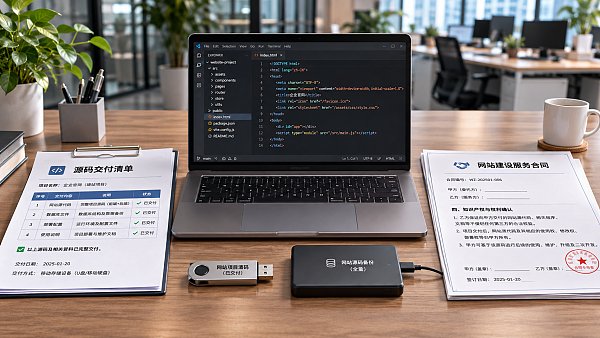
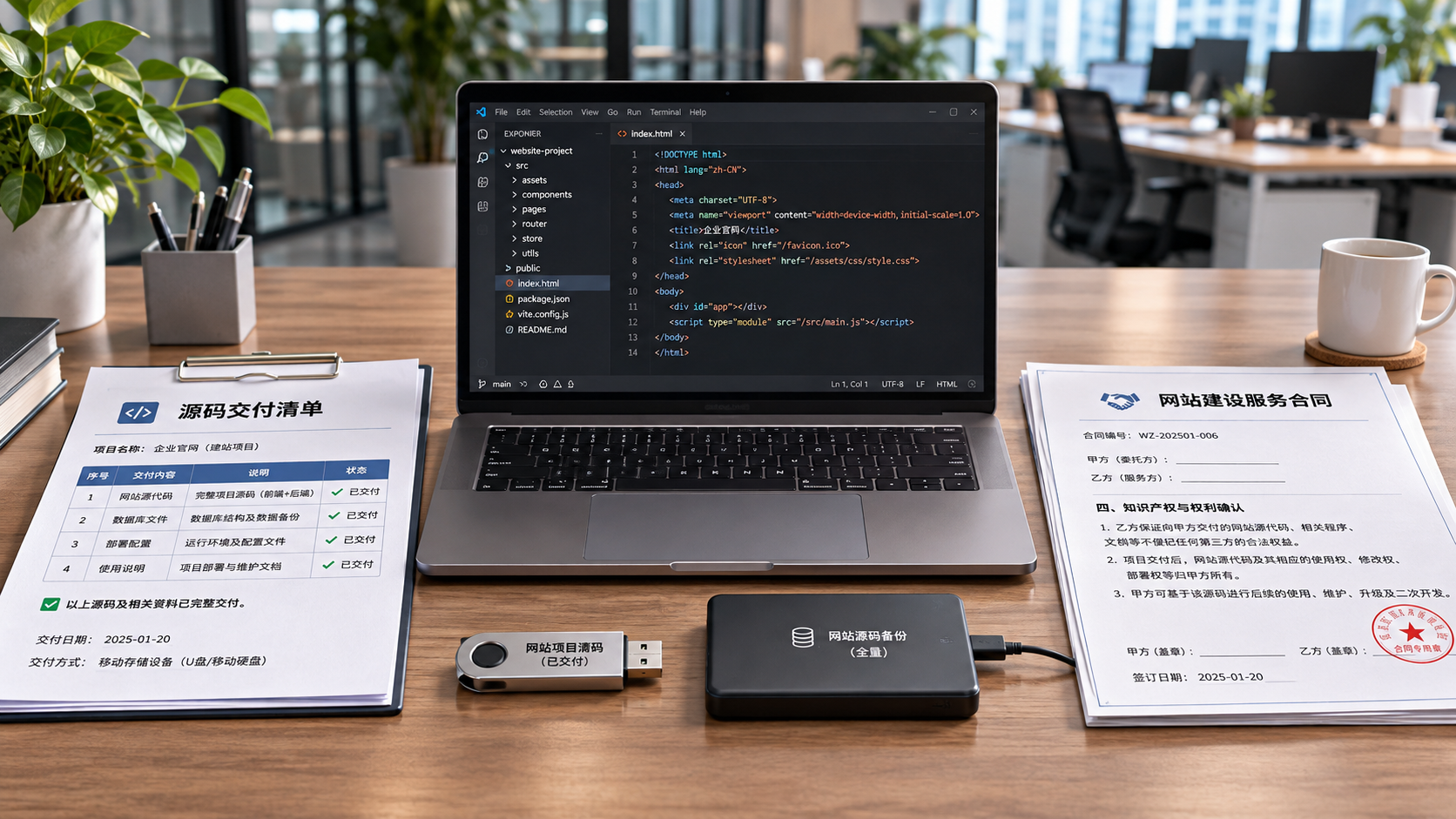
Ask the provider to specify the scope of delivery item by item
Request a written list and distinguish between custom-developed components for the company, the provider’s existing systems, and third-party components. At a minimum, check the following:
- Frontend and backend: Does delivery include editable frontend source code, backend software, API code, and build scripts? Is the deliverable source code or compiled executable files?
- Database: Are the database structure, content data, and import instructions provided? What is the scope and format of exported data, such as customer inquiries?
- Deployment materials: Are the dependency list, runtime environment requirements, configuration instructions, and deployment steps included? Keys should be transferred securely and should not be written directly into ordinary documents.
- Website assets: Who provides the page copy, images, videos, fonts, and templates, respectively? Can the company continue using them on the original website and on a migrated site?
- External services: Do functions such as forms, email, translation, or payments depend on third-party APIs? Who controls the accounts, and will they need to be reconfigured or incur additional fees after migration?
The delivery list should also specify versions and file formats. For example, receiving only HTML files visible in a browser does not mean the backend logic has been delivered; receiving a compressed code package does not mean it includes all dependencies. For anything not being delivered, ask the provider to identify it clearly and explain its impact on the website’s operation.
What questions should the contract terms answer?
It is best to put verbal promises in the contract itself or in an attachment approved by both parties. Avoid ambiguous wording such as “all source code provided free of charge” or “the website belongs to the customer forever.” Pay particular attention to the following:
- Rights and authorization: Specify the ownership of custom-developed code item by item, as well as the scope, term, and restrictions of licenses for the provider’s existing code and third-party components. The company’s right to modify the code or appoint another team to maintain it should also be made clear.
- Delivery milestones: Specify the deliverables, delivery method, and timeline, and align them with acceptance and payment milestones. Set deadlines for remedying missing files or items that cannot be deployed.
- Migration and exit: Specify the timeframe, format, scope of assistance, and fees for data exports when the cooperation ends. If the platform source code will not be delivered, clarify which pages and functions will need to be recreated in a new environment.
- Renewal and restoration: Distinguish fees for software licenses, servers, domains, certificates, and maintenance. Specify the suspension, backup retention, and restoration terms in the event of late payment or termination.
The contract should also list license restrictions on third-party software and assets. A provider should not promise the company full ownership of content it has no right to transfer. The company should assess whether the existing licenses cover its future operational, modification, and migration needs. For complex rights arrangements, consider having a legal professional familiar with software contracts review them.
During acceptance, check more than whether the files have been received
The key to acceptance is verifying that the deliverables meet the contract requirements. For projects that can be independently deployed, ask the provider to demonstrate the process in an environment approved by both parties: install dependencies according to the delivery documentation, import the database, start the frontend and backend, and then test multilingual pages, inquiry forms, and key management functions. If any part requires an account held internally by the provider to run, document it and agree on an alternative or ongoing authorization terms.
If independent deployment cannot be completed immediately, technical personnel should still inspect the code directories, versions, configuration templates, and database backups, and document acceptance conditions for items that have not yet been verified. A website displaying correctly only proves that it works in its current environment. It does not prove that the delivery package is complete, much less that the site can be reproduced in a new environment.
Separately verify control of the domain registration account, server or cloud resource accounts, website backend, and data backups. The company should preferably control key accounts, with the provider granted access as needed for its work. During handover, check administrator accounts, recovery methods, and associated email addresses to avoid being unable to renew services or recover access after the cooperation ends.
How to compare the true costs in different quotations
Break each quotation down into website development, source code or licensing, deployment, maintenance, third-party services, and exit and migration costs, then compare them over the same period of use. A higher price for a source code buyout may not cover future server costs, security updates, and technical maintenance. A platform solution may avoid deployment work initially, but renewal, data export, and rebuilding costs should still be included in the budget.
If the company has an in-house technical team and plans to make ongoing updates independently, focus on source code completeness, modification rights, and deployment feasibility. If a fast launch and platform hosting are more important, focus on renewal terms, data portability, and exit costs. For a quotation that offers neither source code nor a clear explanation of data export, request written terms before deciding whether to proceed with the purchase.
Related Articles
 Is Internet Marketing Consulting Charged by Project or by Month?
 How much does it usually cost to build a standalone e-commerce website for cross-border sales?
 How can you verify website source code ownership when choosing a website development provider for foreign trade?


Related Products
 Yiyingbao SaaS Intelligent Website Building and Marketing SystemYiyingbao SaaS Intelligent Website Building and Marketing System, AI-powered no-code website building, rapid creation of multilingual B2B international websites in 10 minutes, global server acceleration, AI-powered SEO optimization, helping businesses connect efficiently with global markets. The perfect integration of technology and operation makes building an international trade website remarkably simple
 AI+SEM Intelligent Advertising Marketing SystemAI+SEM drives intelligent ad creation, empowering full-funnel precision advertising marketing. The system automatically generates weekly/monthly reports, AI recommends keywords and target countries, monitors core metrics in real-time with intelligent alerts, and enables one-click high-conversion ad solutions to help quickly acquire customers and improve ROI.
 AI+SEO Dual-Engine System Optimization ServicesYiyingbao’s AI+SEO dual-engine optimization system helps foreign trade enterprises acquire high-quality organic traffic through AI-powered keyword research, content generation, and comprehensive technical optimization, significantly improving search rankings and conversion rates.
 AI+SNS Social Media Marketing SystemYingbao AI+SNS Social Media Marketing System - Precision social capture for the social media era. Supports one-click content synchronization across major platforms like Facebook and LinkedIn. AI intelligently rewrites posts for enhanced relevance. 24/7 AI customer service and user profiling analysis empower businesses to efficiently expand into global markets.
 AI+SEO营销解决方案易营宝AI+SEO营销解决方案,通过AI批量写作、智能生成TDK、精准关键词扩词等功能,全面优化网站SEO效果,提升流量与转化率。助力企业构建高效智能网站新生态。
 AI+SEM Advertising Marketing SolutionsAI+SEM Advertising Marketing Solution leverages AI technology to deeply empower SEM ad campaigns. It automatically generates weekly/monthly reports using AI, presenting account data across multiple dimensions for comprehensive insights into campaign performance and trends. The system precisely recommends keywords and target countries, intelligently generates high-conversion ad copy, and enables one-click activation of efficient campaign plans to help businesses rapidly acquire customers. Simultaneously, it monitors core metrics in real time, intelligently identifies abnormal fluctuations, and issues timely alerts to ensure stable, high-return advertising results.
 Domain Name ServicesEasyWin provides professional domain name services, including intelligent queries, one-stop registration, brand protection, and full lifecycle management, helping businesses build a digital brand image.
 EasyOperate B2C Cross-Border E-Commerce Platform & Independent WebsiteEasyStore B2C Cross-border E-commerce Independent Store is an intelligent website building and cross-border e-commerce integrated solution independently developed by EasyStore Information Technology (Beijing) Co., Ltd. The system is specially designed for small and medium-sized as well as large export enterprises, integrating 'website building, operation, marketing, advertising, and conversion' into one, helping enterprises quickly establish cross-border e-commerce independent stores to achieve brand globalization and global sales growth.
The platform supports multiple languages, multiple currencies, and multi-channel marketing, with built-in AI intelligent translation and SEO optimization systems, suitable for mainstream markets such as Southeast Asia, Europe and America, Latin America, and the Middle East, assisting Chinese manufacturing enterprises in efficiently deploying international e-commerce strategies. SSL证书易营宝提供专业SSL安全证书服务,包括单域名和泛域名证书,确保网站数据传输加密、身份验证和完整性保护,助力企业建立安全可信的在线业务环境。









