









- Levanta’s Inaugural China Summit Held in Shenzhen, Focusing on AI and Cross-Border Brand GrowthOct 20, 2026View details
- The October Edition of the 2026 GGE Shenzhen Cross-Border E-Commerce Expo OpensOct 20, 2026View details
- Dongguan’s foreign trade imports and exports reached RMB 1.29 trillion in the first three quarters, a record high for the same periodOct 20, 2026View details
- Liaoning Holds Province-Wide Meeting to Advance Cross-Border E-Commerce, Emphasizing the Need to Explore Differentiated Development PathsOct 20, 2026View details
- Advanced Manufacturing Seizes Global Opportunities as Guangdong’s Q3 Foreign Trade Surpasses RMB 3 Trillion for the First TimeOct 20, 2026View details
- Can the average annual growth rate reflect real opportunities in overseas markets?Oct 07, 2026View details
Can AI-powered website building for fastener export websites automatically optimize SEO?
AI website building can automatically complete part of the basic SEO work, but it should not be understood as meaning that “the website will continuously generate fastener inquiries on its own once it goes live.” For foreign trade companies with complex product lines and detailed specification differences involving bolts, nuts, screws, washers, anchor bolts, and similar products, the value of AI lies mainly in improving website-building and content optimization efficiency. Whether stable organic search traffic can be obtained still depends on product structure, keyword strategy, multilingual quality, and subsequent data iteration.
If a factory previously had only a presentation-style English website with simple product-page information and without systematic organization of models, materials, standards, and application scenarios, AI website building can usually improve the site's crawlability and content completeness relatively quickly. However, expecting the system to automatically determine the purchasing search habits for every type of fastener in different countries, automatically avoid homogeneous competition, and continuously produce credible professional content can easily overestimate the limits of “automated optimization.”
What AI Can Do Automatically—and What It Cannot Do for a Business
An AI website-building system suitable for foreign trade marketing can usually handle many basic SEO tasks: generating standardized page title and description suggestions, creating product detail page frameworks, adding image alt text, generating sitemaps, establishing basic internal linking relationships, and maintaining a good loading and reading experience on mobile devices. Although these tasks may appear basic, they often determine whether search engines can smoothly discover, understand, and index website pages.
For fastener companies, AI can also organize product pages in batches based on existing materials. For example, around clearly defined product terms such as “stainless steel hex bolt” and “DIN 912 socket head cap screw,” it can generate initial page drafts containing materials, specification ranges, applicable standards, surface treatments, packaging methods, and application fields. When there are many products and historical materials are scattered, this step can significantly reduce manual data-entry time.
However, AI cannot create a company's actual manufacturing capabilities and commercial priorities from nothing. It does not know which specifications offer higher profit margins, which products have stable lead times, which certifications may be disclosed, or which markets are currently being developed. Nor can it accurately determine from a single generic prompt that German buyers more often search by DIN standards, while North American buyers may use ANSI, ASTM, SAE, or application-based terms.
Therefore, automation is suitable for “building search infrastructure” and “improving content production efficiency,” while strategic choices still require businesses to provide accurate input and conduct reviews.
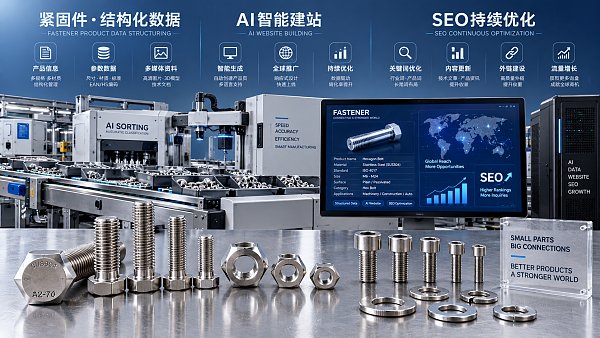
For Fastener Websites, the Challenge of SEO Lies in Product Information, Not the Number of Pages
Search traffic for hardware fasteners is often highly fragmented. For the same type of bolt, users may search by product name, standard, material, strength grade, thread type, surface treatment, usage scenario, or purchasing requirements. A website that merely lists “Bolt,” “Nut,” and “Washer” will find it difficult to cover the actual search paths used by purchasing professionals, even if its pages are quickly generated by AI.
A more valuable approach is to first establish a clear product information structure, and then have AI assist in expanding page content. At a minimum, the following should generally be distinguished:
- Product categories: bolts, nuts, screws, washers, threaded rods, anchors, and more;
- Standards or structures: hex head, socket head, flange, U-shaped, T-shaped, self-tapping, machined parts, and more;
- Materials and performance: carbon steel, stainless steel, alloy steel, brass, and applicable strength grades;
- Surface treatments: zinc plating, hot-dip galvanizing, Dacromet, blackening, phosphating, and more;
- Application scenarios: construction, automotive, machinery and equipment, solar mounting systems, pipelines, power, furniture, and more.
This does not mean that an independent page needs to be created for every attribute combination. Too many pages with only minor content differences can easily create duplicate content and make it difficult for buyers to browse. A more prudent approach is to retain product pages with clearly differentiated demand, while explaining optional sizes, threads, lengths, packaging, and other details in parameter tables on the same product page. AI can help generate descriptions, organize fields, and create related recommendations, but whether a page should exist independently still needs to be determined according to search demand and the company's actual supply capabilities.
Multilingual Content Does Not Simply Mean Translating English Pages Several Times
Fastener foreign trade websites often target multiple markets. Multilingual SEO is one of the most heavily promoted—and most easily superficial—aspects of AI website building. Automated translation can quickly generate French, German, Spanish, or Russian pages, but procurement-oriented searches are highly sensitive to terminology accuracy. Errors in standard numbers, grades, units, performance classes, thread designations, or industry conventions can directly affect professional credibility.
A more common problem is that multiple language versions are translated sentence by sentence, with exactly the same page titles, product categories, and landing-page intent. While this increases the number of pages, it may not correspond to the search expressions used by local buyers. For example, some markets more commonly search using a standard number plus a product name, while others add purchasing-intent terms such as “manufacturer,” “supplier,” “wholesale,” or “custom” to keywords. Pages in different languages need to retain consistent technical facts while allowing titles, descriptions, and Q&A content to align with local search practices.
When using AI to generate multilingual content, companies should at least verify three types of information: whether standards and technical terminology are accurate; whether dimensional units are consistent with market conventions; and whether the materials, processes, certifications, and delivery scope promised on the page align with the actual business. The purpose of SEO content is to attract suitable visits, rather than increase traffic through vague wording.
To Determine Whether “Automated SEO” Is Useful, Review These Verifiable Areas
When choosing an AI website-building service, rather than only asking “Can it do SEO?”, it is better to examine whether the system and service can deliver specific actions. The following areas are more valuable for evaluation than statements such as “AI automated optimization”:
If a system can only generate pages once but cannot conveniently revise content, maintain product data, or monitor search performance, it is closer to a content production tool than a continuous optimization tool. For fastener companies, subsequent maintenance capabilities are often more important than initial generation speed, because product specifications, inventory strategies, market priorities, and inquiry quality all change.
What Is Most Easily Overlooked Is the Review After Automatic Generation
AI-generated English may appear fluent, but that does not mean it is suitable for direct publication. In the fastener industry, two types of issues in particular must be prevented: one is the overgeneralization of technical parameters, such as mixing performance descriptions for different grades or materials; the other is excessive marketing claims, such as presenting optional capabilities as fixed supply capabilities or describing general application scenarios as suitable for all operating conditions.
Such content not only affects a professional image but also creates SEO risks. Search engines are more likely to recognize pages that offer clear value, maintain consistent information, and solve users' problems. A large number of similar AI-generated pages and empty descriptions such as “high quality” and “competitive price” are difficult to create meaningful differentiation. Rather than creating pages in bulk, priority should be given to improving core product pages, standards information pages, material and surface treatment pages, as well as questions buyers frequently ask about customization, minimum order quantities, testing, packaging, and delivery.
For hardware fastener foreign trade companies, AI website building can raise the starting point for SEO: websites can be developed faster, product content can be standardized more easily, and basic technical issues can be handled more readily. However, it cannot replace product expertise, market judgment, or ongoing operations. Using AI for repetitive organization, initial content drafts, and data support, while having business personnel confirm key products and technical facts, is generally closer to a sustainable path for customer acquisition than pursuing “fully automated SEO.”
Related Articles
Related Products
 Yiyingbao SaaS Intelligent Website Building and Marketing SystemYiyingbao SaaS Intelligent Website Building and Marketing System, AI-powered no-code website building, rapid creation of multilingual B2B international websites in 10 minutes, global server acceleration, AI-powered SEO optimization, helping businesses connect efficiently with global markets. The perfect integration of technology and operation makes building an international trade website remarkably simple
 AI+SEM Intelligent Advertising Marketing SystemAI+SEM drives intelligent ad creation, empowering full-funnel precision advertising marketing. The system automatically generates weekly/monthly reports, AI recommends keywords and target countries, monitors core metrics in real-time with intelligent alerts, and enables one-click high-conversion ad solutions to help quickly acquire customers and improve ROI.
 AI+SEO Dual-Engine System Optimization ServicesYiyingbao’s AI+SEO dual-engine optimization system helps foreign trade enterprises acquire high-quality organic traffic through AI-powered keyword research, content generation, and comprehensive technical optimization, significantly improving search rankings and conversion rates.
 AI+SNS Social Media Marketing SystemYingbao AI+SNS Social Media Marketing System - Precision social capture for the social media era. Supports one-click content synchronization across major platforms like Facebook and LinkedIn. AI intelligently rewrites posts for enhanced relevance. 24/7 AI customer service and user profiling analysis empower businesses to efficiently expand into global markets.
 AI+SEO营销解决方案易营宝AI+SEO营销解决方案,通过AI批量写作、智能生成TDK、精准关键词扩词等功能,全面优化网站SEO效果,提升流量与转化率。助力企业构建高效智能网站新生态。
 AI+SEM Advertising Marketing SolutionsAI+SEM Advertising Marketing Solution leverages AI technology to deeply empower SEM ad campaigns. It automatically generates weekly/monthly reports using AI, presenting account data across multiple dimensions for comprehensive insights into campaign performance and trends. The system precisely recommends keywords and target countries, intelligently generates high-conversion ad copy, and enables one-click activation of efficient campaign plans to help businesses rapidly acquire customers. Simultaneously, it monitors core metrics in real time, intelligently identifies abnormal fluctuations, and issues timely alerts to ensure stable, high-return advertising results.
 Domain Name ServicesEasyWin provides professional domain name services, including intelligent queries, one-stop registration, brand protection, and full lifecycle management, helping businesses build a digital brand image.
 EasyOperate B2C Cross-Border E-Commerce Platform & Independent WebsiteEasyStore B2C Cross-border E-commerce Independent Store is an intelligent website building and cross-border e-commerce integrated solution independently developed by EasyStore Information Technology (Beijing) Co., Ltd. The system is specially designed for small and medium-sized as well as large export enterprises, integrating 'website building, operation, marketing, advertising, and conversion' into one, helping enterprises quickly establish cross-border e-commerce independent stores to achieve brand globalization and global sales growth.
The platform supports multiple languages, multiple currencies, and multi-channel marketing, with built-in AI intelligent translation and SEO optimization systems, suitable for mainstream markets such as Southeast Asia, Europe and America, Latin America, and the Middle East, assisting Chinese manufacturing enterprises in efficiently deploying international e-commerce strategies. SSL证书易营宝提供专业SSL安全证书服务,包括单域名和泛域名证书,确保网站数据传输加密、身份验证和完整性保护,助力企业建立安全可信的在线业务环境。









