









- Levanta’s Inaugural China Summit Held in Shenzhen, Focusing on AI and Cross-Border Brand GrowthOct 20, 2026View details
- The October Edition of the 2026 GGE Shenzhen Cross-Border E-Commerce Expo OpensOct 20, 2026View details
- Dongguan’s foreign trade imports and exports reached RMB 1.29 trillion in the first three quarters, a record high for the same periodOct 20, 2026View details
- Liaoning Holds Province-Wide Meeting to Advance Cross-Border E-Commerce, Emphasizing the Need to Explore Differentiated Development PathsOct 20, 2026View details
- Advanced Manufacturing Seizes Global Opportunities as Guangdong’s Q3 Foreign Trade Surpasses RMB 3 Trillion for the First TimeOct 20, 2026View details
- Can the average annual growth rate reflect real opportunities in overseas markets?Oct 07, 2026View details
Is responsive AI website building suitable for complex B2B websites?
Is AI website-building functionality with responsive design suitable for complex B2B websites? The key is not "speed," but whether it can continuously support business operations
Facing multiple product lines, multi-role collaboration, and global customer acquisition needs, whether AI website-building functionality with responsive design can support the expansion, management, and conversion of complex B2B websites has become a key issue in evaluating website-building solutions. Many companies initially see benefits such as "rapid page generation, automatic mobile adaptation, and more time-efficient multilingual launches," but once a project truly moves forward, they often need to address issues such as inconsistent product information, different content for regional markets, the need to route inquiries, frequent updates to technical documentation, and disconnects among SEO, advertising, and sales follow-up.
Therefore, determining whether AI website building is suitable for a complex B2B website cannot rely solely on whether the homepage looks attractive or on page-generation speed. A more practical standard is whether it can break down complex business operations into manageable content structures, present them consistently across different devices and language environments, and leave sufficient room for subsequent promotion, data analysis, and sales conversion.
Responsive design is not about “shrinking pages,” but about reorganizing procurement information
Visitors to complex B2B websites do not always use large-screen computers in an office. Overseas procurement professionals may initially screen suppliers on mobile phones; engineers may review model specifications, drawings, or application conditions; while management pays more attention to qualifications, delivery capabilities, and industry experience. If responsive design merely proportionally compresses desktop pages, common results include difficult-to-read tables, ineffective product filtering, overly long forms, and important downloadable materials hidden in multiple menu levels.
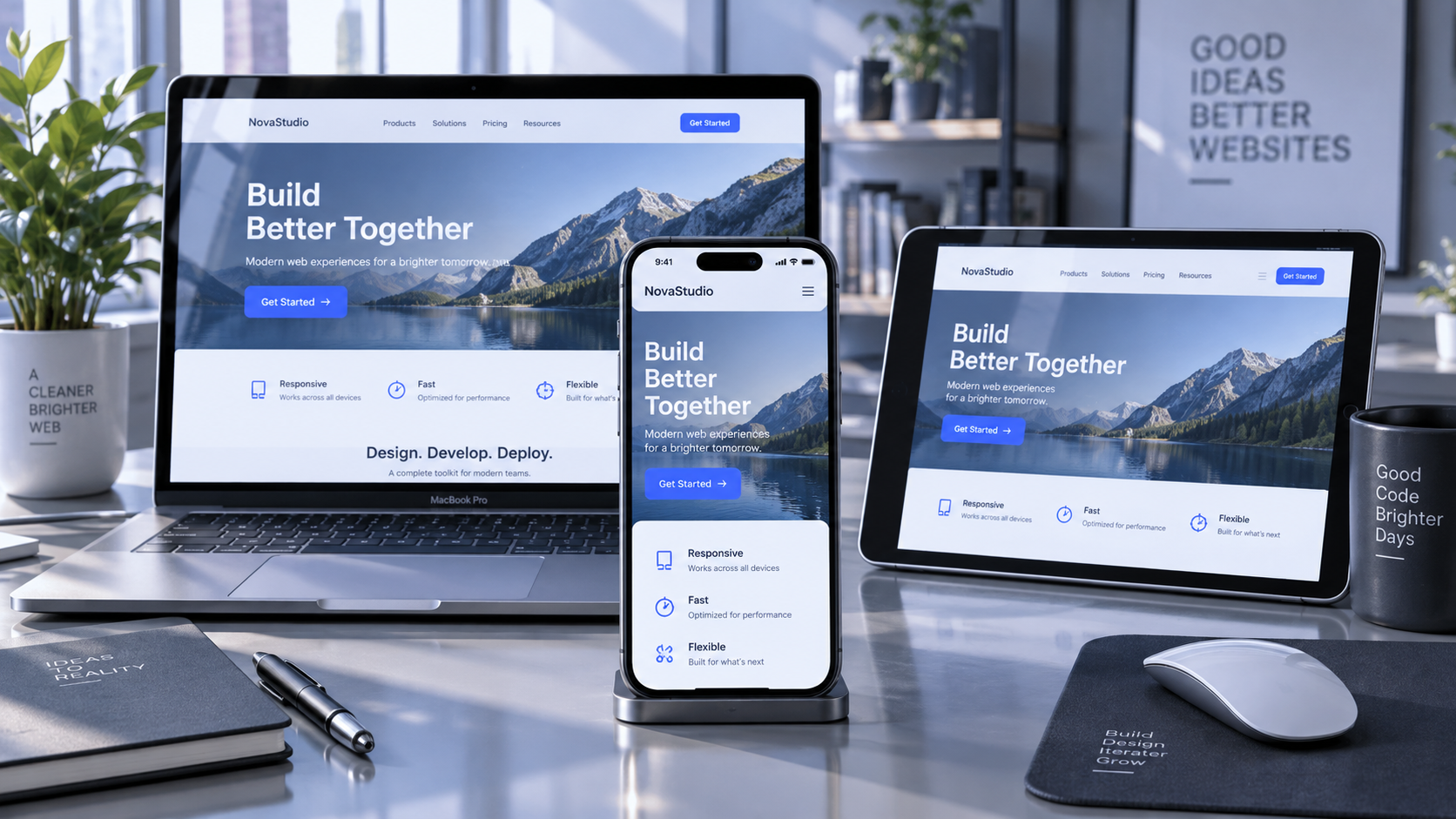
Truly practical AI website-building functionality with responsive design should understand page hierarchy rather than simply adjust font sizes. For example, mobile versions should prioritize core applications, main specification ranges, inquiry entry points, and trust-building information, while desktop versions can expand technical parameter comparisons, series navigation, document downloads, and related products. For businesses with longer decision cycles, such as equipment manufacturing, industrial components, and chemical materials, the “order of information” directly affects whether visitors continue learning more, rather than merely influencing the visual experience.

Complex B2B websites most often encounter bottlenecks in four areas
The first is product architecture. A company may operate dozens of series and hundreds of models while also needing to organize content by industry, process, application scenario, and target country. If an AI tool can only generate isolated pages but cannot support categorization, tags, filtering, related recommendations, and bulk maintenance, the more pages there are, the more difficult subsequent management becomes. AI is suitable for assisting with the establishment of initial catalogs, completing fields, and generating content drafts, but classification rules, naming systems, and key parameters still need to be confirmed by the business team.
The second is multilingual content and localization. Directly translating Chinese materials into English does not mean overseas website development is complete. Product names, units of measurement, procurement priorities, and compliance wording may differ across markets; landing pages for the same model in Europe, the Middle East, or Latin America may not necessarily use exactly the same selling points. AI can improve the efficiency of initial translation and content production, but technical terminology, certification descriptions, delivery commitments, and commercial wording require human review. In particular, automatically generated content must not replace fact verification.
The third is collaboration permissions. Complex websites typically involve marketing, product, technical, sales, and overseas teams. If everyone can directly modify templates, navigation, or language versions, information misalignment can easily occur; if permissions are overly restricted, routine updates can only rely on developers. More mature systems should support assigning editing scopes by role and retain content review, version rollback, or publishing workflows. Although this may appear to be a backend issue, it actually concerns whether the website can operate over the long term.
The fourth is the inquiry workflow. Conversion on a B2B website should not consist of only a “Contact Us” form. Inquiries from different pages should retain context such as the source page, product model, language version, and traffic channel; advertising landing pages also need to be managed separately from organic search pages. Otherwise, after receiving a vague email, sales staff must repeatedly confirm where the customer came from and what they intend to purchase, while marketing investment also becomes difficult to trace.
When evaluating website-building solutions, “AI capabilities” should be examined separately
It is especially important to distinguish between “AI-assisted website building” and “AI replacing project management.” The former can help teams organize page frameworks faster, generate first drafts, adapt modules, and maintain repetitive content; the latter is an unrealistic expectation. Complex B2B websites involve product logic, procurement processes, and market judgment. AI can reduce mechanical work, but it cannot replace a company’s decisions on what information must be disclosed, which parameters require restricted display, and who should handle inquiries in different regions.
Whether website building and marketing services are integrated determines the amount of subsequent rework
Many website project issues do not arise before launch, but after promotion begins. SEO teams want to add topic pages and content clusters, advertising teams need landing pages that better match target keywords, and sales teams want to shorten forms and add instant communication entry points. If the website-building system cannot be adjusted quickly, or if the service provider does not understand overseas customer-acquisition logic, companies will repeatedly communicate among different suppliers, extending the cycle for page changes.
Yiyingbao Information Technology (Beijing) Co., Ltd. has focused on digital marketing services since 2013. Built on artificial intelligence and big data technologies, it has developed an interconnected service system covering intelligent website building, SEO optimization, social media marketing, and advertising. For companies seeking to conduct business in markets such as North America, Europe, Southeast Asia, the Middle East, Japan and South Korea, and Latin America, this integration is not simply about stacking all channels together. Rather, it enables website structure, content language, traffic-driving pages, and inquiry handling to be adjusted collaboratively around the same set of business objectives.
Its self-developed cloud intelligent website-building system, cross-border e-commerce system, AI advertising marketing capabilities, and AI+SEO/GEO optimization capabilities cover common scenarios such as foreign trade B2B inquiry websites, multilingual corporate websites, cross-border e-commerce stores, and advertising landing pages. For complex projects, it is more worthwhile to focus on whether content and promotion can be continuously iterated: whether new products can quickly become pages, whether new markets can establish independent language strategies, and whether traffic from search, social media, and advertising can be identified and accumulated as follow-up-ready leads.
The boundaries of suitability for AI website building should also be clarified in advance
If a company’s core needs are standardized product presentation, multilingual expansion, continuous content publishing, and support for overseas marketing, AI website-building functionality with responsive design can usually significantly reduce the pressure of initial production and day-to-day maintenance. Especially when there are many pages, language versions require ongoing updates, and marketing teams frequently test topic pages, modularization and intelligent content-generation capabilities offer more practical value than one-time customized pages.
However, if a project relies on highly specialized pricing rules, complex distributor permissions, deep ERP or CRM integrations, or needs to address special data security and approval requirements, decisions cannot be based solely on demonstration pages. During the project initiation stage, it is necessary to clarify data sources, integration scope, content migration methods, permission design, handling of historical links, and subsequent operation and maintenance responsibilities. The more complex the website, the more important it is to first define “what must be standardized and what must be customized.”
AI website building is not a universal answer for complex B2B websites, but it can serve as more reliable infrastructure: enabling pages to adapt to different devices, making content management no longer completely dependent on technical personnel, and keeping website building, promotion, and inquiry handling within the same business workflow as much as possible. What truly deserves confirmation is not whether a system can generate a website within minutes, but whether the team can still continue using it quickly and systematically when adding products, expanding markets, or adjusting advertising strategies six months later.
Related Articles

Related Products
 Yiyingbao SaaS Intelligent Website Building and Marketing SystemYiyingbao SaaS Intelligent Website Building and Marketing System, AI-powered no-code website building, rapid creation of multilingual B2B international websites in 10 minutes, global server acceleration, AI-powered SEO optimization, helping businesses connect efficiently with global markets. The perfect integration of technology and operation makes building an international trade website remarkably simple
 AI+SEM Intelligent Advertising Marketing SystemAI+SEM drives intelligent ad creation, empowering full-funnel precision advertising marketing. The system automatically generates weekly/monthly reports, AI recommends keywords and target countries, monitors core metrics in real-time with intelligent alerts, and enables one-click high-conversion ad solutions to help quickly acquire customers and improve ROI.
 AI+SEO Dual-Engine System Optimization ServicesYiyingbao’s AI+SEO dual-engine optimization system helps foreign trade enterprises acquire high-quality organic traffic through AI-powered keyword research, content generation, and comprehensive technical optimization, significantly improving search rankings and conversion rates.
 AI+SNS Social Media Marketing SystemYingbao AI+SNS Social Media Marketing System - Precision social capture for the social media era. Supports one-click content synchronization across major platforms like Facebook and LinkedIn. AI intelligently rewrites posts for enhanced relevance. 24/7 AI customer service and user profiling analysis empower businesses to efficiently expand into global markets.
 AI+SEO营销解决方案易营宝AI+SEO营销解决方案,通过AI批量写作、智能生成TDK、精准关键词扩词等功能,全面优化网站SEO效果,提升流量与转化率。助力企业构建高效智能网站新生态。
 AI+SEM Advertising Marketing SolutionsAI+SEM Advertising Marketing Solution leverages AI technology to deeply empower SEM ad campaigns. It automatically generates weekly/monthly reports using AI, presenting account data across multiple dimensions for comprehensive insights into campaign performance and trends. The system precisely recommends keywords and target countries, intelligently generates high-conversion ad copy, and enables one-click activation of efficient campaign plans to help businesses rapidly acquire customers. Simultaneously, it monitors core metrics in real time, intelligently identifies abnormal fluctuations, and issues timely alerts to ensure stable, high-return advertising results.
 Domain Name ServicesEasyWin provides professional domain name services, including intelligent queries, one-stop registration, brand protection, and full lifecycle management, helping businesses build a digital brand image.
 EasyOperate B2C Cross-Border E-Commerce Platform & Independent WebsiteEasyStore B2C Cross-border E-commerce Independent Store is an intelligent website building and cross-border e-commerce integrated solution independently developed by EasyStore Information Technology (Beijing) Co., Ltd. The system is specially designed for small and medium-sized as well as large export enterprises, integrating 'website building, operation, marketing, advertising, and conversion' into one, helping enterprises quickly establish cross-border e-commerce independent stores to achieve brand globalization and global sales growth.
The platform supports multiple languages, multiple currencies, and multi-channel marketing, with built-in AI intelligent translation and SEO optimization systems, suitable for mainstream markets such as Southeast Asia, Europe and America, Latin America, and the Middle East, assisting Chinese manufacturing enterprises in efficiently deploying international e-commerce strategies. SSL证书易营宝提供专业SSL安全证书服务,包括单域名和泛域名证书,确保网站数据传输加密、身份验证和完整性保护,助力企业建立安全可信的在线业务环境。









