









- China-Europe Railway Express and CIIE Hold Business Matchmaking Event, Focusing on Cross-Border E-commerce B2B ExportsNov 07, 2026View details
- China’s Ministry of Commerce Responds to Additional Charges on Low-Value Imports Imposed by the EUNov 06, 2026View details
- Two Internet Development Reports Released at the 2026 World Internet ConferenceNov 05, 2026View details
- Internet Business Revenue of Enterprises Above the Designated Size Reached RMB 1.716 Trillion in the First Three Quarters, with Profits Up 17.6%Nov 05, 2026View details
- Shopify's Third-Quarter Revenue and GMV Fall Short of Expectations, Sending Shares Tumbling Before the Market OpensNov 04, 2026View details
- Temu Sellers See a Decline in Traffic as the Platform’s Traffic Allocation ShiftsNov 04, 2026View details
How effective is the AI-powered website building tool, Ad Manager? Which advertising scenarios is it suitable for?
How effective are AI-powered website building tools and advertising smart managers? The reason this question has garnered attention isn't just about "faster ad delivery," but rather whether website building, ad placement, and lead conversion can truly be integrated into a cohesive whole. For overseas businesses, advertising spending is becoming increasingly transparent, and traffic competition is becoming more granular. Relying solely on manual account monitoring, bid adjustments, and creative changes is no longer sufficient to consistently amplify results.
From a practical business perspective, the effectiveness of AI-powered advertising management tools for website building often depends on their ability to integrate website building, landing pages, data attribution, and advertising strategies. In other words, it's not an isolated advertising plugin, but rather a central intelligent control system within a unified website and marketing service framework. This capability is particularly valuable in multilingual independent websites, international trade inquiry sites, cross-border e-commerce platforms, and overseas promotion scenarios.
Why this ability is becoming more important
The overseas promotion environment has changed significantly. Platform algorithms are more complex, ad account structures are more granular, and the user's path from click to conversion is longer. Many campaign issues, which appear to be fluctuations in ad performance, are actually due to problems with website support, content matching, and incomplete data feedback.
This is why more and more companies are starting to pay attention to the effectiveness of AI-powered website building tools and advertising intelligent management systems. Its significance lies not only in automating processes, but also in judging "traffic acquisition" and "on-site conversion" within the same system, reducing waste caused by a disconnect between ad placements and the website itself.
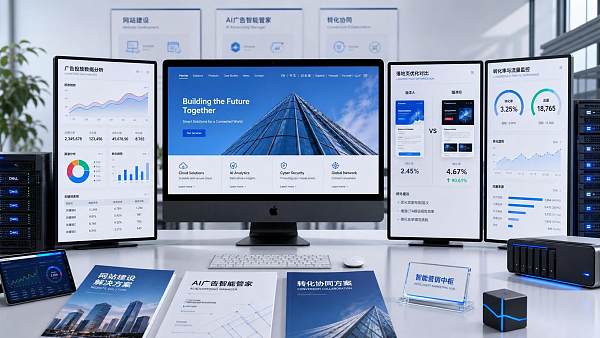
Taking YiYingBao as an example, these platforms don't just provide advertising services at a single point. Instead, they integrate AI-powered website building, multilingual website development, Google SEO, Google Ads, Facebook Ads, social media operations, and GEO optimization into a single digital workflow. The value of this approach lies in the more synchronized optimization of front-end customer acquisition and back-end conversion.
First, figure out exactly what problem it is solving.
In simple terms, the AI-powered advertising assistant doesn't replace advertising staff; rather, it takes over high-frequency, repetitive tasks that rely on data-driven judgment. These include budget allocation, bid fine-tuning, creative combination testing, conversion page matching, abnormal fluctuation alerts, and periodic data analysis.
To understand this more deeply, the effectiveness of an AI-powered website building tool like the Ad Manager depends on three main things: whether it can identify user behavior, whether it can quickly provide adjustment suggestions, and whether it can smoothly guide ad clicks to pages that are easier to convert.
Many accounts perform poorly not because they lack traffic, but because their landing pages have disorganized information structures, inaccurate language versions, excessively long form paths, or inconsistencies between product selling points and ad content. If the website building system can work in tandem with the ad delivery system, the problem is usually easier to pinpoint.
In what ways does the effectiveness of AI-powered website building tools and intelligent advertising management systems typically manifest itself?
The results show that the effectiveness is not only reflected in lower cost-per-click, but more importantly, in more stable conversion quality. Especially when targeting overseas markets, the validity of leads, the matching of inquiries, and the adaptation of pages to regional needs are more important than the lower cost per click.
Higher delivery efficiency
AI can continuously monitor account data, reducing the time spent on repeatedly switching platforms, downloading reports, and manually comparing data. This is especially important for deployments across multiple regions, languages, and product lines.
The page layout is more closely aligned with conversion rates.
When advertising strategies and website building tools are integrated, landing pages are no longer just "pages available," but can be more finely adapted around keywords, regional languages, product selling points, and conversion goals.
More complete data analysis
The true value of AI-powered website building tools like Ad Manager lies in their ability to analyze both ad data and on-site behavior. Which keywords generate inquiries, which pages have high bounce rates, and which regions generate more effective inquiries—these are far more informative than simply looking at impressions and clicks.
Enlarged reproducible results
Once the system identifies high-converting combinations, it becomes easier to replicate effective strategies on other country websites, product pages, or ad groups. In this way, growth relies not on a single inspiration, but on continuously accumulated, reusable experience.
Which advertising scenarios are more suitable for using
Not all advertising accounts need these kinds of tools, but the following scenarios are where the effectiveness of website building tools and AI-powered advertising management tools is often better demonstrated.
From an industry application perspective, foreign trade companies, manufacturing plants, cross-border sellers, and brand overseas expansion projects typically rely more heavily on these systems. This is because they often face multiple national markets and need to consider website building efficiency while also ensuring SEO retention, advertising conversion, and subsequent reinvestment.
To judge the effectiveness, don't just look at the surface data.
When evaluating the effectiveness of AI-powered website building tools like Ad Manager, many people tend to focus on click-through rate (CTR) and cost per click (CPC). While these metrics are important, relying solely on them often leads to misjudgments.
A more reliable approach is to break down the assessment into three levels: external, internal, and business results.
- External factors: Exposure, click-through rate, cost per click, and the health of regional traffic structure.
- On-site metrics: bounce rate, dwell time, form completion rate, and the smoothness of the page conversion path.
- From a business perspective: inquiry effectiveness, order conversion rate, repeat purchase performance, and customer acquisition cost across different channels.
If a system can only help adjust the budget automatically but cannot provide feedback on the website pages and conversion paths, then the effect of the website building tool AI advertising smart manager will remain at the level of local optimization and it will be difficult to achieve sustained growth.
Integrating website and advertising efforts will bring the results closer to reality.
The value of integrating website and marketing services is very direct in these scenarios. Advertising doesn't run in isolation, and building a website isn't the end of the story. What truly impacts the results is whether a closed loop can be formed between keyword strategy, page content, technical structure, conversion components, and advertising models.
Platforms like YiYingBao integrate intelligent website building, advertising, SEO optimization, and AI-powered search visibility into a single growth framework. This integrated approach is more adaptable to local search habits and campaign schedules across diverse markets, including North America, Europe, Southeast Asia, Japan and South Korea, the Middle East, Russian-speaking regions, Latin America, and Africa.
In other words, the stability of the performance of website building tools like AI-powered advertising management tools often depends not only on the strength of the algorithm, but also on the website's fundamentals, content quality, multilingual accuracy, and market relevance. This is why the same tool can yield significantly different results in different projects.
When landing, you can focus on these key judgment points.
In practical use, you can first establish a simple set of judgment criteria to avoid relying solely on concepts or short-term reports.
- Does it support multi-language, multi-region, and multi-page integration, rather than single-account optimization?
- Can the advertising data be fed back to the website behavior analysis to see the real conversion path?
- Does it support quick generation or adjustment of landing pages to reduce waiting time for campaign testing?
- Can it be integrated with SEO, social media, and remarketing to avoid each channel operating independently?
- Does it have the capability for localized services and can continuously optimize for different overseas markets?
If these basic capabilities are relatively complete, the effects of website building tools and AI advertising intelligent management are usually more likely to translate into business results, rather than just remaining at the level of "the system looks very intelligent".
The next step that deserves more attention is not the tool name, but its compatibility.
Returning to the initial question, how effective are AI-powered website building tools and advertising intelligent managers? The answer is usually: provided that the website's foundation, data flow, and campaign objectives are clear, it can significantly improve efficiency and conversion quality; however, if the site has weak load capacity, scattered page content, and unclear attribution, its effectiveness can easily be overestimated.
A more practical approach is to first identify the bottlenecks in the current campaign pipeline: is the problem with traffic acquisition, page load, or lead filtering? Then, consider whether website building, advertising, SEO, and social media need to be coordinated to determine if an integrated system is suitable for the current stage. Only by basing these judgments on scenarios and data can we truly understand the effectiveness of website building tools and AI-powered advertising management, and more easily identify the next steps for optimization.
Related Articles
 Does Relying on Automation Tools Weaken a Team’s SEO Skills?
 AI Global Expansion: Week 1 of November — Over 80% of Roblox’s Top Games Use AI; ChatGPT Introduces Advertising Products
 What Determines the Price of AI Marketing Services?



Related Products
 Yiyingbao SaaS Intelligent Website Building and Marketing SystemYiyingbao SaaS Intelligent Website Building and Marketing System, AI-powered no-code website building, rapid creation of multilingual B2B international websites in 10 minutes, global server acceleration, AI-powered SEO optimization, helping businesses connect efficiently with global markets. The perfect integration of technology and operation makes building an international trade website remarkably simple
 AI+SEM Intelligent Advertising Marketing SystemAI+SEM drives intelligent ad creation, empowering full-funnel precision advertising marketing. The system automatically generates weekly/monthly reports, AI recommends keywords and target countries, monitors core metrics in real-time with intelligent alerts, and enables one-click high-conversion ad solutions to help quickly acquire customers and improve ROI.
 AI+SEO Dual-Engine System Optimization ServicesYiyingbao’s AI+SEO dual-engine optimization system helps foreign trade enterprises acquire high-quality organic traffic through AI-powered keyword research, content generation, and comprehensive technical optimization, significantly improving search rankings and conversion rates.
 AI+SNS Social Media Marketing SystemYingbao AI+SNS Social Media Marketing System - Precision social capture for the social media era. Supports one-click content synchronization across major platforms like Facebook and LinkedIn. AI intelligently rewrites posts for enhanced relevance. 24/7 AI customer service and user profiling analysis empower businesses to efficiently expand into global markets.
 AI+SEO营销解决方案易营宝AI+SEO营销解决方案,通过AI批量写作、智能生成TDK、精准关键词扩词等功能,全面优化网站SEO效果,提升流量与转化率。助力企业构建高效智能网站新生态。
 AI+SEM Advertising Marketing SolutionsAI+SEM Advertising Marketing Solution leverages AI technology to deeply empower SEM ad campaigns. It automatically generates weekly/monthly reports using AI, presenting account data across multiple dimensions for comprehensive insights into campaign performance and trends. The system precisely recommends keywords and target countries, intelligently generates high-conversion ad copy, and enables one-click activation of efficient campaign plans to help businesses rapidly acquire customers. Simultaneously, it monitors core metrics in real time, intelligently identifies abnormal fluctuations, and issues timely alerts to ensure stable, high-return advertising results.
 Domain Name ServicesEasyWin provides professional domain name services, including intelligent queries, one-stop registration, brand protection, and full lifecycle management, helping businesses build a digital brand image.
 EasyOperate B2C Cross-Border E-Commerce Platform & Independent WebsiteEasyStore B2C Cross-border E-commerce Independent Store is an intelligent website building and cross-border e-commerce integrated solution independently developed by EasyStore Information Technology (Beijing) Co., Ltd. The system is specially designed for small and medium-sized as well as large export enterprises, integrating 'website building, operation, marketing, advertising, and conversion' into one, helping enterprises quickly establish cross-border e-commerce independent stores to achieve brand globalization and global sales growth.
The platform supports multiple languages, multiple currencies, and multi-channel marketing, with built-in AI intelligent translation and SEO optimization systems, suitable for mainstream markets such as Southeast Asia, Europe and America, Latin America, and the Middle East, assisting Chinese manufacturing enterprises in efficiently deploying international e-commerce strategies. SSL证书易营宝提供专业SSL安全证书服务,包括单域名和泛域名证书,确保网站数据传输加密、身份验证和完整性保护,助力企业建立安全可信的在线业务环境。









