









- ASEAN Signs Digital Economy Framework Agreement, Moving Toward Harmonized Cross-Border E-Commerce RulesNov 15, 2026View details
- Shenzhen Becomes the First City in Mainland China to Exceed RMB 5 Trillion in Foreign TradeNov 15, 2026View details
- Fujian Announces the First Batch of Provincial-Level Cross-Border E-Commerce Industrial Parks and Key Brands for CultivationNov 14, 2026View details
- Amazon Global Store Announces the Launch of the 2026 Black Friday Global Shopping SeasonNov 14, 2026View details
- CCTV.com Examines APEC’s Role in China’s Foreign TradeNov 12, 2026View details
- China’s Tariff Commission of the State Council Adjusts Additional Tariffs on U.S. Goods: 24% Tariff Suspended for Two MonthsNov 10, 2026View details
Can AI-generated foreign trade blog content be published directly?
Can AI-generated foreign trade blog content be used directly? It can be used as a first draft, but publishing it unchanged is not recommended. The reason is not that “AI-written content can never be indexed,” but that blogs on foreign trade websites usually serve three purposes at once: attracting search traffic, building customer trust, and converting inquiries. If any one of these goes wrong—for example, product specifications are incorrect, English wording is awkward, or keywords do not match purchasing intent—even if the page is indexed by search engines, it will be difficult to attract qualified customers.
A more reliable approach is to let AI handle outlines, first drafts, rewriting, and content expansion, while people are responsible for facts, market-specific wording, commercial judgment, and page conversion. This improves content production efficiency without causing the website to lose credibility because of large volumes of low-quality content.
Which AI-generated foreign trade blog content can be published relatively quickly
Not all content needs to be rewritten from scratch. For topics that are relatively stable and carry lower information risk, AI-generated content can usually move into the publishing process quickly after basic editing. Examples include common product applications, basic material knowledge, maintenance recommendations, explanations of industry terminology, and general questions buyers need to understand before purchasing.
The prerequisite is that the article does not use unverified data, certifications, performance claims, or competitor comparisons, and that the content accurately corresponds to the products and services the company actually provides. For example, a manufacturer of industrial fasteners can let AI create the main framework for an article on “which usage environments are suitable for different surface treatments”; however, any content involving corrosion resistance, load capacity, or applicable standards must be added or confirmed by someone familiar with the products.
Another suitable scenario for AI assistance is converting existing materials into different formats. When a company already has product manuals, engineers’ responses, frequently asked customer questions, or trade show materials, it can use these reliable sources to generate blog drafts, FAQs, product category page descriptions, and social media posts. In this case, AI is used for organization and expression, not for “creating facts” for the company.
Where are the risks in content that cannot be published directly?
The most common issue with foreign trade blogs is not grammar, but information that appears reasonable while failing to reflect reality. AI organizes answers based on commonly available public texts, so it may produce statements that are common in the industry but do not apply to your products. For overseas buyers, such discrepancies directly affect trust.
- Product specifications and delivery capabilities: Size ranges, material grades, customization capabilities, minimum order quantities, packaging methods, lead times, and similar information must not be completed by AI on its own.
- Certification and compliance content: When an article mentions a certification, test, environmental requirement, or market access condition, it must match the actual product and target market.
- Technical solutions and selection recommendations: When specific equipment, components, chemical materials, or medical-related products are involved, generic recommendations may mislead purchasing decisions.
- Competitor comparisons and performance claims: Statements such as “more durable,” “lower cost,” or “suitable for all environments” lack conditions and can easily become vague promotion or even create commercial risks.
- Case-study content: Customer stories, project results, and usage feedback without genuine supporting sources should not be presented as company case studies.
There is also a common situation in which the facts in an article are not obviously wrong, but the article is disconnected from the page’s commercial objective. For example, users searching for “how to choose industrial valves” may be at the selection stage. If the page only explains what valves are, without describing decision factors such as media, pressure, temperature, connection methods, and sealing materials, or naturally guiding users to relevant products, traffic will be difficult to convert into inquiries.
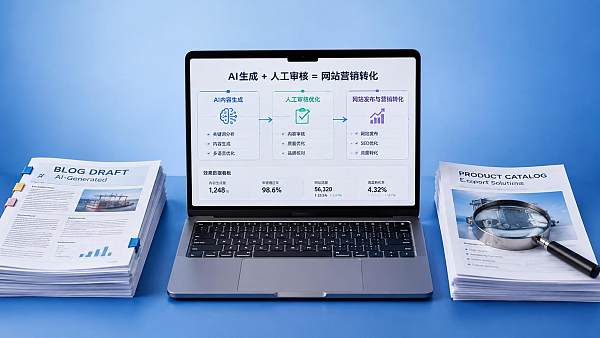
Before publishing, process an AI first draft in these five steps
1. First confirm which purchasing question the article needs to answer
Do not ask AI to write a “product introduction” from the start. This type of topic is too broad, and the resulting content is often equally generic. Topics more suitable for foreign trade SEO usually address a specific question, such as “How to choose stainless steel fasteners for marine environments,” “What injection mold information should OEM buyers confirm before requesting a quotation,” or “How should food packaging materials be compared for barrier performance?”
The closer a topic is to purchasing, selection, usage, or maintenance scenarios, the easier it is for the content to demonstrate expertise and match long-tail search demand.
2. Verify every fact that can be checked
Identify each number, specification, standard, certification, material name, applicable condition, and market description in the AI draft. As long as this information may affect customer judgment, it should be verified against company materials, with the product manager, or through technical documentation.
There is no need to force uncertain information into overly specific wording. Rather than writing “suitable for all harsh environments,” explain the variables that affect selection, such as humidity, salt spray, chemical media, temperature, and installation methods. This wording is more accurate and also helps readers continue their evaluation.
3. Rewrite key sections using the language of the target market
Directly translating Chinese thinking into English is often the most obvious issue in AI-generated foreign trade content. Grammatically correct language does not necessarily sound natural, nor does it necessarily match the reading habits of local buyers. Overseas B2B buyers generally focus more on specifications, application limitations, procurement processes, and verifiable information than on excessive adjectives.
For example, common Chinese expressions such as “excellent quality, competitive prices, and attentive service,” even when translated without grammatical errors, lack decision-making information. They should be replaced with specific details such as available materials, drawing or sample support, quality control documents, packaging methods, and the scope of after-sales response. Multilingual pages should also not rely solely on machine translation, as different regions may have different concerns regarding units, terminology, case studies, and delivery.
4. Make keywords serve the page intent
AI can list many keywords, but they should not all be inserted into the main text. A foreign trade blog should first define one primary question and then develop the content around related terms. For example, if the main term is “custom metal fabrication,” related expressions such as sheet metal parts, fabrication process, material selection, and OEM manufacturing can appear naturally in the content, but each term should be included in a paragraph with an actual explanation.
Titles, opening paragraphs, subheadings, image descriptions, and internal links can carry terms at different levels, but there is no need to repeat the same full keyword phrase. What a page truly needs is topical consistency: fully answer what readers are searching for, and then guide them to the appropriate product page or inquiry page.
5. Add company-specific information and the next action
If an article would be equally valid on any competitor’s website, its value to the brand is limited. Before publishing, add content the company can genuinely provide, such as production ranges, common customization options, accepted drawing formats, information required for sample discussions, methods for providing quality documents, or internal links to different product lines.
Calls to action should not simply say “Contact us.” For selection-related articles, readers can be prompted to submit their application environment, dimensions, material preferences, and estimated quantities. For customization-related content, they can be prompted to prepare drawings, intended use, and procurement schedules. This better reflects the actual communication process for B2B inquiries.
What search engines care about is not “whether content is AI-generated,” but whether it provides value
Treating “AI-generated” as the only criterion for indexing risk can easily miss the point. Search engines are more concerned with whether a page solves users’ problems, whether the content is repetitive, whether it has credible sources, and whether it provides a clear structure and a good user experience. Publishing large amounts of similar content with no new information, written only to cover keywords, will not perform well in the long run even if it is created manually.
Conversely, AI-assisted content that has been reviewed by people, includes genuine product knowledge, has a clear structure, and can address purchasing questions can be an effective way to keep a website updated. The issue is not the tool itself, but whether a company treats it as a content production line or as an efficiency tool for its editorial and marketing teams.
Foreign trade websites should not pursue only “publishing quickly”
As the number of blog posts grows, management becomes more difficult: which articles correspond to product pages, which articles generate organic traffic, which keywords bring visits but no inquiries, and which multilingual pages have duplicate content. All of these need to be considered together during website development, SEO, and promotion.
For companies that need to operate independent overseas websites on an ongoing basis, content publishing should ideally be integrated into the overall website operation process. Yiyingbao provides AI-powered website development, multilingual website development, Google SEO optimization, and overseas marketing-related services. The value of this type of integrated solution is not merely generating pages, but helping companies manage blogs, product pages, landing pages, and promotional channels within the same growth path. When selecting a service, the focus should still be on whether content can be reviewed, whether pages are easy to optimize, and whether continuous adjustments can be made later based on inquiry and search performance.
Therefore, AI-generated foreign trade blog content can be used, but it must undergo a “business validation” before the publish button is clicked. Confirm that it describes what the company can genuinely provide, that readers are truly asking these questions, and that the page can turn interest into the next stage of communication. Only then does AI save time rather than create website burdens at scale.
Related Articles
 Report: U.S. E-commerce Companies Adopt AI but Remain Cautious About Marketing Spend Decisions
 Constant Contact Launches Catalyst AI Marketing Agent to Autonomously Execute Marketing Tasks for Small Businesses
 How Can AI Content Distribution Marketing Match the Audiences of Different Channels?


Related Products
 Yiyingbao SaaS Intelligent Website Building and Marketing SystemYiyingbao SaaS Intelligent Website Building and Marketing System, AI-powered no-code website building, rapid creation of multilingual B2B international websites in 10 minutes, global server acceleration, AI-powered SEO optimization, helping businesses connect efficiently with global markets. The perfect integration of technology and operation makes building an international trade website remarkably simple
 AI+SEM Intelligent Advertising Marketing SystemAI+SEM drives intelligent ad creation, empowering full-funnel precision advertising marketing. The system automatically generates weekly/monthly reports, AI recommends keywords and target countries, monitors core metrics in real-time with intelligent alerts, and enables one-click high-conversion ad solutions to help quickly acquire customers and improve ROI.
 AI+SEO Dual-Engine System Optimization ServicesYiyingbao’s AI+SEO dual-engine optimization system helps foreign trade enterprises acquire high-quality organic traffic through AI-powered keyword research, content generation, and comprehensive technical optimization, significantly improving search rankings and conversion rates.
 AI+SNS Social Media Marketing SystemYingbao AI+SNS Social Media Marketing System - Precision social capture for the social media era. Supports one-click content synchronization across major platforms like Facebook and LinkedIn. AI intelligently rewrites posts for enhanced relevance. 24/7 AI customer service and user profiling analysis empower businesses to efficiently expand into global markets.
 AI+SEO营销解决方案易营宝AI+SEO营销解决方案,通过AI批量写作、智能生成TDK、精准关键词扩词等功能,全面优化网站SEO效果,提升流量与转化率。助力企业构建高效智能网站新生态。
 AI+SEM Advertising Marketing SolutionsAI+SEM Advertising Marketing Solution leverages AI technology to deeply empower SEM ad campaigns. It automatically generates weekly/monthly reports using AI, presenting account data across multiple dimensions for comprehensive insights into campaign performance and trends. The system precisely recommends keywords and target countries, intelligently generates high-conversion ad copy, and enables one-click activation of efficient campaign plans to help businesses rapidly acquire customers. Simultaneously, it monitors core metrics in real time, intelligently identifies abnormal fluctuations, and issues timely alerts to ensure stable, high-return advertising results.
 Domain Name ServicesEasyWin provides professional domain name services, including intelligent queries, one-stop registration, brand protection, and full lifecycle management, helping businesses build a digital brand image.
 EasyOperate B2C Cross-Border E-Commerce Platform & Independent WebsiteEasyStore B2C Cross-border E-commerce Independent Store is an intelligent website building and cross-border e-commerce integrated solution independently developed by EasyStore Information Technology (Beijing) Co., Ltd. The system is specially designed for small and medium-sized as well as large export enterprises, integrating 'website building, operation, marketing, advertising, and conversion' into one, helping enterprises quickly establish cross-border e-commerce independent stores to achieve brand globalization and global sales growth.
The platform supports multiple languages, multiple currencies, and multi-channel marketing, with built-in AI intelligent translation and SEO optimization systems, suitable for mainstream markets such as Southeast Asia, Europe and America, Latin America, and the Middle East, assisting Chinese manufacturing enterprises in efficiently deploying international e-commerce strategies. SSL证书易营宝提供专业SSL安全证书服务,包括单域名和泛域名证书,确保网站数据传输加密、身份验证和完整性保护,助力企业建立安全可信的在线业务环境。









