









- 21st Century Business Herald: AI and CTV Become Core Growth Engines for Digital Marketing in Overseas MarketsNov 18, 2026View details
- China Presents 25 Cooperation Outcomes in Areas Including Cross-Border E-Commerce During APECNov 18, 2026View details
- AI Products Drive Hong Kong Exports Up 64.9% in September, Fastest Growth in Over 40 YearsNov 17, 2026View details
- National Bureau of Statistics: Foreign trade grew rapidly in October, providing stable support for global tradeNov 17, 2026View details
- The U.S. has ended the $800 de minimis exemption for non-postal shipments; express courier packages must be formally declared.Nov 16, 2026View details
- ASEAN Signs Digital Economy Framework Agreement, Moving Toward Harmonized Cross-Border E-Commerce RulesNov 15, 2026View details
How to balance showcase and lead generation in cloud website development? Key points in corporate website planning analysis
Cloud Website Development Starts with Clarifying Who the Official Website Is For
Cloud website development has undergone a clear change in recent years. Many businesses are no longer satisfied with just “having a website.” What matters more is whether the website can bring real inquiries and support business growth.
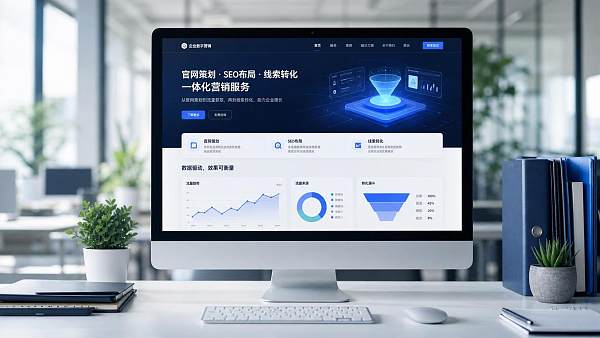
This also means that corporate website planning can no longer focus only on whether the page looks good. It must also take on several tasks at the same time: brand presentation, search visibility, lead generation, and sales support. Miss any one of these, and the website can easily become just a display piece.
In actual business operations, the most common issues in cloud website development are threefold: vague positioning, shallow content, and broken conversion paths. After users enter the site, they do not know what you do or what action to take next, so it is naturally difficult to leave their contact information.
Therefore, if you want a website that balances presentation and customer acquisition, the first step is not to rush into page design, but to clarify the website objective first. Is it for brand awareness, search-based lead generation, or both? Different goals require very different planning priorities.
For most businesses, a more stable approach is to pursue “dual goals in parallel.” The homepage and core sections are responsible for presenting strengths, while product pages, case pages, and content pages are responsible for capturing search traffic and conversions. This is the cloud website development approach that better fits the current market.
How You Position the Official Website Determines Its Future Performance Ceiling
When many businesses build an official website, they most easily overlook positioning. The result is a website that is complete, but lacks focus. It may seem to have a lot of content, but very little of it truly moves customers.
Cloud website development must avoid this. It is essential to first clarify what users care about.
Answer Three Core Questions First
- Who are your customers: local customers, regional customers, or national customers?
- Why do customers choose you: price, delivery, experience, or service capability?
- What do you want customers to do after entering the website?
These three questions may seem basic, but they directly affect section planning, copywriting, and conversion design. For example, a website focused on distributor recruitment should emphasize model, policy, and support systems. A website centered on industrial manufacturing should highlight production capacity, case studies, and delivery assurance.
Website Structure Should Be Built Around the Decision Path
An effective cloud website development plan usually does not make sections overly complicated. The core structure should be built around “understand you, trust you, contact you,” which creates a smoother logic and makes inquiries easier to generate.
- Homepage: clearly communicate value in one sentence and quickly build the first impression.
- Product or service pages: explain capability boundaries and solutions.
- Case studies: strengthen trust with real projects.
- About us: supplement qualifications, team, and development background.
- Contact entry: make it easy for users to take action.
If the business also wants to grow through search, the news section is worth keeping as well. It is not only a place to “update content,” but also an important entry point for long-tail keywords and industry-related traffic.
Good Content Planning Is What Makes Cloud Website Development Truly Convincing
Many official website problems are not caused by weak technology, but by content that is too empty. The whole site is full of phrases like “excellent quality,” “rich experience,” and “thoughtful service,” but after reading them, customers have no memorable points and no basis for judgment.
More effective content planning should turn abstract strengths into verifiable information. In other words, say less fluff, and talk more about facts, scenarios, and results. That is more aligned with the lead-generation goal of cloud website development.
Content Should Cover Four Types of Information
- Company strength: founding time, service scope, qualifications and honors, team composition.
- Product capability: feature highlights, application scenarios, delivery process, after-sales support.
- Case evidence: customer type, project challenges, implementation results, user feedback.
- Decision support: pricing model, timeline explanation, cooperation process, common concerns.
If a company provides integrated website and marketing services, the content expression can go one step further. For example, clearly explain website development, SEO optimization, ad placement, and social media operations within the same growth pathway, so customers understand that the website is not the endpoint, but the starting point of a customer acquisition system.
Platforms like Yiyingbao, which have intelligent website building, SEO optimization, advertising marketing, and multilingual site capabilities, are better suited to highlight the closed-loop value of “from build to promotion to conversion” on the official website. What customers really need is often not just a website, but a continuous growth solution.
SEO Layout Is Not an Add-on; It Is the Foundation of Cloud Website Development
After many company websites go live, they have no traffic and no inquiries, and people start to wonder whether the website is useless. In fact, the problem is often not that the website has no value, but that no search layout was done in the early stage. Without keyword planning, even the most beautiful website is hard to be seen.
From this perspective, cloud website development must place SEO first. That means considering section naming, page topics, content direction, and internal linking relationships during the planning stage, rather than adding them after launch.
Keyword Layout Should Be Layered
The homepage is suitable for core terms, such as cloud website development and cloud corporate website development, which are high-intent keywords. Service pages are suitable for solution-related terms. Article pages are more suitable for problem-related terms and long-tail keywords.
If a business targets a broader market, or even operates in multiple languages, then it should choose a platform with technical support capabilities. Through AI website building, multilingual content management, SEO structural optimization, and data analysis working together, website indexing, visibility, and conversion efficiency will become more stable.
Only When Conversion Design Is in Place Will the Official Website Stop Staying at “Being Viewed”
The final issue to solve is the one many businesses care about most: why do people visit the website but not submit inquiries? The answer is usually not complicated. The page lacks a clear call to action, users do not know how to contact you, and they do not know what they will get after doing so.
Therefore, cloud website development cannot only consider the browsing experience; it must also consider whether the conversion actions are smooth. A website that can generate leads usually places the inquiry entry, trust proof, and action reasons in key positions at the same time.
Conversion Design Should Capture These Five Points
- Set a clear inquiry button on every core page.
- Do not include too many form fields; lower the submission barrier first.
- Insert case studies, reviews, qualifications, and other trust elements into the page.
- Tell users what will happen after submission to reduce concerns.
- Use data tools to track sources, clicks, and inquiry behavior.
If conditions allow, the official website can also be planned together with SEO, advertising, and social media traffic generation. In this way, traffic from different channels can all land on a clear conversion page, instead of each channel doing its own thing. For businesses pursuing long-term growth, this integrated approach is more practical.
Ultimately, the value of cloud website development lies not in how many pages are produced, but in whether brand expression, search visibility, and customer conversion can be connected into one chain. Clarify the positioning, make the content real, put SEO first, and refine conversion details; only then can the official website truly become a business growth asset.
If you are planning a new official website, or preparing to upgrade an existing one, it is worth starting with a self-check across four dimensions: objective, structure, keywords, and conversion path. Get the planning framework right first, then move into design and development. The later results are usually much more reassuring, and the continuous payoff is easier to see.
Related Articles
 How Should You Structure a Product Showcase Website to Improve SEO?
 How do I set up website navigation when building a site with Yingbao?
 How Can You Tell Whether a Company Website Is Truly Optimized for Mobile?


Related Products
 Yiyingbao SaaS Intelligent Website Building and Marketing SystemYiyingbao SaaS Intelligent Website Building and Marketing System, AI-powered no-code website building, rapid creation of multilingual B2B international websites in 10 minutes, global server acceleration, AI-powered SEO optimization, helping businesses connect efficiently with global markets. The perfect integration of technology and operation makes building an international trade website remarkably simple
 AI+SEM Intelligent Advertising Marketing SystemAI+SEM drives intelligent ad creation, empowering full-funnel precision advertising marketing. The system automatically generates weekly/monthly reports, AI recommends keywords and target countries, monitors core metrics in real-time with intelligent alerts, and enables one-click high-conversion ad solutions to help quickly acquire customers and improve ROI.
 AI+SEO Dual-Engine System Optimization ServicesYiyingbao’s AI+SEO dual-engine optimization system helps foreign trade enterprises acquire high-quality organic traffic through AI-powered keyword research, content generation, and comprehensive technical optimization, significantly improving search rankings and conversion rates.
 AI+SNS Social Media Marketing SystemYingbao AI+SNS Social Media Marketing System - Precision social capture for the social media era. Supports one-click content synchronization across major platforms like Facebook and LinkedIn. AI intelligently rewrites posts for enhanced relevance. 24/7 AI customer service and user profiling analysis empower businesses to efficiently expand into global markets.
 AI+SEO营销解决方案易营宝AI+SEO营销解决方案,通过AI批量写作、智能生成TDK、精准关键词扩词等功能,全面优化网站SEO效果,提升流量与转化率。助力企业构建高效智能网站新生态。
 AI+SEM Advertising Marketing SolutionsAI+SEM Advertising Marketing Solution leverages AI technology to deeply empower SEM ad campaigns. It automatically generates weekly/monthly reports using AI, presenting account data across multiple dimensions for comprehensive insights into campaign performance and trends. The system precisely recommends keywords and target countries, intelligently generates high-conversion ad copy, and enables one-click activation of efficient campaign plans to help businesses rapidly acquire customers. Simultaneously, it monitors core metrics in real time, intelligently identifies abnormal fluctuations, and issues timely alerts to ensure stable, high-return advertising results.
 Domain Name ServicesEasyWin provides professional domain name services, including intelligent queries, one-stop registration, brand protection, and full lifecycle management, helping businesses build a digital brand image.
 EasyOperate B2C Cross-Border E-Commerce Platform & Independent WebsiteEasyStore B2C Cross-border E-commerce Independent Store is an intelligent website building and cross-border e-commerce integrated solution independently developed by EasyStore Information Technology (Beijing) Co., Ltd. The system is specially designed for small and medium-sized as well as large export enterprises, integrating 'website building, operation, marketing, advertising, and conversion' into one, helping enterprises quickly establish cross-border e-commerce independent stores to achieve brand globalization and global sales growth.
The platform supports multiple languages, multiple currencies, and multi-channel marketing, with built-in AI intelligent translation and SEO optimization systems, suitable for mainstream markets such as Southeast Asia, Europe and America, Latin America, and the Middle East, assisting Chinese manufacturing enterprises in efficiently deploying international e-commerce strategies. SSL证书易营宝提供专业SSL安全证书服务,包括单域名和泛域名证书,确保网站数据传输加密、身份验证和完整性保护,助力企业建立安全可信的在线业务环境。









