









- Which customer acquisition channels will be affected by cross-border marketing trends in 2026?Sep 06, 2026View details
- Which homogenization risks should be considered in an analysis of the AI-powered website building industry?Aug 30, 2026View details
- How Will AI Marketing Trends 2026 Change Advertising Budget AllocationAug 28, 2026View details
- Is the EV SSL certificate market shrinking or upgrading? How should companies assess certificate procurement?Aug 11, 2026View details
- Why the old AMP SEO 2020 practices no longer work and what has changed in current optimization prioritiesAug 02, 2026View details
- How to Choose Topics for an Industry News Section to Attract More Organic Search TrafficJul 29, 2026View details
- Digital Marketing Shenzhen Market Insights: Why Are Companies Expanding Overseas Looking for Growth Teams in Shenzhen?Jul 31, 2026View details
- Can Zhejiang foreign trade independent websites still be developed today? Look at changes in traffic and lead generationJul 28, 2026View details
What is the main focus of a website optimization audit? See speed, indexing, and conversion at a glance
When conducting a website optimization diagnosis, what truly needs to be checked is not just keyword rankings. Many websites may appear to have traffic, but still suffer from slow loading, pages not being indexed, and visitors not converting, ultimately resulting in fewer inquiries, higher advertising costs, and weaker organic traffic growth. For an integrated website and marketing services scenario, the value of a diagnosis lies in first identifying the bottlenecks, and then deciding whether to fix technical issues, improve content, or rebuild the conversion path.
First, understand exactly what website optimization diagnosis is diagnosing
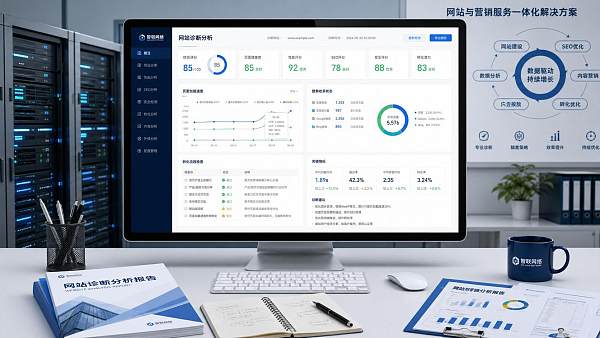
Website optimization diagnosis is essentially a systematic inspection of a website’s ability to acquire and retain traffic. It is not simply about checking whether a certain page has rankings, nor is it only about looking at a few technical error reports. Rather, it is about determining whether a website can be found, visited, and generate results.
In actual business operations, diagnosis usually covers three layers of meaning. The first layer is basic performance, which determines whether the browsing experience is smooth. The second layer is search visibility, which determines whether pages can enter the search engine’s field of view. The third layer is conversion efficiency, which determines whether the traffic can turn into inquiries, orders, or valid leads once it arrives.
This is also why, even when doing SEO, some websites continue to perform steadily while others receive plenty of traffic but still fail to produce results. The problem is often not a single action, but the fact that the overall chain of breakpoints has not been identified.
Why speed, indexing, and conversion have become core dimensions
Search engines and real visitors are both evaluating a website based on results. If a page loads too slowly, visitors will leave, and crawling efficiency may also drop. If the page structure is chaotic, the amount of indexed content is difficult to grow steadily. Even if traffic enters the site, if the content does not match the page’s goals, conversion will stop before the click.
This is especially true for multilingual official websites, foreign trade independent sites, cross-border e-commerce stores, and advertising landing pages, where these three dimensions influence one another. Slow speed drives up advertising conversion costs; insufficient indexing makes SEO hard to gain traction; poor conversion design wastes both advertising and content efforts.
Therefore, website optimization diagnosis should not be treated as an isolated task; it should be viewed together with the customer acquisition process. Technical factors, content, and marketing data need to be analyzed on the same map so that the diagnosis can be closer to real business issues.
Speed diagnosis is not about how fast the page opens, but where the experience is being slowed down
The focus of speed diagnosis is not only whether the homepage appears in a few seconds, but whether key pages are stable, whether different regions experience consistent performance, and whether mobile users can accept the experience. Many websites work normally for local visitors, but become noticeably slower when accessed from overseas markets, which directly affects bounce rate and dwell time.
Common checks include server response time, image size, script loading methods, cache strategy, the number of third-party plugins, and whether mobile resources are too heavy. Multilingual websites also need to pay special attention to the extra burden caused by fonts, translation components, and external tracking code.
If the page carries advertising traffic, speed issues need to be prioritized even more. Since ad clicks are paid for, if the first screen loads slowly, the budget is more likely to be lost during the waiting stage rather than during the product competition stage.
- Does the first screen present core content quickly, rather than leaving a blank wait.
- Are mobile buttons, forms, and images delayed due to oversized resources.
- Are overseas access nodes stable, and is there regional latency.
- Do analytics code, chat tools, and pop-up scripts slow down the page.
From an implementation perspective, speed optimization is most afraid of only doing superficial compression without adjusting the resource structure. Truly effective optimization usually requires coordinated handling of the website system, server environment, and marketing tracking configuration.
Indexing diagnosis determines whether the website has entered the growth channel
For many websites, the problem is not the lack of content, but that search engines simply have not successfully crawled and understood the pages. When doing website optimization diagnosis, indexing checks should be more detailed than simply looking at the number of indexed pages, because the causes behind “not indexed” and “low-quality indexing” are completely different.
Usually, you need to check whether the sitemap is complete, whether the robots settings are mistakenly blocking pages, whether there are duplicate titles, duplicate descriptions, or duplicate content, whether internal links can send key pages to shallower levels, and whether there is a correct correspondence between multilingual versions.
For foreign trade websites and brand global sites, indexing diagnosis also has a commonly overlooked point: content localization quality. If translation is only mechanical, search engines will judge the page as lacking independent value, and both indexing and rankings will be difficult to stabilize.
If indexing problems persist for a long time, content investment becomes sunk cost. Even if many pages have been written, if sustainable search assets have not been built, this is precisely the risk that website optimization diagnosis needs to identify early.
Conversion diagnosis determines whether traffic ultimately has business value
The problem with many websites is not traffic, but how they receive traffic. After visitors arrive on the page, if they cannot understand the core selling points, cannot find the action entry, or if the form is too long and trust signals are insufficient, the conversion rate will be significantly low. Such websites may still gain indexing growth, but they will not truly bring in inquiries.
When doing website optimization diagnosis, the conversion layer usually looks at whether the page goal is clear, whether the content path is smooth, whether the contact method is easy to find, whether the form is reasonable, whether cases and qualifications support decision-making, and whether the mobile experience is sufficiently operable.
If a website handles SEO, advertising, and social media traffic at the same time, conversion diagnosis should be broken down by source. Organic search visitors often need more complete information, while advertising visitors rely more on first-screen judgment and clear call-to-action buttons. The page acceptance logic for the two is not exactly the same.
- Is the page organized around a single goal rather than information stacking.
- Are there verifiable trust elements, such as cases, parameters, and delivery instructions.
- Are the form steps too many, affecting submission willingness.
- Are inquiry, consultation, and purchase entry points clearly clickable on mobile.
Only from an integrated perspective does the diagnosis result have real reference value
Looking at a website alone makes it easy to attribute problems to a certain technical detail. Placed in the integrated scenario of website and marketing services, the judgment becomes more accurate. Because website structure, content strategy, search optimization, advertising placement, and social traffic generation are inherently interconnected.
From the perspective of Yiyingbao’s informatized service path, website building, SEO, advertising, and multi-channel customer acquisition are placed within the same growth logic. The advantage of this is that website optimization diagnosis no longer stops at the page level, but can continue tracking traffic sources, search performance, advertising conversion, and multilingual market adaptation.
For overseas independent sites in particular, whether a website is promotable, indexable, and convertible is often more critical than a single redesign. If a self-developed website system, cross-border e-commerce system, AI advertising and marketing system, and AI+SEO/GEO optimization system can share data and execution logic, diagnostic conclusions will be easier to implement.
Which scenarios require website optimization diagnosis as soon as possible
Not every website needs frequent major overhauls, but the following situations are usually worth prioritizing. Because these signals often indicate that the website has already affected customer acquisition efficiency.
- The website has been online for a long time and content continues to increase, but organic traffic hardly grows.
- Ad clicks are not low, but page dwell time is short and form submissions are few.
- Multilingual pages are complete, but overseas search exposure is very low.
- After a website redesign, rankings fluctuate significantly and indexed pages decline.
- Mobile access accounts for a high proportion, but bounce rate is abnormally high.
When encountering these situations, the meaning of website optimization diagnosis is not to prove where things were done wrong, but to help the team determine priorities. Fixing the most impactful bottlenecks first is usually more efficient than a full-scale rebuild.
When starting an investigation, it is recommended to first establish a judgment checklist
If you want website optimization diagnosis to be truly useful, it is best to first define the judgment criteria. Look at key pages for speed, key directories for indexing, and major target behaviors for conversion. Do not mix all problems together, or the conclusions can easily become inaccurate.
A more reliable approach is to record items one by one according to “problem phenomenon, affected page, possible cause, priority, and handling method.” This not only facilitates internal collaboration, but also prevents each discussion from staying at the level of feelings.
When a website is responsible for brand presentation, SEO growth, and advertising conversion tasks at the same time, diagnostic conclusions should also be interpreted in combination with business goals. First clarify whether the website currently needs exposure, indexing, or inquiries, and subsequent actions will not drift off course.
In short, website optimization diagnosis is not the end after finishing a report, but the starting point for continuous optimization. Once the three lines of speed, indexing, and conversion are clear, subsequent adjustments to content, page optimization, or system and marketing strategy upgrades will all be more evidence-based.
Related Articles



Related Products
 Yiyingbao SaaS Intelligent Website Building and Marketing SystemYiyingbao SaaS Intelligent Website Building and Marketing System, AI-powered no-code website building, rapid creation of multilingual B2B international websites in 10 minutes, global server acceleration, AI-powered SEO optimization, helping businesses connect efficiently with global markets. The perfect integration of technology and operation makes building an international trade website remarkably simple
 AI+SEM Intelligent Advertising Marketing SystemAI+SEM drives intelligent ad creation, empowering full-funnel precision advertising marketing. The system automatically generates weekly/monthly reports, AI recommends keywords and target countries, monitors core metrics in real-time with intelligent alerts, and enables one-click high-conversion ad solutions to help quickly acquire customers and improve ROI.
 AI+SEO Dual-Engine System Optimization ServicesYiyingbao’s AI+SEO dual-engine optimization system helps foreign trade enterprises acquire high-quality organic traffic through AI-powered keyword research, content generation, and comprehensive technical optimization, significantly improving search rankings and conversion rates.
 AI+SNS Social Media Marketing SystemYingbao AI+SNS Social Media Marketing System - Precision social capture for the social media era. Supports one-click content synchronization across major platforms like Facebook and LinkedIn. AI intelligently rewrites posts for enhanced relevance. 24/7 AI customer service and user profiling analysis empower businesses to efficiently expand into global markets.
 AI+SEO营销解决方案易营宝AI+SEO营销解决方案,通过AI批量写作、智能生成TDK、精准关键词扩词等功能,全面优化网站SEO效果,提升流量与转化率。助力企业构建高效智能网站新生态。
 AI+SEM Advertising Marketing SolutionsAI+SEM Advertising Marketing Solution leverages AI technology to deeply empower SEM ad campaigns. It automatically generates weekly/monthly reports using AI, presenting account data across multiple dimensions for comprehensive insights into campaign performance and trends. The system precisely recommends keywords and target countries, intelligently generates high-conversion ad copy, and enables one-click activation of efficient campaign plans to help businesses rapidly acquire customers. Simultaneously, it monitors core metrics in real time, intelligently identifies abnormal fluctuations, and issues timely alerts to ensure stable, high-return advertising results.
 Domain Name ServicesEasyWin provides professional domain name services, including intelligent queries, one-stop registration, brand protection, and full lifecycle management, helping businesses build a digital brand image.
 EasyOperate B2C Cross-Border E-Commerce Platform & Independent WebsiteEasyStore B2C Cross-border E-commerce Independent Store is an intelligent website building and cross-border e-commerce integrated solution independently developed by EasyStore Information Technology (Beijing) Co., Ltd. The system is specially designed for small and medium-sized as well as large export enterprises, integrating 'website building, operation, marketing, advertising, and conversion' into one, helping enterprises quickly establish cross-border e-commerce independent stores to achieve brand globalization and global sales growth.
The platform supports multiple languages, multiple currencies, and multi-channel marketing, with built-in AI intelligent translation and SEO optimization systems, suitable for mainstream markets such as Southeast Asia, Europe and America, Latin America, and the Middle East, assisting Chinese manufacturing enterprises in efficiently deploying international e-commerce strategies. SSL证书易营宝提供专业SSL安全证书服务,包括单域名和泛域名证书,确保网站数据传输加密、身份验证和完整性保护,助力企业建立安全可信的在线业务环境。









