









- AliExpress Global Double 11: Brand Sales Grow Nearly 50% in the First Week, U.S. GMV Rises 70%Nov 21, 2026View details
- Ministry of Commerce Reports E-commerce Development from January to October 2026, with Cross-Border Imports Performing StronglyNov 21, 2026View details
- Amazon Black Friday Orders Sluggish on Day One; NRF Forecasts 4.2 Million Fewer ParticipantsNov 21, 2026View details
- 21st Century Business Herald: AI and CTV Become Core Growth Engines for Digital Marketing in Overseas MarketsNov 18, 2026View details
- China Presents 25 Cooperation Outcomes in Areas Including Cross-Border E-Commerce During APECNov 18, 2026View details
- AI Products Drive Hong Kong Exports Up 64.9% in September, Fastest Growth in Over 40 YearsNov 17, 2026View details
How long does it take to see changes in organic traffic from website optimization services?
How long does it take to see changes in organic traffic after website optimization? You can use the following timeframes as a planning guide: For websites that are already indexed to some extent and have search visibility, resolving obvious issues may lead to changes in impressions or clicks within a few weeks to three months. New websites, sites in highly competitive industries, or sites that require extensive page redevelopment often need three to six months or longer before you can determine whether traffic is developing a more stable growth trend. These are experience-based observation periods for planning purposes, not delivery deadlines guaranteed by search engines.
Before starting a partnership, it is best to clarify what both parties mean by “change”: page indexing, increased visibility in search results, growth in organic search clicks, and generating qualified inquiries do not always happen at the same time. If a service provider only promises improved rankings for certain keywords without explaining how organic traffic and business results will be measured, it is difficult for a company to judge whether its investment is effective.
Several stages lie between improving pages and increasing inquiries
The first step in optimization is usually to ensure that search engines can discover and process pages properly. For example, an important product page that was mistakenly blocked from crawling may become accessible again, or the website’s internal links may be adjusted to make the page easier to discover. Technical changes can be completed relatively quickly, but when search engines recrawl a page, whether they index it, and how they rank it are not entirely under the website’s control.
Next, you can monitor search impressions. When pages begin appearing for more relevant queries, it means search engines have the opportunity to show them to users. However, more impressions do not necessarily lead to more clicks: page rankings, title wording, and user search intent all affect click volume. Sometimes a page receives more impressions simply because it appears in many lower-ranking positions, so short-term traffic changes remain limited.
After organic clicks increase, you also need to assess whether visitors align with your business goals. For an export-oriented manufacturer, an industry knowledge article may attract a large number of visitors. But if the company’s primary goal is to receive product purchase inquiries, it should also separately monitor traffic to product pages, application pages, and pages attracting relevant search queries. Traffic growth and growth in qualified business opportunities often happen at different times.
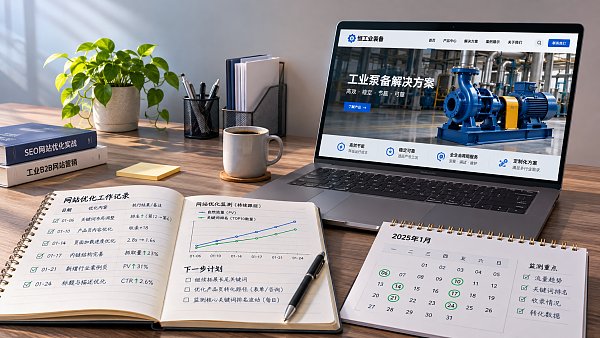
Why do some websites see results quickly while others take longer?
A website’s existing foundation affects its starting point. A website with stable indexing and comprehensive product pages may show early signs of improvement after issues such as unclear page titles, weak internal links, or inaccessible pages are fixed. A new website first needs to build its pages, get discovered, and gradually establish search visibility, so you cannot simply apply the observation period used for an established website.
Target markets and competition affect the level of difficulty. In overseas markets, competition for the same product can vary across countries, languages, and search results. Pages targeting specific specifications, applications, or purchasing needs may gain more qualified visibility first. Even with greater investment, broad, generic terms may not achieve noticeable ranking improvements in the short term. Companies should determine which pages to prioritize based on how their target customers actually search.
The scope of services and speed of execution also matter. A diagnostic report alone will not automatically generate traffic. The observation period is affected by whether pages can be updated, whether product information is complete, when technical issues are fixed, and whether content is published as planned. If optimization recommendations require internal approval or development support, the evaluation period should be calculated from when the changes actually go live, while data from the start of the partnership should be retained as a baseline.
Multilingual websites also need to ensure that pages in each language provide distinct, accurate information. Translating a small amount of text and publishing it in bulk does not amount to building content for local markets. If product names, specification descriptions, or purchasing questions are not relevant, pages may struggle to generate qualified inquiries even if they attract visitors.
How can you tell whether the service is working?
Record a baseline before getting started: organic search clicks and impressions, key landing pages, target markets, and existing inquiries from organic search. For Google Search, you can use Search Console to monitor impressions and clicks by query, page, country, or region, and then use website analytics tools to review visitor behavior. The reporting methodologies of the two types of tools may differ; the key is to use consistent metrics when comparing trends over time.
- In the early stage, monitor execution: Can important pages be accessed and discovered? Have the planned technical fixes and content updates gone live?
- In the middle stage, monitor search signals: Are impressions and clicks for target pages and relevant queries changing consistently? Also note which countries and pages are driving the growth.
- In the later stage, assess business value: Are inquiries from organic search via forms, email, or other channels increasing? Do the product requirements, regions, and purchasing intent behind these inquiries align with your goals?
When making comparisons, do not focus only on a single day or keyword. Search traffic may be affected by holidays, industry purchasing cycles, and changes in search demand. Where possible, compare periods of the same length and refer to the same period last year. Website redesigns, advertising campaigns, and tracking code changes may also affect how data is measured, so check for these changes before analyzing results.
If impressions and clicks have not improved after an agreed observation period, first check whether the key recommendations have actually been implemented and whether search engines can process the pages. Then check whether the target keywords match the page content. If impressions increase but clicks do not keep pace, review rankings and titles in search results. If visits increase but inquiries do not, revisit the target audience, product information, and conversion path to identify the issue.
It is therefore best to agree on service periods alongside delivery milestones: which pages will be completed and when, what data will be used for evaluation, and how adjustments will be made if progress stalls. By assessing intermediate signals separately from business results, companies can determine whether to wait longer, adjust direction, or first address foundational issues that have not yet been resolved.
Related Articles
 XYZ Applies for the .seo Top-Level Domain in ICANN’s New Round; Launch May Be Coming Soon
 How to troubleshoot slow server response times when optimizing website speed?
 How can you configure browser caching to improve website loading speed?

Related Products
 Yiyingbao SaaS Intelligent Website Building and Marketing SystemYiyingbao SaaS Intelligent Website Building and Marketing System, AI-powered no-code website building, rapid creation of multilingual B2B international websites in 10 minutes, global server acceleration, AI-powered SEO optimization, helping businesses connect efficiently with global markets. The perfect integration of technology and operation makes building an international trade website remarkably simple
 AI+SEM Intelligent Advertising Marketing SystemAI+SEM drives intelligent ad creation, empowering full-funnel precision advertising marketing. The system automatically generates weekly/monthly reports, AI recommends keywords and target countries, monitors core metrics in real-time with intelligent alerts, and enables one-click high-conversion ad solutions to help quickly acquire customers and improve ROI.
 AI+SEO Dual-Engine System Optimization ServicesYiyingbao’s AI+SEO dual-engine optimization system helps foreign trade enterprises acquire high-quality organic traffic through AI-powered keyword research, content generation, and comprehensive technical optimization, significantly improving search rankings and conversion rates.
 AI+SNS Social Media Marketing SystemYingbao AI+SNS Social Media Marketing System - Precision social capture for the social media era. Supports one-click content synchronization across major platforms like Facebook and LinkedIn. AI intelligently rewrites posts for enhanced relevance. 24/7 AI customer service and user profiling analysis empower businesses to efficiently expand into global markets.
 AI+SEO营销解决方案易营宝AI+SEO营销解决方案,通过AI批量写作、智能生成TDK、精准关键词扩词等功能,全面优化网站SEO效果,提升流量与转化率。助力企业构建高效智能网站新生态。
 AI+SEM Advertising Marketing SolutionsAI+SEM Advertising Marketing Solution leverages AI technology to deeply empower SEM ad campaigns. It automatically generates weekly/monthly reports using AI, presenting account data across multiple dimensions for comprehensive insights into campaign performance and trends. The system precisely recommends keywords and target countries, intelligently generates high-conversion ad copy, and enables one-click activation of efficient campaign plans to help businesses rapidly acquire customers. Simultaneously, it monitors core metrics in real time, intelligently identifies abnormal fluctuations, and issues timely alerts to ensure stable, high-return advertising results.
 Domain Name ServicesEasyWin provides professional domain name services, including intelligent queries, one-stop registration, brand protection, and full lifecycle management, helping businesses build a digital brand image.
 EasyOperate B2C Cross-Border E-Commerce Platform & Independent WebsiteEasyStore B2C Cross-border E-commerce Independent Store is an intelligent website building and cross-border e-commerce integrated solution independently developed by EasyStore Information Technology (Beijing) Co., Ltd. The system is specially designed for small and medium-sized as well as large export enterprises, integrating 'website building, operation, marketing, advertising, and conversion' into one, helping enterprises quickly establish cross-border e-commerce independent stores to achieve brand globalization and global sales growth.
The platform supports multiple languages, multiple currencies, and multi-channel marketing, with built-in AI intelligent translation and SEO optimization systems, suitable for mainstream markets such as Southeast Asia, Europe and America, Latin America, and the Middle East, assisting Chinese manufacturing enterprises in efficiently deploying international e-commerce strategies. SSL证书易营宝提供专业SSL安全证书服务,包括单域名和泛域名证书,确保网站数据传输加密、身份验证和完整性保护,助力企业建立安全可信的在线业务环境。









