









- Can the average annual growth rate reflect real opportunities in overseas markets?Oct 07, 2026View details
- Which customer acquisition channels will be affected by cross-border marketing trends in 2026?Sep 06, 2026View details
- Which homogenization risks should be considered in an analysis of the AI-powered website building industry?Aug 30, 2026View details
- How Will AI Marketing Trends 2026 Change Advertising Budget AllocationAug 28, 2026View details
- Is the EV SSL certificate market shrinking or upgrading? How should companies assess certificate procurement?Aug 11, 2026View details
- Why the old AMP SEO 2020 practices no longer work and what has changed in current optimization prioritiesAug 02, 2026View details
What Should a Website Design Requirements Document Include to Avoid Repeated Project Rework?
A website design requirements document is not simply a list of pages and functions. For project managers, it serves more as a definition of project boundaries and a basis for acceptance: the clearer the objectives, the more consistently suppliers will understand them, and the fewer instances of rework, additional charges, and delays caused by unclear scope later on.
This is particularly important for projects such as foreign trade websites, brand websites, and multilingual standalone websites, where website design often involves content, development, SEO, advertising landing pages, and data analytics at the same time. If the requirements document addresses only visual style while overlooking lead-generation objectives and technical requirements, the site may prove to be “visually appealing but impractical” after launch.
An executable website design requirements document should ensure that internal stakeholders, design and development teams, and external service providers share the same expectations for deliverables. The following can serve as a practical checklist for project initiation, quotation comparison, execution, and acceptance.
First, clarify: Why is the website being built, and what problems should it solve after launch?
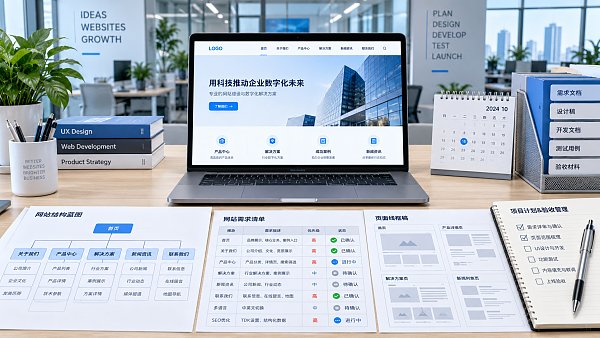
At project kickoff, one of the most commonly overlooked issues is mistaking “building a website” for the objective itself. What truly needs to be defined are business outcomes, such as generating overseas B2B inquiries, showcasing manufacturing capabilities, receiving Google Ads traffic, selling cross-border products, or improving brand credibility in target markets.
The requirements document should specify the highest-priority conversion actions, including submitting an inquiry, booking a demo, downloading a catalog, making a phone call, communicating via WhatsApp, or placing an order directly. Different conversion objectives determine the page structure, form fields, content depth, and subsequent data tracking methods.
It should also identify the target markets, primary languages, customer roles, and typical procurement cycles. For example, an industrial products website targeting European and American procurement managers needs to emphasize certifications, lead times, customization capabilities, and case studies; an e-commerce store targeting consumers, on the other hand, focuses more on pricing, payment, logistics, and review systems.
Page and content scope must be quantifiable to avoid “starting first and seeing how it goes”
A website design requirements document should include a complete sitemap, at minimum clarifying whether pages such as the homepage, product category pages, product detail pages, application pages, About Us, case studies, news or blog, and contact page are required, as well as the approximate number of each page type and language versions.
Do not simply state “product display is required.” Further specify whether products should be filterable by industry, model, application, or parameters, and whether detail pages should include specification tables, PDF downloads, videos, FAQs, related products, and inquiry components. These differences can significantly affect workload and website development costs.
Content responsibilities should also be allocated in advance: what materials the company will provide, what organization, translation, copywriting, or asset production the service provider will handle, and who is responsible for final approval. If product information, images, and brand files are not provided in a timely manner, even the best schedule will be delayed by the content process.
For companies requiring ongoing operations, it is advisable to define publishing mechanisms for articles, case studies, and new products. Whether the backend supports updates by non-technical staff, whether multilingual content is maintained independently, and how historical content will be migrated should all be specified during the requirements stage to avoid continued dependence on developers for text and image updates after launch.
Functional requirements should describe “usage scenarios,” rather than merely listing terms
The functional checklist is best described according to the user journey. For example, after entering a product page, visitors can filter by parameters, view certificates, download materials, and submit inquiries; after receiving a lead, sales personnel can view the source page, country, product interest, and contact information to facilitate prioritized follow-up.
Common requirements include responsive design, inquiry forms, live chat, maps, file downloads, on-site search, membership functions, payment systems, and ERP or CRM integration. However, more features are not necessarily better; unvalidated complex features increase testing, maintenance, and security risks.
If the website supports overseas marketing, configuration requirements for Google Analytics, Search Console, advertising pixels, conversion events, Cookie notices, and form email notifications should be clearly defined. Only with clear data collection standards can subsequent SEO and advertising optimization have a reliable basis for decision-making.
When cross-departmental approvals, quotations, or financial documents are involved, the information management approach in Research on Enterprise Financial Management Informatization Development Paths in the Context of the Digital Economy can be referenced to incorporate requirements for permissions, workflows, and data traceability into the system scope in advance, rather than adding them temporarily after launch.
How should visual and technical standards be specified so that suppliers can execute them accurately?
For the visual section, do not use only subjective terms such as “premium,” “international,” or “technology-oriented.” Provide brand guidelines, Logo source files, primary colors and prohibited colors, and competitor reference websites, and explain specific reasons for what you like or dislike, such as information density, whitespace, navigation methods, image style, and button hierarchy.
The purpose of reference websites is to align direction, not to require copying. The requirements document should distinguish between “referencing structure,” “referencing interaction,” and “referencing visual character,” and require the design team to provide prototypes for the homepage and key internal pages before proceeding to batch page design after confirmation, thereby reducing overall rework.
Technical requirements should clearly define domain and server ownership, the CMS or website-building platform, source code delivery scope, account permissions, backup strategy, HTTPS, security updates, and basic page load speed standards. Foreign trade websites also need to confirm access stability overseas and loading performance across different regions.
Basic SEO specifications should be included in website design requirements, such as URL rules, editable titles and descriptions, image alt text, sitemaps, 301 redirects, structured data, and multilingual tags. Addressing these items only after launch often requires repeated changes to templates and page structures.
Budget, scheduling, and acceptance criteria are the final safeguards for controlling rework
The budget should not state only a total price; it should break down costs for design, development, multilingual support, content migration, third-party plugins, servers, maintenance, and subsequent optimization. For supporting advertising or SEO projects, website development costs should also be distinguished from ongoing operating costs to facilitate return-on-investment assessment.
The schedule should include milestones for requirements confirmation, prototypes, visual designs, development, content entry, testing, training, and launch, while specifying the approver and feedback deadline for each stage. Project delays are often not technical issues, but rather the inability of multiple internal stakeholders to reach agreement in a timely manner.
Acceptance criteria must be verifiable, such as the number of pages and languages, compatibility with mainstream browsers, mobile adaptation, normal receipt of form submissions, error-free key links, completed basic SEO configuration, active analytics code, and the ability of administrators to independently complete specified content updates.
The number of revision rounds and change procedures should also be agreed upon. Any pages, functions, or languages added after the requirements document is confirmed should be evaluated in writing for their timeline and costs. This both protects the company’s budget and enables the service provider to deliver within a stable scope, preventing the project from remaining in a prolonged state of “just one more adjustment.”
Use the requirements document to select service providers, focusing on whether they understand the growth funnel
When comparing website design service providers, look beyond the visual quality of their case studies and pay closer attention to the quality of their questions. Teams that proactively ask about target markets, product competitiveness, customer acquisition channels, content readiness, data tracking, and ongoing operating plans usually have a better understanding of the project’s actual business objectives.
For companies seeking global customer acquisition, a website should be viewed as marketing infrastructure rather than a one-time display asset. When AI-powered website building, multilingual content management, SEO optimization, advertising landing pages, and overseas social media traffic generation work together, traffic and conversion efficiency after the website goes live are more likely to improve continuously.
Ultimately, a good website design requirements document does not need to be lengthy. It needs to clearly define objectives, scope, responsibilities, standards, and change mechanisms. As long as project managers maintain control over these key items, they can significantly reduce communication discrepancies and ensure that website design truly serves business growth.
Related Articles


Related Products
 Yiyingbao SaaS Intelligent Website Building and Marketing SystemYiyingbao SaaS Intelligent Website Building and Marketing System, AI-powered no-code website building, rapid creation of multilingual B2B international websites in 10 minutes, global server acceleration, AI-powered SEO optimization, helping businesses connect efficiently with global markets. The perfect integration of technology and operation makes building an international trade website remarkably simple
 AI+SEM Intelligent Advertising Marketing SystemAI+SEM drives intelligent ad creation, empowering full-funnel precision advertising marketing. The system automatically generates weekly/monthly reports, AI recommends keywords and target countries, monitors core metrics in real-time with intelligent alerts, and enables one-click high-conversion ad solutions to help quickly acquire customers and improve ROI.
 AI+SEO Dual-Engine System Optimization ServicesYiyingbao’s AI+SEO dual-engine optimization system helps foreign trade enterprises acquire high-quality organic traffic through AI-powered keyword research, content generation, and comprehensive technical optimization, significantly improving search rankings and conversion rates.
 AI+SNS Social Media Marketing SystemYingbao AI+SNS Social Media Marketing System - Precision social capture for the social media era. Supports one-click content synchronization across major platforms like Facebook and LinkedIn. AI intelligently rewrites posts for enhanced relevance. 24/7 AI customer service and user profiling analysis empower businesses to efficiently expand into global markets.
 AI+SEO营销解决方案易营宝AI+SEO营销解决方案,通过AI批量写作、智能生成TDK、精准关键词扩词等功能,全面优化网站SEO效果,提升流量与转化率。助力企业构建高效智能网站新生态。
 AI+SEM Advertising Marketing SolutionsAI+SEM Advertising Marketing Solution leverages AI technology to deeply empower SEM ad campaigns. It automatically generates weekly/monthly reports using AI, presenting account data across multiple dimensions for comprehensive insights into campaign performance and trends. The system precisely recommends keywords and target countries, intelligently generates high-conversion ad copy, and enables one-click activation of efficient campaign plans to help businesses rapidly acquire customers. Simultaneously, it monitors core metrics in real time, intelligently identifies abnormal fluctuations, and issues timely alerts to ensure stable, high-return advertising results.
 Domain Name ServicesEasyWin provides professional domain name services, including intelligent queries, one-stop registration, brand protection, and full lifecycle management, helping businesses build a digital brand image.
 EasyOperate B2C Cross-Border E-Commerce Platform & Independent WebsiteEasyStore B2C Cross-border E-commerce Independent Store is an intelligent website building and cross-border e-commerce integrated solution independently developed by EasyStore Information Technology (Beijing) Co., Ltd. The system is specially designed for small and medium-sized as well as large export enterprises, integrating 'website building, operation, marketing, advertising, and conversion' into one, helping enterprises quickly establish cross-border e-commerce independent stores to achieve brand globalization and global sales growth.
The platform supports multiple languages, multiple currencies, and multi-channel marketing, with built-in AI intelligent translation and SEO optimization systems, suitable for mainstream markets such as Southeast Asia, Europe and America, Latin America, and the Middle East, assisting Chinese manufacturing enterprises in efficiently deploying international e-commerce strategies. SSL证书易营宝提供专业SSL安全证书服务,包括单域名和泛域名证书,确保网站数据传输加密、身份验证和完整性保护,助力企业建立安全可信的在线业务环境。









