









- China’s Tariff Commission of the State Council Adjusts Additional Tariffs on U.S. Goods: 24% Tariff Suspended for Two MonthsNov 10, 2026View details
- APEC Shenzhen Spotlight: Cross-Border E-Commerce Orders Promote Asia-Pacific Trade and Economic CooperationNov 08, 2026View details
- China-Europe Railway Express and CIIE Hold Business Matchmaking Event, Focusing on Cross-Border E-commerce B2B ExportsNov 07, 2026View details
- China’s Ministry of Commerce Responds to Additional Charges on Low-Value Imports Imposed by the EUNov 06, 2026View details
- Two Internet Development Reports Released at the 2026 World Internet ConferenceNov 05, 2026View details
- Internet Business Revenue of Enterprises Above the Designated Size Reached RMB 1.716 Trillion in the First Three Quarters, with Profits Up 17.6%Nov 05, 2026View details
Before optimizing a commercial website for AI, first assess gaps in conversion pages and service information
When preparing to launch AI optimization of a commercial website, what is most easily overlooked is not the technical deployment, but whether the site already has pages and information capable of receiving traffic. Even if a commercial website is cited more frequently by search engines or AI answer systems, visitors may still be unable to find the service scope, applicable conditions, delivery methods, or contact options after entering the site. In the end, it may only generate page views without producing actionable inquiries.
Therefore, before starting optimization, a clear assessment should be made: can the existing website help unfamiliar visitors understand within a short time “what you offer, who it is for, how to work with you, and what to do next”? If the answer is uncertain, completing conversion pages and service information is usually more valuable than directly expanding keywords or generating content in bulk.
First identify: which pages appear complete but cannot actually convert
Many websites have relatively complete homepage designs, including company introductions, product images, and contact details. However, from the perspective of the business decision-making path, what is truly missing is content pages that can answer customer questions. Especially for businesses such as engineering services, equipment supply, custom manufacturing, and technical solutions, visitors often do not submit a form immediately. Instead, they first verify capability boundaries, specification requirements, project collaboration methods, and service regions.
You can first check whether the website has any of the following issues:
- The homepage contains extensive introductions, but specific services have only a few vague names and no dedicated explanation pages.
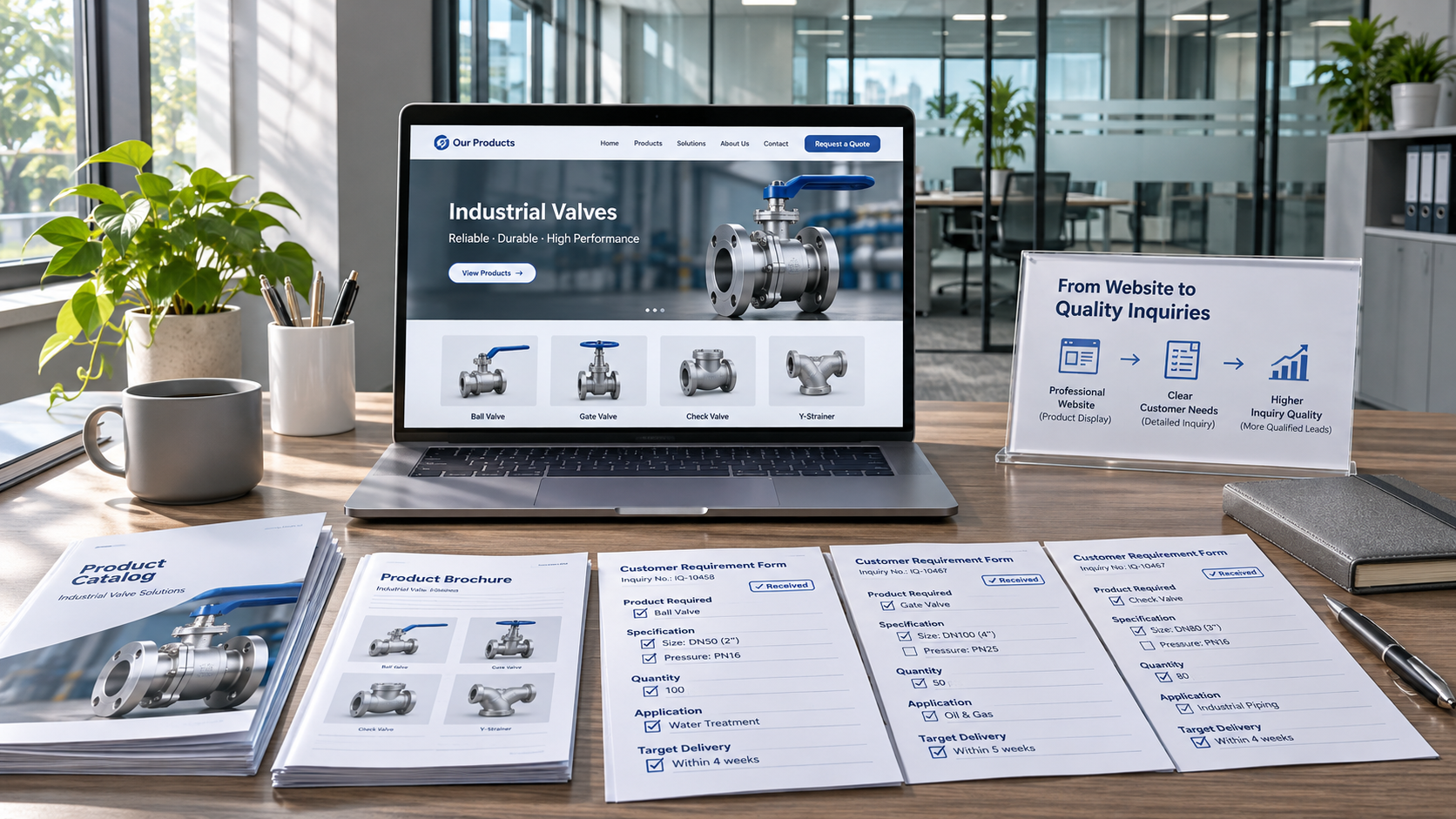
- Product pages display only models or images, without explaining applicable operating conditions, available configurations, factors affecting lead time, or information required for quotation requests.
- Different business lines share one contact form, making it difficult for visitors to determine whether they should submit technical requirements, procurement lists, or partnership inquiries.
- Multilingual page content is inconsistent: English or other language versions contain only the homepage, while key service pages remain available in only one language.
- Pages contain only “Contact Us” without clear next-step actions, such as requesting a solution, submitting drawings, obtaining specifications, or scheduling a consultation.
These gaps directly affect the effectiveness of AI optimization. Like traditional search, AI search needs to extract clear and verifiable business information from pages; visitors also need this information to determine whether the company is worth further communication. When information is expressed vaguely, systems struggle to accurately understand the service topic, and customers also find it difficult to establish initial trust.
Break down “service information” into understandable content units
Service information should not be written merely as promotional copy. A more practical approach is to use the information customers need to confirm when making a request as a guide, dividing it into page units that can be read independently and linked to one another. Each core service should at least cover the business target, delivery scope, applicable scenarios, cooperation prerequisites, and communication entry point.
For example, pages targeting engineering projects should not only emphasize “reliable quality” or “extensive experience.” They should explain the types of projects that can be supported, common technical parameter ranges, and whether drawing confirmation, sample validation, batch delivery, or after-sales document preparation is available. There is no need to promise results that cannot be controlled, but what can and cannot be provided should be clearly stated. Such pages make it easier for procurement and technical personnel to screen options and can also reduce ineffective back-and-forth communication later.

Review conversion pages through the visitor journey, rather than looking only at individual page copy
A page being complete in itself does not mean the path is smooth. You can select a real and common entry point, for example, where a visitor enters a service page through “customization of a certain type of equipment” or “a particular engineering service,” and then review it based on actual browsing habits: can they continue to see explanations of relevant capabilities? Can they find process information beyond case studies? Is there a submission option matching their current needs? After submission, do they know what materials need to be prepared?
During the review, prioritize addressing three types of breakpoints:
- Mismatch between entry point and landing page: The search content discusses a specific need, but the landing page directs visitors to a general homepage, requiring them to search for the service again.
- Missing key supporting information: The page presents a solution but lacks supporting information such as parameters, processes, materials, scope, or delivery conditions.
- Excessive action cost: The contact button is not prominent, the form asks too many questions, or there is no guidance on “what information to submit and what response can be expected.”
In terms of priority, it is recommended to first fix breakpoints on existing high-traffic pages before expanding new topic-specific content. The reason is simple: existing pages are already handling a certain level of search demand, and after the information is completed, it is easier to observe whether inquiry quality improves. Conversely, if foundational pages lack conversion capability, new content will only direct more traffic to the same gap.
Multilingual sites should check “information equivalence,” not just language coverage
When targeting overseas markets, having more languages does not mean service information is complete. Pages in different languages often have translated headings but incomplete body content, or their technical terminology, units, and date formats do not align with local conventions. For commercial websites, such differences may lead visitors to believe that the market is not a key coverage area and may also affect AI systems’ identification of page topics and entity information.
Content that should be kept equivalent as a priority includes core service scope, product parameters, application scenarios, inquiry fields, privacy statements, delivery processes, and frequently asked questions. Marketing wording may be adjusted by region, but factual information that determines cooperation decisions should not be missing from different language versions. When maintaining multilingual service pages in batches, you can use the Yiyingbao AI Translation Center to generate multilingual content, and verify details such as terminology, dialect expressions, and local units of measurement through human-machine collaborative editing. It supports dynamic content synchronization and is suitable for reducing the inconsistency between language versions after page updates.
Before starting AI optimization, first identify pages that can be cited
Not every page is suitable as an optimization priority. Homepage, news, or purely brand-focused pages can be retained, but the pages that should be improved first are those that solve specific problems, such as service description pages, product application pages, technical parameter pages, delivery process pages, and regional market pages. These pages should have a clear topic and should not include too many business directions at the same time.
To determine whether a page has the foundation for citation and conversion, check whether it can independently answer five questions: what is offered; what needs it applies to; how customers can determine whether it is a match; what needs to be prepared before cooperation; and where to begin the next step. If more than two of these five questions are missing, the page should not be rushed into use as a key promotion entry point.
Finally, check data handling: whether forms, phone numbers, email addresses, and instant communication options are available; whether inquiries from different sources can be identified; and whether the sales or project team can understand the services the customer is interested in based on the page source after receiving a lead. What AI optimization brings is not merely a change in exposure, but new visitor paths. First ensure that page information and follow-up actions are properly in place. Then, when adding content, expanding languages, or adjusting search visibility, investments are more likely to lead to real business communication.
Related Articles
 How Can You Launch a B2C Online Store Quickly Using a Template?
 How do you evaluate the results delivered by a website SEO company in Beijing?
 How to Choose a Deployment Region for a Cross-Border SaaS Website


Related Products
 Yiyingbao SaaS Intelligent Website Building and Marketing SystemYiyingbao SaaS Intelligent Website Building and Marketing System, AI-powered no-code website building, rapid creation of multilingual B2B international websites in 10 minutes, global server acceleration, AI-powered SEO optimization, helping businesses connect efficiently with global markets. The perfect integration of technology and operation makes building an international trade website remarkably simple
 AI+SEM Intelligent Advertising Marketing SystemAI+SEM drives intelligent ad creation, empowering full-funnel precision advertising marketing. The system automatically generates weekly/monthly reports, AI recommends keywords and target countries, monitors core metrics in real-time with intelligent alerts, and enables one-click high-conversion ad solutions to help quickly acquire customers and improve ROI.
 AI+SEO Dual-Engine System Optimization ServicesYiyingbao’s AI+SEO dual-engine optimization system helps foreign trade enterprises acquire high-quality organic traffic through AI-powered keyword research, content generation, and comprehensive technical optimization, significantly improving search rankings and conversion rates.
 AI+SNS Social Media Marketing SystemYingbao AI+SNS Social Media Marketing System - Precision social capture for the social media era. Supports one-click content synchronization across major platforms like Facebook and LinkedIn. AI intelligently rewrites posts for enhanced relevance. 24/7 AI customer service and user profiling analysis empower businesses to efficiently expand into global markets.
 AI+SEO营销解决方案易营宝AI+SEO营销解决方案,通过AI批量写作、智能生成TDK、精准关键词扩词等功能,全面优化网站SEO效果,提升流量与转化率。助力企业构建高效智能网站新生态。
 AI+SEM Advertising Marketing SolutionsAI+SEM Advertising Marketing Solution leverages AI technology to deeply empower SEM ad campaigns. It automatically generates weekly/monthly reports using AI, presenting account data across multiple dimensions for comprehensive insights into campaign performance and trends. The system precisely recommends keywords and target countries, intelligently generates high-conversion ad copy, and enables one-click activation of efficient campaign plans to help businesses rapidly acquire customers. Simultaneously, it monitors core metrics in real time, intelligently identifies abnormal fluctuations, and issues timely alerts to ensure stable, high-return advertising results.
 Domain Name ServicesEasyWin provides professional domain name services, including intelligent queries, one-stop registration, brand protection, and full lifecycle management, helping businesses build a digital brand image.
 EasyOperate B2C Cross-Border E-Commerce Platform & Independent WebsiteEasyStore B2C Cross-border E-commerce Independent Store is an intelligent website building and cross-border e-commerce integrated solution independently developed by EasyStore Information Technology (Beijing) Co., Ltd. The system is specially designed for small and medium-sized as well as large export enterprises, integrating 'website building, operation, marketing, advertising, and conversion' into one, helping enterprises quickly establish cross-border e-commerce independent stores to achieve brand globalization and global sales growth.
The platform supports multiple languages, multiple currencies, and multi-channel marketing, with built-in AI intelligent translation and SEO optimization systems, suitable for mainstream markets such as Southeast Asia, Europe and America, Latin America, and the Middle East, assisting Chinese manufacturing enterprises in efficiently deploying international e-commerce strategies. SSL证书易营宝提供专业SSL安全证书服务,包括单域名和泛域名证书,确保网站数据传输加密、身份验证和完整性保护,助力企业建立安全可信的在线业务环境。









