









- 21st Century Business Herald: AI and CTV Become Core Growth Engines for Digital Marketing in Overseas MarketsNov 18, 2026View details
- China Presents 25 Cooperation Outcomes in Areas Including Cross-Border E-Commerce During APECNov 18, 2026View details
- AI Products Drive Hong Kong Exports Up 64.9% in September, Fastest Growth in Over 40 YearsNov 17, 2026View details
- National Bureau of Statistics: Foreign trade grew rapidly in October, providing stable support for global tradeNov 17, 2026View details
- The U.S. has ended the $800 de minimis exemption for non-postal shipments; express courier packages must be formally declared.Nov 16, 2026View details
- ASEAN Signs Digital Economy Framework Agreement, Moving Toward Harmonized Cross-Border E-Commerce RulesNov 15, 2026View details
Why Fuzhou Website Development Projects Should Prioritize Delivery Capability Before Price
Many website projects get stuck at the very beginning, not because the requirements cannot be articulated or the budget cannot be approved, but because too much attention is placed on the quotation too early during vendor selection. Especially for website development projects in Fuzhou, where both presentation quality and subsequent promotion and operations need to be considered, looking at the price too soon often causes people to overlook the factors that truly determine project success or failure: who can deliver on time, and who can turn the requirements into a finished product that can be launched, maintained, and continuously expanded.
In actual implementation, the most frustrating issues are not whether the price is “a little higher or lower,” but the problems that keep emerging after the project starts: misunderstandings of requirements, repeated page rework, continuously delayed launch milestones, omissions in mobile adaptation, unstable form collection, and discovering only later—when SEO is needed—that the basic structure does not support it. When these problems appear all at once, the procurement costs saved at the beginning may have to be offset later with much more communication time and coordination costs.
Why Many Projects Go Wrong at the “Price Comparison” Stage
A common situation is that several service providers can all build a corporate website, and their demo pages appear more or less similar. As a result, procurement decisions are easily simplified to “the functions are similar, so choose the cheapest one.” However, a website is not a one-time graphic design draft. It is an online business platform that will be continuously visited, modified, promoted, and used for data tracking. Whether the pages can be reproduced according to the prototypes is only one part of delivery; whether the backend is easy to use, whether content can be updated conveniently, whether the basic SEO settings are complete, and whether landing pages for future advertising campaigns can be quickly reused are the real issues encountered every day after launch.
If discussions focus only on price from the beginning, the service boundaries usually become unclear. When reviewing the quotation, it may seem that “the homepage, category pages, forms, and backend are all included,” but during implementation you may discover that mobile details are charged separately, multilingual support is outside the scope, site speed optimization is only a recommendation, and post-launch issue handling is available for only a very short period. This kind of ambiguity is particularly risky during project implementation because it does not surface on the day of signing, but tends to appear all at once when deadlines are tight.
What Exactly Should You Examine When Assessing Delivery Capability?
Delivery capability cannot be proven simply by saying, “We have completed many projects.” A more practical way to assess it is to see whether the provider has divided the project from requirements to launch into a clear process, with someone responsible for every stage.
First, examine its ability to handle requirements. A truly reliable team will not only ask how many pages you want to create. It will also ask: What business objectives will the website primarily serve? Is the focus brand presentation, inquiry generation, or subsequent advertising traffic? Where are the visitors located? Will multilingual content be integrated later? Who will be responsible for content updates? If no one asks these preliminary questions, rework will most likely be needed later to make up for the omissions.
Next, examine the coordination between prototyping, design, and development. Many projects appear to be stuck at the development stage, when the actual problem is that key details were not clearly defined earlier. For example, the category hierarchy has not been confirmed, button navigation logic has not been specified, form fields are incomplete, or the data-entry rules for the news system and product system are inconsistent. These are not technical difficulties, but they can directly slow down delivery.
Then examine the provider’s awareness of launch requirements. Some teams prioritize design over release. Their demo environments are well prepared, but they are not sufficiently prepared for essential launch tasks such as official domain deployment, basic security configuration, search engine crawling settings, 301 redirects, sitemaps, and analytics tracking implementation. As a result, the pages may appear complete, but a series of problems emerges once the website is put into actual use.
Finally, examine subsequent maintenance capabilities. Website projects are rarely left completely unchanged after launch. Business adjustments, product updates, new campaign pages, and content replacements are all routine. If the backend is difficult to operate, or every minor change requires submitting a ticket and waiting in line again, the user experience during the later stages of the project will be poor. For procurement decisions, this is often more important than the initial quotation difference.
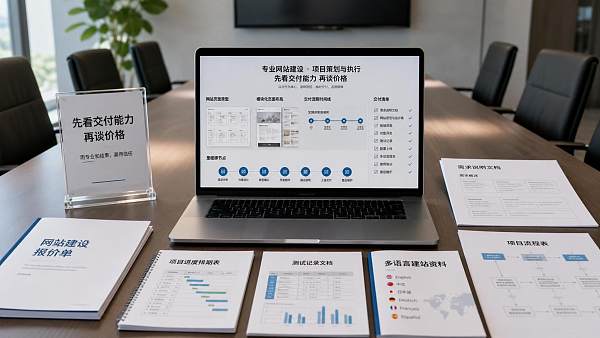
A More Effective Way to Compare Than Price: Break Down the Delivery
If you are comparing several website development service providers in Fuzhou, consider changing the order of evaluation. Do not rank several quotations by price first. Instead, break “delivery” down into several evaluation points and then see whether each provider can explain them clearly.
Step One: Confirm Whether the Scope Is Detailed Enough
The biggest hidden risk in a quotation is not the amount, but the overly vague use of the word “included.” For example, the phrase “design and develop one website” has little value for evaluation by itself. What deserves more attention is: Which page types are included? Are desktop and mobile versions distinguished? Which modules can be managed in the backend? Are form lead collection functions supported? Who is responsible for images and copywriting? How many rounds of testing and revisions are included? If the scope is not detailed, communication costs will inevitably be high later.
Step Two: Ask About Deliverables Rather Than Looking Only at Visual Mockups
Many people are attracted by homepage mockups, but launching a website is not the same as delivering an image. You should instead confirm whether the deliverables include site structure planning, page prototypes, design drafts, front-end and back-end development, testing checklists, launch support, and backend user instructions. Being able to explain all of these items completely usually indicates that the team has basic control over the project schedule. If it cannot explain them fully, the project may be completed while continuously filling in gaps.
Step Three: Focus on “Operational Usability”
If a newly built website is difficult to maintain, it will soon become a mere formality. Whether page content can be updated independently, whether products and news can be managed in batches, whether landing pages can be added conveniently, and whether basic titles, descriptions, and URL rules can be configured independently all affect subsequent promotional efficiency. Especially if search optimization, advertising traffic handling, or multi-channel campaigns will be carried out later, the flexibility of the website is more valuable than saving a few thousand on the initial price.
Step Four: See Whether the Provider Understands Marketing Scenarios
Not every website project is simply about “having a corporate website.” Some projects must also support Google SEO, some need to handle advertising traffic, some will have multilingual versions, and some need to support B2B inquiry conversion. Teams that understand these scenarios usually take a longer-term view of the site structure, loading performance, content organization, and form paths. This is particularly important for projects in which the website is expected to generate leads as well as serve as a corporate presence.
When Are Low-Priced Solutions Most Likely to Cause Problems?
This does not mean that a low price is necessarily unacceptable. The key is to examine how the low price is achieved. There are several common risks.
One is excessive reliance on templates. This may allow a fast launch in the short term, but once the business needs to adjust categories, add special modules, or implement more detailed SEO settings, the limitations become very obvious. Another is making many promises in the early stage but leaving a large amount of work to you during implementation, such as organizing materials, adapting copy, entering content, and conducting pre-launch checks. A third is having development capabilities but weak delivery management, with no clear milestones, causing every communication session to feel like the beginning of a new project meeting.
The most troublesome aspect of these issues is that they are difficult to identify before signing a contract based solely on the statement, “No problem, we can do it.” Therefore, instead of asking “Can you do it?”, ask “How will it be done, who will do it, and what constitutes completion at each stage?” The more specific the provider’s answers are, the lower the uncertainty will be later.
If the Project Must Also Support Promotion, Take the Evaluation Criteria One Step Further
Many companies now build websites not merely to launch an image page, but also to continuously generate inquiries or handle traffic later. In this situation, looking only at page delivery is not enough. You must also assess whether the website has the foundation for subsequent growth.
For example, does it support multilingual website development? Does it take the visitor experience in different regions into account? Is it easy to expand product pages and content pages? Is it suitable for a B2B marketing website or an independent site? Has room been reserved for SEO and content optimization? If traffic will later be generated through search, advertising, social media, and other channels, the website should ideally be built from the beginning with the principles of being “promotable, indexable, and conversion-oriented,” rather than first creating a purely presentational site and repeatedly restructuring it later.
For these types of requirements, it is much more efficient to choose a team that understands both the website development process and the logic of marketing implementation. Some service models incorporate intelligent website development, multilingual capabilities, basic SEO, and advertising landing-page adaptation into one implementation framework. The benefit is not that there are “more functions,” but that it reduces rework caused by fragmented systems later. For projects that require coordinated website and marketing implementation, this is more practical than simply reducing the initial quotation.
A Practical Order for Decision-Making
If you have already entered the vendor comparison stage, a more reliable order is usually as follows: first eliminate providers whose delivery boundaries are unclear, then compare the maturity of their processes, next assess whether the backend and subsequent maintenance are convenient, and only then discuss whether the price is appropriate. This is because price essentially reflects procurement costs, while delivery capability determines the total project cost, including time, communication, rework, and subsequent adjustments.
When communicating with providers, you can also ask more direct questions: Who leads requirements confirmation? How are changes controlled after the design draft is approved? Who is responsible for testing? What items will be checked before launch? Can the backend be maintained independently after delivery? If SEO or advertising needs to be integrated later, can the current structure support it directly? People who have genuinely managed long-term projects usually pay more attention to these questions than to what the homepage looks like or how much lower the total price is.
Ultimately, Fuzhou website development is not about buying a static finished product, but about purchasing a controllable execution process. Price certainly matters, but the order of evaluation should not be reversed. First determine who can properly handle the requirements, control the process, and deliver a genuinely usable website; then assess whether the quotation offers good value. This makes procurement decisions less likely to become passive before or after launch. For many projects, taking this step may seem slightly slower, but it actually helps save time later.
Related Articles
 How can you configure browser caching to improve website loading speed?
 Where should you start when optimizing the user experience of an international trade website? Start by reviewing the inquiry form
 How Can Global Server Node Deployment Reduce Latency for Overseas Visitors?


Related Products
 Yiyingbao SaaS Intelligent Website Building and Marketing SystemYiyingbao SaaS Intelligent Website Building and Marketing System, AI-powered no-code website building, rapid creation of multilingual B2B international websites in 10 minutes, global server acceleration, AI-powered SEO optimization, helping businesses connect efficiently with global markets. The perfect integration of technology and operation makes building an international trade website remarkably simple
 AI+SEM Intelligent Advertising Marketing SystemAI+SEM drives intelligent ad creation, empowering full-funnel precision advertising marketing. The system automatically generates weekly/monthly reports, AI recommends keywords and target countries, monitors core metrics in real-time with intelligent alerts, and enables one-click high-conversion ad solutions to help quickly acquire customers and improve ROI.
 AI+SEO Dual-Engine System Optimization ServicesYiyingbao’s AI+SEO dual-engine optimization system helps foreign trade enterprises acquire high-quality organic traffic through AI-powered keyword research, content generation, and comprehensive technical optimization, significantly improving search rankings and conversion rates.
 AI+SNS Social Media Marketing SystemYingbao AI+SNS Social Media Marketing System - Precision social capture for the social media era. Supports one-click content synchronization across major platforms like Facebook and LinkedIn. AI intelligently rewrites posts for enhanced relevance. 24/7 AI customer service and user profiling analysis empower businesses to efficiently expand into global markets.
 AI+SEO营销解决方案易营宝AI+SEO营销解决方案,通过AI批量写作、智能生成TDK、精准关键词扩词等功能,全面优化网站SEO效果,提升流量与转化率。助力企业构建高效智能网站新生态。
 AI+SEM Advertising Marketing SolutionsAI+SEM Advertising Marketing Solution leverages AI technology to deeply empower SEM ad campaigns. It automatically generates weekly/monthly reports using AI, presenting account data across multiple dimensions for comprehensive insights into campaign performance and trends. The system precisely recommends keywords and target countries, intelligently generates high-conversion ad copy, and enables one-click activation of efficient campaign plans to help businesses rapidly acquire customers. Simultaneously, it monitors core metrics in real time, intelligently identifies abnormal fluctuations, and issues timely alerts to ensure stable, high-return advertising results.
 Domain Name ServicesEasyWin provides professional domain name services, including intelligent queries, one-stop registration, brand protection, and full lifecycle management, helping businesses build a digital brand image.
 EasyOperate B2C Cross-Border E-Commerce Platform & Independent WebsiteEasyStore B2C Cross-border E-commerce Independent Store is an intelligent website building and cross-border e-commerce integrated solution independently developed by EasyStore Information Technology (Beijing) Co., Ltd. The system is specially designed for small and medium-sized as well as large export enterprises, integrating 'website building, operation, marketing, advertising, and conversion' into one, helping enterprises quickly establish cross-border e-commerce independent stores to achieve brand globalization and global sales growth.
The platform supports multiple languages, multiple currencies, and multi-channel marketing, with built-in AI intelligent translation and SEO optimization systems, suitable for mainstream markets such as Southeast Asia, Europe and America, Latin America, and the Middle East, assisting Chinese manufacturing enterprises in efficiently deploying international e-commerce strategies. SSL证书易营宝提供专业SSL安全证书服务,包括单域名和泛域名证书,确保网站数据传输加密、身份验证和完整性保护,助力企业建立安全可信的在线业务环境。









