









- China’s Tariff Commission of the State Council Adjusts Additional Tariffs on U.S. Goods: 24% Tariff Suspended for Two MonthsNov 10, 2026View details
- APEC Shenzhen Spotlight: Cross-Border E-Commerce Orders Promote Asia-Pacific Trade and Economic CooperationNov 08, 2026View details
- China-Europe Railway Express and CIIE Hold Business Matchmaking Event, Focusing on Cross-Border E-commerce B2B ExportsNov 07, 2026View details
- China’s Ministry of Commerce Responds to Additional Charges on Low-Value Imports Imposed by the EUNov 06, 2026View details
- Two Internet Development Reports Released at the 2026 World Internet ConferenceNov 05, 2026View details
- Internet Business Revenue of Enterprises Above the Designated Size Reached RMB 1.716 Trillion in the First Three Quarters, with Profits Up 17.6%Nov 05, 2026View details
What Pages and Features Should a B2B Website Have to Better Support Long-Term Lead Generation
A B2B website that is truly suitable for long-term customer acquisition is not defined by how many pages it has, but by whether each page has a clear role. It must be understandable to search engines, help potential customers form a quick judgment, and gradually turn visits into inquiries and business opportunities. For companies that value overseas growth, lead accumulation, and brand credibility, page structure and functional configuration directly affect whether subsequent marketing investment can generate sustainable returns.
First, understand that a B2B website is not an online business card
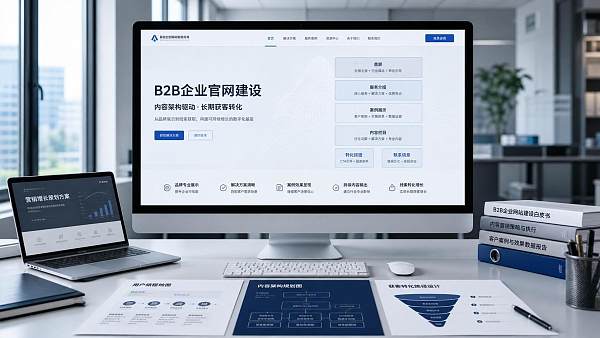
Many websites receive no inquiries for a long time after launch, not because traffic is absolutely insufficient, but because the website only displays information and fails to complete screening, persuasion, and conversion. Especially in scenarios such as foreign trade, manufacturing, and cross-border brand expansion, a B2B website often plays multiple roles.
It is a brand official website and also a search entry point; it is a product information database and also the first round of validation before business communication. Visitors usually do not place an order because of a slogan. Instead, they judge through page content whether the company is professional, stable, and worth contacting further.
In other words, a long-term effective B2B website needs to take care of three things: being discoverable, being trustworthy, and being easy to contact. This is also why more and more companies now consider website development, SEO, advertising, and social media traffic acquisition within an integrated framework.
Pages that determine customer acquisition efficiency usually include these key types
Pages do not need to be overloaded, but key pages cannot be missing. For a B2B website aimed at generating inquiries, the following structure is more common and better supports long-term growth.
Homepage: responsible for establishing the first judgment
The homepage is not a place to pile up all information, but the starting point for communicating value. Visitors need to understand three things in a short time: who you are, what you provide, and why you are worth contacting further.
Clear industry positioning, service scope, proof of advantages, and explicit entry points are often more effective than long, empty slogans. The homepage should also serve as a navigation and traffic distribution hub, guiding different visitor intentions to product pages, solution pages, or contact pages.
Product or service pages: responsible for answering specific questions
This is the part of a B2B website that most easily affects conversion. Many companies only provide brief introductions but lack information such as specifications, applications, delivery scope, applicable scenarios, and cooperation methods, making it difficult for visitors to continue evaluating.
For manufacturing or foreign trade businesses, product pages should consider both search indexing and business communication. Titles, parameters, application fields, certification information, FAQs, downloadable materials, and inquiry buttons should all be developed around real purchasing decisions.
Solution pages: responsible for handling complex needs
When a business covers multiple industries, regions, or usage scenarios, product pages alone are not enough. Solution pages can connect product capabilities, service processes, delivery methods, and real scenarios, making them more suitable for receiving medium- to high-intent traffic.
For example, multilingual official website development, overseas promotion landing pages, B2B inquiry-driven independent websites, and long-term SEO growth solutions are all suitable for being separated into independent pages to form clearer content entry points.
About us and trust pages: responsible for reducing decision-making risk
B2B websites rarely compete on price alone. More often, customers care about stability, delivery capability, and continuous service capability. Therefore, company introductions, development history, team strength, service regions, customer cases, and qualification certifications are all very important.
These pages are not merely formal additions, but trust nodes in the conversion chain. For an integrated service platform like 易营宝, which has long focused on intelligent website development, SEO optimization, advertising, and social media marketing, its industry experience, technical capabilities, and service coverage are naturally suitable to be clearly presented as part of its trust content.
Content pages: responsible for accumulating long-term traffic
If a B2B website is expected to continuously generate organic traffic, articles, cases, knowledge pages, and industry topics cannot be missing. They are not supplementary sections, but core assets for SEO and content marketing.
Especially in overseas markets, multilingual content, industry question pages, FAQs, and localized topics are more likely to cover long-tail searches and are also better suited to work together with advertising and social media traffic acquisition.
Beyond pages, these functions have a greater impact on long-term performance
Many people evaluate a B2B website only by its visuals and the number of sections. In reality, what truly determines long-term customer acquisition results is often whether the underlying functions support promotion, indexing, and conversion.
In practice, if a B2B website lacks these capabilities, later marketing activities will be forced to rely on manual fixes. For example, slow content publishing, difficulty creating landing pages, and the inability to track form leads will all continuously increase promotion costs.
This is also why integrated website development is receiving more and more attention. A website is not a standalone project, but the infrastructure for subsequent SEO, advertising, social media, and AI search visibility improvement.
In different business scenarios, the key configurations are not the same
Not every B2B website needs to be built with the same structure. Pages and functions should match the business model, avoiding an overly heavy setup from the beginning while also preventing the loss of key capabilities.
- Websites focused on foreign trade inquiries place greater emphasis on multilingual support, product details, certification display, form conversion, and Google SEO fundamentals.
- Websites focused on global brand expansion place greater emphasis on brand expression, content operations, social media coordination, and advertising landing page reception.
- Websites focused on regional market expansion place greater emphasis on localized pages, regional cases, language versions, and adaptation to search habits.
- Websites focused on multi-channel advertising place greater emphasis on page replication efficiency, data tracking, and content testing capabilities.
For platforms like 易营宝 that cover intelligent website development, cross-border e-commerce systems, AI advertising marketing, and AI+SEO/GEO optimization, the advantage lies in being able to view website development within a complete growth chain, rather than staying at the level of page delivery.
To evaluate whether a B2B website is suitable for long-term customer acquisition, focus on several judgment points
During actual selection or redesign, do not rush to look at the visual style first. What deserves more attention is whether the website can continuously support business activities after launch.
Whether content can continue to expand
Long-term customer acquisition depends on continuous updates. Product additions, market changes, keyword adjustments, and case supplementation all require a B2B website to have stable content expansion capabilities.
Whether the technical structure supports promotion
If pages load slowly, the structure is chaotic, and indexing is difficult, even the best content will struggle to create value. Search friendliness, mobile adaptation, and page stability are all basic requirements.
Whether the conversion path is smooth enough
From entering the homepage, to viewing content, and then submitting an inquiry, every step in between should reduce obstacles as much as possible. Contact methods hidden too deeply, forms that are too long, and pages lacking trust information will all directly affect results.
Whether it can work together with marketing systems
Today, a B2B website no longer exists in isolation. It needs to connect with SEO strategy, advertising accounts, social media content, data analytics, and lead management, so the website becomes more valuable the more it is operated.
What is truly worth investing in is not a one-time website build, but a sustainable growth foundation
From the perspective of industry trends, competition among B2B websites has shifted from “whether there is a website” to “whether the website can continuously bring in qualified leads.” Whether the pages are complete is only the surface. Whether the structure is designed around customer acquisition goals and whether the functions support subsequent operations determine the long-term results.
If you are planning or optimizing a B2B website, you can first clarify three questions: whether the existing pages cover core decision-making information, whether the website supports search and multi-channel promotion, and whether leads can be effectively tracked and continuously converted. After clarifying these three points, then compare website development solutions, content strategies, and marketing collaboration capabilities. The judgment will be more reliable and closer to the practical needs of long-term growth.
Related Articles
 How Can You Launch a B2C Online Store Quickly Using a Template?
 How do you evaluate the results delivered by a website SEO company in Beijing?
 How to Choose a Deployment Region for a Cross-Border SaaS Website


Related Products
 Yiyingbao SaaS Intelligent Website Building and Marketing SystemYiyingbao SaaS Intelligent Website Building and Marketing System, AI-powered no-code website building, rapid creation of multilingual B2B international websites in 10 minutes, global server acceleration, AI-powered SEO optimization, helping businesses connect efficiently with global markets. The perfect integration of technology and operation makes building an international trade website remarkably simple
 AI+SEM Intelligent Advertising Marketing SystemAI+SEM drives intelligent ad creation, empowering full-funnel precision advertising marketing. The system automatically generates weekly/monthly reports, AI recommends keywords and target countries, monitors core metrics in real-time with intelligent alerts, and enables one-click high-conversion ad solutions to help quickly acquire customers and improve ROI.
 AI+SEO Dual-Engine System Optimization ServicesYiyingbao’s AI+SEO dual-engine optimization system helps foreign trade enterprises acquire high-quality organic traffic through AI-powered keyword research, content generation, and comprehensive technical optimization, significantly improving search rankings and conversion rates.
 AI+SNS Social Media Marketing SystemYingbao AI+SNS Social Media Marketing System - Precision social capture for the social media era. Supports one-click content synchronization across major platforms like Facebook and LinkedIn. AI intelligently rewrites posts for enhanced relevance. 24/7 AI customer service and user profiling analysis empower businesses to efficiently expand into global markets.
 AI+SEO营销解决方案易营宝AI+SEO营销解决方案,通过AI批量写作、智能生成TDK、精准关键词扩词等功能,全面优化网站SEO效果,提升流量与转化率。助力企业构建高效智能网站新生态。
 AI+SEM Advertising Marketing SolutionsAI+SEM Advertising Marketing Solution leverages AI technology to deeply empower SEM ad campaigns. It automatically generates weekly/monthly reports using AI, presenting account data across multiple dimensions for comprehensive insights into campaign performance and trends. The system precisely recommends keywords and target countries, intelligently generates high-conversion ad copy, and enables one-click activation of efficient campaign plans to help businesses rapidly acquire customers. Simultaneously, it monitors core metrics in real time, intelligently identifies abnormal fluctuations, and issues timely alerts to ensure stable, high-return advertising results.
 Domain Name ServicesEasyWin provides professional domain name services, including intelligent queries, one-stop registration, brand protection, and full lifecycle management, helping businesses build a digital brand image.
 EasyOperate B2C Cross-Border E-Commerce Platform & Independent WebsiteEasyStore B2C Cross-border E-commerce Independent Store is an intelligent website building and cross-border e-commerce integrated solution independently developed by EasyStore Information Technology (Beijing) Co., Ltd. The system is specially designed for small and medium-sized as well as large export enterprises, integrating 'website building, operation, marketing, advertising, and conversion' into one, helping enterprises quickly establish cross-border e-commerce independent stores to achieve brand globalization and global sales growth.
The platform supports multiple languages, multiple currencies, and multi-channel marketing, with built-in AI intelligent translation and SEO optimization systems, suitable for mainstream markets such as Southeast Asia, Europe and America, Latin America, and the Middle East, assisting Chinese manufacturing enterprises in efficiently deploying international e-commerce strategies. SSL证书易营宝提供专业SSL安全证书服务,包括单域名和泛域名证书,确保网站数据传输加密、身份验证和完整性保护,助力企业建立安全可信的在线业务环境。









