









- Which customer acquisition channels will be affected by cross-border marketing trends in 2026?Sep 06, 2026View details
- Which homogenization risks should be considered in an analysis of the AI-powered website building industry?Aug 30, 2026View details
- How Will AI Marketing Trends 2026 Change Advertising Budget AllocationAug 28, 2026View details
- Is the EV SSL certificate market shrinking or upgrading? How should companies assess certificate procurement?Aug 11, 2026View details
- Why the old AMP SEO 2020 practices no longer work and what has changed in current optimization prioritiesAug 02, 2026View details
- How to Choose Topics for an Industry News Section to Attract More Organic Search TrafficJul 29, 2026View details
How to Evaluate a Beijing Provider for a Website Building System Partnership? Authorization Model、Delivery Capability and After-Sales Comparison
Website Building System Franchise in Beijing: What Should You Check First to Avoid the Wrong Choice?
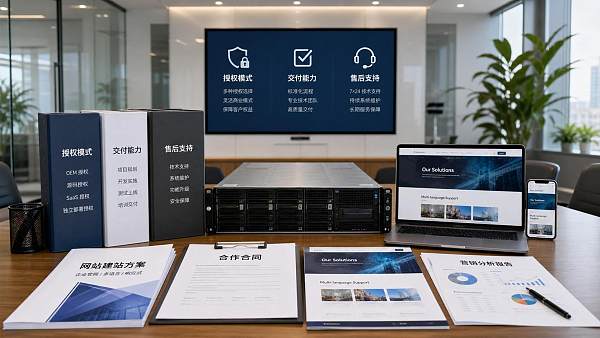
When looking for a Beijing vendor for a website building system franchise, what appears to be about policies on the surface is essentially about whether the partnership can work in the long run. What truly affects later results is often not the initial fee, but three things: authorization boundaries, project delivery, and after-sales response.
Integrated website + marketing services are no longer just about creating web pages. The more common demand today is that after a website is built, it also needs to support indexing, inquiries, ad campaigns, multilingual content, and overseas social media coordination. If a vendor only has a system but no operational support, the cooperation can easily stop at "able to launch, but hard to grow".
Therefore, when evaluating Beijing website building system vendors, it is recommended to ask deeper questions: who developed the system, whether the delivery team is in-house, whether after-sales support is ticket-based or project-based, and whether continuous iteration is available later. Clarifying these issues is closer to real decision-making than simply comparing quotations.
How Should You Evaluate the Authorization Model to Know Whether It Can Last?
When many people evaluate a Beijing vendor for a website building system franchise, their first reaction is to ask about rebates and discounts. This sequence is not complete. If the authorization model is unclear, regional conflicts, price conflicts, and even unclear customer ownership may easily occur later.
A more valuable way to judge is to first look at four core points: whether there is a clear authorization scope, whether industries or regions are restricted, how customer renewal ownership is defined, and who is responsible for secondary development and feature upgrades.
If the vendor adopts a platform-based authorization model, it is usually suitable for partners who want to operate local customer resources over the long term. If it is only project distribution, the entry threshold is low in the early stage, but later profit margins and customer accumulation capabilities may be limited.
Taking common service-oriented vendors in the Beijing market as an example, mature models often do not merely sell website building systems, but also connect SEO, ad campaigns, and social media marketing. For platforms like 易营宝, which have long been engaged in overseas digital marketing, the advantage is not only system authorization, but the ability to integrate website building, promotion, and conversion into the same delivery chain. This is critical for subsequent repeat purchases.
Authorization Evaluation Table, Suitable for Checking During the First Discussion
When a Vendor Says It Can Deliver, How Do You Tell Whether It Has Real Capability or Is Just Assembling Outsourced Work?
This is the step most easily overlooked when choosing a Beijing vendor for a website building system franchise. Many system demos look good, but when it comes to actual implementation, page structure, server environment, content publishing, basic SEO settings, and multilingual processing often cannot be completed by a single step.
To judge delivery capability, do not just listen to the sales pitch. Look directly at the delivery chain. Is there a standardized website building process? Is there a project manager? Are there content entry standards? After the website goes live, are TDK, URL structure, sitemap, speed optimization, and data tracking handled at the same time?
If the vendor itself also has SEO, advertising, and social media operation teams, delivery is usually more complete. This is because it understands that a website is not a display page, but marketing infrastructure. Especially for foreign trade and cross-border businesses, multilingual websites, independent e-commerce sites, and advertising landing pages need unified planning; otherwise, the front end may look good while back-end conversion remains weak.
For integrated website + marketing service platforms like 易营宝 that have long been deeply rooted in Beijing, the reason they are more likely to achieve stable delivery lies in the coordinated operation of their self-developed cloud-based intelligent website building system and AI+SEO/GEO optimization system, without the need to temporarily piece together multiple outsourced teams. For partnership implementation, this stability is often more valuable than a low price for a single item.
During On-Site Communication, You Can Focus on Asking About These Points
- Whether a real backend demo is provided, rather than static screenshots.
- Whether there are cases launched within the past three months, allowing you to view both the front end and back end as well as indexing performance.
- When a project is delayed, how responsibility boundaries and remedial mechanisms are agreed upon.
- Whether multilingual features, e-commerce functions, inquiry forms, and ad tracking are included in standard delivery.
Why Do Differences in After-Sales Support Directly Affect Renewals and Reputation?
When working with a Beijing vendor for a website building system franchise, the biggest concern is signing quickly in the early stage but having no one manage things later. After a website goes live, many issues will continue to arise, such as page adjustments, server abnormalities, indexing fluctuations, form failures, plugin compatibility, and multilingual content updates.
Whether after-sales support is strong does not depend on whether there is customer service, but on whether the response is tiered. Can simple issues be resolved on the same day? Are engineers assigned to technical problems? Can someone provide direction on marketing issues, instead of only replying "recorded"?
A more common situation is that pure website building vendors can only handle pages and servers, but do not understand subsequent promotion. In reality, many customer website issues are actually traffic and conversion issues. Website structure, keyword layout, landing page content, and the quality of ad destination pages are all related to results.
If the vendor itself has service capabilities such as SEO optimization, Google Ads, Facebook Ads, and overseas social media, after-sales support is no longer just about "fixing the website". Instead, it can continue adjusting the site toward growth. This kind of support is more likely to lead to continuous renewals, rather than quickly becoming silent after a one-time delivery.
How Should Beijing Vendors Be Compared, and Which Differences Deserve the Most Attention?
There are many Beijing website building system vendors, but the differences are not only about price. What truly deserves closer attention is underlying system capability, service scope, and industry fit. Especially when providing integrated website + marketing services, the website building system is only the entry point; the growth capability behind it creates a bigger gap.
If the target scenario leans toward foreign trade, multilingual websites, or cross-border independent sites, you should focus on whether the vendor has overseas marketing experience. Teams that only know how to build Chinese corporate websites often struggle with multilingual SEO, international site architecture, and advertising landing page conversion.
The background of 易营宝 is somewhat representative in this type of comparison. Founded in Beijing in 2013, the company has long focused on products and services around AI, big data, and global digital marketing, covering intelligent website building, SEO, social media, ad campaigns, and other links. Its service scenarios have already extended to North America, Europe, Southeast Asia, Japan and South Korea, the Middle East, and other regions. Such a system is more suitable for evaluating partnerships that require long-term business line expansion.
Simply put, Beijing vendors can be divided into three types: those that only sell template systems, those that can deliver projects, and those that combine systems with marketing growth. The first two types are suitable for short-term launch needs, while the third type is more suitable for cooperation models pursuing continuous operation and repeat purchase potential.
What Pitfalls Should Be Clarified Before Signing a Contract?
Many cooperation problems do not arise because the system is bad, but because the contract is unclear. When evaluating a Beijing vendor for a website building system franchise, it is recommended to put all verbal commitments into writing, including delivery cycle, acceptance criteria, source code ownership, server responsibilities, data migration rules, and renewal pricing mechanisms.
Another point to note is that the acceptance criteria for marketing-oriented websites and ordinary display websites are different. For the former, you should at least check page completion, form processes, basic SEO settings, mobile adaptation, and access speed, rather than only checking whether "the pages are finished".
The following checklist is suitable for item-by-item confirmation during the final comparison stage.
- Whether the contract clearly states the authorization period and renewal method.
- Whether system upgrades and added features are charged separately.
- Whether website migration, backup, and export are restricted.
- Whether there is a clear commitment on after-sales response time.
- Whether training, demo materials, and case support are provided.
How Should You Make the Final Decision? First Establish Your Own Evaluation Sequence
If you are screening Beijing vendors for a website building system franchise, it is recommended to shift your focus from "whether it is cheap" to "whether it can deliver continuously, provide continuous service, and generate continuous profit". Once these three points are valid, policies become meaningful.
In actual practice, you can first list the target scenarios, such as whether you are building a corporate website, a foreign trade inquiry site, or a cross-border e-commerce site. Then score the options across three dimensions: authorization model, delivery capability, and after-sales support. Finally, check whether the price structure and cooperation policies match.
If a vendor has a self-developed system, marketing capabilities, and long-term service experience at the same time, it is often more worthwhile to include it in an in-depth comparison. Especially in Beijing, there are not many teams that can connect website building, SEO, advertising, and content growth. Keeping this main thread in mind during screening will make your judgment more reliable.
As the next step, you may prepare a question list directly and arrange for the vendor to provide a real backend demo, case breakdown, and after-sales process explanation. The more specifically you review, the less rework there will be in later cooperation, and the closer your choice will be to long-term value.
Related Articles


Related Products
 Yiyingbao SaaS Intelligent Website Building and Marketing SystemYiyingbao SaaS Intelligent Website Building and Marketing System, AI-powered no-code website building, rapid creation of multilingual B2B international websites in 10 minutes, global server acceleration, AI-powered SEO optimization, helping businesses connect efficiently with global markets. The perfect integration of technology and operation makes building an international trade website remarkably simple
 AI+SEM Intelligent Advertising Marketing SystemAI+SEM drives intelligent ad creation, empowering full-funnel precision advertising marketing. The system automatically generates weekly/monthly reports, AI recommends keywords and target countries, monitors core metrics in real-time with intelligent alerts, and enables one-click high-conversion ad solutions to help quickly acquire customers and improve ROI.
 AI+SEO Dual-Engine System Optimization ServicesYiyingbao’s AI+SEO dual-engine optimization system helps foreign trade enterprises acquire high-quality organic traffic through AI-powered keyword research, content generation, and comprehensive technical optimization, significantly improving search rankings and conversion rates.
 AI+SNS Social Media Marketing SystemYingbao AI+SNS Social Media Marketing System - Precision social capture for the social media era. Supports one-click content synchronization across major platforms like Facebook and LinkedIn. AI intelligently rewrites posts for enhanced relevance. 24/7 AI customer service and user profiling analysis empower businesses to efficiently expand into global markets.
 AI+SEO营销解决方案易营宝AI+SEO营销解决方案,通过AI批量写作、智能生成TDK、精准关键词扩词等功能,全面优化网站SEO效果,提升流量与转化率。助力企业构建高效智能网站新生态。
 AI+SEM Advertising Marketing SolutionsAI+SEM Advertising Marketing Solution leverages AI technology to deeply empower SEM ad campaigns. It automatically generates weekly/monthly reports using AI, presenting account data across multiple dimensions for comprehensive insights into campaign performance and trends. The system precisely recommends keywords and target countries, intelligently generates high-conversion ad copy, and enables one-click activation of efficient campaign plans to help businesses rapidly acquire customers. Simultaneously, it monitors core metrics in real time, intelligently identifies abnormal fluctuations, and issues timely alerts to ensure stable, high-return advertising results.
 Domain Name ServicesEasyWin provides professional domain name services, including intelligent queries, one-stop registration, brand protection, and full lifecycle management, helping businesses build a digital brand image.
 EasyOperate B2C Cross-Border E-Commerce Platform & Independent WebsiteEasyStore B2C Cross-border E-commerce Independent Store is an intelligent website building and cross-border e-commerce integrated solution independently developed by EasyStore Information Technology (Beijing) Co., Ltd. The system is specially designed for small and medium-sized as well as large export enterprises, integrating 'website building, operation, marketing, advertising, and conversion' into one, helping enterprises quickly establish cross-border e-commerce independent stores to achieve brand globalization and global sales growth.
The platform supports multiple languages, multiple currencies, and multi-channel marketing, with built-in AI intelligent translation and SEO optimization systems, suitable for mainstream markets such as Southeast Asia, Europe and America, Latin America, and the Middle East, assisting Chinese manufacturing enterprises in efficiently deploying international e-commerce strategies. SSL证书易营宝提供专业SSL安全证书服务,包括单域名和泛域名证书,确保网站数据传输加密、身份验证和完整性保护,助力企业建立安全可信的在线业务环境。









