









- Which customer acquisition channels will be affected by cross-border marketing trends in 2026?Sep 06, 2026View details
- Which homogenization risks should be considered in an analysis of the AI-powered website building industry?Aug 30, 2026View details
- How Will AI Marketing Trends 2026 Change Advertising Budget AllocationAug 28, 2026View details
- Is the EV SSL certificate market shrinking or upgrading? How should companies assess certificate procurement?Aug 11, 2026View details
- Why the old AMP SEO 2020 practices no longer work and what has changed in current optimization prioritiesAug 02, 2026View details
- How to Choose Topics for an Industry News Section to Attract More Organic Search TrafficJul 29, 2026View details
What Are the Core Values of Integrated Website and Marketing Services
Why has website and marketing integration been brought up repeatedly in recent years?
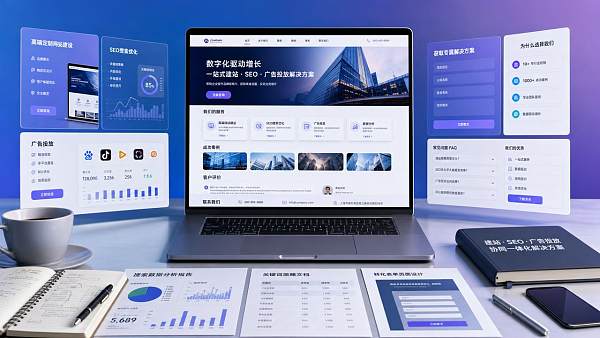
The value of website and marketing integration lies not in simply putting a “website” and “promotion” together, but in truly connecting the customer acquisition path. If a website is used only for display, without considering search, advertising, conversion, and data feedback, it will often quickly run into problems such as low traffic, weak inquiries, and difficult follow-up after launch.
The more realistic situation is that many companies in the past handed website development to the technical team, promotion to external channels, and content and conversion pages to different service providers. As a result, every part was working, yet it was difficult to form a unified goal. The core value of website and marketing integration is to align content structure, keyword layout, ad landing pages, form design, and subsequent optimization around the same growth logic.
For businesses that want to continue expanding overseas markets, this approach is especially important. YiYingBao provides one-stop services centered on intelligent website building, SEO optimization, advertising, social media operations, and AI search visibility improvement. In essence, it solves the same problem: making the website not a standalone asset, but a digital hub that is promotable, indexable, and convertible.
What problem does it actually solve, beyond just “having a website”?
When many people first hear about website and marketing integration, they interpret it as “build a website first, then run some ads.” That understanding is incomplete. True integration solves the disconnect from exposure to inquiries to online lead nurturing.
In simple terms, it usually handles four things at the same time: whether the website can be understood by search engines, whether the pages can receive traffic from different channels, whether the content is sufficient to build trust, and whether the conversion path is short enough. If any one link is weak, the overall investment can easily be discounted.
For example, in heavy-industry scenarios, product parameters are complex and the decision cycle is long. If a page only has equipment images and a parameter table, users usually will not submit an inquiry right away. By contrast, pages like heavy machinery equipment, heavy industry are better suited to a modular funnel layout, core data indicators, customer testimonial modules, and high-contrast inquiry entry points, combining brand strength, application scenarios, and conversion actions. This is, in fact, how website and marketing integration is implemented at the page level.
What types of businesses need website and marketing integration more?
It is not only large companies that need website and marketing integration. As long as the business relies on online lead generation, brand building, or overseas traffic growth, it is worth prioritizing. The value of integration becomes even more obvious when the following situations exist at the same time.
- The website has been online for years, but organic traffic and inquiry volume remain unstable over the long term.
- There is ad spend, but landing page bounce rates are high and lead costs are too high.
- The business needs to target multiple country markets, with complex content versions and language versions.
- The product is highly specialized, and users need multiple rounds of comparison before leaving their information.
In actual use, foreign trade companies, manufacturing plants, cross-border malls, and brand export businesses are the most likely to feel this difference. Because these businesses not only need a website that “looks good,” but also need the website to enter search results, absorb ad traffic, support social media distribution, and ultimately form effective leads that can be followed up.
The reason YiYingBao has drawn attention is also because its self-developed cloud intelligent website building system, AI advertising marketing system, and AI+SEO/GEO optimization system are built around the same growth path. For multilingual official websites, B2B inquiry sites, and B2C standalone sites, this is more conducive to continuous optimization than one-off procurement.
Compared with the traditional “build first, promote later” approach, what is the real difference?
The most obvious difference is not the number of service items, but the completely different construction logic. The traditional approach usually builds the website first, then thinks about what keywords to target, what content to publish, and what ads to run. By the time promotion starts, it is discovered that the page structure is not suitable for SEO and the pages are not suitable for conversion.
Website and marketing integration, by contrast, is designed in reverse from the start. It first looks at the target market, keyword opportunities, conversion paths, and content hierarchy, and then determines the page structure, functional modules, and data touchpoints. This order is closer to actual growth needs.
From the results, an integrated model is more likely to become a long-term asset. Website content can continue to bring in organic traffic after being indexed, ad pages can be repeatedly scaled after testing, and social media content can also flow back to the site to complete conversions. This is why it has more compounded value than single-point execution.
The pitfall most likely to be stepped on during implementation is usually not technology, but the order of judgment
Many project failures are not because the system is bad, but because the wrong questions were asked at the beginning. Some people first ask whether “the homepage looks impressive enough,” without first confirming what the target market is searching for, what users care about after entering the site, and on which level the form should be placed.
There are three other common misunderstandings. First, only looking at website-building price and not at subsequent operating capability. Second, only pursuing traffic and not looking at lead quality. Third, treating multilingual sites as a translation project rather than a market-entry project.
If the business is aimed at overseas markets, it is best to consider website structure, language localization, SEO foundation, ad account coordination, and AI search visibility together from the project initiation stage. The significance of platforms like YiYingBao lies precisely in integrating website building, content, advertising, and data through a unified system, reducing communication loss caused by multiple service providers working separately.
- First confirm the target market and customer acquisition channels, then determine the site structure.
- First sort out conversion actions, then design page modules and forms.
- First define data indicators, then arrange SEO, advertising, and content cadence.
If you are preparing to launch, should you look at cost first or cycle first?
Both are important, but the recommended judgment order should be reversed: first look at the objective, then the cycle, and only then the cost. Because different objectives place very different requirements on the configuration of website and marketing integration. Brand display, inquiry generation, and cross-border sales each require different columns, content depth, ad combinations, and optimization cycles.
If the goal is to quickly start overseas lead generation, the usual priority is to build a basic site that can be indexed, advertised, and converted, while simultaneously preparing keyword strategy and ad landing pages. If the goal is medium- to long-term organic growth, more emphasis should be placed on the content matrix, technical SEO, multilingual architecture, and a continuous update mechanism.
Using a heavy-industry website as an example, the page should not just pile up technical parameters. High-recognition visual elements such as yellow and black, when combined with an industry hero banner, real-world application scene carousel, service commitment list, and product guide modules, are often better at establishing professionalism and inquiry entry points at the same time. Presentation like heavy machinery equipment, heavy industry is closer to a closed-loop approach of “brand presentation to precise lead generation.”
What really matters is not how much money was spent on the website, but how long after launch it can generate traceable data, how long it takes to begin accumulating organic traffic, and how long it takes to verify whether the channels and pages match. These are the indicators that are more valuable when evaluating an integrated solution.
How should the core value of website and marketing integration ultimately be judged?
To judge whether website and marketing integration is valuable, you can return to a very direct standard: whether the website has truly become part of the growth system. If it can both support brand presentation and support SEO, advertising, social media, and AI search traffic, while also steadily collecting high-quality leads, then the system is effective.
From industry practice, truly sustainable solutions usually have three characteristics: first, the website structure revolves around customer acquisition rather than aesthetics alone; second, traffic sources are diversified and not dependent on a single channel; third, data can flow back to guide the next round of pages and ad optimization.
If you are evaluating whether to adopt website and marketing integration, a more prudent approach is to first sort out the existing site problems, then list the target markets, core pages, key channels, and expected conversion actions, and then compare whether the service plan has unified planning capability. Putting the judgment standard on whether the chain is closed-loop, rather than looking only at the individual quote, often leads to a more correct choice.
When the website, content, promotion, and data start to work in the same direction, online growth will no longer rely on occasional traffic, but will gradually become a replicable, accumulable, and scalable operating capability. This is the core value of website and marketing integration that is most worth recognizing.
Related Articles



Related Products
 Yiyingbao SaaS Intelligent Website Building and Marketing SystemYiyingbao SaaS Intelligent Website Building and Marketing System, AI-powered no-code website building, rapid creation of multilingual B2B international websites in 10 minutes, global server acceleration, AI-powered SEO optimization, helping businesses connect efficiently with global markets. The perfect integration of technology and operation makes building an international trade website remarkably simple
 AI+SEM Intelligent Advertising Marketing SystemAI+SEM drives intelligent ad creation, empowering full-funnel precision advertising marketing. The system automatically generates weekly/monthly reports, AI recommends keywords and target countries, monitors core metrics in real-time with intelligent alerts, and enables one-click high-conversion ad solutions to help quickly acquire customers and improve ROI.
 AI+SEO Dual-Engine System Optimization ServicesYiyingbao’s AI+SEO dual-engine optimization system helps foreign trade enterprises acquire high-quality organic traffic through AI-powered keyword research, content generation, and comprehensive technical optimization, significantly improving search rankings and conversion rates.
 AI+SNS Social Media Marketing SystemYingbao AI+SNS Social Media Marketing System - Precision social capture for the social media era. Supports one-click content synchronization across major platforms like Facebook and LinkedIn. AI intelligently rewrites posts for enhanced relevance. 24/7 AI customer service and user profiling analysis empower businesses to efficiently expand into global markets.
 AI+SEO营销解决方案易营宝AI+SEO营销解决方案,通过AI批量写作、智能生成TDK、精准关键词扩词等功能,全面优化网站SEO效果,提升流量与转化率。助力企业构建高效智能网站新生态。
 AI+SEM Advertising Marketing SolutionsAI+SEM Advertising Marketing Solution leverages AI technology to deeply empower SEM ad campaigns. It automatically generates weekly/monthly reports using AI, presenting account data across multiple dimensions for comprehensive insights into campaign performance and trends. The system precisely recommends keywords and target countries, intelligently generates high-conversion ad copy, and enables one-click activation of efficient campaign plans to help businesses rapidly acquire customers. Simultaneously, it monitors core metrics in real time, intelligently identifies abnormal fluctuations, and issues timely alerts to ensure stable, high-return advertising results.
 Domain Name ServicesEasyWin provides professional domain name services, including intelligent queries, one-stop registration, brand protection, and full lifecycle management, helping businesses build a digital brand image.
 EasyOperate B2C Cross-Border E-Commerce Platform & Independent WebsiteEasyStore B2C Cross-border E-commerce Independent Store is an intelligent website building and cross-border e-commerce integrated solution independently developed by EasyStore Information Technology (Beijing) Co., Ltd. The system is specially designed for small and medium-sized as well as large export enterprises, integrating 'website building, operation, marketing, advertising, and conversion' into one, helping enterprises quickly establish cross-border e-commerce independent stores to achieve brand globalization and global sales growth.
The platform supports multiple languages, multiple currencies, and multi-channel marketing, with built-in AI intelligent translation and SEO optimization systems, suitable for mainstream markets such as Southeast Asia, Europe and America, Latin America, and the Middle East, assisting Chinese manufacturing enterprises in efficiently deploying international e-commerce strategies. SSL证书易营宝提供专业SSL安全证书服务,包括单域名和泛域名证书,确保网站数据传输加密、身份验证和完整性保护,助力企业建立安全可信的在线业务环境。









